Once the Webinar begins, if you cant hear the sound, please hang up - - PowerPoint PPT Presentation

once the webinar begins if you can t hear the sound
SMART_READER_LITE
LIVE PREVIEW

Once the Webinar begins, if you cant hear the sound, please hang up - - PowerPoint PPT Presentation

Once the Webinar begins, if you cant hear the sound, please hang up and dial in again All attendees are on mute, so if you would like to ask a question, please type it into the Q&A box in the control panel on your screen If you


slide-1
SLIDE 1

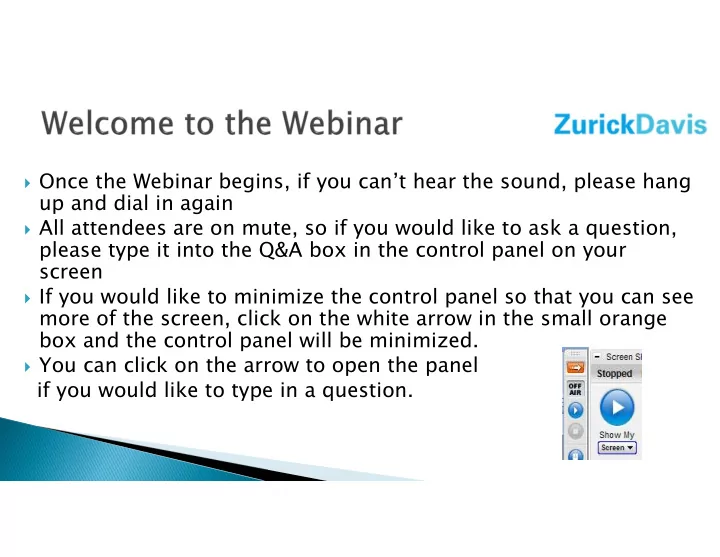
 Once the Webinar begins, if you can’t hear the sound, please hang

up and dial in again

 All attendees are on mute, so if you would like to ask a question,

please type it into the Q&A box in the control panel on your screen

 If you would like to minimize the control panel so that you can see

more of the screen, click on the white arrow in the small orange box and the control panel will be minimized.

 You can click on the arrow to open the panel

if you would like to type in a question.

slide-2
SLIDE 2

Rich Parker, M.D. Parker Healthcare Innovations raparkermd@gmail.com

slide-3
SLIDE 3

 US population – 320 million  Medicare – 40 million elderly and 8 million disabled  Medicaid – 58 million  Commercial Insurance – +/- 200 million  32 million uninsured  $9,000/person X 320 million = $2.9 TRILLION

slide-4
SLIDE 4

 $2.9 Trillion dollars spent on healthcare in 2013  17.9% of US GDP  Median family income in Mass is $61,000  Family healthcare costs -- $24,000  Is something wrong??

slide-5
SLIDE 5

Britai Britain Canada ada Fra ranc nce Germany many USA USA MRI Scan $187 $304 $398 $632 $1,009 Normal Childbirth $2,792 $2,667 $3,768 2,147 $8,435 Appendectomy $3,456 $3,810 $2,795 $3,285 $13,123 Average Hospital Stay Not Available $7,707 $4,715 $4,718 $14,427 Cataract Surgery $1,299 $927 $3,352 Not Available $14,764 Hip Replacement $9,637 $10,753 $12,629 $15,329 $34,454 Bypass Surgery $13,998 $22,212 $16,325 $27,237 $59,770

Source: International Federation of Health Plans

slide-6
SLIDE 6

 V = Q/C  Value will win out in the end  What is the risk of standing still in a changing world?  What is the risk of moving ahead in a changing world?  How will you assess these two choices?

slide-7
SLIDE 7

 In the FFS world, “the more I do, the more I make”.  In the Global Payment world, “the more I do, the less

I make”.

 Global Payment – long range view -- incentive is

higher quality higher quality care resulting in decreased decreased expense

 Examples – colon cancer screening, cholesterol and

BP control

slide-8
SLIDE 8

 Leadership  Governance – roles of PCPs and specialists differ  Quality of providers and services  Information Technology  Contracts  Quality measures  Reduction of Total Medical Expense (TME)

slide-9
SLIDE 9

 Accurate coding  Pharmacy management – costs now higher than in-patient!  RN Care Management  NP Home Visits

slide-10
SLIDE 10

 NP Housecalls program  Nurse care managers  Referral to community home care services  Disease management programs  Clinical pharmacists

10

slide-11
SLIDE 11

 Data and analytics to measure and monitor

quality and utilization

 Care coordination among specialists,

providers, hospitals

 Predictive modeling to identify and target

high-risk patients

 Registry to plan and track care, ensure follow

up

 Resources to support patient education and

self-management

11

slide-12
SLIDE 12

1.

Palliative Care/Hospice Care

2.

Diabetes

3.

Congestive Heart Failure

4.

COPD

5.

Chronic Kidney Disease

6.

Behavioral Health

slide-13
SLIDE 13

 Information technology  Clinical infrastructure  Culture and leadership  Physician, advanced care

practitioner, RN and hospital collaboration

13

slide-14
SLIDE 14

 PCPs and Advanced Practice

Providers serve as the backbone

 Primary Care structure based on

shared culture and geography

 Primary Care Leader training  Specialists engagement

14

slide-15
SLIDE 15

 Management of Quality measures  Interoperability for EMRs and

data center

 Risk stratification  Efficiency and utilization

reporting

15

slide-16
SLIDE 16

 Complete understanding of all expenditures  Admits, OBS  Pharmacy  Radiology  Specialty visits and procedures  Lab

slide-17
SLIDE 17

 Transparent sharing of data between groups  “Best practices” benchmarks of utilization  Mechanism for sharing of data and demonstrating progress

  • ver time

 Practice pattern variation analysis for common diagnoses, e.g.

GERD, sinusitis and joint pain

slide-18
SLIDE 18

 Emergency department (ED)

engagement

 Inpatient case management  Skilled Nursing Facility (SNF)

strategy

 Post-acute care

18

slide-19
SLIDE 19

 Moving more care into patients’ homes and other non-

acute settings

 Increased patient care self management  Ongoing initiatives to reduce excess utilization  Constant emphasis on improving quality, and patients

and families experience of care

 Finding innovative ways to increase specialist

engagement

19

slide-20
SLIDE 20
slide-21
SLIDE 21
slide-22
SLIDE 22

Thank You! Thank You!

We hope you enjoyed this presentation. To make sure that you receive invitations to future Webinars, follow us: @ZurickDavis

Rich Parker MD Parker Healthcare Innovations raparkermd@gmail.com