OpenGL Shading Language Benj Lipchak Rob Simpson Bill Licea-Kane - - PDF document

opengl shading language
SMART_READER_LITE
LIVE PREVIEW

OpenGL Shading Language Benj Lipchak Rob Simpson Bill Licea-Kane - - PDF document

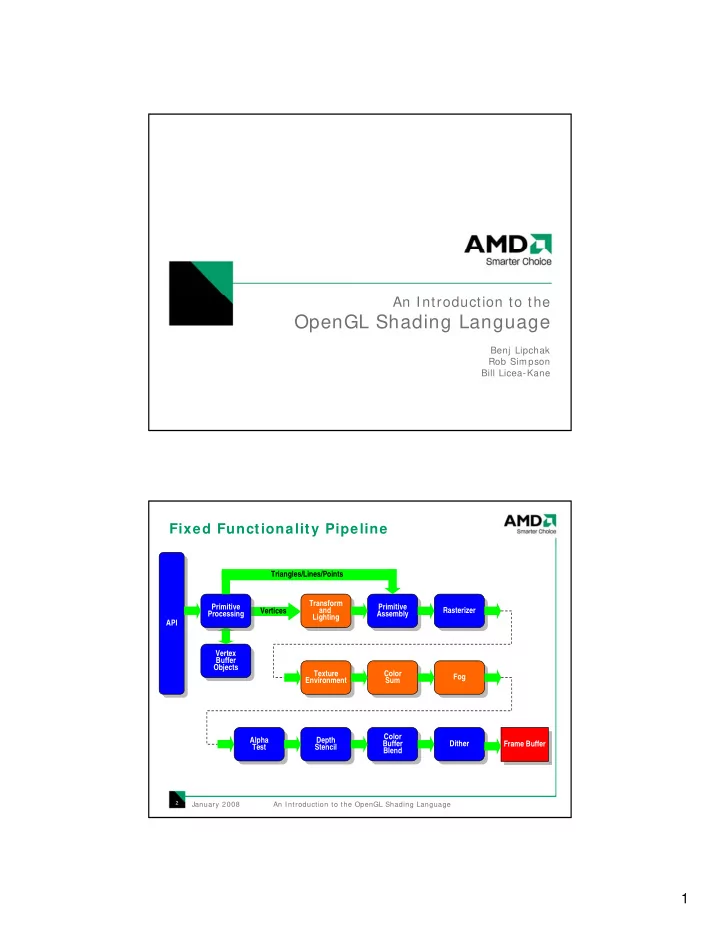
An Introduction to the OpenGL Shading Language Benj Lipchak Rob Simpson Bill Licea-Kane Fixed Functionality Pipeline Triangles/Lines/Points Transform Primitive Transform Primitive Primitive and Primitive Rasterizer Vertices


slide-1
SLIDE 1

1 An Introduction to the

OpenGL Shading Language

Benj Lipchak Rob Simpson Bill Licea-Kane

An Introduction to the OpenGL Shading Language

2

January 2008

Fixed Functionality Pipeline

API API Transform and Lighting Transform and Lighting Rasterizer Rasterizer Primitive Assembly Primitive Assembly Texture Environment Texture Environment Depth Stencil Depth Stencil Color Sum Color Sum Alpha Test Alpha Test Fog Fog Dither Dither Color Buffer Blend Color Buffer Blend Vertex Buffer Objects Vertex Buffer Objects Vertices Triangles/Lines/Points Primitive Processing Primitive Processing Frame Buffer Frame Buffer

slide-2
SLIDE 2

2

An Introduction to the OpenGL Shading Language

3

January 2008

Program m able Shader Pipeline

API API Vertex Shader Vertex Shader Rasterizer Rasterizer Primitive Assembly Primitive Assembly Fragment Shader Fragment Shader Depth Stencil Depth Stencil Dither Dither Color Buffer Blend Color Buffer Blend Vertex Buffer Objects Vertex Buffer Objects Vertices Triangles/Lines/Points Primitive Processing Primitive Processing Frame Buffer Frame Buffer Alpha Test Alpha Test

An Introduction to the OpenGL Shading Language

4

January 2008

Program m er’s Model

Vertex Shader Vertex Shader Fragment Shader Fragment Shader Primitive Assembly & Rasterize Primitive Assembly & Rasterize Per-Sample Operations Per-Sample Operations Attributes (m * vec4) Attributes (m * vec4) Vertex Uniforms (p * vec4) Vertex Uniforms (p * vec4) Varyings (n * vec4) Varyings (n * vec4) Fragment Uniforms (q * vec4) Fragment Uniforms (q * vec4)

slide-3
SLIDE 3

3

An Introduction to the OpenGL Shading Language

5

January 2008

Vertex Shader Environm ent

Attribute 0 Attribute 0 Uniforms Uniforms Textures Textures Attribute 1 Attribute 1 Attribute 2 Attribute 2 Attribute 3 Attribute 3 Attribute 4 Attribute 4 Attribute 5 Attribute 5 … … Attribute m Attribute m Varying 0 Varying 0 Varying 1 Varying 1 Varying 2 Varying 2 Varying 3 Varying 3 Varying 4 Varying 4 Varying 5 Varying 5 … … Varying n Varying n Temporary variables Temporary variables Clip position Clip position Vertex Shader Vertex Shader Point size Point size

An Introduction to the OpenGL Shading Language

6

January 2008

Fragm ent Shader Environm ent

Uniforms Uniforms Textures Textures Temporary variables Temporary variables Fragment Color(s) Fragment Color(s) Varying 0 Varying 0 Varying 1 Varying 1 Varying 2 Varying 2 Varying 3 Varying 3 Varying 4 Varying 4 Varying 5 Varying 5 … … Varying n Varying n Fragment Shader Fragment Shader Window coord Window coord Front facing flag Front facing flag Point coord Point coord Fragment Depth Fragment Depth

slide-4
SLIDE 4

4

An Introduction to the OpenGL Shading Language

7

January 2008

Precursors to GLSL

Texture combiners  EXT_texture_env_combine Vendor-specific assembly-like programmable shaders  EXT_vertex_shader  ATI_fragment_shader, ATI_text_fragment_shader  NV_* _program* Standardized low-level programmable shaders  ARB_vertex_program  ARB_fragment_program Not to be confused with GLSL extensions!  GL_VERTEX_SHADER  GL_FRAGMENT_SHADER

An Introduction to the OpenGL Shading Language

8

January 2008

Hello W orld!

void main(void) { // This is our Hello World vertex shader // Standard MVP transform gl_Position = gl_ModelViewProjectionMatrix * gl_Vertex; } void main(void) { // This is our Hello World fragment shader // Set to a constant color (hint: look at it upside down) gl_FragColor = vec4(0.7734); }

slide-5
SLIDE 5

5

An Introduction to the OpenGL Shading Language

9

January 2008

Language Basics: variables types

Scalar  void float int bool Vector  Floating point: vec2 vec3 vec4  Integer: ivec2 ivec3 ivec4  Boolean: bvec2 bvec3 bvec4 Matrix  mat2 mat3 mat4 == mat2x2 mat3x3 mat4x4  mat2x3 mat2x4 mat3x2 mat3x4 mat4x2 mat4x3 Containers  Structures: struct  Arrays: []

An Introduction to the OpenGL Shading Language

10

January 2008

Language Basics: storage qualifiers

const  Local constants defined within shader uniform  Constant shader parameters that can be changed between draws  Do not change per-vertex or per-fragment attribute  Per-vertex values (position, normal, color, etc.) varying  Values output by the vertex shader, input by the fragment shader  Interpolated during rasterization

slide-6
SLIDE 6

6

An Introduction to the OpenGL Shading Language

11

January 2008

Grouping, function/ constructor () Array/ component indexing [] Component/ member selection . Unary ++ -- + - ! Binary * / + - Relational < <= > >= == != Logical && ^^ || Ternary conditional ?: Assignment = *= /= += -= Sequence ,

Language Basics: operators

An Introduction to the OpenGL Shading Language

12

January 2008

 Used to initialize a structure or built-in type – Built-in type initialization: vec3 myRGB = vec3(0.25, 0.5, 0.75); – Structure initialization: struct S { int a; float b; }; S s = S(2, 3.5);  Provide enough components of correct type vec2 myYZ = vec2(0.5, 0.75); vec4 myPos = vec4(0.25, myYZ, 1.0);  Also provides explicit type conversions – no casting in GLSL! – Only int to float implicit conversions are allowed float numTexels = countTexels(); if (!bool(numTexels)) discard; // non-zero value -> true

Language Basics: constructors

slide-7
SLIDE 7

7

An Introduction to the OpenGL Shading Language

13

January 2008

Vector com ponents

vec2 v2 ; vec3 v3 ; vec4 v4 ; v2 .x / / is a float v2 .z / / w rong: undefined for type v4 .rgba / / is a vec4 v4 .stp / / is a vec3 v4 .b / / is a float v4 .xy / / is a vec2 v4 .xgp / / w rong: m ism atched com ponent sets

An Introduction to the OpenGL Shading Language

14

January 2008

 Components from { xyzw} , { rgba} , or { stpq}  Writemask or swizzle during assignment vec4 foo = vec4(1.0); foo.xyz = vec3(0.25, 0.5, 0.75); foo.wzyx = foo; // reverse the components  Swizzle or replicate components on right hand side foo = foo.wzyx; // another way to reverse components foo = foo.xxyy; // components reusable on right side v2 .yyyy // wrong: too many components for type  Use indexing for vector and matrix component selection mat4 myMatrix = mat4(1.0); foo.x = foo[2]; // same as foo.x = foo.z; foo = myMatrix[0]; // first column of matrix foo.x = myMatrix[0][0]; // first column, first row

Language Basics: sw izzles

slide-8
SLIDE 8

8

An Introduction to the OpenGL Shading Language

15

January 2008

Language Basics: flow control

 for while do – Loops can have break, continue  if else  Function calls – Can have return  The above can all be nested!  Note: no unstructured jumps (a.k.a goto)  discard – Only available in fragment shaders – “Kills” the fragment, no further processing in the pipeline

An Introduction to the OpenGL Shading Language

16

January 2008

Language Basics: VS built-in variables

Inputs  attribute vec4 gl_Vertex  attribute vec3 gl_Normal  attribute vec4 gl_Color  attribute vec4 gl_SecondaryColor  attribute vec4 gl_MultiTexCoordn (0-7)  attribute float gl_FogCoord Outputs  vec4 gl_Position: m ust be w ritten!  float gl_PointSize  vec4 gl_ClipVertex  varying vec4 gl_FrontColor  varying vec4 gl_BackColor  varying vec4 gl_FrontSecondaryColor  varying vec4 gl_BackSecondaryColor  varying vec4 gl_TexCoord[n]  varying float gl_FogFragCoord

slide-9
SLIDE 9

9

An Introduction to the OpenGL Shading Language

17

January 2008

Language Basics: FS built- in variables

Inputs  vec4 gl_FragCoord  bool gl_FrontFacing  varying vec4 gl_Color  varying vec4 gl_SecondaryColor  varying vec4 gl_TexCoord[n]  varying float gl_FogFragCoord  varying vec2 gl_PointCoord Outputs  vec4 gl_FragColor  vec4 gl_FragData[n]  float gl_FragDepth

An Introduction to the OpenGL Shading Language

18

January 2008

Built-in variables

Attributes & uniform s For ease of program m ing OpenGL state m apped to variables Som e special variables are required to be w ritten to, others are optional

slide-10
SLIDE 10

10

An Introduction to the OpenGL Shading Language

19

January 2008

Special built-ins

Vertex shader

vec4 gl_Position; // must be written vec4 gl_ClipPosition; // may be written float gl_PointSize; // may be written

Fragment shader

float gl_FragColor; // may be written float gl_FragDepth; // may be read/written vec4 gl_FragCoord; // may be read bool gl_FrontFacing; // may be read An Introduction to the OpenGL Shading Language

20

January 2008

Attributes

Built-in attribute vec4 gl_Vertex; attribute vec3 gl_Normal; attribute vec4 gl_Color; attribute vec4 gl_SecondaryColor; attribute vec4 gl_MultiTexCoordn; attribute float gl_FogCoord; User-defined

attribute vec3 myTangent; attribute vec3 myBinormal; Etc…

slide-11
SLIDE 11

11

An Introduction to the OpenGL Shading Language

21

January 2008

Built-in Uniform s

uniform mat4 gl_ModelViewMatrix; uniform mat4 gl_ProjectionMatrix; uniform mat4 gl_ModelViewProjectionMatrix; uniform mat3 gl_NormalMatrix; uniform mat4 gl_TextureMatrix[n]; struct gl_MaterialParameters { vec4 emission; vec4 ambient; vec4 diffuse; vec4 specular; float shininess; }; uniform gl_MaterialParameters gl_FrontMaterial; uniform gl_MaterialParameters gl_BackMaterial; An Introduction to the OpenGL Shading Language

22

January 2008

Built-in Uniform s

struct gl_LightSourceParameters { vec4 ambient; vec4 diffuse; vec4 specular; vec4 position; vec4 halfVector; vec3 spotDirection; float spotExponent; float spotCutoff; float spotCosCutoff; float constantAttenuation float linearAttenuation float quadraticAttenuation }; Uniform gl_LightSourceParameters gl_LightSource[gl_MaxLights];

slide-12
SLIDE 12

12

An Introduction to the OpenGL Shading Language

23

January 2008

Built-in Varyings

varying vec4 gl_FrontColor // vertex varying vec4 gl_BackColor; // vertex varying vec4 gl_FrontSecColor; // vertex varying vec4 gl_BackSecColor; // vertex varying vec4 gl_Color; // fragment varying vec4 gl_SecondaryColor; // fragment varying vec4 gl_TexCoord[]; // both varying float gl_FogFragCoord; // both

An Introduction to the OpenGL Shading Language

24

January 2008

Language Basics: function calls

Special storage qualifiers apply to function parameters, e.g.:

bool f(in vec2 inputVec, out float retVal) { ... }

in: Parameter is copied in to the function but not copied out (default) const in: Parameter is copied in to the function and cannot change

  • ut: Parameter is copied out of the function but not copied in

inout: Parameter is both copied in and copied out Notes  Recursion is strictly forbidden!  Functions can return a value or void

slide-13
SLIDE 13

13

An Introduction to the OpenGL Shading Language

25

January 2008

Built-in functions

Angles & Trigonometry  radians, degrees, sin, cos, tan, asin, acos, atan Exponentials  pow , exp2 , log2 , sqrt, inversesqrt Common  abs, sign, floor, ceil, fract, m od, m in, m ax, clam p

An Introduction to the OpenGL Shading Language

26

January 2008

Built-in functions

Interpolations  m ix(x,y,a) x* ( 1 .0 -a) + y* a)  step(edge,x) x < = edge ? 0 .0 : 1 .0  sm oothstep(edge0,edge1,x) – zero if x < = edge0 , – 1 if x > = edge1 – perform s sm ooth Herm ite interpolation betw een 0 and 1 w hen edge0 < x < edge1 .

slide-14
SLIDE 14

14

An Introduction to the OpenGL Shading Language

27

January 2008

Built-in functions

Geometric  length, distance, cross, dot, norm alize, faceForw ard, reflect Matrix  m atrixCom pMult Vector relational  lessThan, lessThanEqual, greaterThan, greaterThanEqual, equal, notEqual, notEqual, any, all

An Introduction to the OpenGL Shading Language

28

January 2008

Built-in functions

Texture  texture1 D, texture2 D, texture3 D, textureCube  texture1 DProj, texture2 DProj, texture3 DProj, textureCubeProj  shadow 1 D, shadow 2 D, shadow 1 DProj, shadow 2 Dproj Vertex  ftransform

slide-15
SLIDE 15

15

An Introduction to the OpenGL Shading Language

29

January 2008

Starter Shaders: color m anipulation

// simple.fs // // copy primary color void main(void) { // Copy the primary color gl_FragColor = gl_Color; } // colorinvert.fs // // invert like a color negative void main(void) { // invert color components gl_FragColor.rgb = 1.0 - gl_Color.rgb; gl_FragColor.a = 1.0; }

An Introduction to the OpenGL Shading Language

30

January 2008

Starter Shaders: color m anipulation

// grayscale.fs // // convert RGB to grayscale void main(void) { // Convert to grayscale using NTSC conversion weights float gray = dot(gl_Color.rgb, vec3(0.299, 0.587, 0.114)); // replicate grayscale to RGB components gl_FragColor = vec4(gray, gray, gray, 1.0); } // sepia.fs // // convert RGB to sepia tone void main(void) { // Convert to grayscale using NTSC conversion weights float gray = dot(gl_Color.rgb, vec3(0.299, 0.587, 0.114)); // convert grayscale to sepia gl_FragColor = vec4(gray * vec3(1.2, 1.0, 0.8), 1.0); }

slide-16
SLIDE 16

16

An Introduction to the OpenGL Shading Language

31

January 2008

Starter Shaders: color m anipulation

// heatsig.fs // // map grayscale to heat signature uniform sampler1D sampler0; void main(void) { // Convert to grayscale using NTSC conversion weights float gray = dot(gl_Color.rgb, vec3(0.299, 0.587, 0.114)); // look up heatsig value gl_FragColor = texture1D(sampler0, gray); }

An Introduction to the OpenGL Shading Language

32

January 2008

Starter Shaders: color m anipulation

// fog.fs // // per-pixel fog uniform float density; void main(void) { const vec4 fogColor = vec4(0.5, 0.8, 0.5, 1.0); // calculate 2nd order exponential fog factor // based on fragment's Z distance const float e = 2.71828; float fogFactor = (density * gl_FragCoord.z); fogFactor *= fogFactor; fogFactor = clamp(pow(e, -fogFactor), 0.0, 1.0); // Blend fog color with incoming color gl_FragColor = mix(fogColor, gl_Color, fogFactor); }

slide-17
SLIDE 17

17

An Introduction to the OpenGL Shading Language

33

January 2008

Starter Shaders: convolution

// passthrough.fs // // pass through a single texel value uniform sampler2D sampler0; void main(void) { gl_FragColor = texture2D(sampler0, gl_TexCoord[0].st); }

An Introduction to the OpenGL Shading Language

34

January 2008

Starter Shaders: convolution

// blur.fs // // blur (low-pass) 3x3 kernel uniform sampler2D sampler0; uniform vec2 tc_offset[9]; void main(void) { vec4 sample[9]; for (int i = 0; i < 9; i++) { sample[i] = texture2D(sampler0, gl_TexCoord[0].st + tc_offset[i]); } // 1 2 1 // 2 1 2 / 13 // 1 2 1 gl_FragColor = (sample[0] + (2.0*sample[1]) + sample[2] + (2.0*sample[3]) + sample[4] + (2.0*sample[5]) + sample[6] + (2.0*sample[7]) + sample[8]) / 13.0; }

slide-18
SLIDE 18

18

An Introduction to the OpenGL Shading Language

35

January 2008

Starter Shaders: convolution

1 2 1 Blur 2 1 2 / 13 1 2 1 Sharpen

  • 1 -1 -1
  • 1 9 -1
  • 1 -1 -1
  • 1 -1 -1

LaPlacian

  • 1 8 -1
  • 1 -1 -1

Dilation max(kernel) Erosion min(kernel)

An Introduction to the OpenGL Shading Language

36

January 2008

Starter Shaders: vertex shaders

// simple.vs // // Generic vertex transformation, // copy primary color void main(void) { // normal MVP transform gl_Position = gl_ModelViewProjectionMatrix * gl_Vertex; // Copy the primary color gl_FrontColor = gl_Color; }

slide-19
SLIDE 19

19

An Introduction to the OpenGL Shading Language

37

January 2008

Starter Shaders: vertex shaders

// diffuse.vs // // Generic vertex transformation, // diffuse lighting based on one // white light uniform vec3 lightPos[1]; void main(void) { // normal MVP transform gl_Position = gl_ModelViewProjectionMatrix * gl_Vertex; vec3 N = normalize(gl_NormalMatrix * gl_Normal); vec4 V = gl_ModelViewMatrix * gl_Vertex; vec3 L = normalize(lightPos[0] - V.xyz); // output the diffuse color float NdotL = dot(N, L); gl_FrontColor = gl_Color * vec4(max(0.0, NdotL)); }

An Introduction to the OpenGL Shading Language

38

January 2008

Exam ple: Fragm ent Shader

varying vec4 diffuseColor; varying vec3 lightVector; varying vec3 fragNormal; void main(){ float perFragmentLighting=max(dot(lightVector,fragNormal),0.0); gl_FragColor = diffuseColor * lightingFactor; }

slide-20
SLIDE 20

20

An Introduction to the OpenGL Shading Language

39

January 2008

Starter Shaders: vertex shaders

// ptsize.vs // // Generic vertex transformation, // attenuated point size void main(void) { // normal MVP transform gl_Position = gl_ModelViewProjectionMatrix * gl_Vertex; vec4 V = gl_ModelViewMatrix * gl_Vertex; gl_FrontColor = gl_Color; // calculate point size based on distance from eye float ptSize = length(V); ptSize = ptSize * ptSize * ptSize; gl_PointSize = 20000000.0 / ptSize; }

An Introduction to the OpenGL Shading Language

40

January 2008

Starter Shaders: vertex shaders

// stretch.vs // // Generic vertex transformation, // followed by squash/stretch uniform vec3 lightPos[1]; uniform vec3 squashStretch; void main(void) { // normal MVP transform, followed by squash/stretch vec4 stretchedCoord = gl_Vertex; stretchedCoord.xyz *= squashStretch; gl_Position = gl_ModelViewProjectionMatrix * stretchedCoord; ... }

slide-21
SLIDE 21

21

An Introduction to the OpenGL Shading Language

41

January 2008

Basic m ethod

2 basic object types  Shader object  Program object Create Vertex & Fragment Shader Objects Compile both Create program object & attach shaders Link program Use program

An Introduction to the OpenGL Shading Language

42

January 2008

Creating Shaders

slide-22
SLIDE 22

22

An Introduction to the OpenGL Shading Language

43

January 2008

Com piling

void glShaderSource(GLuint shader, GLsizei nstrings, const GLchar **strings, const GLint *lengths)

/ / if lengths= = NULL, assumed to be null-terminated

void glCompileShader (GLuint shader);

An Introduction to the OpenGL Shading Language

44

January 2008

Attaching & Linking

void glAttachShader(GLuint program, GLuint shader);

/ / twice, once for vertex shader & once for fragment shader

void glLinkProgram(GLuint program); / / program now ready to use

void glUseProgram(GLuint program);

/ / switches on shader, bypasses FFP / / if program= = 0, shaders turned off, returns to FFP

slide-23
SLIDE 23

23

An Introduction to the OpenGL Shading Language

45

January 2008

I n short…

GLuint programObject; GLuint vertexShaderObject; GLuint fragmentShaderObject; unsigned char *vertexShaderSource = readShaderFile(vertexShaderFilename); unsigned char *fragmentShaderSource = readShaderFile(fragmentShaderFilename); programObject=glCreateProgram (); vertexShaderObject=glCreateShader (GL_VERTEX_SHADER); fragmentShaderObject=glCreateShader (GL_FRAGMENT_SHADER); glShaderSource (vertexShaderObject 1 (const

An Introduction to the OpenGL Shading Language

46

January 2008

Exam ple

void setShaders( ) { char * vs,* fs; v = glCreateShader( GL_ VERTEX_ SHADER) ; f = glCreateShader( GL_ FRAGMENT_SHADER) ; vs = textFileRead( "toon.vert") ; fs = textFileRead( "toon.frag") ; const char * vv = vs; const char * ff = fs; glShaderSource( v, 1 , &vv,NULL) ; glShaderSource( f, 1 , &ff,NULL) ; free( vs) ;free( fs) ; glCom pileShader( v) ; glCom pileShader( f) ; p = glCreateProgram ( ) ; glAttachShader( p,v) ; glAttachShader( p,f) ; glLinkProgram ( p) ; glUseProgram ( p) ; }

slide-24
SLIDE 24

24

An Introduction to the OpenGL Shading Language

47

January 2008

Other functions Clean-up

void glDetachObject (GLuint container, GLuint attached); void glDeleteObject (GLuint object);

Info Log

void glGetInfoLog (GLuint object, GLsizei maxLength, GLsizei *length, GLchar *infoLog);

 Returns compile & linking information, errors

An Introduction to the OpenGL Shading Language

48

January 2008

Loading Uniform s

void glUniform{1|2|3|4}{f|i} (GLint location,…);

Location obtained with

GLint glGetUniformLocation (GLuint program, const GLuint *name);

Shader must be enabled with glUseProgramObject () before uniforms can be loaded

slide-25
SLIDE 25

25

An Introduction to the OpenGL Shading Language

49

January 2008

Loading Attributes

void glVertexAttrib{1234}{sfd} (GLint index,…);

Index obtained with

GLint glGetAttribLocation (GLuint program, const GLuint *name);

Alternate method

void glBindAttribLocation (GLuint program, GLuint index, const GLuint *name);

 Program must be linked after binding attrib locations

An Introduction to the OpenGL Shading Language

50

January 2008

Loading Textures

Bind textures to different units as usual

glActiveTexture(GL_TEXTURE0); glBindTexture(GL_TEXTURE_2D,myFirstTexture); glActiveTexture(GL_TEXTURE1); glBindTexture(GL_TEXTURE_2D,mySecondTexture);

Then load corresponding sampler with texture unit that texture is bound to

glUniform1i (glGetUniformLocation ( programObject,”myFirstSampler”),0); glUniform1i (glGetUniformLocation ( programObject,”mySecondSampler”),1);

slide-26
SLIDE 26

26

An Introduction to the OpenGL Shading Language

51

January 2008

I vory – vertex shader

uniform vec4 lightPos; varying vec3 normal; varying vec3 lightVec; varying vec3 viewVec; void main(){ gl_Position = gl_ModelViewProjectionMatrix * gl_Vertex; vec4 vert = gl_ModelViewMatrix * gl_Vertex; normal = gl_NormalMatrix * gl_Normal; lightVec = vec3(lightPos - vert); viewVec = -vec3(vert); }

An Introduction to the OpenGL Shading Language

52

January 2008

I vory – fragm ent shader

varying vec3 normal; varying vec3 lightVec; varying vec3 viewVec; void main(){ vec3 norm = normalize(normal); vec3 L = normalize(lightVec); vec3 V = normalize(viewVec); vec3 halfAngle = normalize(L + V); float NdotL = dot(L, norm); float NdotH = clamp(dot(halfAngle, norm), 0.0, 1.0); // "Half-Lambert" technique for more pleasing diffuse term float diffuse = 0.5 * NdotL + 0.5; float specular = pow(NdotH, 64.0); float result = diffuse + specular; gl_FragColor = vec4(result); }

slide-27
SLIDE 27

27

An Introduction to the OpenGL Shading Language

53

January 2008

Gooch – vertex shader

uniform vec4 lightPos; varying vec3 normal; varying vec3 lightVec; varying vec3 viewVec; void main(){ gl_Position = gl_ModelViewProjectionMatrix * gl_Vertex; vec4 vert = gl_ModelViewMatrix * gl_Vertex; normal = gl_NormalMatrix * gl_Normal; lightVec = vec3(lightPos - vert); viewVec = -vec3(vert); }

An Introduction to the OpenGL Shading Language

54

January 2008

Gooch – fragm ent shader

uniform vec3 ambient; varying vec3 normal; varying vec3 lightVec; varying vec3 viewVec; void main(){ const float b = 0.55; const float y = 0.3; const float Ka = 1.0; const float Kd = 0.8; const float Ks = 0.9; vec3 specularcolor = vec3(1.0, 1.0, 1.0); vec3 norm = normalize(normal); vec3 L = normalize (lightVec); vec3 V = normalize (viewVec); vec3 halfAngle = normalize (L + V);

slide-28
SLIDE 28

28

An Introduction to the OpenGL Shading Language

55

January 2008

Gooch – fragm ent shader ( 2 )

vec3 orange = vec3(.88,.81,.49); vec3 purple = vec3(.58,.10,.76); vec3 kCool = purple; vec3 kWarm = orange; float NdotL = dot(L, norm); float NdotH = clamp(dot(halfAngle, norm), 0.0, 1.0); float specular = pow(NdotH, 64.0); float blendval = 0.5 * NdotL + 0.5; vec3 Cgooch = mix(kWarm, kCool, blendval); vec3 result = Ka * ambient + Kd * Cgooch + specularcolor * Ks * specular; gl_FragColor = vec4(result, 1.0); }

An Introduction to the OpenGL Shading Language

56

January 2008

Useful References

http: / / www.3dshaders.com/  Home page for the “orange book” focused solely on GLSL http: / / www.opengl.org/ sdk/  OpenGL SDK, including links to the below resources http: / / www.opengl.org/ sdk/ libs/ OpenSceneGraph/ glsl_quickref.pdf  one double-sided page cheat sheet to GLSL – indispensible! http: / / www.opengl.org/ registry/ doc/ GLSLangSpec.Full.1.20.8.pdf  This is the ultimate authority: the GLSL specification document http: / / www.opengl.org/ sdk/ docs/ books/ SuperBible/  Full reference and tutorial to OpenGL 2.1  All sample code downloadable for Windows, Mac OS X, and Linux