Opening the Gravitational Wave Window Gabriela Gonzlez Louisiana - - PowerPoint PPT Presentation

opening the gravitational wave window
SMART_READER_LITE
LIVE PREVIEW

Opening the Gravitational Wave Window Gabriela Gonzlez Louisiana - - PowerPoint PPT Presentation

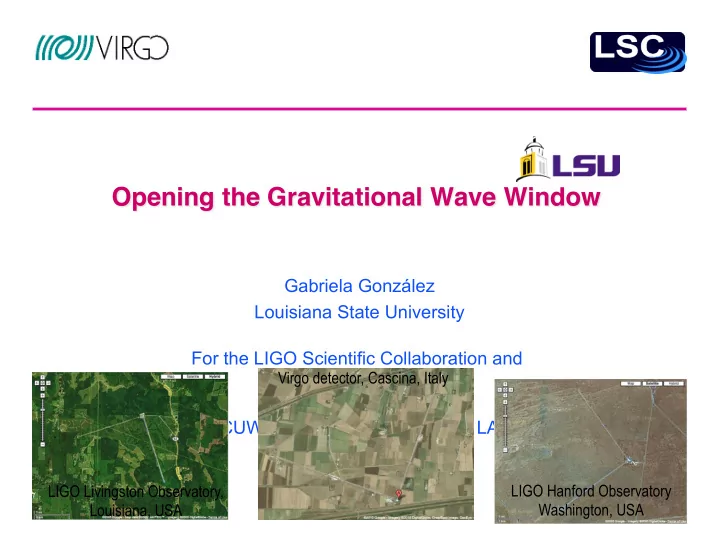
Opening the Gravitational Wave Window Gabriela Gonzlez Louisiana State University For the LIGO Scientific Collaboration and Virgo detector, Cascina, Italy the Virgo Collaboration CUWIP meeting, Baton Rouge, LA January 19, 2014 LIGO


slide-1
SLIDE 1

LIGO-G1301143

Opening the Gravitational Wave Window

  • Gabriela González

Louisiana State University For the LIGO Scientific Collaboration and the Virgo Collaboration CUWIP meeting, Baton Rouge, LA January 19, 2014

LIGO Livingston Observatory, Louisiana, USA LIGO Hanford Observatory Washington, USA Virgo detector, Cascina, Italy

slide-2
SLIDE 2

LIGO-G1301143

Newtons’ gravity

  • “Newton’s law”: F = Gm1m2/r2

Explains why apples fall, why the planets move around the Sun,…

slide-3
SLIDE 3

LIGO-G1301143

sciencebulletins.amnh.org And in YouTube!

Einstein’s gravity

slide-4
SLIDE 4

LIGO-G1301143

When masses move, they wrinkle the space time fabric, making other masses move…

Einstein’s gravitation

  • .. but it also predicts

traveling away from moving masses!

Explains just as well as Newtons’ why things fall and planetary motion…

Einstein’s messengers, National Science Foundation video www.einsteinsmessengers.org

slide-5
SLIDE 5

LIGO-G1301143

From stars living in galaxies…

Where do gravitational waves come from?

slide-6
SLIDE 6

LIGO-G1301143

Supernova explosions (that form a BH or a NS) From stars living in galaxies…

Where do gravitational waves come from?

  • Credits: Animation: NASA/CXC/D.Berry & A.Hobart
slide-7
SLIDE 7

LIGO-G1301143

From stars living in galaxies…

Where do gravitational waves come from?

  • Rotating stars (pulsars)

Credit: NASA/CXC/ASU/J.Hester et al.

slide-8
SLIDE 8

LIGO-G1301143

Supernova explosions From stars living in galaxies…

Where do gravitational waves come from?

  • Rotating stars (pulsars)

Credit: John Rowe

Binary systems coalescing into a black hole

slide-9
SLIDE 9

LIGO-G1301143

Supernova explosions From stars living in galaxies…

Where do gravitational waves come from?

  • Rotating stars (pulsars)

..and from the beginning of the Universe!

Credit: NASA/WMAP

Binary systems coalescing into a black hole

slide-10
SLIDE 10

LIGO-G1301143

How to detect gravitational waves
 with an interferometer

  • Einstein’s messengers,

National Science Foundation video

http://www.einsteinsmessengers.org/

slide-11
SLIDE 11

LIGO-G1301143

Gravitational waves: how big?

  • Gravitational waves are quadrupolar distortions of

distances between freely falling masses. They are produced by time-varying mass quadrupoles.

Gµν = 8πG c 4 Tµν (= 0 in vacuum) gµν = ηµν + hµν

h = ΔL L

11

slide-12
SLIDE 12

LIGO-G1301143

The LIGO Observatories

  • Livingston, LA

Hanford, WA

slide-13
SLIDE 13

LIGO-G1301143

13

13

The GW Detector Network 2005-2010

GEO600

LIGO Hanford LIGO Livingston

Virgo

slide-14
SLIDE 14

LIGO-G1301143

LIGO Scientific Collaboration
 www.ligo.org

  • 900+ members, 86+ institutions, 17 countries

14

https://www.zeemaps.com/map?group=245330

roster.ligo.org

slide-15
SLIDE 15

LIGO-G1301143

LIGO Detectors 2009-10 (S6)

  • 15

Find all LSC results and publications in www.ligo.org - science tab

Crab pulsar (NASA, Chandra Observatory)

?

10-23 10-22 10-21 10-20 10-19

Strain (1/ Hz)

2 3 4 5 6 7 8 9

102

2 3 4 5 6 7 8 9

103

2 3 4 5 6 7 8 9

104

Frequency (Hz)

Hanford 4 km S6 Livingston 4 km S6 Initial LIGO Science Requirement

Strain (1/√Hz)

NASA, WMAP

slide-16
SLIDE 16

LIGO-G1301143

Some interesting results 2005-2011

  • 16

atlasofthe universe.com

GRB070201

  • Astrophys. J. 681 (2008) 1419

GW100916

  • Phys. Rev D85 (2012) 082002
slide-17
SLIDE 17

LIGO-G1301143

In progress: Advanced LIGO

  • Vacuum system – same as initial LIGO

US NSF funding for Advanced LIGO: 2008-2015.

17

slide-18
SLIDE 18

LIGO-G1301143

More on Adv LIGO: 
 LIGO magazine in www.ligo.org

  • 18
slide-19
SLIDE 19

LIGO-G1301143

Are we there yet?

  • Neutron Star Binaries:

Initial LIGO: Average BNS reach ~15 Mpc → rate ~1/50yrs Advanced LIGO: ~ 200 Mpc “Realistic rate” ~ 40/year (but can be 0.4-400) Other binary systems: NS-BH: 0.004/yr → 10/yr BH-BH: 0.007/yr→ 20/yr

  • Class. Quant. Grav. 27, 173001 (2010)

19

slide-20
SLIDE 20

LIGO-G1301143

Coming soon near you:
 Advanced GW Detectors running!

  • 20

arXiv:1304.0670

slide-21
SLIDE 21

LIGO-G1301143

21

21

The GW Detector Network~2020

GEO600

Advanced LIGO Hanford Advanced LIGO Livingston

Advanced Virgo LIGO-India KAGRA

slide-22
SLIDE 22

LIGO-G1301143

Multi-messenger astronomy

  • The astrophysical events

we expect produce electromagnetic waves, gravitational waves, neutrinos… we need all eyes and ears open!

22

slide-23
SLIDE 23

LIGO-G1301143

Gravitational waves are coming!

  • 23

www.ligo.org