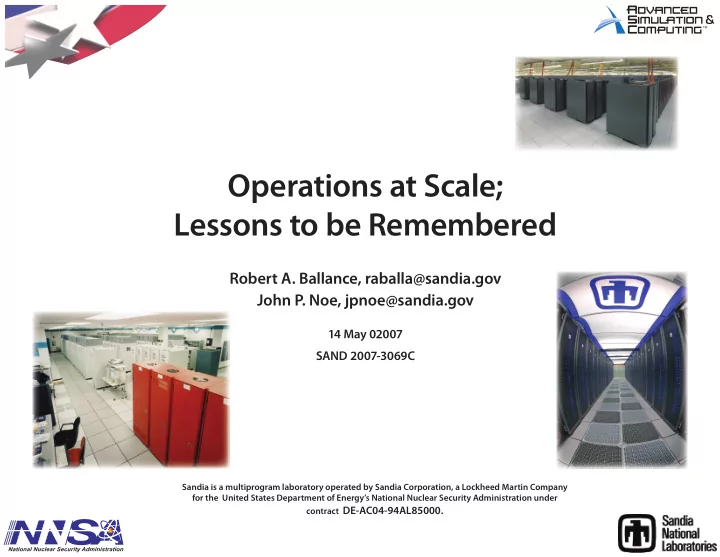
SLIDE 1 Operations at Scale; Lessons to be Remembered
Robert A. Ballance, raballa@sandia.gov John P. Noe, jpnoe@sandia.gov
14 May 02007 SAND 2007-3069C
Sandia is a multiprogram laboratory operated by Sandia Corporation, a Lockheed Martin Company for the United States Department of Energy’s National Nuclear Security Administration under contract DE-AC04-94AL85000.
SLIDE 2 Map of Talk: Hardware Projection
ASCI RED CPLANT
Paragon
Red Storm
BlueGene nCube, nCube-2 Los Lobos BeoWulf ICC/NWCC
Thunderbird
SP Cray Vector T3
?
CM-2 Whirlwind•Stretch•BBN•ETA•Alliant•Elexsi•MasPar•Convex •Kendall Square•CDC•Cray 3•…
SLIDE 3
Red Storm & Thunderbird
Red Storm Thunderbird Vendor Cray/Sandia Dell Nov 2006 Rank #2 #6 Stance Classifjed + Unclassifjed Unclassifjed Service Nodes 320 + 320 Processor 2.4 Ghz Dual-core Opteron 3.6 Ghz EMT64 Compute Nodes 12,960 4,480 Compute Cores 25,960 8,960 Segments 3360/6240/3360 5 Interconnect SeaStar Mesh Infjniband Disk 170TB + 170TB 46TB + 420TB shared OS Linux & Catamount Linux Job Size (Cores) > 1024, many > 5,000 < 1024 PE
SLIDE 4
Map of Talk: Conceptual Projection
“I want to build a clock that ticks once a year. Ti e century hand advances once every one hundred years, and the cuckoo comes out on the millennium. I want the cuckoo to come out every millenni- um for the next 10,000 years. If I hurry I should fi nish the clock in time to see the cuckoo come out for the fi rst time.” Danny Hillis
SLIDE 5
Seek First to Emulate
A complex system that works is invariably found to have evolved from a simple system that works. John Gall
Learn from the past
The role of failure in system (bridge) design Sibley’s 30-year cycle
Simulate the future
Systems are too large to start fjxing after they are built One of the fjrst things a computer does to design the next computer!
SLIDE 6 The big bang only worked once
Nobody ever builds just one system
Single systems change over time Need for consistency checking Prototypes!
Globalize agility; localize fragility Deploy test platforms early and often
System test Software checkout Application test Regression testing
Only dead systems never change
Livable systems are automated Living systems get smarter over time Teams can get smarter over time
SLIDE 7
Build descalable scalable systems
Scalability has to be designed into the system from the start
Even small details can hurt you; the Alegra story
Never forget that you have to get it running fjrst
Argument: We can’t add logging; it will slow down the system. Build scafgolding that meets the structure
Is the build/test/benchmark infrastructure in place fjrst?
Will it efgectively support the installation team, the users, and operations?
Leave the support structures (even non-scalable ones) in working condition
You’ll need to debug someday Like yesterday! This means you have to test the testers
SLIDE 8
When the lights turn green, better recheck the connections!
Software only reports reality as it sees it
You can’t really trust software when it is new You might be able to trust it after considerable use You can’t ever trust software that believes itself
Requirements for management software
Explore to see what is out there, and make that information part of the internal view. Coerce what is out there to match the internal view Compare internal structures and the external reality Depth perception!
Parallel tools for parallel systems
SLIDE 9
End-to-End Arguments Apply
Building complex function into a network implicitly optimizes the network for one set of uses while substantially increasing the cost of a set of potentially valuable uses that may be unknown or unpredictable at design time
Within large systems
complexity at edge fmexibility at core
Within teams
communication structures decision-making structures
SLIDE 10 Even Tiger Woods has a coach
Don’t assume you know/understand it all
Observers help Open processes Transparency: of Process, Code, and Operations Collaborative systems
Never underestimate your blind spots
Play with your mental blocks!
- Risk Analysis (Kaplan & Garrick, 1981)
What can go wrong? How likely is it to happen? What are the consequences? Add a fourth: How will we know it has happened?
SLIDE 11
Successful technology transitions require people transformations
Roles for veterans
Philosophers Tilt meters Historians The Bell Labs experience
What is the right ratio of veterans to newbies?
1:5? 1:10? 5:1?
SLIDE 12 Begin with the End in Mind
Involve Operations from Day 1 Making it work cannot be a downstream task Operations folks are scouts
They’ll fj gure out how to make it work They probably understand the terrain and the natives
Operations Operations End Users App Developers System Builders Developers Developers System Software Build Run Systems Applications
SLIDE 13 Mind the Long Term
Trust the future
There will be a next system Beware Brooks’ 2nd system efgect!
Measure for life
LINPACK as Apgar What is the HPC equivalent of a lifetime achievement award? NERSC ESP Benchmark is one inspiration
- THE HONORARY AWARD (Statuette). This award shall be given to honor
extraordinary distinction in lifetime achievement, exceptional contribu- tions to the state of motion picture arts and sciences, or for outstanding service to the Academy. What is the Apgar score? “One minute — and again fjve minutes — after your baby is born, doctors calculate his Apgar score to see how he’s doing. It’s a simple process that helps determine whether your newborn is ready to meet the world without additional medi- cal assistance. This score — developed by anesthesiologist Virginia Apgar in 1952 and now used in modern hospitals worldwide — rates a baby’s appearance, pulse, responsiveness, muscle activity, and breath- ing with a number between zero and 2 (2 being the strongest rating). The numbers are totaled, and 10 is considered a perfect score.” [2]
SLIDE 14 Seek fjrst to emulate The big bang only worked once Build descalable scalable systems Make the lights green, then recheck the connections Even Tiger Woods has a coach End-to-end arguments apply Successful technology transitions require people transformations Begin with the end in mind Mind the long term
SLIDE 15
Design Principles: Clock of the Long Now
Longevity: Display the correct time for ten millennia. Maintainability: with Bronze-age technology if need be. Transparency: obvious operational principles. Evolvability: improvable over time. Scalability: the same design should work from tabletop to monument size.
From Tie Clock of the Long Now, Stewart Brand, 01999
SLIDE 16
Acknowledgements
For patience, good humor, new opportunities, elegant in- sights, and quotable phrases:
Ron Brightwell, Bill Camp, Sophia Corwell, Joe Davison, Frank Gilfeather, Michael Hannah, Jim Harrell, Tram Hudson, Steve Johnson, Sue Kelly, Ruth Klundt, Jim Laros, Rob Leland, Barney Maccabe, Michael Mahon, Geofg McGirt,John Naegle, Kevin Pedretti, Rolf Riesen, Brian Smith, Jon Stearley, Jim Sundet, Jim Tomkins, Michael Van De Vanter, John Van Dyke, David Wallace, and Lee Ward
Finally, thanks to all the system administrators who are keep- ing our systems running, even as we speak.