
SLIDE 1
Oral Case Presentation Guidelines for 3rd year Medicine Clerkship
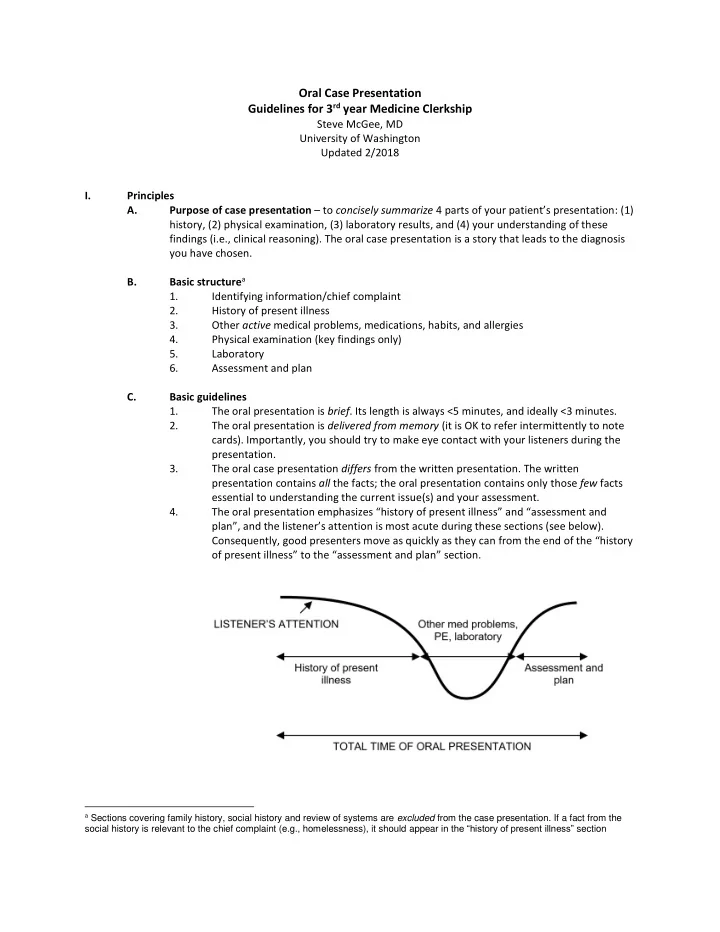
Steve McGee, MD University of Washington Updated 2/2018 I. Principles A. Purpose of case presentation – to concisely summarize 4 parts of your patient’s presentation: (1) history, (2) physical examination, (3) laboratory results, and (4) your understanding of these findings (i.e., clinical reasoning). The oral case presentation is a story that leads to the diagnosis you have chosen. B. Basic structurea 1. Identifying information/chief complaint 2. History of present illness 3. Other active medical problems, medications, habits, and allergies 4. Physical examination (key findings only) 5. Laboratory 6. Assessment and plan C. Basic guidelines 1. The oral presentation is brief. Its length is always <5 minutes, and ideally <3 minutes. 2. The oral presentation is delivered from memory (it is OK to refer intermittently to note cards). Importantly, you should try to make eye contact with your listeners during the presentation. 3. The oral case presentation differs from the written presentation. The written presentation contains all the facts; the oral presentation contains only those few facts essential to understanding the current issue(s) and your assessment. 4. The oral presentation emphasizes “history of present illness” and “assessment and plan”, and the listener’s attention is most acute during these sections (see below). Consequently, good presenters move as quickly as they can from the end of the “history
- f present illness” to the “assessment and plan” section.
a Sections covering family history, social history and review of systems are excluded from the case presentation. If a fact from the