Oral Presentation Rubric (8-24-00) Department of Educational - - PowerPoint PPT Presentation

oral presentation rubric 8 24 00 department of
SMART_READER_LITE
LIVE PREVIEW

Oral Presentation Rubric (8-24-00) Department of Educational - - PowerPoint PPT Presentation

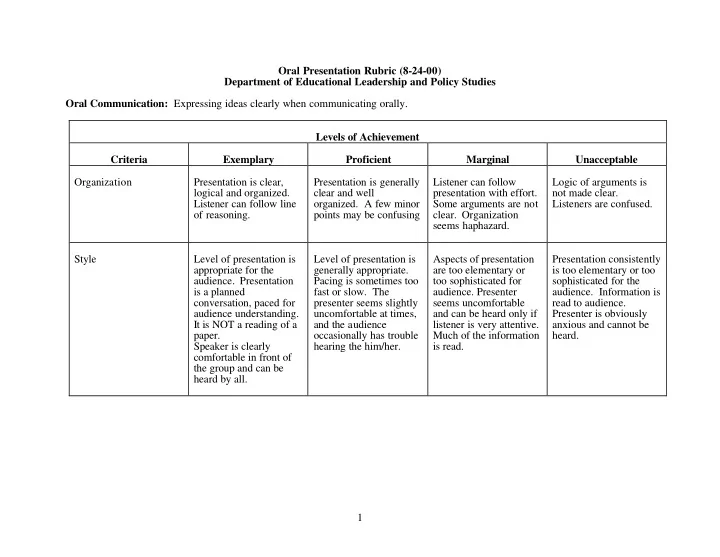
Oral Presentation Rubric (8-24-00) Department of Educational Leadership and Policy Studies Oral Communication: Expressing ideas clearly when communicating orally. Levels of Achievement Criteria Exemplary Proficient Marginal Unacceptable


slide-1
SLIDE 1

1 Oral Presentation Rubric (8-24-00) Department of Educational Leadership and Policy Studies Oral Communication: Expressing ideas clearly when communicating orally. Levels of Achievement Criteria Exemplary Proficient Marginal Unacceptable Organization Presentation is clear, logical and organized. Listener can follow line

  • f reasoning.

Presentation is generally clear and well

  • rganized. A few minor

points may be confusing Listener can follow presentation with effort. Some arguments are not

  • clear. Organization

seems haphazard. Logic of arguments is not made clear. Listeners are confused. Style Level of presentation is appropriate for the

  • audience. Presentation

is a planned conversation, paced for audience understanding. It is NOT a reading of a paper. Speaker is clearly comfortable in front of the group and can be heard by all. Level of presentation is generally appropriate. Pacing is sometimes too fast or slow. The presenter seems slightly uncomfortable at times, and the audience

  • ccasionally has trouble

hearing the him/her. Aspects of presentation are too elementary or too sophisticated for

  • audience. Presenter

seems uncomfortable and can be heard only if listener is very attentive. Much of the information is read. Presentation consistently is too elementary or too sophisticated for the

  • audience. Information is

read to audience. Presenter is obviously anxious and cannot be heard.

slide-2
SLIDE 2

2 Criteria Exemplary Proficient Marginal Unacceptable Use of Communication Aids (e.g., Transparencies, Slides, Posters, Handouts, Computer- Generated Materials) Communication aids enhance the

  • presentation. They are

prepared in a professional manner.

  • Font on visuals is

large enough to be seen by all.

  • Information is
  • rganized to

maximize audience understanding.

  • Details are

minimized so that main points stand

  • ut.

Communication aids contribute to the quality

  • f the presentation. Font

size is appropriate for

  • reading. Appropriate

information is included. Some material is not supported by visual aids. Communication aids are poorly prepared or used

  • inappropriately. Font is

too small to be easily

  • seen. Too much

information is included. Unimportant material is

  • highlighted. Listeners

may be confused. No communication aids are used, or they are so poorly prepared that they detract from the presentation. Content: Depth of Content Speaker provides an accurate and complete explanation of key concepts and theories, drawing upon relevant

  • literature. Applications
  • f theory are included to

illuminate issues. Listeners gain insights. For the most part, explanations of concepts and theories are accurate and complete. Some helpful applications are included. Explanations of concepts and/or theories are inaccurate or

  • incomplete. Little

attempt is made to tie theory to practice. Listeners gain little from the presentation. No reference is made to literature or theory. Listeners gain no new insights.

slide-3
SLIDE 3

3 Criteria Exemplary Proficient Marginal Unacceptable Content: Accuracy of Content Information (names, facts, etc.) included in the presentation is consistently accurate. No significant errors are

  • made. Listeners

recognize any errors to be the result of nervousness or

  • versight.

Enough errors are made to distract a knowledgeable listener, but some information is

  • accurate. The

presentation is useful if the listener can determine what information is reliable. Information included is sufficiently inaccurate that the listener cannot depend on the presentation as a source

  • f accurate information.

Listeners may have been misled. Use of Language: Grammar and Word Choice Sentences are complete and grammatical, and they flow together

  • easily. Words are

chosen for their precise meaning. For the most part, sentences are complete and grammatical, and they flow together

  • easily. With a few

exceptions, words are chosen for their precise meaning. Listeners can follow the presentation, but some grammatical errors and use of slang are evident. Some sentences are incomplete/ halting, and/or vocabulary is somewhat limited or inappropriate. Listeners are so distracted by the presenter’s apparent difficulty with grammar and appropriate vocabulary that they cannot focus on the ideas presented. Use of Language: Freedom from Bias (e.g., Sexism, Racism, Agism, Heterosexism, etc.) Both oral language and body language are free from bias. Oral language and body language are free from bias with one or two minor exceptions. Oral language and/or body language includes some significant bias. Listeners may be

  • ffended.

Oral language and/or body language frequently reflects bias. Some, if not all, listeners will probably be

  • ffended.
slide-4
SLIDE 4

4 Criteria Exemplary Proficient Marginal Unacceptable Personal Appearance Personal appearance is completely appropriate for the occasion and the audience. For the most part, personal appearance is appropriate for the

  • ccasion and the

audience. Personal appearance is somewhat inappropriate for the occasion and audience. Personal appearance is inappropriate for the

  • ccasion and audience.

Responsiveness to Audience: Verbal Interaction Highly responsive to audience comments and

  • needs. Consistently

clarifies, restates, and responds to questions. Summarizes when needed. Generally responsive to audience comments and

  • needs. Most of the time,

clarifies, restates, and responds to questions, and summarizes when

  • needed. Misses some
  • pportunities for

interaction. Reluctantly interacts with audience. Responds to questions inadequately. Avoids or discourages active audience

  • participation. Is not

responsive to group. Responsiveness to Audience: Body Language Body language reflects confidence and ease when interacting with audience. Body language reflects comfort when interacting with audience. Body language reflects some discomfort when interacting with audience. Body language reveals a reluctance to interact with audience.