
SLIDE 1
- rganic solar cells
michele.maggini@unipd.it
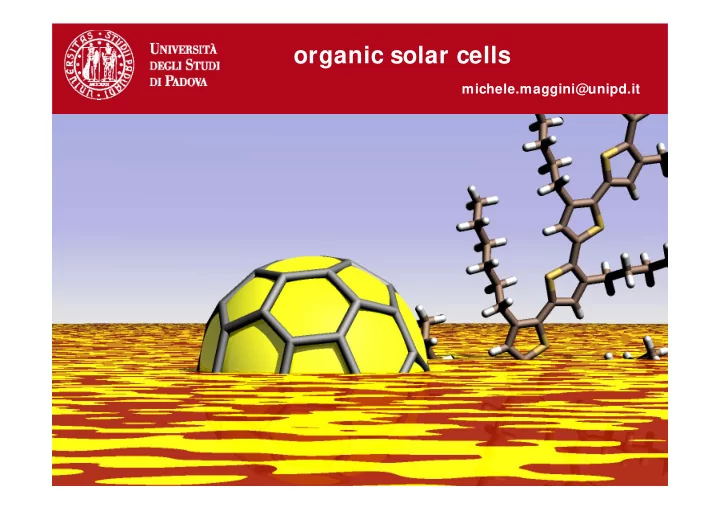
organic solar cells michele.maggini@unipd.it Humanitys core - - PowerPoint PPT Presentation
organic solar cells michele.maggini@unipd.it Humanitys core problems in 2050 Energy Water Food Environment Poverty War Disease Education 2009 6.8 billion people Democracy 2050 8-10 billion people
michele.maggini@unipd.it
DSSC PNSC PFSC
5
7.6%, claimed by Solarmer Energy, Inc. on Dec. 2, 2009
(Source: NREL)
n
light-absorbing semiconducting polymer (MEH-PPV)
N.S. Sariciftci, L. Smilowitz, A.J. Heeger, F. Wudl Science 258, 1474 (1992)
Brabec, Zerza, Cerullo, De Silvestri, Luzzati, Hummelen, Sariciftci
Transfer times in the range of 100 fs Quantum efficiency approaching unity
PCBM
R.H. Friend et al. Nature 1995, 376, 498 A.J. Heeger et al. Science 1995, 270, 1789
donor absorbs light generating an exciton that must diffuse to the D/A interface to split. Electrons travel to the back electrode. Holes travel to the front electrode.
light
PEDOT PSS
Glass/plastic Active layer
LiF
Aluminum
+
S.E. Shaheen et al. Appl. Phys. Lett. 2001, 78, 841 (eff = 2.5% ) C.J. Brabec et al. Appl. Phys. Lett. 2002, 80, 1288 (eff = 3.3% )
H.-Y. Chen et al. Nature Photonics 2009, 3, 649 (eff = 6.77% )
Balance of system @ 70 €/m2 1000 h of sun a year
Source: G. Dennler et al. Adv. Mater. 2009, 21, 1323
Source: www.energy.eu
Source: N. Camaioni, Bologna
0.32 0.68 0.19 0.31 0.68 0.59 5.6 8.2 3:1
0.82 2.50
0.28 0.35 0.76 0.63 8.6 2.5
3:2 (%)
FF Voc (V) jsc× 104 (A cm-2)
PHT/3
0,1 1
jsc (mA cm
0,45 0,50 0,55 0,60
Voc (V)
20 30 40 50 60 70 0,25 0,30 0,35 0,40
FF Temperature (°C)
20 30 40 50 60 70 1 2 3
(%) Temperature (°C)
▲
◊
after cooling to room T after cooling to room T and a further cycle from 22 to 50 °C
before thermal treatment after thermal treatment Pin: 20 mW cm-2. Room T PTH/3, 3:2 WR, 1 °C/min
(N. Camaioni – ISOF-CNR)
P3HT
jsc: short-circuit current density Voc: open-circuit voltage FF: fill factor : photovoltaic conversion efficiency
= FF
JSC VOC P0 (holes in the polymer band, electrons in PCBM LUMO)
Source: A. Heeger – Linz 2008
New device architectures (optical spacer) Opportunity: 25%-50% improvement New polymers for matching the solar spectrum (energy gap engineering) Opportunity: 2 improvement Better charge percolation and collection (optimize morphology) Opportunity: 25% improvement Increase open circuit voltage (deeper HOMO for the polymer or raise the fullerene LUMO) Opportunity: 50% improvement Multijunction (tandem) solar cells Opportunity: 50% improvement Achieve all the advances in the same cell: 1.252 1.25 1.5 1.5 = 7
Source: A. Heeger Linz 2008
MISCHA
Fabbrica Italiana Sintetici SpA
FIRB RBNE033KMA