Out ( F n ) Outer space and the work of Karen Vogtmann F n = < a - - PDF document

out f n outer space and the work of karen vogtmann
SMART_READER_LITE
LIVE PREVIEW

Out ( F n ) Outer space and the work of Karen Vogtmann F n = < a - - PDF document

Out ( F n ) Outer space and the work of Karen Vogtmann F n = < a 1 , a 2 , , a n > is the free group of rank n . Out ( F n ) = Aut ( F n ) / Inn ( F n ) contains MCG ( S ) for punctured surfaces S maps to GL n ( Z ) The


slide-1
SLIDE 1

Outer space and the work of Karen Vogtmann Out(Fn)

Fn =< a1, a2, · · · , an > is the free group of rank n. Out(Fn) = Aut(Fn)/Inn(Fn)

◮ contains MCG(S) for punctured surfaces S ◮ maps to GLn(Z)

The study of mapping class groups and arithmetic groups is an inspiration in the study of Out(Fn).

Theorem (Nielsen, 1924)

Aut(Fn) (and Out(Fn)) are finitely presented. A generating set consists of the automorphisms σ: a1 → a1a2, ai → ai for i > 1 plus the signed permutations of the ai’s.

Outer space

Definition

◮ graph: finite 1-dimensional cell complex Γ, all vertices have

valence ≥ 3.

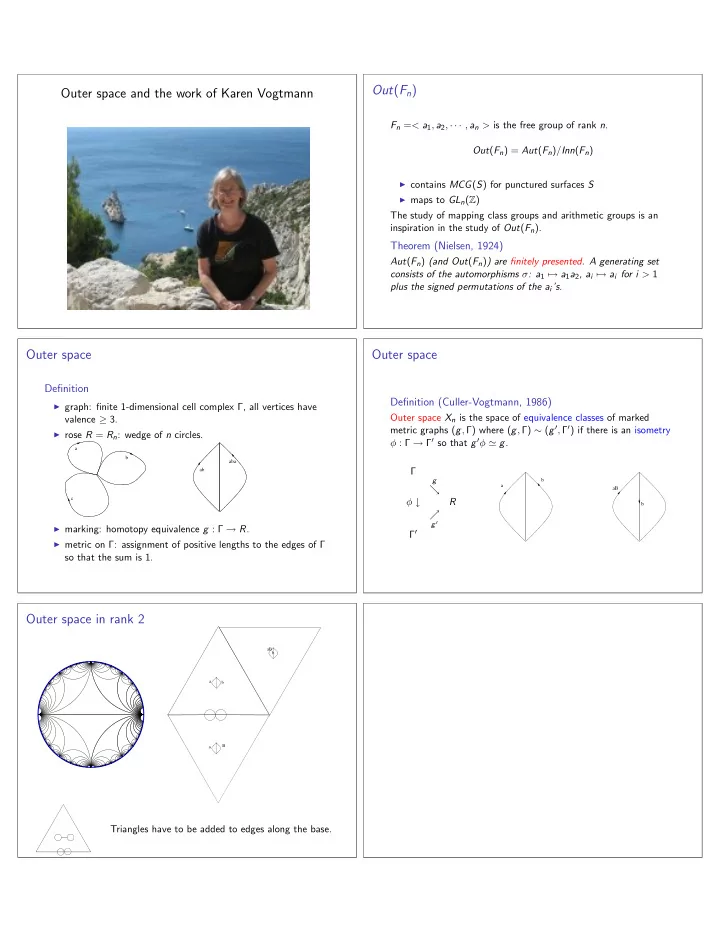
◮ rose R = Rn: wedge of n circles.

a b c ab aba

◮ marking: homotopy equivalence g : Γ → R. ◮ metric on Γ: assignment of positive lengths to the edges of Γ

so that the sum is 1.

Outer space

Definition (Culler-Vogtmann, 1986)

Outer space Xn is the space of equivalence classes of marked metric graphs (g, Γ) where (g, Γ) ∼ (g′, Γ′) if there is an isometry φ : Γ → Γ′ so that g′φ ≃ g. Γ

g

ց φ ↓ R ր

g′

Γ′

a b b aB

Outer space in rank 2

a b a B aB b

Triangles have to be added to edges along the base.

slide-2
SLIDE 2

Outer space

Topology (3 approaches, all equivalent):

◮ simplicial, with respect to the obvious decomposition into

“simplices with missing faces”.

◮ (g, Γ) is close to (g′, Γ′) if there is a (1 + ǫ)-Lipschitz map

f : Γ → Γ′ with g′f ≃ g.

◮ via length functions: if α is a conjugacy class in Fn let

ℓ(g,Γ)(α) be the length in Γ of the unique immersed curve a such that g(a) represents α. Then, for S =set of conjugacy classes Xn → [0, ∞)S (g, Γ) → (α → ℓ(g,Γ)(α)) is injective – take the induced topology.

Theorem (Culler-Vogtmann, 1986)

Xn is contractible.

Action

If φ ∈ Out(Fn) let f : R → R be a h.e. with π1(f ) = φ and define φ(g, Γ) = (fg, Γ) Γ

g

→ Rn

f

→ Rn

◮ action is simplicial, ◮ point stabilizers are finite. ◮ there are finitely many orbits of simplices (but the quotient is

not compact).

◮ the action is cocompact on the spine SXn ⊂ Xn.

Topological properties

◮ Virtually finite K(G, 1) (Culler-Vogtmann 1986). ◮ vcd(Out(Fn)) = 2n − 3 (n ≥ 2) (Culler-Vogtmann 1986). ◮ every finite subgroup fixes a point of Xn. ◮ every solvable subgroup is finitely generated and virtually

abelian (Alibegovi´ c 2002)

◮ Tits alternative: every subgroup H ⊂ Out(Fn) either contains

a free group or is virtually abelian (B-Feighn-Handel, 2000, 2005)

◮ Bieri-Eckmann duality (B-Feighn 2000)

Hi(G; M) ∼ = Hd−i(G; M ⊗ D)

◮ Homological stability (Hatcher 1995, Hatcher-Vogtmann

2004) Hi(Aut(Fn)) ∼ = Hi(Aut(Fn+1)) for n >> i

◮ Computation of stable homology (Galatius, to appear)

Dictionary 1

SL2(Z) SLn(Z) MCG(S) Out(Fn) Trace Jordan normal form Nielsen- Thurston theory train-tracks H2 symmetric space Teichm¨ uller space Outer space hyperbolic (Anosov) element semi-simple (diagonaliz- able) pseudo-Anosov mapping class fully irreducible automorphism shear parabolic Dehn twist polynomially growing auto- morphism

Links

An n-complex is Cohen-Macauley if the link of every k-cell is homotopy equivalent to a wedge of (n − k − 1)-spheres (for every k).

Examples

◮ manifolds, ◮ buildings.

Theorem (Vogtmann 1990)

Both Outer space and its spine are Cohen-Macauley.

slide-3
SLIDE 3

Homological stability

Some groups come in natural sequences G1 ⊂ G2 ⊂ G3 ⊂ · · ·

Examples

◮ permutation groups Sn, ◮ signed permutation groups S± n , ◮ braid groups, ◮ SLn(Z), On,n(Z), ◮ mapping class groups of surfaces with one boundary

component,

◮ Aut(Fn).

The sequence satisfies homological stability if for every k for sufficiently large n Hk(Gn)

∼ =

→ Hk(Gn+1) is an isomorphism.

Homological stability

Theorem

Aut(Fn) satisfies homological stability. Hatcher 1995, Hatcher-Vogtmann 1998, Hatcher-Vogtmann 2004, Hatcher-Vogtmann-Wahl 2006. The proof over Q is particularly striking, from [Hatcher-Vogtmann 1998].

Homological stability

Aut(Fn) acts on Autre espace: this is the space of marked metric graphs with a basepoint. The degree of a graph is 2n − (valence at the basepoint).

1 2 2

Degree Theorem. The space An,k of graphs in the spine of degree ≤ k is (k − 1)-connected. [H-V 1998], [Bux-McEwen 2009]

Homological stability

We are interested in Hk−1(Aut(Fn), Q) = Hk−1(An,k/Aut(Fn), Q). Homological stability follows from: An,k/Aut(Fn) = An+1,k/Aut(Fn+1) for n ≥ 2k. An,k/Aut(Fn) is the space of unmarked metric graphs. Increasing n amounts to wedging a loop at the basepoint. When n is large every degree k graph has a loop at the basepoint.

Homological stability

One can give a proof over Z along the same lines. Stability holds for

◮ symmetric groups Sn (Nakaoka 1960, Maazen 1979 simpler

proof),

◮ signed symmetric groups S± n (Maazen’s proof easily modifies.) ◮ H × S± n for a fixed group H (K¨

unneth formula). View An,k/Aut(Fn) as an “orbihedron”; pay attention to the (finite) stabilizers. E.g. at the rose, the stabilizers are signed permutation groups S±

n = Sn ⋊ Zn

  • 2. Stability holds for this sequence.

In fact, stability holds for the sequence of stabilizers at every point

  • f the orbihedron. They all have the form

H × S±

n

for a fixed group H.

Dynamical properties

◮ Xn can be equivariantly compactified to Xn (Culler-Morgan,

1987), analogous to Thurston’s compactification of Teichm¨ uller space via projective measured laminations.

Xn ⊂ [0, ∞)S → P[0, ∞)S is injective; take the closure.

◮ A point of Xn can be viewed as a free simplicial Fn-tree; a

point in ∂Xn = Xn \ Xn is an Fn-tree (not necessarily free nor simplicial).

slide-4
SLIDE 4

Dynamical properties

◮ Points in ∂Xn can be studied using the Rips machine. ◮ Guirardel (2000): action on ∂Xn does not have dense orbits.

He also conjecturally identified the minimal closed invariant set.

◮ North-South dynamics for fully irreducible elements

(Levitt-Lustig, 2003)

Dictionary 2

MCG(S) Out(Fn) simple closed curve primitive conjugacy class incompressible subsurface free factor splitting of Fn measured lamination R-tree Thurston’s boundary Culler-Morgan’s boundary attracting lamination for a pseudo-Anosov attracting tree for a fully irre- ducible automorphism measured geodesic current measured geodesic current intersection number between measured laminations length of a current in an R-tree curve complex free factor complex splitting complex Marc Culler and Karen Vogtmann. Moduli of graphs and automorphisms of free groups.

  • Invent. Math., 84(1):91–119, 1986.

Karen Vogtmann. Automorphisms of free groups and outer space. In Proceedings of the Conference on Geometric and Combinatorial Group Theory, Part I (Haifa, 2000), volume 94, pages 1–31, 2002. Karen Vogtmann. The cohomology of automorphism groups of free groups. In International Congress of Mathematicians. Vol. II, pages 1101–1117. Eur. Math. Soc., Z¨ urich, 2006. Martin R. Bridson and Karen Vogtmann. Automorphism groups of free groups, surface groups and free abelian groups. In Problems on mapping class groups and related topics, volume 74 of Proc. Sympos. Pure Math., pages 301–316.

  • Amer. Math. Soc., Providence, RI, 2006.