
SLIDE 1
1 Comparison of Flow Routing Algorithms Used in Geographic Information Systems
Christine Lam Yongxin Deng John Wilson University of Southern California
Outline
Background Hypotheses Study Area Fuzzy Classification Results Conclusions Lam, Deng, and Wilson AAG 2004
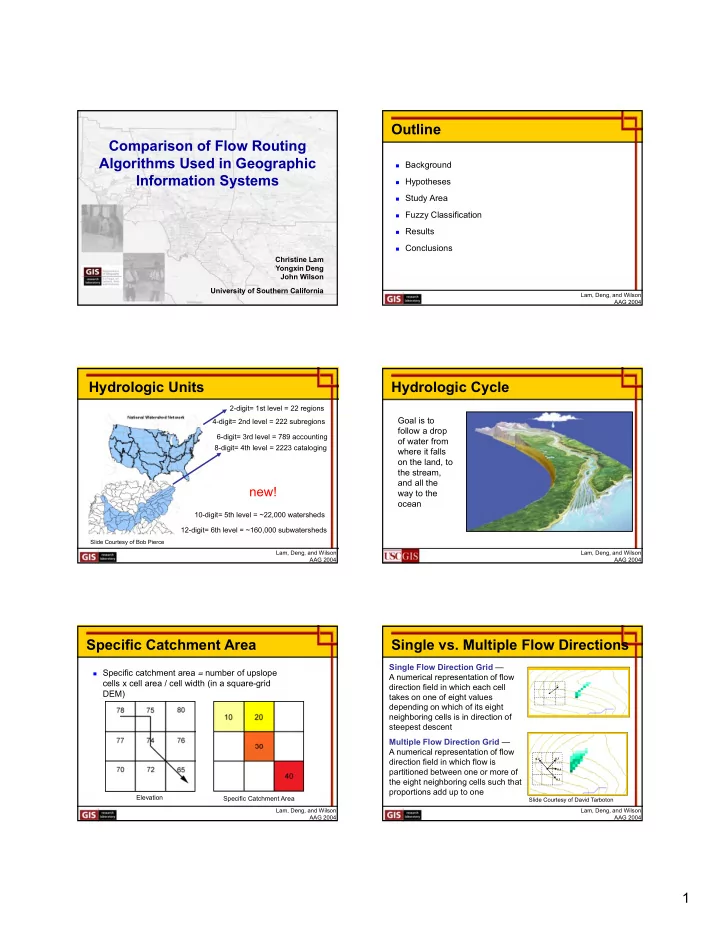
Hydrologic Units
2-digit= 1st level = 22 regions 4-digit= 2nd level = 222 subregions 6-digit= 3rd level = 789 accounting 8-digit= 4th level = 2223 cataloging 10-digit= 5th level = ~22,000 watersheds 12-digit= 6th level = ~160,000 subwatersheds
new!
Slide Courtesy of Bob Pierce Lam, Deng, and Wilson AAG 2004
Hydrologic Cycle
Lam, Deng, and Wilson AAG 2004
Goal is to follow a drop
- f water from
where it falls
- n the land, to
the stream, and all the way to the
- cean
Specific Catchment Area
Specific catchment area = number of upslope
cells x cell area / cell width (in a square-grid DEM)
Elevation Specific Catchment Area
Lam, Deng, and Wilson AAG 2004
Single Flow Direction Grid — A numerical representation of flow direction field in which each cell takes on one of eight values depending on which of its eight neighboring cells is in direction of steepest descent Multiple Flow Direction Grid — A numerical representation of flow direction field in which flow is partitioned between one or more of the eight neighboring cells such that proportions add up to one
0.4 0.3 0.1 0.2
1
Slide Courtesy of David Tarboton
Single vs. Multiple Flow Directions
Lam, Deng, and Wilson AAG 2004