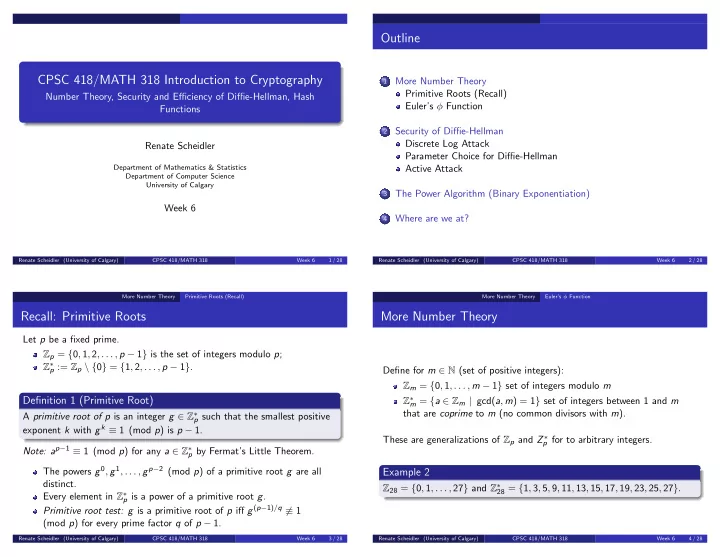
Outline CPSC 418/MATH 318 Introduction to Cryptography More Number - - PowerPoint PPT Presentation

outline cpsc 418 math 318 introduction to cryptography
SMART_READER_LITE
LIVE PREVIEW

Outline CPSC 418/MATH 318 Introduction to Cryptography More Number - - PowerPoint PPT Presentation

Outline CPSC 418/MATH 318 Introduction to Cryptography More Number Theory 1 Primitive Roots (Recall) Number Theory, Security and Efficiency of Diffie-Hellman, Hash Eulers Function Functions Security of Diffie-Hellman 2 Discrete Log


slide-1
SLIDE 1

CPSC 418/MATH 318 Introduction to Cryptography

Number Theory, Security and Efficiency of Diffie-Hellman, Hash Functions Renate Scheidler

Department of Mathematics & Statistics Department of Computer Science University of Calgary

Week 6

Renate Scheidler (University of Calgary) CPSC 418/MATH 318 Week 6 1 / 28

Outline

1

More Number Theory Primitive Roots (Recall) Euler’s φ Function

2

Security of Diffie-Hellman Discrete Log Attack Parameter Choice for Diffie-Hellman Active Attack

3

The Power Algorithm (Binary Exponentiation)

4

Where are we at?

Renate Scheidler (University of Calgary) CPSC 418/MATH 318 Week 6 2 / 28 More Number Theory Primitive Roots (Recall)

Recall: Primitive Roots

Let p be a fixed prime. Zp = {0, 1, 2, . . . , p − 1} is the set of integers modulo p; Z∗

p := Zp \ {0} = {1, 2, . . . , p − 1}.

Definition 1 (Primitive Root)

A primitive root of p is an integer g ∈ Z∗

p such that the smallest positive

exponent k with gk ≡ 1 (mod p) is p − 1. Note: ap−1 ≡ 1 (mod p) for any a ∈ Z∗

p by Fermat’s Little Theorem.

The powers g0, g1, . . . , gp−2 (mod p) of a primitive root g are all distinct. Every element in Z∗

p is a power of a primitive root g.

Primitive root test: g is a primitive root of p iff g(p−1)/q ≡ 1 (mod p) for every prime factor q of p − 1.

Renate Scheidler (University of Calgary) CPSC 418/MATH 318 Week 6 3 / 28 More Number Theory Euler’s φ Function

More Number Theory

Define for m ∈ N (set of positive integers): Zm = {0, 1, . . . , m − 1} set of integers modulo m Z∗

m = {a ∈ Zm | gcd(a, m) = 1} set of integers between 1 and m

that are coprime to m (no common divisors with m). These are generalizations of Zp and Z ∗

p for to arbitrary integers.

Example 2

Z28 = {0, 1, . . . , 27} and Z∗

28 = {1, 3, 5, 9, 11, 13, 15, 17, 19, 23, 25, 27}.

Renate Scheidler (University of Calgary) CPSC 418/MATH 318 Week 6 4 / 28

slide-2
SLIDE 2

More Number Theory Euler’s φ Function

Euler’s φ Function

Definition 3 (Euler’s φ Function)

Let m be a positive integer. Euler’s phi function is defined via φ(m) = |Z∗

m|, the cardinality of Z∗ m.

Interpretation: φ(m) is the number of integers between 1 and m − 1 which are coprime to m.

Example 4

φ(28) = |Z∗

28| = |{1, 3, 5, 9, 11, 13, 15, 17, 19, 23, 25, 27}| = 12

Renate Scheidler (University of Calgary) CPSC 418/MATH 318 Week 6 5 / 28 More Number Theory Euler’s φ Function

φ(pn), p prime

Let p be a prime. Then φ(p) = p − 1 = p0(p − 1) φ(p2) = p2 − p = p1(p − 1) . . . φ(pn) = pn − pn−1 = pn−1(p − 1) . What about composites with more than one prime factor?

Theorem 1

If gcd(m1, m2) = 1, then φ(m1m2) = φ(m1)φ(m2). In other words, Euler’s phi function is multiplicative.

Renate Scheidler (University of Calgary) CPSC 418/MATH 318 Week 6 6 / 28 More Number Theory Euler’s φ Function

Computing φ(m)

Corollary 2

If the prime factorization of m is given by m = pe1

1 pe2 2 · · · pek k ,

pi prime, then φ(m) = φ(pe1

1 )φ(pe2 2 ) · · · φ(pek k )

= pe1−1

1

(p1 − 1)pe2−1

2

(p2 − 1) · · · pek−1

k

(pk − 1) .

Example 5

φ(28) = φ(22 × 7) = φ(22)φ(7) = 22−1(2 − 1) × (7 − 1) = 12.

Renate Scheidler (University of Calgary) CPSC 418/MATH 318 Week 6 7 / 28 More Number Theory Euler’s φ Function

Euler’s Theorem

Recall Fermat’s Little Theorem:

Theorem 3 (Fermat)

If a is an integer and p is a prime with p ∤ a, then ap−1 ≡ 1 (mod p). The generalization to composite numbers is Euler’s Theorem:

Theorem 4 (Euler)

If a and m are integers with m > 0 and gcd(a, m) = 1, then aφ(m) ≡ 1 (mod m). Fermat’s Little Theorem is the special case of Euler’s Theorem with m = p prime.

Renate Scheidler (University of Calgary) CPSC 418/MATH 318 Week 6 8 / 28

slide-3
SLIDE 3

More Number Theory Euler’s φ Function

Sizes of φ(m) versus m

For any prime p, we have φ(p) = p − 1 p (for p large). How does φ(m) compare to m in general? It can be shown that for sufficiently large m, φ(m) ≥ C m log log(m) , where C ≈ 1.7. So for large m, φ(m) is not much smaller than m.

Renate Scheidler (University of Calgary) CPSC 418/MATH 318 Week 6 9 / 28 More Number Theory Euler’s φ Function

Euler’s Theorem and Primitive Roots

Theorem 5

For any prime p, there are exactly φ(p − 1) primitive roots of p.

Example 6

For p = 7, there are φ(p − 1) = φ(6) = (3 − 1)(2 − 1) = 2 primitive roots. Recall that φ(p − 1) ≥ 1.7 p − 1 log log(p − 1) . That’s a lot of primitive roots!

Renate Scheidler (University of Calgary) CPSC 418/MATH 318 Week 6 10 / 28 Security of Diffie-Hellman

Recall: Diffie-Hellman Key Agreement Protocol

Alice and Bob agree on a large public prime p, a primitive root g of p. Alice Public channel Bob Selects a randomly Selects b randomly (1 < a < p − 1) (1 < b < p − 1) ya ≡ ga (mod p) ya − → ya yb ← − yb yb ≡ gb (mod p) K ≡ ya

b (mod p)

K ≡ yb

a (mod p)

Shared key: K ≡ gab (mod p).

Renate Scheidler (University of Calgary) CPSC 418/MATH 318 Week 6 11 / 28 Security of Diffie-Hellman Discrete Log Attack

Security of Diffie-Hellman

Adversary’s objective: find K. Diffie-Hellman Problem (DHP): Given p, g, ga (mod p), gb (mod p), find gab (mod p). equivalent to finding K. Recall the Discrete Logarithm Problem (DLP): Given p, g, gx (mod p), find x. If an adversary can solve an instance of the DLP, she can solve the DHP. It is unknown if there are ways of solving the DHP, and hence breaking DH key agreement, other than extracting discrete logs.

Renate Scheidler (University of Calgary) CPSC 418/MATH 318 Week 6 12 / 28

slide-4
SLIDE 4

Security of Diffie-Hellman Discrete Log Attack

DLP Algorithms and Record

The fastest known algorithm for extracting discrete logs is the Number Field Sieve which is a very complicated algorithm using extremely sophisticated number theory.

Note 1

The current NFS DL record is for the prime p = RSA-240 + 49204 (798 bits, 240 decimal digits), held by Boudot-Gaudry-Guillevic-Heninger- Thom´ e-Zimmerman (December 2019):

log5(774356626343973985966622216006087686926705588649958206166317147722421706101723470351970238538755049093424997) = 92603135928144195363094955331732855502961099191437611616729420475898744562365366788100548099072093487548258752802923326 447367244150096121629264809207598195062213366889859186681126928982506005127728321426751244111412371767375547225045851716

Another algorithm for extracting discrete logs, due to Pohlig and Hellman, is very efficient if p − 1 is smooth. i.e. has only small prime factors. Its run time is governed by the largest prime factor of p − 1.

Renate Scheidler (University of Calgary) CPSC 418/MATH 318 Week 6 13 / 28 Security of Diffie-Hellman Parameter Choice for Diffie-Hellman

Diffie-Hellman – Best Choice for p

The best choice for p is a safe prime, i.e. a prime of the form p = 2q + 1 with q prime . Such a q is called a Sophie Germain prime. p − 1 = 2q has a prime factor that is as large as possible, thus foiling Pohlig-Hellman attacks; Lots of primitive roots of p: φ(p − 1) = φ(2)φ(q) = 1 · (q − 1) = p − 3 2 ≈ p 2 . Select 1 < g < p − 1. Since the only prime factors of p − 1 are 2 and q, the primitive root test only needs to check that gq ≡ 1 (mod p). p is found by first finding a prime q (1023 bits) and then checking that p = 2q + 1 is prime.

Renate Scheidler (University of Calgary) CPSC 418/MATH 318 Week 6 14 / 28 Security of Diffie-Hellman Parameter Choice for Diffie-Hellman

Diffie-Hellman – Best Choice for g

Best choice for g: a primitive root of p. Maximizes the number of possible values K. Assuming p = 2q + 1 is a safe prime (i.e. q a Sophie-Germain prime): g is easily found via random choices (almost half of all integers modulo p are primitive roots of p); Primitive root test is very fast and simple: a squaring and an exponentiation by q.

Renate Scheidler (University of Calgary) CPSC 418/MATH 318 Week 6 15 / 28 Security of Diffie-Hellman Parameter Choice for Diffie-Hellman

Generating Primes

Recall

Fermat’s Little Theorem

If p is a prime and a is an integer with p ∤ a, then ap−1 ≡ 1 (mod p). Given N (which may or may not be prime), let a ∈ ZN. If aN−1 ≡ 1 (mod N), then N is composite (by Fermat). If aN−1 ≡ 1 (mod N), then N could be prime, or it could be composite in which case it is referred to as a “base a pseudoprime”.

Example 7

N = 15 : 11N−1 ≡ 1114 ≡ 1 (mod 15), but 1314 ≡ 4 (mod 15). So 15 is a base 11 pseudoprime.

Renate Scheidler (University of Calgary) CPSC 418/MATH 318 Week 6 16 / 28

slide-5
SLIDE 5

Security of Diffie-Hellman Parameter Choice for Diffie-Hellman

The Fermat Primality Test

Input: N Output: “prime” or “composite”.

1 Generate random a ∈ ZN. 2 If gcd(a, N) > 1, output “composite” and stop. 3 If aN−1 ≡ 1 (mod N), output “composite”, else output ‘prime”.

The “else” clause in line 3 may produce a lie. Provably, this test lies with expected probability ≤ 1/2, but in practice, it rarely lies. To obtain a large prime:

1 Generate a random number N of the desired size 2 trial-divide N by all small primes (say up to a billion) 3 If N passes step 2 (i.e. has no small prime factors), run the Fermat

test on N for a few small prime bases a. If N passes, declare N prime.

Renate Scheidler (University of Calgary) CPSC 418/MATH 318 Week 6 17 / 28 Security of Diffie-Hellman Parameter Choice for Diffie-Hellman

Is this Fool-Proof?

Unfortunately, there are composite numbers (called Carmichael numbers) for which aN−1 ≡ 1 (mod N) for ALL a ∈ Z∗

N.

Thus, the Fermat test always lies. The smallest Carmichael number is 561 = 3 · 11 · 17. The next few are 1105, 1729, 2465, 2821, 6601, 8911. These are all the Carmichael numbers up to 10,000. Even worse: it has been proved that there are infinitely many Carmichael numbers. The good news is that they are very rare, so this test will give work well for most integers (and works very well in practice).

Renate Scheidler (University of Calgary) CPSC 418/MATH 318 Week 6 18 / 28 Security of Diffie-Hellman Active Attack

Man-in-the-Middle Attack against Diffie-Hellman

Consider the following (active) attack: Eve intercepts ga from Alice and gb from Bob.

She selects e, 1 < e < p and sends g e to both Alice and Bob. Alice now thinks that g e is g b, and Bob thinks g e is g a.

Alice computes what she thinks is (gb)a, but in fact computes gea. Bob computes what he thinks is (ga)b, but in fact computes geb. Eve computes (ga)e (which is what Alice thinks is the key) and (gb)e (which is what Bob thinks is the key).

Renate Scheidler (University of Calgary) CPSC 418/MATH 318 Week 6 19 / 28 Security of Diffie-Hellman Active Attack

Man-in-the-Middle Attack, consequence

If Alice sends a message encrypted with gea to Bob: Eve intercepts it, decrypts it with gea, re-encrypts it with geb and sends it on to Bob. Bob decrypts it unsuspectingly and in his perspective correctly using geb. Similarly, Eve can read all traffic from Bob to Alice. Even worse - can modify it!!

Renate Scheidler (University of Calgary) CPSC 418/MATH 318 Week 6 20 / 28

slide-6
SLIDE 6

Security of Diffie-Hellman Active Attack

Issues

Solution: keys need to be entity-authenticated (i.e. verified as belonging to the correct person). This is done using digital signatures, which we’ll discuss later. Man-in-the-middle attack is an example of protocol failure that can happen when adversarial models are too weak Basic (un-authenticated, or anonymous) DH is provably secure against passive adversaries (can only eavedrop) Easily defeated by active adversary Be aware of cryptography textbooks that only focus on the mathematics and ignore these issues!

Renate Scheidler (University of Calgary) CPSC 418/MATH 318 Week 6 21 / 28 The Power Algorithm (Binary Exponentiation)

Efficiency of Diffie-Hellman

Recall that Diffie Hellman requires computation of ga, gb, (ga)b, (gb)a (mod p). How efficient is DH key agreement? In other words, how fast is it to evaluate modular powers? Fast modular exponentiation is also needed in the Fermat primality test, the primitive root test, and RSA (later). Goal: Efficiently evaluate an (mod m) given a, n, m. One example: binary exponentiation based on the binary expansion of n : n = b02k + b12k−1 + · · · + bk−12 + bk where b0 = 1, bi ∈ {0, 1} for 1 ≤ i ≤ k with k = ⌊log2 n⌋.

Renate Scheidler (University of Calgary) CPSC 418/MATH 318 Week 6 22 / 28 The Power Algorithm (Binary Exponentiation)

Binary Exponentiation: Idea

Given b0, . . . , bk, we can evaluate n efficiently using Horner’s Method: n = 2(. . . (2(2b0 + b1) + b2) · · · + bk−1) + bk . Define s0 = b0, si+1 = 2si + bi+1 for 0 ≤ i ≤ k − 1. Then s0 = b0 s1 = 2s0 + b1 = 2b0 + b1 s2 = 2s1 + b2 = 2(2b0 + b1) + b2 = 22b0 + 2b1 + b2 . . . sk = n . One can formally prove (using induction on i): si =

i

  • j=0

bj2i−j for 0 ≤ i ≤ k .

Renate Scheidler (University of Calgary) CPSC 418/MATH 318 Week 6 23 / 28 The Power Algorithm (Binary Exponentiation)

Binary Exponentiation: Description

For 0 ≤ i ≤ k, define ri ≡ asi (mod m) . Then rk ≡ ask ≡ an (mod m) and we can compute rk iteratively as follows: r0 ≡ as0 ≡ a (mod m) r1 ≡ as1 ≡ a2s0+b1 ≡ (as0)2ab1 ≡ (r0)2ab1 (mod m) . . . ri+1 ≡ asi+1 ≡ a2si+bi+1 ≡ (asi)2abi+1 ≡ (ri)2abi+1 (mod m) .

Renate Scheidler (University of Calgary) CPSC 418/MATH 318 Week 6 24 / 28

slide-7
SLIDE 7

The Power Algorithm (Binary Exponentiation)

Binary Exponentiation: Algorithm

The actual algorithm:

1 Initialize r0 = a. 2 for 0 ≤ i ≤ k − 1 compute

ri+1 =

  • r2

i

(mod m) if bi+1 = 0 , r2

i a

(mod m) if bi+1 = 1 . AKA “Square & Multiply”.

Renate Scheidler (University of Calgary) CPSC 418/MATH 318 Week 6 25 / 28 The Power Algorithm (Binary Exponentiation)

Binary Exponentiation: Analysis

What is the computational cost of this? k modular squarings h(n) − 1 modular multiplications by a, where h(n) is the Hamming weight of n, i.e. the number of ‘1’s in the binary expansion of n. Total cost: at most 2⌊log2(n)⌋ modular multiplications. Also note that all intermediate operands are smaller than m2 Important that ri is reduced modulo m after every operation

Renate Scheidler (University of Calgary) CPSC 418/MATH 318 Week 6 26 / 28 The Power Algorithm (Binary Exponentiation)

A Toy Example

Compute 213 (mod 22). 13 = 8 + 4 + 1 = (1101)2, so k = 4 and b0 = 1 , b1 = 1 , b2 = 0 , b3 = 1 . Initialization: r0 = 2 Since b1 = 1: r1 ≡ r2

0 a ≡ 22 · 2 ≡ 8

(mod 22) Since b2 = 0: r2 ≡ r2

1 ≡ 82 ≡ 20

(mod 22) Since b3 = 1: r3 ≡ r2

2 a ≡ 202 · 2 ≡ (−2)2 · 2 ≡ 8

(mod 22) Answer: 213 ≡ 8 (mod 22) .

Renate Scheidler (University of Calgary) CPSC 418/MATH 318 Week 6 27 / 28 Where are we at?

Were are we at?

Recall cryptographic services: Data confidentiality: discussed Data integrity: next Authentication: next Non-repudiation Access Control Recall cryptographic mechanisms: Encryption — for confidentiality and limited data integrity: discussed Hash functions, Message Authentication Codes (MACs) — for data integrity : next Digital signatures — for data origin authentication and non-repudiation Authentication protocol — for entity authentication

Renate Scheidler (University of Calgary) CPSC 418/MATH 318 Week 6 28 / 28