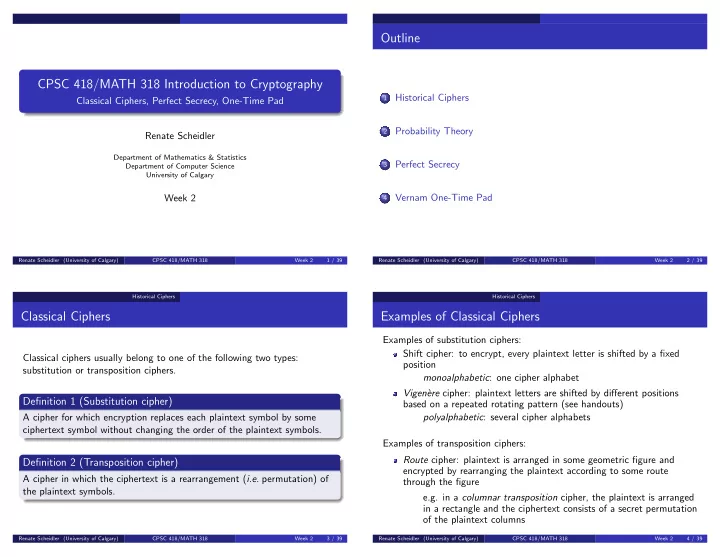
Outline CPSC 418/MATH 318 Introduction to Cryptography Historical - - PowerPoint PPT Presentation

outline cpsc 418 math 318 introduction to cryptography
SMART_READER_LITE
LIVE PREVIEW

Outline CPSC 418/MATH 318 Introduction to Cryptography Historical - - PowerPoint PPT Presentation

Outline CPSC 418/MATH 318 Introduction to Cryptography Historical Ciphers 1 Classical Ciphers, Perfect Secrecy, One-Time Pad Probability Theory 2 Renate Scheidler Department of Mathematics & Statistics Perfect Secrecy 3 Department of


slide-1
SLIDE 1

CPSC 418/MATH 318 Introduction to Cryptography

Classical Ciphers, Perfect Secrecy, One-Time Pad Renate Scheidler

Department of Mathematics & Statistics Department of Computer Science University of Calgary

Week 2

Renate Scheidler (University of Calgary) CPSC 418/MATH 318 Week 2 1 / 39

Outline

1

Historical Ciphers

2

Probability Theory

3

Perfect Secrecy

4

Vernam One-Time Pad

Renate Scheidler (University of Calgary) CPSC 418/MATH 318 Week 2 2 / 39 Historical Ciphers

Classical Ciphers

Classical ciphers usually belong to one of the following two types: substitution or transposition ciphers.

Definition 1 (Substitution cipher)

A cipher for which encryption replaces each plaintext symbol by some ciphertext symbol without changing the order of the plaintext symbols.

Definition 2 (Transposition cipher)

A cipher in which the ciphertext is a rearrangement (i.e. permutation) of the plaintext symbols.

Renate Scheidler (University of Calgary) CPSC 418/MATH 318 Week 2 3 / 39 Historical Ciphers

Examples of Classical Ciphers

Examples of substitution ciphers: Shift cipher: to encrypt, every plaintext letter is shifted by a fixed position monoalphabetic: one cipher alphabet Vigen` ere cipher: plaintext letters are shifted by different positions based on a repeated rotating pattern (see handouts) polyalphabetic: several cipher alphabets Examples of transposition ciphers: Route cipher: plaintext is arranged in some geometric figure and encrypted by rearranging the plaintext according to some route through the figure e.g. in a columnar transposition cipher, the plaintext is arranged in a rectangle and the ciphertext consists of a secret permutation

  • f the plaintext columns

Renate Scheidler (University of Calgary) CPSC 418/MATH 318 Week 2 4 / 39

slide-2
SLIDE 2

Historical Ciphers

Past Uses of Substitution Ciphers

History: Mary Queen of Scotts conspiring to overthrow Queen Elizabeth I and gain the English throne Famous 1917 WW I Zimmerman telegram Navajo Code talkers in WW II Literature: Edgar Allan Poe’s The Gold Bug Arthur Conan Doyle’s The Adventure of the Dancing Men (a Sherlock Holmes story) Kabalistic texts, writings of Jewish mysticism and the biblical book of Jeremiah use the atbash cipher (encrypts via alphabet reversal) A pathological example (which would not work for frequency analysis): Gadsby by Ernest Vincent Wright (1939) is a 50,000 word novel written entirely without using the letter E

Renate Scheidler (University of Calgary) CPSC 418/MATH 318 Week 2 5 / 39 Historical Ciphers

Cryptanalysis of Monoalphabetic Substitution Ciphers

1 Highly vulnerable to KPA’s: each portion of corresponding plaintext

and ciphertext reveals some of the cipher.

  • Eg. For shift ciphers, one letter pair reveals the key!

2 Each plaintext letter is encrypted to the same ciphertext letter .

Frequent ciphertext letters correspond to common plaintext letters Pairs of identical ciphertext letters correspond to such paintext letter pairs (e.g. “XX” corresponds to “yy”)

3 Language redundancy generally yields the key, given a sufficient

amount of ciphertext (COA).

frequency distribution of the plaintext alphabet (letters, pairs of letters, triples of letters etc.) in a given language can be established statistically and compared with the ciphertext (see frequency and digraph handouts).

Renate Scheidler (University of Calgary) CPSC 418/MATH 318 Week 2 6 / 39 Historical Ciphers

Cryptanalysis of Other Classical Ciphers

Polyalphabetic substitution ciphers and transposition ciphers are also vulnerable to KPAs and COAs. Cryptanalysis of Vigen` ere cipher: Determine the length of rotation patterns (i.e. the number of cipher alphabets) via guessing, the kappa test or Kasiski’s factoring method Cryptanalyze each subtext as a shift cipher Cryptanalysis of columnar transposition: Guess the dimensions of the rectangle Determine the order of the columns via frequency counts (which will be the same as for English text). Place columns adjacent to each

  • ther if they produce common latter pairs (e.g. QX is extremely

unlikely, but EN is highly likely).

Renate Scheidler (University of Calgary) CPSC 418/MATH 318 Week 2 7 / 39 Historical Ciphers

Modern Usage

Individually, substitution ciphers and transposition ciphers are generally insecure. However, when alternating them repeatedly, M − → T − → S − → T − → S − → · · · − → T − → S − → C , they become very secure. This idea, due to Claude Shannon, is the basis of the design of modern symmetric cryptosystems.

Renate Scheidler (University of Calgary) CPSC 418/MATH 318 Week 2 8 / 39

slide-3
SLIDE 3

Probability Theory

Information Theory

Claude Shannon is widely hailed as the “father of information theory”. seminal work in the late 1940’s and early 1950’s in this field credited with turning cryptography into a scientific discipline. in addition, modern satellite transmission would not be possible without his work Information theory measures the amount of information conveyed by a piece of data. captures how much partial information you need to have in order to

  • btain full information.

Renate Scheidler (University of Calgary) CPSC 418/MATH 318 Week 2 9 / 39 Probability Theory

Partial Information

For example, partial information reveals the full word or phrase in: Abbreviations — “LOL” Contractions — “I’ve” Omitted vowels — “BSKTBLL” Glyphs — smiley face How much partial information is enough? E.g. “BLL” could mean “ball”, “bell”, “bill”, “bull”, . . .

Renate Scheidler (University of Calgary) CPSC 418/MATH 318 Week 2 10 / 39 Probability Theory

Definitions for Probability Theory

Definition 3

Sample space – a finite set X = {X1, X2, . . . , Xn} whose elements are called outcomes. Probability distribution on X – a complete set of probabilities; i.e. p(X1), p(X2), . . . , p(Xn) ≥ 0 with

n

  • i=1

p(Xi) = 1. Random variable – a pair X consisting of a sample space X and a probability distribution p on X. The (a priori) probability that X takes on the value x ∈ X is denoted by p(X = x) or simply p(x).

Renate Scheidler (University of Calgary) CPSC 418/MATH 318 Week 2 11 / 39 Probability Theory

Joint and Conditional Probability

Let X and Y be random variables, x ∈ X and y ∈ Y.

Definition 4

Joint probability p(x, y): probability that p(X = x) and p(Y = y). Conditional probability p(x|y): probability that p(X = x) given that p(Y = y). Joint and conditional probabilities are related as follows: p(x, y) = p(x|y)p(y) .

Renate Scheidler (University of Calgary) CPSC 418/MATH 318 Week 2 12 / 39

slide-4
SLIDE 4

Probability Theory

Bayes’ Theorem

Theorem 1 (Bayes Theorem)

If p(y) > 0, then p(x|y) = p(x)p(y|x) p(y) .

Proof.

Clearly p(x, y) = p(y, x), so p(x|y)p(y) = p(y|x)p(x). Now divide by p(y).

Renate Scheidler (University of Calgary) CPSC 418/MATH 318 Week 2 13 / 39 Probability Theory

Independence

Definition 5

Two random variables X, Y are independent if p(x, y) = p(x)p(y) for all x ∈ X and y ∈ Y.

Example 6

A fair coin toss is modeled by a random variable on the sample space X = {heads, tails} so that p(heads) = p(tails) = 1/2. Two fair coin tosses in a row represent independent events as each of the 4 possible

  • utcomes has (joint) probability 1/4.

Corollary 2

X and Y are independent if and only if p(x|y) = p(x) for all x ∈ X, y ∈ Y with p(y) > 0.

Renate Scheidler (University of Calgary) CPSC 418/MATH 318 Week 2 14 / 39 Perfect Secrecy

Idea of Perfect Secrecy

Recall the notion of unconditional security which requires that an adversary with unlimited computing power cannot defeat the system. This relates to perfect secrecy. Intuitively, for perfect secrecy, ciphertexts should reveal no information whatsoever about plaintexts. Theoretically unbreakable!

Renate Scheidler (University of Calgary) CPSC 418/MATH 318 Week 2 15 / 39 Perfect Secrecy

Setup

We consider the following three probability distributions: A random variable on the message space M; plaintexts M occur with probabilities p(M) such that

M∈M p(M) = 1.

A random variable on the ciphertext space C; ciphertexts C occur with probabilities p(C) such that

C∈C p(C) = 1.

A random variable on the key space K; keys K are selected with prior probabilities p(K) such that

K∈K p(K) = 1.

We assume that the random variables on K and M are independent, as keys are usually chosen before the plaintext is ever seen. Most of the time, each key is selected with equal likelyhood 1/|K|, regardless of the nature of the messages to be encrypted.

Renate Scheidler (University of Calgary) CPSC 418/MATH 318 Week 2 16 / 39

slide-5
SLIDE 5

Perfect Secrecy

Notation

We consider the following probabilities: p(M) — (a priori) probability that plaintext M is sent. p(C) – probability that ciphertext C was received. p(M|C) — (a posteriori) probability that plaintext M was sent, given that ciphertext C was received. p(C|M) – probability that ciphertext C was received, given that plaintext M was sent. p(K) – probability that key K was chosen.

Renate Scheidler (University of Calgary) CPSC 418/MATH 318 Week 2 17 / 39 Perfect Secrecy

Definition

Definition 7 (Perfect Secrecy)

A cryptosystem provides perfect secrecy if p(M|C) = p(M) for all M ∈ M and C ∈ C with p(C) > 0. Formally, perfect secrecy means exactly that the random variables on M and C are independent. Informally, this implies that knowing the ciphertext C gives us no information about M. The probabilities p(M|C) and p(M) are hard to quantify (we may not know anything about which plaintexts occur). Bayes’ Theorem relates these quantities to p(C|M) and p(C), and these probabilities turn out to be easier to quantify.

Renate Scheidler (University of Calgary) CPSC 418/MATH 318 Week 2 18 / 39 Perfect Secrecy

Equivalent Definition

Theorem 3

A cryptosystem provides perfect secrecy if and only if p(C|M) = p(C) for all M ∈ M, C ∈ C with p(M) > 0 and p(C) > 0.

Proof

By Bayes’ Theorem, p(C|M) = p(C)p(M|C) p(M) for all M ∈ M, C ∈ C with p(M) > 0, p(C) > 0. (∗) “⇒”: Assume perfect secrecy, and let M ∈ M, C ∈ C with p(M) > 0 and p(C) > 0. Since p(M|C) = p(M) by perfect secrecy, (∗) yields p(C|M) = p(C).

Renate Scheidler (University of Calgary) CPSC 418/MATH 318 Week 2 19 / 39 Perfect Secrecy

Proof of Theorem 3 (cont’d)

Proof (cont’d)

“⇐”: Assume p(C|M) = p(C) for all M ∈ M, C ∈ C with p(M) > 0 and p(C) > 0. By definition of perfect secrecy, we need to prove that p(M|C) = p(M) for all M ∈ M and C ∈ C with p(C) > 0.a So let M ∈ M and C ∈ C with p(C) > 0. Case p(M) > 0. Since p(C|M) = p(C) by assumption, (∗) yields p(M|C) = p(M) in this case. Case p(M) = 0. Thenb p(M|C) = 0, as the additional restriction that C is given does not increase the probability. Hence p(M|C) = 0 = p(C).

aThis needs to be proved for ALL messages M, i.e. those with p(M) > 0 and those for which p(M) = 0. bIn this case, the assertion of the theorem is not applicable because it is a statement about messages M with p(M) > 0 and says nothing about messages M with p(M) = 0. So we must prove prefect secrecy by other means. Renate Scheidler (University of Calgary) CPSC 418/MATH 318 Week 2 20 / 39

slide-6
SLIDE 6

Perfect Secrecy

Intuition

Informally, perfect secrecy means that the probability of receiving a particular ciphertext C, given that M was sent (enciphered with some key K) is the same as the probability of receiving C given that any other message M was sent (possibly enciphered under another key).

Example 8

Suppose we have 3 messages, i.e. M = {M1, M2, M3}, and 3 ciphertexts C = {C1, C2, C3}, and all occur with equal probabilities (p(M1) = p(M2) = p(M3) = 1/3 and p(C1) = p(C2) = p(C3) = 1/3). Also, suppose that we have perfect secrecy, i.e. p(Mi|Cj) = p(Mi) = 1/3 for all i, j. By Theorem 3, we have p(Ci|Mj) = p(Ci) = 1/3 for all i, j. This means that Ci corresponds to Mj with equal probability for all i, j.

Renate Scheidler (University of Calgary) CPSC 418/MATH 318 Week 2 21 / 39 Perfect Secrecy

Illustration of the Example

Each ciphertext (Ci) could be the encryption of any of the messages with equal probability. M1 M2 M3 C1 C2 C3

Renate Scheidler (University of Calgary) CPSC 418/MATH 318 Week 2 22 / 39 Perfect Secrecy

Computing p(C|M)

Recall that perfect secrecy is equivalent to p(C|M) = p(C) for all messages M and all ciphertexts C that occur. How can we determine p(C|M) and p(C)? For any message M ∈ M, we have p(C|M) =

  • K∈K

EK (M)=C

p(K) . That is, p(C|M) is the sum of probabilities p(K) over all those keys K ∈ K that encipher M to C.

Renate Scheidler (University of Calgary) CPSC 418/MATH 318 Week 2 23 / 39 Perfect Secrecy

Number of Keys in the Sum

Usually there is at most one key K with EK(M) = C for given M and C. However, some ciphers can transform the same plaintext into the same ciphertext with different keys. A monoalphabetic substitution cipher will transform a message into the same ciphertext with different keys if the only differences between the keys occur for characters which do not appear in the message

  • Eg. key1 = ECONOMICS, key2 = ECONOMY, and we encrypt a

message of at most 6 characters).

Renate Scheidler (University of Calgary) CPSC 418/MATH 318 Week 2 24 / 39

slide-7
SLIDE 7

Perfect Secrecy

Example: Computing p(C|M)

M = {a, b}, K = {K1, K2, K3}, and C = {1, 2, 3, 4}. Encryption is given by the following table: Key M = a M = b K1 C = 1 C = 2 K2 C = 2 C = 3 K3 C = 3 C = 4 Thus, p(1|a) = p(K1) , p(1|b) = 0 , p(2|a) = p(K2) , p(2|b) = p(K1) , p(3|a) = p(K3) , p(3|b) = p(K2) , p(4|a) = 0 , p(4|b) = p(K3) .

Renate Scheidler (University of Calgary) CPSC 418/MATH 318 Week 2 25 / 39 Perfect Secrecy

Description of EK

Consider a fixed key K. The mathematical description of the set of all possible encryptions (of any plaintext) under this key K is exactly the image of EK, i.e. the set EK(M) = {EK(M) | M ∈ M}. Key M = a M = b K1 C = 1 C = 2 K2 C = 2 C = 3 K3 C = 3 C = 4 In the previous example, we have EK1(M) = {1, 2} EK2(M) = {2, 3} EK3(M) = {3, 4}.

Renate Scheidler (University of Calgary) CPSC 418/MATH 318 Week 2 26 / 39 Perfect Secrecy

Computation of p(C)

For a key K and ciphertext C ∈ EK(M), consider the probability p(DK(C)) that the message M = DK(C) was sent. Then p(C) =

  • K∈K

C∈EK (M)

p(K)p(DK(C)) . That is, p(C) is the sum of probabilities over all those keys K ∈ K under which C has a decryption under key K, each weighted by the probability that that key K was chosen.

Renate Scheidler (University of Calgary) CPSC 418/MATH 318 Week 2 27 / 39 Perfect Secrecy

Example, cont.

The respective probabilities of the four ciphertexts 1, 2, 3, 4 are: p(1) = p(K1)p(a), p(2) = p(K1)p(b) + p(K2)p(a) p(3) = p(K2)p(b) + p(K3)p(a), p(4) = p(K3)p(b) If we assume that every key and every message is equally probable, i.e. p(K1) = p(K2) = p(K3) = 1/3 and p(a) = p(b) = 1/2, then p(1) = 1 3 · 1 2 = 1 6, p(2) = 1 3 · 1 2 + 1 3 · 1 2 = 1 3 p(3) = 1 3 · 1 2 + 1 3 · 1 2 = 1 3, p(4) = 1 3 · 1 2 = 1 6 Note that p(1|a) = p(K1) = 1/3 = 1/6 = p(1), so this system does not provide perfect secrecy.

Renate Scheidler (University of Calgary) CPSC 418/MATH 318 Week 2 28 / 39

slide-8
SLIDE 8

Perfect Secrecy

Necessary Condition for Perfect Secrecy

Theorem 4

If a cryptosystem has perfect secrecy, then |K| ≥ |M|. Informal argument: suppose |K| < |M|. Pick a ciphertext C with p(C) > 0 (i.e. C actually occurs as the encryption of some message under some key). Since |K| < |M|, there is some message M such that no key K encrypts M to C. This means that the sum defining p(C|M) is empty, so p(C|M) = 0. Since p(C) > 0, we have no perfect security. (Note that after intercepting a particular ciphertext C (i.e. p(C) > 0), knowing that p(C|M) = 0 for certain plaintexts M allows the cryptanalyst to eliminate these plaintexts M from consideration — e.g. p(1|b) = 0 in example.)

Renate Scheidler (University of Calgary) CPSC 418/MATH 318 Week 2 29 / 39 Perfect Secrecy

Necessary Condition for Perfect Secrecy (cont’d)

Consider a cryptosystem where keys are bit strings (sequences of 0’s and 1’s) of some length k and messages are bit strings of some length m. Then |K| = 2k and |M| = 2m. The theorem shows that in order for such a system to provide perfect secrecy, we must have k ≥ m, i.e. keys must be at least as long as messages!

Renate Scheidler (University of Calgary) CPSC 418/MATH 318 Week 2 30 / 39 Perfect Secrecy

Shannon’s Theorem

Theorem 5 (Shannon’s Theorem, 1949/50)

A cryptosystem with |M| = |K| = |C| has perfect secrecy if and only if p(K) = 1/|K| for all K ∈ K (i.e. every key is chosen with equal likelihood) and for every M ∈ M and every C ∈ C, there exists a unique key K ∈ K such that EK(M) = C.

Proof.

See Theorem 3.4, p. 68, in Stinson-Paterson.

Renate Scheidler (University of Calgary) CPSC 418/MATH 318 Week 2 31 / 39 Perfect Secrecy

Is Perfect Secrecy the Holy Grail?

Perfect secrecy isn’t all it’s made out to be. For example, by Shannon’s Theorem, the shift cipher — which we have seen is completely insecure — provides perfect secrecy if every key is chosen equally likely (see Theorem 3.3, pp. 66-67, of Stinson-Paterson). We will next discuss the one-time pad, which also provides perfect secrecy but is quite impractical.

Renate Scheidler (University of Calgary) CPSC 418/MATH 318 Week 2 32 / 39

slide-9
SLIDE 9

Vernam One-Time Pad

One-Time Pad

Generally attributed to Vernam (1917, WW I) who patented it, but recent research suggests the technique may have been used as early as 1882 in any case, it was long before Shannon It is the only substitution cipher that does not fall to statistical analysis.

Renate Scheidler (University of Calgary) CPSC 418/MATH 318 Week 2 33 / 39 Vernam One-Time Pad

Bitwise Exclusive-Or

Fix a string length n. Then set {0, 1}n is the set of bit strings of length n.

Definition 9 (bitwise exclusive or, XOR)

For a, b ∈ {0, 1}, we define a ⊕ b = a + b (mod 2) =

  • a = b ,

1 a = b . For A = (a1, a2, . . . , an), B = (b1, b2, . . . , bn) ∈ {0, 1}n, we define then A ⊕ B = (a1 ⊕ b1, a2 ⊕ b2, . . . , an ⊕ bn) . (component-wise XOR).

Renate Scheidler (University of Calgary) CPSC 418/MATH 318 Week 2 34 / 39 Vernam One-Time Pad

The One-Time Pad

Definition 10 (Vernam one-time pad)

M = C = K = {0, 1}n (n ∈ N). Encryption of M ∈ {0, 1}n under key K ∈ {0, 1}n is bitwise XOR, i.e. C = M ⊕ K . Decryption of C under K is done the same way, i.e. M = C ⊕ K. Decryption is the inverse of encryption, since K ⊕ K = (0, 0, . . . , 0) and M ⊕ (0, 0, . . . , 0) = M.

Renate Scheidler (University of Calgary) CPSC 418/MATH 318 Week 2 35 / 39 Vernam One-Time Pad

Security of the One-Time Pad

Theorem 6

The one-time pad provides perfect secrecy if each key is chosen with equal

  • likelihood. Under this assumption, each ciphertext occurs with equal

likelihood (regardless of the probability distribution on the plaintext space).

Proof sketch

The first assertion follows immediately from Shannon’s Theorem (Theorem 5). The second assertion is proved by computing p(C) for all C ∈ C using the formula. This means that in the one-time pad, any given ciphertext can be decrypted to any plaintext with equal likelihood (def’n of perfect secrecy). There is no “distinguished” (e.g. meaningful) decryption. So even exhaustive search doesn’t help.

Renate Scheidler (University of Calgary) CPSC 418/MATH 318 Week 2 36 / 39

slide-10
SLIDE 10

Vernam One-Time Pad

Cryptanalysis of the One-Time Pad

It is imperative that each key is only used once: Immediately falls to a KPA: if a plaintext/ciphertext pair (M, C) is known, then the key is K = M ⊕ C. Suppose K were used twice: C1 = M1 ⊕ K , C2 = M2 ⊕ K = ⇒ C1 ⊕ C2 = M1 ⊕ M2 . Note that C1 ⊕ C2 = M1 ⊕ M2 is just a coherent running key cipher (adding two coherent texts, M1 and M2), which as we have seen is insecure. For the same reason, we can’t use shorter keys and “re-use” portions of

  • them. Keys must be randomly chosen and at least as long as messages.

This makes the one-time pad impractical.

Renate Scheidler (University of Calgary) CPSC 418/MATH 318 Week 2 37 / 39 Vernam One-Time Pad

Practical Issues

Main disadvantages of one-time pad: requires a random key which is as long as the message each key can be used only once. One-time schemes are used when perfect secrecy is crucial and practicality is less of a concern, for example, Moscow-Washington hotline.

Renate Scheidler (University of Calgary) CPSC 418/MATH 318 Week 2 38 / 39 Vernam One-Time Pad

One-Time Pad: Conclusion

The major problem with the one-time pad is the cost. As a result, we generally rely on computationally secure ciphers. These ciphers would succumb to exhaustive search, because there is a unique “distinguished” (e.g. meaningful) decipherment. The computational difficulty of finding this solution foils the cryptanalyst. A proof of security does not exist for any proposed computationally secure system.

Renate Scheidler (University of Calgary) CPSC 418/MATH 318 Week 2 39 / 39