1
Overcoming The Work Inexperience Gap Through Quality - - PowerPoint PPT Presentation
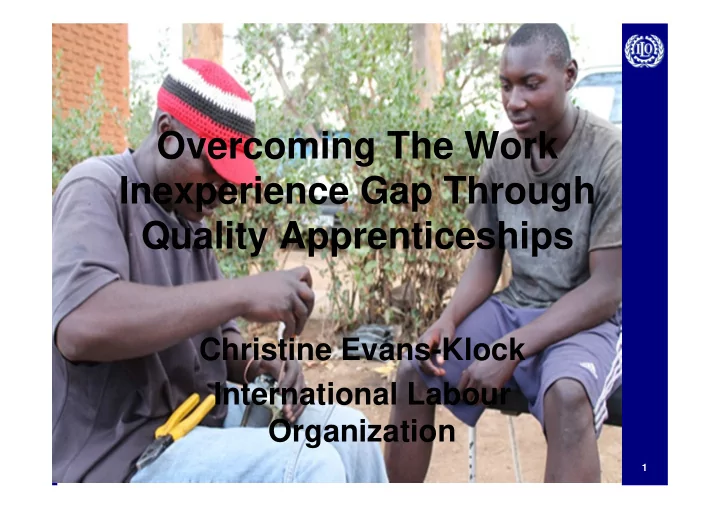
Overcoming The Work Inexperience Gap Through Quality Apprenticeships Christine Evans-Klock International Labour Organization 1 ILOs mandate on skills development, set through tripartite consultations of Governments, Workers and
2
ILO’s mandate on skills development, set through tripartite consultations of Governments, Workers and Employers: Help constituents bridge the world of education and training to the world of work
– to improve the employability of workers, – to increase the productivity and competitiveness of enterprises, and – to expand the inclusiveness of economic growth
3
Linking skills development to Decent work From a Vicious Downward Circle…
Unavailable or low quality education and training: – Traps the working poor in low-skilled, low productive, low-wage jobs – Excludes workers without the right skills from participating in economic growth – Discourages investment in new technologies
... To a Virtuous Circle...
More and better skills makes it easier to: – Innovate and adopt new technologies – Attract investment – Compete in new markets, – Diversify the economy, and – Boost job growth
4
Countries sustain a “virtuous circle” link education, skills, decent work by…
1. Ensuring the broad availability of quality education 2. Matching supply to current demand for skills 3. Helping workers and enterprises adjust to change 4. Sustaining a dynamic development process: Use skills as a driver of change to move from lower to higher productivity 5. Expanding accessibility of quality training: rural, women, disadvantaged youth, persons with disabilities
HOWEVER... The potential benefits of training are not realised without job-rich growth
This is the ILO’s conceptual framework for skills for employment
5
Youth employment crisis
0.0 5.0 10.0 15.0 20.0 25.0 30.0
Total Unemployment Youth Unemployment
6
Where apprenticeship systems are weak, the ratio of youth to adult unemployment rates tends to be higher
39 30 44 32 27 14 17 40 20 24 5 10 15 20 25 30 35 40 45 50 0.00 1.00 2.00 3.00 4.00 5.00 6.00
Ratio of youth unemployment rate to adult unemployment rate Apprentices per 1000 employed
7
Some countries with more formal apprenticeships have enjoyed lower youth unemployment
8
Presentation
ILO and skills development
- Youth employment crisis
How apprenticeship overcomes the work inexperience gap
- How to create more and better apprenticeships
Current ILO work and future questions
9
How apprenticeship eases transitions to work
10
Why do apprenticeships improve youth employment? Because employers’ leadership means training matches needs; avoids mismatch Workplace training matches employers’ needs - why else
would they train?
Training is kept relevant to workplace needs – fast response
to new technologies
Technical skills evaluated at the workplace – no discrepancy
between what’s on a diploma and what a worker can do
Sector-based apprenticeships sustain engagement of
employers and trade unions with training providers
Core skills made visible – teamwork, decision-making, ability
to learn
Role of trade unions and employers to lead apprenticeship
systems, financing, monitoring
11
Why do apprenticeships improve youth employment: Because who pays matches who benefits: Business, Students and Society
International Labour Standards reflect tripartite agreement Recommendation on Human Resources Development 2004: Governments have primary responsibility for – education – pre-employment training, core skills – training the unemployed, people with special needs The social partners play a significant role in – further training – workplace learning and training Individuals need to make use of opportunities for education, training & lifelong learning
Apprenticeship Systems
12
Why do apprenticeships improve youth employment? Because they can attract young people into training…MAYBE
Opportunity to earn while learning attracts many young people Providing work experience eases transitions to first job Learning how to run a business on basis of vocational skill
HOWEVER the perception of the jobs ahead matters!
? Quality training and quality jobs are both required to raise and
maintain the social status of apprenticeship
? Are “Skills gaps” really working conditions gaps? ? Do young people have good information about job availability,
apprenticeships and career paths; are employment services widely available?
? Do apprenticeships offer pathways to higher education? ? Do apprenticeships broaden opportunities for young women?
13
Job quality – perception and reality – matters to young peoples’ education choices and to apprenticeship policy Skills utilization Is this the prevailing business strategy, or is
it based on low-wage low-productivity strategies?
Youths’ expectations Productive and decent work, in
broader set of industries - tourism, creative arts, ITC, business management?
Job growth Should we prepare young people for the labour
market or prepare the labour market for young people? ILO calls for job-centred economic growth. TRAINING HAS TO BRIDGE TO SOMETHING.
14
How to increase apprenticeship opportunities
15
Create more and better apprenticeships: Expand formal apprenticeship
Barriers Responses
Poaching
- Correct market failure through sharing
training costs.
- Include non-transferable company-specific
skills in apprenticeship training. Social stigma
- Make the jobs attractive.
- Build pathways to higher education through
apprenticeship. Lack of information
- Expand Public Employment Services to
- make labour market information available
through career guidance;
- broaden youths’ perspectives – improve
impressions about apprenticeships & jobs;
- match apprentices to enterprises,
especially small enterprises;
- monitor & disseminate employment
- utcomes of apprenticeship.
16
Create more and better apprenticeships: Expand formal apprenticeship (continued)
Barriers Response
Small enterprises are largest source of job growth but least likely to to offer quality apprenticeship
- Pool apprentices across small enterprises
to broaden training.
- Share costs via public-private partnerships.
- Attract students with entrepreneurship
training.
- Document how apprentices improve
productivity.
- Include small enterprises in sector
approaches.
- Deploy Public Employment Services to
connect small enterprises to apprentices Youth without good basic education cannot enter apprenticeship
- Public private partnerships can make up
literacy or basic skills gaps of school drop-
- uts or target disadvantaged groups
17
Create more and better apprenticeships: Informal apprenticeship system
Informal apprenticeship is a training system... .... Where rules based on customs, social norms, traditions .... are enforced by social networks, informal associations, kinship groups It is NOT ad-hoc work experience. It is the best chance many young people have of learning a trade and entering productive and decent work.
18
Create more and better apprenticeships: Capitalize on strengths of Informal apprenticeship
Strengths Rationale
Accessible to poor youth in urban and rural areas
- Admission not based on educational
achievement.
- Flexible financing arrangements.
Training is cost-effective
- Costs shared by master craftsperson and
apprentice.
- Apprenticeship duration ensures cost
recovery by master craftsperson.
- Equipment and tools available.
System is self-regulating and produces employable skills
- Set of rules embedded in social norms
establish mutually-beneficial incentives – for starting and for completing apprenticeships Training within social, business network teaches business skills & improves employability
- As part of the master craftsperson’s
business, apprentices build up client relations and business contacts
19
Create more and better apprenticeships: Overcome weaknesses of Informal Apprenticeship
Weaknesses Interventions Lack of access to new skills or technology
- Upgrade master craftspersons’ skills
through business or institution partners. Create links to formal training. Perpetuates occupational segregation, restricts
- pportunities for girls
- Empower girls and boys to enter new
trades.
- Encourage master craftswomen and
entrepreneurs to take apprentices. Recognition of acquired skills restricted to local area
- Expand recognition through assessment &
credentials by business associations or formal training centres. Risks of exploitation
- Train master craftspersons on safety &
health; help finance safety equipment.
- Enforce working hours.
- Pay fair wages.
- Respect fair duration and ensure training so
apprenticeship is not disguised child labour.
20
Current and future ILO work
Promote formal apprenticeship Upgrade informal apprenticeship Boost international coordination
21
Promote key success factors for quality apprenticeship
- Leadership by social partners
- Application of sector based approaches
- School and business partnerships
- Structured systems of skills tracking, testing and certification
- Reinforcing
core skills while balancing specific and transferable skills
- Career guidance to expand young people’s awareness
- Incorporation of entrepreneurship within technical training
- Growth of productive , decent work and skills utilization
- Involvement by non-traditional industries and small enterprises
- Innovative and fair financing with sound accountability
22
Examples of ILO support for promoting formal apprenticeship
Research:
- “Overview of apprenticeship systems and issues”, for G20
Taskforce on employment and input into ‘Key Elements for Quality Apprenticeships’
- Lessons on expanding apprenticeship: Denmark, US,
Australia, India, China, Colombia. Support constituents:
- International review and national workshops in India in
collaboration with World Bank
- Support setting up formal apprenticeship systems in
Bangladesh, Tanzania
- Tool kit for the design and operation of formal apprenticeship
systems (forthcoming)
- Apprenticeship included in G20 Pilot Countries for inter-
agency support for Skills for Employment Action Plans
23
Examples of ILO support for promoting formal apprenticeship
Global Business Network on Apprenticeship
- In collaboration with International Organization of
Employers
- Objective: increase quality apprenticeships, reduce
youth unemployment & improve business productivity
- ILO completing feasibility study – MNCs’
apprenticeship programmes and interest in knowledge sharing of good practices and good policies (UK, Germany, India, Argentina, South Africa, Turkey)
24
Upgrade informal apprenticeships
Research focus on: Improved working conditions Connecting apprenticeship to workplace productivity involving SMES gender equity Tools Resource Guide on Upgrading Informal Apprenticeship in Africa Guide on Skills testing for small business associations Knowledge sharing
25
Upgrading Informal Apprenticeship
Technical Cooperation examples in Africa
- Benin: support national crafts association in establishing
skills standards
- Egypt: promote off-job training for informal apprentices
- Niger:
include provisions for improving informal apprenticeship in national TVET policy
- Tanzania: Piloting recognition of apprenticeship learning
through national TVET authority
- Zimbabwe: promotion of skills standards by local crafts
associations
26
Inter-agency coordination
- Inter-agency Group on TVET – UNESCO, ETF, ILO,
OECD, WB, EC
- Post-2015 Sustainable Development Goals:
Include TVET in Education Goals
- Inter-agency
coordination at the country level? Requires national leadership!
- Knowledge-sharing platform
27
Global Public-Private Knowledge Sharing Platform on Skills for Employment
One-stop platform : pool knowledge products on linking skills to employment from private sector, ILO, UNESCO, OECD, World Bank Different knowledge products for different users Builds up knowledge from case studies to research to policy Or drill down from synthesis to sources
- f evidence
28
Global Public-Private Knowledge Sharing Platform on Skills for Employment
Operational now in test environment, : www.skillsforemployment.org Username: skpviewer Password: edms1234 Translate operation into French and Spanish – July, 2013 Contributions welcome at: knowledge@skillsforemployment.org
29