Overview of Sleep Disorders - Overview of Sleep Disorders - - PowerPoint PPT Presentation

overview of sleep disorders overview of sleep disorders
SMART_READER_LITE
LIVE PREVIEW

Overview of Sleep Disorders - Overview of Sleep Disorders - - PowerPoint PPT Presentation

Overview of Sleep Disorders - Overview of Sleep Disorders Disclosures Richard J. Schwab, M.D. NIH grants - RO1/PPG (Obesity and OSA) Professor of Medicine Division of Sleep Medicine Consultant: Pulmonary, Allergy and Critical Care


slide-1
SLIDE 1

Overview of Sleep Disorders

Richard J. Schwab, M.D. Professor of Medicine Division of Sleep Medicine Pulmonary, Allergy and Critical Care Division University of Pennsylvania Medical Center Philadelphia, Pennsylvania

Overview of Sleep Disorders - Disclosures

  • NIH grants - RO1/PPG (Obesity and OSA)
  • Consultant:

– Apnicure – Foramis

Overview of Sleep Disorders

  • Sleep deprivation:

– Normals/driving/Maggie’s law

  • Sleep disorders causing daytime sleepiness:

– Restless leg syndrome/periodic limb movements – Narcolepsy - use of Provigil/Nuvigil/Xyrem – Parasomnias/REM behavior disorder – Insomnia - should we be using hypnotics?

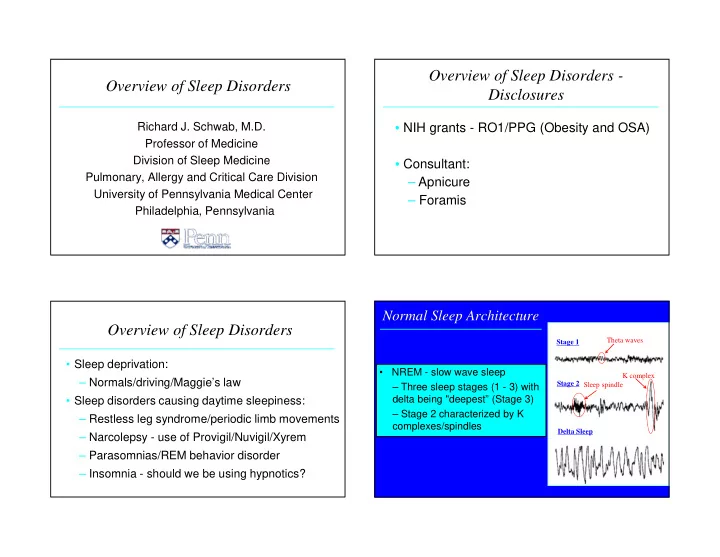
  • NREM - slow wave sleep

– Three sleep stages (1 - 3) with delta being "deepest” (Stage 3) – Stage 2 characterized by K complexes/spindles

Normal Sleep Architecture

Stage 1 Stage 2 Delta Sleep Theta waves K complex Sleep spindle

slide-2
SLIDE 2
  • REM - active or rapid eye movement

– Characteristic EEG pattern (sawtooth waves), bursts of rapid eye movements, muscle atonia

Normal Sleep Architecture

REM Sleep Sawtooth waves

Rapid Eye Movements Rapid Eye Movements

Age-Related Sleep Changes

  • Loss of delta

sleep with aging

  • Teenagers need

more sleep than adults

14 13 Total Sleep Time (h) Age (yr) 10 12 11 10 9 8 7 6 5 4 3 2 1 20 30 40 50 60 70 Lifetime Sleep Patterns REM sleep

Stage 1 sleep Awake in bed

Delta Sleep Stage 2 sleep

  • Normal

latency to REM sleep is 90 minutes

  • 20 - 25% of

sleep is REM

  • More REM

episodes as the night progresses

Sleep Cycle During the Night

Young Adult

wakefulness REM Light non-REM Deep non-REM 1 2 3 4 5 6 7

Old Adult

National Sleep Debt

  • Over the past century sleep time has declined 20%
  • 1910 survey found that Americans slept an average of 9

hours a night

  • Presently Americans sleep ~ 7 hours a night

– 6 hours 51 minutes on weekdays; 7 hours 37 minutes on weekend (National Sleep Foundation 2013 poll (23-60 y/o) www.sleepfoundation.org/2013poll – Sleep time has steadily declined in the last ten years

  • 80% of adolescents get a less-than-optimal amount of sleep

(9+ hours – NSF/2006)

  • Most adults need 8 hours of sleep nightly

– When Bill Clinton was President he slept only 5-6 hours a night

slide-3
SLIDE 3

National Sleep Debt

  • We live in a 24 hour

society: – Work, family demands, cable TV, the Internet encroach

  • n our sleep time

– Individuals who use Internet at night stay up and lose at least

  • ne hour of sleep

Consequences of Sleep Deprivation

– Reduced productivity in school and workplace – Lowered cognitive performance – Decreased quality of family and social life – Accidents at work or at home

Exxon Valdez Oil Spill (March 1989)

slide-4
SLIDE 4

Is it Safe to Drive Sleepy? Driving Sleepy

  • Department of Transportation estimates that

100,000 automobile accidents yearly are direct result of driver sleepiness/drowsiness

– 1,500 fatalities and 71,000 injuries per year – $12.5 billion in diminished productivity and property loss

  • Another one million crashes (1/6 of all crashes)

related to driver inattention

– Fatigue makes inattention more likely

CDC: 1 in 24 Report Driving While Drowsy

  • Report (1/2013) from the Centers for Disease Control and

Prevention (CDC) estimates 15% to 33% of fatal crashes involve tired drivers

  • CDC report analyzed a 2009-2010 national behavioral

telephone survey of more than 147,000 respondents

  • Approximately 4.2% reported having fallen asleep while

driving at least once during the last month (1 out of 24)

  • Reports of falling asleep while driving were more

common among adults who reported usually sleeping < 6 hours per night, snoring, or unintentionally falling asleep during the day, compared to adults who did not report these characteristics

Driving Sleepy: Who are at Risk?

  • 2012 NSF poll: 24% of respondents report they

have driven drowsy in the last month

  • Teenagers are at very high risk for sleep related

automobile accidents (55% of fall asleep MVA’s)

  • American and Canadian long haul truck drivers get

fewer than 5 hours sleep night, and some exhibit OSA, contributing to sleepiness – Mitler et al, N Engl J Med 337;755-761, 1997 – Pack et al, Am J Respir Crit Care Med 174; 446- 454, 2006

slide-5
SLIDE 5

Sleep Deprivation and Driving

(1999 AAA Foundation for Traffic Safety Report: “Why Do People Have Drowsy Driving Crashes?”)

  • 24 hours of sleep deprivation impairs performance

as much as 0.10 blood alcohol level (legally drunk) – Alcohol makes the sleepy driver more impaired

  • Individuals are not good at determining the

likelihood that they will fall asleep

  • Characteristics of fall asleep accidents:

– Single vehicle – Occurrence at night or mid-afternoon – Results in serious injuries

Is Driving Sleepy a Crime?

  • Driving while drunk is a crime
  • Driving sleepy is not

– Or is it in New Jersey/England?

Maggie’s Law

  • 20 year old woman (Maggie McDonnell) killed in a

head on collision in 1997 in Clementon, NJ

  • Man who caused accident had fallen asleep at wheel

and told police that he had not slept in 30 hours – Jury acquitted him of vehicular homicide and he walked away with a $200 fine for reckless driving

  • 2/15/01 - NJ Assemblyman George Geist introduces

a bill establishing driving while fatigued as recklessness under vehicular homicide statute

Maggie’s Law

  • Bill signed into NJ law, August 5, 2003
  • It is now possible to charge a motorist with vehicular

homicide (up to 10 years in prison; $100,000 fine) if driver falls asleep and kills another driver

  • Driver fatigue is defined as driving after being up for

24 hours – What does this mean for housestaff?

  • First conviction (8/20/05); 26 year old man who

caused a fatal crash in NJ after not having sleep for > 24 hours sentenced to 5 years in prison

slide-6
SLIDE 6

British (Selby) Rail Crash

  • 37 year old man (2/28/01) driving a

Land Rover (pulling a car on a trailer)

  • Falls asleep while driving and

car/trailer rolls down an embankment to train tracks

6:12AM: Newcastle to London train traveling 125 mph

British (Selby) Rail Crash

  • He was up all night on the phone

talking to his new girl friend

  • Passenger train (125 mph) smashes

into 2 vehicles

6:12AM

British (Selby) Rail Crash

  • Passenger train (100 on board)

derails and collides with freight train carrying 100 tons of coal

  • 10 passengers killed - many injured

British (Selby) Rail Crash

  • All 9 passenger cars derailed and
  • ne was completely flattened
  • He was found guilty of 10 charges of

causing death by dangerous driving

  • Sentenced (1/25/02) to 5 years in jail
slide-7
SLIDE 7

Is it Safe to Drive Sleepy?

  • No!!

– Especially in New Jersey or England!!! – ? Housestaff or medical students

Epworth Sleepiness Scale (ESS)

(Johns, Sleep 14:540, 1991)

Situation Score Sitting and reading _____ Watching TV _____ Sitting inactive in a public place _____ Passenger in car _____ Lying down to rest in afternoon _____ Sitting talking to someone _____ Sitting after lunch without alcohol _____ In a car, stopped for minutes in traffic _____ Total (normal ≤10) _____ Dozing: 0 = Never, 1 = Slight Chance, 2 = Mod Chance, 3 = High Chance

  • ESS - measures subjective sleepiness; should be performed in office

Objective Measures of Sleepiness

  • Multiple sleep latency test (how

quickly can you fall asleep in the dark?)

  • Maintenance of wakefulness test (how

long can you stay awake in the dark?)

  • Standards (Sleep 28; 113-121, 2005)

Epidemiology and Presentation of PLMD/RLS

  • Estimated to affect 3 - 5% of the population

– Prevalence of PLM’s correlated with age - most common in patients over 50 years old – 43% develop RLS before age 20 – RLS autosomal dominant trait; more common in women

  • 60% of patients with RLS first degree relatives manifest RLS
  • Common cause of excessive daytime sleepiness
  • Bed partner often complains of being kicked -

sheets “messed up” in morning

slide-8
SLIDE 8

Restless Legs Syndrome (RLS)/Periodic Limb Movement Disorder (PLMD)

(Allen RP 2003, Sleep Medicine 4: 101-119)

  • Restless Legs Syndrome (essential criteria -

http://irlssg.org/diagnostic-criteria/):

– An urge to move the legs, often accompanied by uncomfortable or unpleasant sensations in the legs – These sensations are worsened with rest or inactivity – These sensations are improved by movement – These sensations are worse in the evening or night

  • Periodic Limb Movement Disorder:

– Recurrent stereotypic movements of legs during sleep

  • Rhythmic extension of big toe & dorsiflexion of ankle

– 80% of patients with RLS manifest PLMD

Periodic Limb Movement Disorder (PLMD)/RLS

  • Diagnosis with a PSG:

– EEG arousals related to increased EMG on leg channels – Each movement lasts 0.5 to 10 seconds – Interval between movements 5 - 90 seconds – Frequency decreases during delta/REM sleep

  • Treat if > 5 - 10 arousals per hour

and clinical symptoms

“I wish you could stop tossing in bed and get some sleep!”

Periodic Limb Movement With Arousal Prospective Survey on the Natural Course of Restless Legs Syndrome Over Two Years in a Closed Cohort

Kagimura T, et al. Prospective survey on the natural course of restless legs syndrome over two years in a closed cohort. Sleep Med. 2011;12:821-6

  • Among 1592 valid respondents, only 20 (40%) of 50 RLS-

positive subjects at the first survey were repeatedly RLS- positive at the second survey

  • The frequency of RLS symptoms at the first survey was

associated with the repeated appearance of RLS symptoms (odds ratio 8.70, p = 0.03)

  • The chronic morbidity of RLS seemed to be associated

with the existence of depression and subjective sleep disturbance

  • Reevaluate treatment - not all subjects may need chronic

treatment

slide-9
SLIDE 9

Conditions Associated with RLS/PLMD

  • Iron deficiency anemia - primarily RLS

– 25% of RLS population is iron deficient – Ferritin levels < 50 mcg/l; question repeat blood donors; careful of inflammatory state – In a stable patient whose RLS abruptly worsens evaluate for GI bleed

  • Uremia
  • Neuropathy/spinal cord pathology
  • Pregnancy - typically worse second half
  • Medications - TCA, lithium, dopamine antagonists

Treatment of RLS/PLMD

  • First Line - Iron therapy or FDA approved meds:

– Iron therapy if iron deficient (325 mg BID/TID) – Dopamine agonists: –Pramipexole (Mirapex): start with 0.125 mg

  • In parkinson’s patients recent associations with CHF
  • Sleepiness, N/V, compulsive gambling
  • Monitor for augmentation

–Ropinirole (Requip): 0.25 - 2.0 mg (1-2 hrs Qhs) –Neupro (Rotigotine Transdermal Patches)

  • Dopamine agonist in patch (dosing 1-3 mg/24 hours)
  • Stable around the clock delivery

– Gabapentin (Horizant - extended release): 600 mg (@ 5 PM). Once a day and same dosage for all (EDS/nausea)

Treatment of RLS/PLMD

  • Second line agents:

– Carbidopa 50 mg/Levodopa 200 mg (Sinemet) – Augmentation common – Clonazepam (Klonopin) 0.5 - 2 mg at night

  • May worsen sleep apnea
  • Increase risks of falls at night
  • Sedation

– Opiates - Codeine, Methadone, Tylenol #3 – Nausea and vomiting – Constipation – Addiction

Narcolepsy

  • Neurologic condition - etiology:

– Canine narcolepsy gene identified (canarc-1)

  • Encodes a receptor for orexin (hypocretin)

– Reduction in orexin cells in human brains (hypothalmus) and CSF of patients with narcolepsy (Neuro 57;2253, 2001) – Genetic link to HLA antigens (HLA DQB1*0602/HLA-DR2)

  • Autoimmune disorder? Destruction of orexin cells?
  • Prevalence comparable to multiple sclerosis

– Estimated 250,000 - 375,000 afflicted – 1 out of 2000 individuals – Age of onset usually in the second decade

slide-10
SLIDE 10

Is Narcolepsy an Autoimmune Disease?

  • Evidence for narcolepsy as an autoimmune disease with

environmental triggers – 17 fold increase in narcolepsy incidence in Finland children after H1N1 vaccine

  • Partinen M, et al, PloS ONE, 2012

– No higher incidence of narcolepsy with vaccine for H1N1 (Pandemrix) in Sweden but a small sample

  • Bardage C, et al, BMJ, 2011

– Narcolepsy incidence in Chinese subjects increased after H1N1 pandemic, spring onset++, not vaccine

  • Han F, et al, Ann Neurol, 2011

Clinical Presentation of Narcolepsy

  • Diagnostic pentad:

– Excessive daytime sleepiness – Cataplexy - lasts less than 2 minutes – Abrupt and reversible loss of muscle tone (bilateral) elicited by strong emotions/laughter; subtle changes – Consciousness maintained – Hypnogogic hallucinations - vivid dreams at sleep onset – Sleep paralysis – Disturbed nocturnal sleep - increased arousals

  • Length of time of onset to diagnosis: 11 years

Diagnosis of Narcolepsy

  • Suggestive clinical history especially cataplexy
  • Polysomnogram:

– Early REM onset (< 90 minutes) – Sleep fragmentation - increased arousals; PLM’s

  • Multiple Sleep Latency Test (MSLT)

– 2 or more sleep onset REM periods (SOREMPs) in a series of 20 minute naps – Short latency to stage 1 sleep

  • < 5 minutes

Treatment of Narcolepsy

  • Short daytime naps/good sleep hygiene
  • Stimulants (risk of HTN, MI - T/C EST):

– Methylphenidate (short/long acting preparations)

  • Ritalin

– Amphetamine (short/long acting preparations)

  • Dextroamphetamine sulfate (Dexedrin)
  • Adderall
  • Modafinil (Provigil) - wakefulness promoting agent
  • Armodafinil (Nuvigil) - longer acting R isomer
  • Gamma-hydroxybutrate (Xyrem) - approved by FDA

– Consolidates sleep/effective for cataplexy/improves EDS

  • Cataplexy

– GHB/Tricyclic antidepressants/SSRI

slide-11
SLIDE 11

Treatment of Narcolepsy?

It is all about Caffeine

Modafinil/Armodafinil Indications

  • Provigil/Nuvigil are indicated in patients with EDS:
  • Narcolepsy
  • Obstructive sleep apnea
  • Secondary treatment in patients using CPAP
  • ? Primary Rx for mild/moderate OSA no CPAP
  • Chapman et al, Thorax 2014;69:274-279
  • Shift work - (Walsh, Sleep 27, 434 - 439, 2004)
  • Provigil improves alertness, vigilance and

executive function during simulated night shifts

  • Provigil dosage (200 - 800 mg in AM/PM); Nuvigil

Dosage 150/250 mg in AM. Careful of skin rash

Xyrem (Gamma-hydroxybutrate - GHB)

  • Neurotransmitter/neuromodulator - mechanism of

action unclear. Only one pharmacy prescribes

  • FDA approved for cataplexy/EDS in narcoleptics
  • Improves cataplexy, daytime alertness and

consolidates nocturnal sleep in narcoleptics

– Significant reductions in catapletic attacks – Increases in delta sleep, decreases in nocturnal awakenings

  • Dosage (liquid) from 3 - 9 gms/night (start @ 4.5 gms)

– Given at night since it causes sedation (Q4 hours)

  • Generally well tolerated - issues about “date rape”

Idiopathic Hypersomnolence

  • Idiopathic disorder characterized by chronic

sleepiness without cataplexy - not well understood

  • Long periods of EDS that impair performance
  • Nocturnal sleep is long and often undisturbed

– Sleep drunkenness in the morning

  • Automatic behaviors
  • Short latency to stage 1 sleep on MSLT w/o REM
  • Age of onset usually in the second decade
  • Treat with Provigil/Nuvigil
slide-12
SLIDE 12

REM Behavior Disorder

(Paparrigopoulos 2005, Int Rev Psychiatry 17:293-300)

  • Occurs in older men - may be related to a neurodegenerative

disease – ? related to/precipitate Parkinson's disease and dementia with Lewy bodies alhough the link is unproven – MRI of head

  • History of acting out dreams

– Sleep related injuries/aggressive behavior

  • Diagnosis: polysomnograph demonstrating increased EMG

tone during REM sleep

  • Treatment with Clonazepam (Klonopin)

REM Behavior Disorder

Somnambulism (Sleepwalking)

(Plazzi 2005, Neurol Sci 26: 193-198)

  • Usually occurs in childhood or

adolescence

  • Episodes occur during slow wave sleep
  • Episodes last < 10 minutes
  • Positive family history
  • Confusion on waking
  • Minimal recall of events
slide-13
SLIDE 13

Somnambulism (Sleepwalking)

  • Patients are able to maneuver around obstacles

and perform simple tasks

  • High risk for injury

– Jumping out of windows – Leaving the house – Driving automobiles – Climbing ladders – Using weapons

Insomnia

  • 35% of population complain about insomnia at

some time in a given year

  • Insomnia is a perception of inadequate sleep
  • Risk groups

– Women – Older adults – Shift workers – Patients with medical and psychiatric disorders

slide-14
SLIDE 14

Causes of Insomnia

  • Sleep Disorders:

– Sleep apnea – PLM/RLS – Circadian rhythm disorders

  • Insomnia inducing agents:

– Caffeine (lasts 8 - 12 hours)/Excedrin – Steroids, beta adrenergic agents, antidepressants – Smoking

  • Circadian rhythm disorder
  • Persistent (> 6 months) inability to fall asleep and arise at

conventional clock times

  • Sleep onset delayed until early morning (3AM - 6AM) with

risetime in early afternoon (11AM - 2PM)

  • Patients complain of sleep onset insomnia
  • Often presents in adolescents (high school)
  • Awakening early because of social/occupational

requirements results in daytime sleepiness

  • Sleep is normal in pattern and duration

Delayed Sleep Phase Syndrome

  • Chronotherapy:

– Bedtime is systematically delayed 2-3 hours each day – Patients sleep only 7-8 hours without naps – Chronotherapy is maintained until the desired bedtime is reached (11PM or midnight) – Bedtime subsequently rigidly maintained

  • Early morning bright light therapy (2500 lux) for 1-2

hours and light restriction after 4PM

Treatment of Delayed Sleep Phase Syndrome

  • Chronic circadian rhythm disorder - free running bed time

consistently delayed

  • Symptoms result when the non-entrained (free-running)

endogenous circadian rhythm drifts out of alignment with the desired or conventional sleep–wake schedule

  • The majority of patients with non-24 are totally blind, and

the failure of entrainment is explained by an absence of photic input to the circadian clock

  • New FDA treatment
  • Tasimelteon 20 mg entrains circadian rhythms in some
  • f these patients

Non-24-Hour Sleep - Wake Disorder

slide-15
SLIDE 15

Non-24-Hour Sleep - Wake Disorder Causes of Insomnia

  • Medical

– Neurologic conditions - Parkinson’s,

Alzheimer’s, – Chronic lung disease, CHF – Chronic renal failure, pain, reflux

  • Psychiatric causes:

– Depression/anxiety/panic disorders

  • Psychophysiologic

Treatment of Insomnia

  • Often remains untreated
  • First line treatment self-initiated with over the

counter sleep aids and alcohol (this is a problem)

  • Improve sleep hygiene
  • Pharmacotherapy
  • Cognitive behavioral treatment - this is the best
  • ption

– Studies have shown it works as well as hypnotics – Underutilized in clinical practice

What is Cognitive Behavorial Therapy?

  • Sleep hygiene
  • Stimulus control
  • Aims to associate the bed with sleeping and limit its

association with stimulating behavior

  • Relaxation training
  • Cognitive therapy
  • Offering education in order to target dysfunctional

beliefs/attitudes

  • Sleep restriction

– It involves controlling time in bed (TIB) based upon the individual's sleep efficiency in order to restore the homestatic drive to sleep

slide-16
SLIDE 16

What is the Hypnotic of Choice?

  • Alcohol - causes significant sleep disruption - bad choice
  • Diphenhydramine (Benadryl) - very little sleep data - bad choice
  • Temazepam (Restoril) 15 mg ($42-$500/month)
  • Low dose of aspirin/Tylenol - very little sleep data
  • Zolpidem (Ambien) 10 mg ($169-$364/month)
  • Zaleplon (Sonata) 10 mg ($140-220/month)
  • Desyrel (Trazadone) - little sleep data 50 mg ($35-$93/month)
  • Melatonin
  • Eszopiclone (Lunesta) 3 mg ($390/month)
  • Rozerem (Ramelteon) 8 mg ($293/month)
  • Few head-to-head trials

Source: Penn Outpatient Pharmacy

Zolpidem Is Independently Associated With Increased Risk of Inpatient Falls

  • Background:

– Zolpidem has been reported to decrease balance and is associated with falls – Despite that, it is a commonly used hypnotic agent in the inpatient setting – Zolpidem use in hospitalized patients may be a significant and potentially modifiable risk factor for falling

  • Study objective:

– To determine whether inpatients administered zolpidem are at greater risk of falling

Zolpidem Is Independently Associated With Increased Risk of Inpatient Falls

  • Findings: Fall rate among patients who received zolpidem

(n=4962) was significantly greater than among patients who were prescribed but did not receive zolpidem (n = 11,358) – 3.04% vs 0.71%; p < 0.001

  • Even after accounting for age, gender, insomnia, delirium, dose,

Charlson comorbidity index, Hendrich’s fall risk score, length of stay, visual impairment, gait abnormalities, and dementia/cognitive impairment, zolpidem use remained significantly associated with increased fall risk – Adjusted odds ratio [OR] 4.37, 95% confidence interval [CI] = 3.34 - 5.76; p < 0.001

slide-17
SLIDE 17

Sleep Disorders are Important and Exceedingly Common!

  • Ask about daytime sleepiness,

snoring

  • Consider PLM’s, narcolepsy,

parasomnias and insomnia

  • Prevent sleep deprivation
  • We need at least 7 - 8 hours of

sleep a night!

  • Thank you for your attention -

any questions?? rschwab@mail.med.upenn.edu

Narcolepsy – Etiologic Factors

  • 2009 - 2010 was the year of genetic factors

associated to narcolepsy –TCR alpha locus as promoting narcolepsy

– Hallmayer J, et al, Nat Gen, 2009

– HLA DQB1*0603 as a protective gene

– Hor H, et al, Nat Gen, 2010

– Common variants in purigenic receptor P2RY11

– Kornum BR, et al, Nat Gen, 2011

  • 2011 - 2012 is the year of environmental factors

(infections and vaccine) promoting narcolepsy