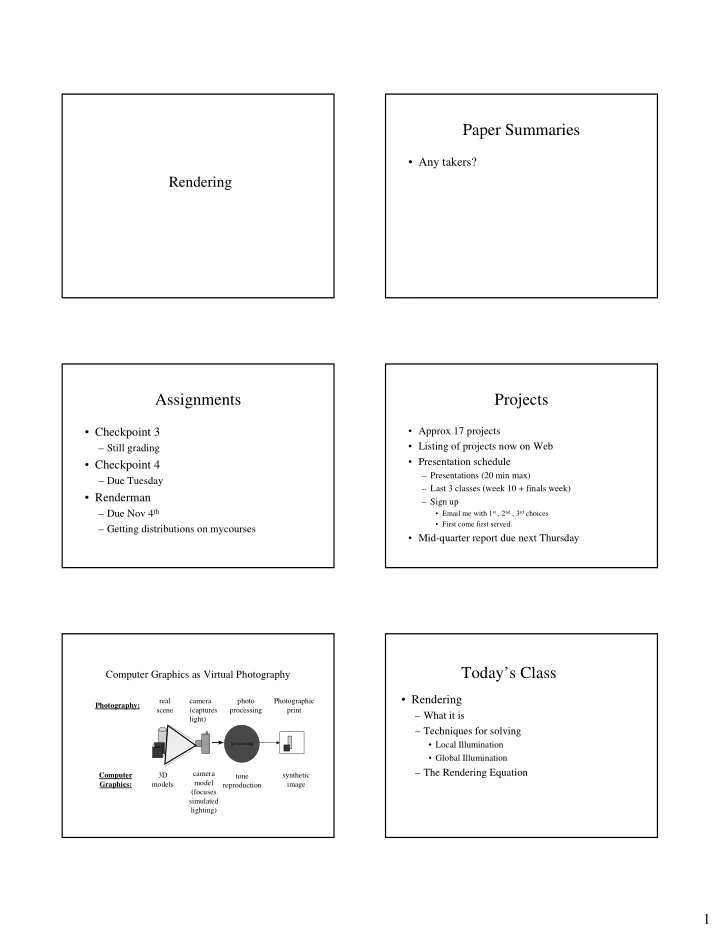
Paper Summaries Any takers? Rendering Assignments Projects - - PDF document

paper summaries
SMART_READER_LITE
LIVE PREVIEW

Paper Summaries Any takers? Rendering Assignments Projects - - PDF document

Paper Summaries Any takers? Rendering Assignments Projects Approx 17 projects Checkpoint 3 Listing of projects now on Web Still grading Presentation schedule Checkpoint 4 Presentations (20 min max) Due


slide-1
SLIDE 1

1 Rendering

Paper Summaries

  • Any takers?

Assignments

  • Checkpoint 3

– Still grading

  • Checkpoint 4

– Due Tuesday

  • Renderman

– Due Nov 4th – Getting distributions on mycourses

Projects

  • Approx 17 projects
  • Listing of projects now on Web
  • Presentation schedule

– Presentations (20 min max) – Last 3 classes (week 10 + finals week) – Sign up

  • Email me with 1st , 2nd , 3rd choices
  • First come first served.
  • Mid-quarter report due next Thursday

Computer Graphics as Virtual Photography

camera (captures light) synthetic image camera model (focuses simulated lighting)

processing

photo processing tone reproduction real scene 3D models Photography: Computer Graphics: Photographic print

Today’s Class

  • Rendering

– What it is – Techniques for solving

  • Local Illumination
  • Global Illumination

– The Rendering Equation

slide-2
SLIDE 2

2

Rendering

  • See Render

Render

  • (v.) To make visible the final result.
  • Aka Shading.

Shading

  • Computing the light that leaves a point
  • Shading point - point under investigation
  • Illumination model - function or algorithm

used to describe the reflective characteristics of a given surface.

  • Shading model – algorithm for using an

illumination model to determine the color of a point on a surface.

Shading Models

  • Illumination vs. Shading Models

– Each of the illumination models given last class could be applied by either a local or global shading algorithm – The illumination models are not global vs. local, the illumination algorithms are.

  • Shading models are examples of local illumination

algorithms.

Shading

  • Goal: Determine the color at each pixel

Rasterization

  • Visible Surface Determination

– Determine what is rendered where – Done in 2D camera space – Image precision vs object precision

  • Image Precision – determine for each pixel, which
  • bject is visible at the pixel
  • Object Precision – determine for each object, which

part of the object is potentially visible.

slide-3
SLIDE 3

3 Image Precision AFTER Projection

For each pixel in image { O = object that is closest draw pixel with appropriate color from O }

Object Precision – BEFORE projection

For each object in scene { determine which parts of object not obscured shade these parts }

Z-buffer

  • Visible surface algorithm to determine what
  • bject appears on a given pixel

– Image Precision Algorithm – Two frame buffers

  • One contains colors
  • One contains depth values (Z-buffer)

– Basic idea

  • Only calculate shading on object if depth is closer to

value at z-buffer

Z-buffer

  • Basic algorithm

Initialize frame buffer (to background) Initialize Z-buffer (to 0) For each polygon P { For each pixel p in polygon’s projection { z = P’s z at pixel p if (z > Zbuffer at that pixel) { zBuffer at pixel = z Frame buffer at pixel = calcColor() } }

Z-buffer

  • Applet

http://www.cs.technion.ac.il/%7Ecs234325/Homepage/A pplets/applets/zbuffer/GermanApplet.html

List Priority Algorithms

  • Object precision and image-precision

– Sort polygons by z – Rasterize each polygon in order – Problems:

  • Polygons must not overlap in z
  • If they do, they must be split
slide-4
SLIDE 4

4

Shading models

Interpolation

Scan line p1 p2 p3

Shading Models

  • Direct Shading Models

– Only consider direct lighting from light sources – Flat (constant) shading – Gouraud Shading – Phong Shading

Shading Models

  • Geometry

N H S V R

reflection viewer normal Half-way source

Phong Illumination Model

specular diffuse ambient

V) R ( N) S ( ) (

∑ ∑

  • +
  • +

=

i k i i s i i i d a a

e

L k L k L k V L

Note: Ln are radiance terms, include both light and material info

Shading Models

  • Flat Shading

– Illumination model applied once per polygon. – Constant color for entire polygon – Assumes normal vector is constant across the entire polygon

Shading Models

  • Flat shading

Hwang

slide-5
SLIDE 5

5

Shading Models

  • Gouraud Shading

– Illumination is interpolated across each polygon – Normals required at each polygon vertex, calculated as an average of the normals of each face that shares that vertex – Illumination is calculated for each polygon vertex – Interior points interpolated from endpoint illumination intensities

Shading Models

  • Gouraud Shading – finding the normal

Shading Model

  • Gouraud Shading

Hwang

Gouraud Rendering Pipeline with Z Buffer

Database traversal Model transform Culling Lighting Viewing transform Clipping Projection Rasterization Display

Shading Models

  • Phong Shading

– Normal vectors are interpolated across each polygon – Averaged normal (per Gouraud required at each polygon vertex) – Illumination is calculated for each polygon interior point by applying illumination model directly using interpolated normal

Shading Models

  • Phong Shading

Hwang

slide-6
SLIDE 6

6 Phong Rendering Pipeline with Z-Buffer

Database traversal Model transform Trivial Accept / Reject View transform Clipping Projection Rasterization and lighting Display

Shading models

  • Phong vs. Gouraud

Shading Models

– Comparison

Flat Gouraud Phong

To summarize

  • Rasterization

– Scan conversion / Interpolation in 2D – Z-buffer

  • Local Illumination models

– Only considers first reflection of light with object – No shadows (unless you add them)

  • Shading vs. Illumination Models

– A shading model can use any illumination model – Phong was a busy guy!

The Rendering Equation

  • Kajiya: 1986
  • “Unified context for viewing rendering

algorithms as more or less accurate approximations to the solution of a single equation”

  • Expresses the quantity of light

transferred from one point x’ to another x, summed over all points.

The Rendering Equation

  • General form

[ ]

′ ′ ′ ′ ′ ′ ′ ′ + ′ ′ = ′

S

x d x x I x x x x x x x g x x I ) , ( ) , , ( ) , ( ) , ( ) , ( ρ ε

Ashdown

slide-7
SLIDE 7

7

The Rendering Equation

  • Transport Intensity

I(x, x’) = Transport energy or intensity of light passing from point x’ to point x (unoccluded two point transport)

[ ]

′ ′ ′ ′ ′ ′ ′ ′ + ′ ′ = ′

S

x d x x I x x x x x x x g x x I ) , ( ) , , ( ) , ( ) , ( ) , ( ρ ε

The Rendering Equation

  • Geometry term

[ ]

′ ′ ′ ′ ′ ′ ′ ′ + ′ ′ = ′

S

x d x x I x x x x x x x g x x I ) , ( ) , , ( ) , ( ) , ( ) , ( ρ ε

g(x, x’) = geometry term = 0, if x is not visible from x’ = 1/d2 otherwise

The Rendering Equation

  • Emittance

[ ]

′ ′ ′ ′ ′ ′ ′ ′ + ′ ′ = ′

S

x d x x I x x x x x x x g x x I ) , ( ) , , ( ) , ( ) , ( ) , ( ρ ε

ε(x, x′) = light energy emitted from point x′ towards x.

The Rendering Equation

  • Scattering

[ ]

′ ′ ′ ′ ′ ′ ′ ′ + ′ ′ = ′

S

x d x x I x x x x x x x g x x I ) , ( ) , , ( ) , ( ) , ( ) , ( ρ ε

ρ(x, x′, x′′) = light energy reflected off point x’ towards point x from light coming from x′′

The Rendering Equation

ρ(x, x’, x’’) = light energy reflected from point x’ towards point x from light coming from x’’, i.e. BRDF

The Rendering Equation

  • Incoming = direct + indirect (scattered)

[ ]

′ ′ ′ ′ ′ ′ ′ ′ + ′ ′ = ′

S

x d x x I x x x x x x x g x x I ) , ( ) , , ( ) , ( ) , ( ) , ( ρ ε

indirect direct

) (I gR g I + = ε

slide-8
SLIDE 8

8

The Rendering Equation

  • In short…

– The transport of light from point x’ to point x is equal to the sum of

  • the light emitted from x’ in the direction of x and
  • the total light scattered from x’ towards x due to

light from all other surfaces in the scene.

The Rendering Equation The Rendering Equation

  • This can be expanded using the Neuman series for

implementation purposes:

… + + + + =

3 2

) ( ) ( ) ( Rg g Rg g Rg g g I ε ε ε ε

  • r

∞ =

= ) (

i i

Rg g I ε The Rendering Equation

  • Why is this important?

… + + + + =

scattering 3rd 3 scattering 2nd 2 scattering 1st direct

) ( ) ( ) ( Rg g Rg g Rg g g I ε ε ε ε

Rendering methods can be characterized by the number of scatterings considered

The Rendering Equation

  • Local vs Global Illumination Models

Local illumination - only considers direct component Global illumination - also considers other scattered component

… + + + + =

scattering 3rd 3 scattering 2nd 2 scattering 1st direct

) ( ) ( ) ( Rg g Rg g Rg g g I ε ε ε ε

The Rendering Equation

  • Local Illumination

direct

g I ε =

Only object’s first contact with light is considered. Lighting “simulated” by illumination model used. NOTE: Kajiya does not include ambient light!

slide-9
SLIDE 9

9

The Rendering Equation

  • Global Illumination

Considers multiple scatterings

  • Ray-Tracing
  • Radiosity
  • Kajiya’s method

… + + + + =

scattering 3rd 3 scattering 2nd 2 scattering 1st direct

) ( ) ( ) ( Rg g Rg g Rg g g I ε ε ε ε

The Rendering Equation

  • Drawbacks

– Uses geometric optics, based on light as rays – Phase, diffraction, and transmission through participatory media not considered (i.e., only homogenous refraction considered) – Dependence on wavelength is implied – Not expressed using physical units

  • Question: Isn’t I (x, x’) simply radiance at a point?
  • Yes! (with the exception of some geometric terms…)
  • More when we talk about radiosity

The Rendering Equation

  • Summary

– Equation for describing rendering algorithms. – Describes light arriving at a point from another point (and indirectly all other points) – Considers direct light and recursive scattering

Break

  • When we return…

– Ways of approximating the solution to the rendering equation… – Don’t touch that dial!

Rendering Methods

  • Ray Tracing

– Light rays are traced from the eye, through a viewing plane, into scene – When rays strike an object, further rays are spawned representing reflection and refraction. – These newly spawned rays can strike objects and spawn more rays, etc.

Rendering Methods

  • Ray Tracing

Watt/Watt

slide-10
SLIDE 10

10

Rendering Methods

  • Ray tracing

… + + + + =

scattering 3rd 3 scattering 2nd 2 scattering 1st direct

) ( ) ( ) ( Rg g Rg g Rg g g I ε ε ε ε

Number of scatterings depend

  • n recursion depth allowed by

ray tracer

Rendering Method

  • Ray Tracing – Examples
  • Cheesy Video (in case you missed it the first time)

Rendering Methods

  • Radiosity

– The problem with ray tracing

  • Great for specular type reflections
  • Awful for diffuse reflections.

– Radiosity

  • From the guys who brought you Cook-Torrance illumination

model!

  • Not quite as elegant as ray tracing
  • More physically based

Rendering Methods

  • Radiosity

– Based on the theory of heat transfer – Calculate lighting in a steady state – Assumes that all surfaces are perfectly diffuse – Formulates a large systems of linear equations – Solution of these equations give you radiant exitance at each point

Rendering Methods

  • Radiosity

– Radiant exitance - radiant flux out dA

dA d M Φ =

Rendering Methods

  • Radiosity

– Image is created by using calculated radiant existance values in standard rendering process.

  • In essence, radiosity defines a “made to fit” texture

mapping

slide-11
SLIDE 11

11

Rendering Methods

  • Radiosity

– View dependence vs view independence

  • Radiosity provides a view independent solution
  • Scene needs to be further rendered from a given

view point.

Rendering Methods

  • Radiosity

– Not points -- But patches

  • Scene is subdivided into patches
  • Radiant exitance will be calculated for each patch

Rendering Methods

  • Radiosity

– Patches

[Ashdown94]

Radiosity - Basics

  • Basic idea

– Each patch will receive a certain amount of light from the environment – It will reflect fraction back into the environment – Keep track of amount of light reflected back – Continue till all light has been exhasted.

Radiosity - Basics

  • Key idea

– Since all objects are perfectly diffuse, we can determine where light is coming from (and going) by simply considering the geometry of the scene. – Calculation of radiant exitance per patch is can be detemined mathematically using a closed form solution.

Rendering Methods

  • Radiosity

… + + + + =

scattering 3rd 3 scattering 2nd 2 scattering 1st direct

) ( ) ( ) ( Rg g Rg g Rg g g I ε ε ε ε

Mathematical derivation assumes limit as number of scatterings goes to Infinity

slide-12
SLIDE 12

12

Rendering Methods

  • Radiosity – Examples
  • Video

But does anyone use radiosity in practice

  • Glad you asked!

– Bunny (Blue Sky Studios)

Remember BRDFs?

Perfectly diffuse Radiosity Perfectly specular Ray tracing Specular & diffuse Reality

Rendering Methods

  • Getting closer to reality

– Ray tracing

  • Replace rays with cones/beams
  • Distributed ray tracing

– Spawn more rays – Stochastic sampling

  • Supplement backward ray tracing with forward ray

tracing (e.g. Photon Mapping)

Rendering Methods

  • Getting closer to reality

– Radiosity

  • Two path method – combine ray tracing and

radiosity

Rendering Methods

  • Kajiya’s solution (Path tracing)

– Much like ray tracing – Determine the path of light that eventually reaches the eye. – Only 1 ray spawned per intersection

  • Reflection in specular
  • Reflection in diffuse
  • Refraction

– Which ray to spawn determined via stochastic sampling.

slide-13
SLIDE 13

13

Kajiya’s Method Summary

  • Rendering equation

– Mathematical expression of rendering process

  • Solutions

– Ray Tracing – Radiosity – Combination of both.

  • Questions?

Next time

  • Recursive ray tracing…in depth