UMBC A B M A L T F O U M B C I M Y O R T 1 - - PowerPoint PPT Presentation

umbc
SMART_READER_LITE
LIVE PREVIEW

UMBC A B M A L T F O U M B C I M Y O R T 1 - - PowerPoint PPT Presentation

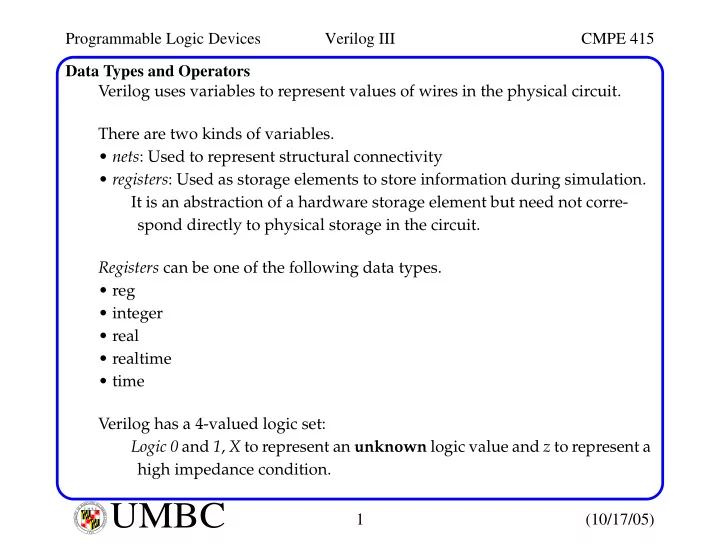
Programmable Logic Devices Verilog III CMPE 415 Data Types and Operators Verilog uses variables to represent values of wires in the physical circuit. There are two kinds of variables. nets : Used to represent structural connectivity


slide-1
SLIDE 1

Programmable Logic Devices Verilog III CMPE 415 1 (10/17/05)

UMBC

U M B C U N I V E R S I T Y O F M A R Y L A N D B A L T I M O R E C O U N T Y 1 9 6 6

Data Types and Operators Verilog uses variables to represent values of wires in the physical circuit. There are two kinds of variables.

  • nets: Used to represent structural connectivity
  • registers: Used as storage elements to store information during simulation.

It is an abstraction of a hardware storage element but need not corre- spond directly to physical storage in the circuit. Registers can be one of the following data types.

  • reg
  • integer
  • real
  • realtime
  • time

Verilog has a 4-valued logic set: Logic 0 and 1, X to represent an unknown logic value and z to represent a high impedance condition.

slide-2
SLIDE 2

Programmable Logic Devices Verilog III CMPE 415 2 (10/17/05)

UMBC

U M B C U N I V E R S I T Y O F M A R Y L A N D B A L T I M O R E C O U N T Y 1 9 6 6

Data Types and Operators The value x is used by the simulator to denote ambiguity -- cannot determine whether the value is 0 or 1. The value z is used when the driver of a net is disabled or disconnected. A truth table is used to define the mapping of inputs to outputs for each of these values. A B y 1 x z A B y

slide-3
SLIDE 3

Programmable Logic Devices Verilog III CMPE 415 3 (10/17/05)

UMBC

U M B C U N I V E R S I T Y O F M A R Y L A N D B A L T I M O R E C O U N T Y 1 9 6 6

Data Types and Operators Input values in Verilog can also have a strength associated with them. This allows pMOS and nMOS transistor (switch-level) modeling. For example, pseudo-xMOS includes "always-on" xMOS transistors that act as a weak pullup or pulldown resistor. These strengths allow the simulator to resolve the final logic value when contention exists. Data Types Data types are designed to allow structural connectivity and storage (reg) to be defined, and allow for procedural computation, (integer, etc). We listed the data types of registers earlier as reg, integer, real, time, real- time. All register variables are static variables, i.e., they maintain their assigned values during the entire simulation.

slide-4
SLIDE 4

Programmable Logic Devices Verilog III CMPE 415 4 (10/17/05)

UMBC

U M B C U N I V E R S I T Y O F M A R Y L A N D B A L T I M O R E C O U N T Y 1 9 6 6

Data Types and Operators A net may be assigned value only by a continuous assignment stmt or a force ... release procedural assignment. All structural connections are made with nets, and the different net types allow the code to accurately model the hardware.

  • wire defines connectivity with no logical behavior or functionality implied.
  • tri - same as wire except it will be tri-stated in hardware.
  • wand, wor -- a net with multiple drivers, which models hardware as a

"wired and" (open collector) or "wired or" (emitter coupled), respectively.

  • triand, trior -- same except the net can be tri-stated.
  • supply0, supply1 -- nets connected to the supply rails -- fixed value during

the entire simulation.

  • tri0, tri1 -- a net connected to ground/power by a resistive pulldown/pul-

lup connection and assumes a 0 or 1, respectively, if the driver is weaker.

  • trireg - a net that models the charge storage on a net. The amount of charge

stored determines the strength. Charge strengths include small, medium and large.

slide-5
SLIDE 5

Programmable Logic Devices Verilog III CMPE 415 5 (10/17/05)

UMBC

U M B C U N I V E R S I T Y O F M A R Y L A N D B A L T I M O R E C O U N T Y 1 9 6 6

Data Types and Operators Each variable in list_of_net_ids can be a scalar (default) or an array. delay3 allows the transport delay of the wire to be modeled. vectored can be used to indicate that the net is to be treated as a single object, i.e., the individual bits canNOT be referenced or assigned to. scalared is the default, which allows individual bits to be referenced. Values are assigned to nets through primitive outputs, continuous assign- ment stmts or through input/inout ports. Multiple drivers having the same strength cause the simulator to assign x. Initial value assignments are x (driven or reg types) and z for undriven nets. net_declaration ::= net_type [vectored | scalared] [range][delay3] list_of_net_ids; | trireg [vectored | scalared] [charge_strength] [range][delay3] list_of_net_ids; net_type [vectored | scalared] [drive_strength] [range][delay3] list_of_net_ids;

slide-6
SLIDE 6

Programmable Logic Devices Verilog III CMPE 415 6 (10/17/05)

UMBC

U M B C U N I V E R S I T Y O F M A R Y L A N D B A L T I M O R E C O U N T Y 1 9 6 6

Data Types and Operators Meaning of the register family of variables

  • reg - stores a logic value.
  • integer - supports computation
  • time - stores time as a 64-bit unsigned quantity
  • real - stores values (e.g., delay) as real numbers
  • realtime - stores time values as real numbers

reg (an abstraction of hardware storage element) can be assigned only within a procedural stmt, a user-defined sequential primitive, task or function. It cannot be the output of a primitive gate or target of a continuous assignment. The rules for using nets and registers in ports of modules and primitives: Note that registers cannot be declared to be input or inout port. Variable type input

  • utput

inout net YES

YES YES

register NO

YES NO

slide-7
SLIDE 7

Programmable Logic Devices Verilog III CMPE 415 7 (10/17/05)

UMBC

U M B C U N I V E R S I T Y O F M A R Y L A N D B A L T I M O R E C O U N T Y 1 9 6 6

Data Types and Operators Also, a register variable cannot be placed in an output port of a primitive gate, which is an implicit assignment. It cannot be the target (LHS) of a continuous assignment stmt, which is an explicit assignment. These rules result from the fact that a register variable may only be changed within a behavior, task or function within a module. Memory Declaration (two-dimensional arrays) Verilog provides an extension to the register variable declaration for this. For example, for 1024, 32-bit words: Note that bit-select and part-select are not valid with memories, only entire words can be addressed. To access bits, assign a word to a 32-bit register. reg_declaration ::= reg [range] register_name {, register_name}; register_name ::= register_identifier | memory_identifier [upper_limit : lower_limit] reg [31:0] cache_memory [0:1023];

slide-8
SLIDE 8

Programmable Logic Devices Verilog III CMPE 415 8 (10/17/05)

UMBC

U M B C U N I V E R S I T Y O F M A R Y L A N D B A L T I M O R E C O U N T Y 1 9 6 6

Data Types and Operators Verilog supports hierarchical de-referencing, which allows the use of a path name (separated by ’.’s) to access the variable. This is useful in test benches to access internal signals. Strings Verilog does not have a distinct data type for strings. Instead, a strings must be stored within a properly sized register by a procedural assignment stmt. Don’t forget, each character requires 8 bits. Assignments of shorter strings, e.g., "Hello World" to a 12 character array, will cause zeros to be assigned starting at the MSB. reg [8*num_char-1 : 0] string_holder;

slide-9
SLIDE 9

Programmable Logic Devices Verilog III CMPE 415 9 (10/17/05)

UMBC

U M B C U N I V E R S I T Y O F M A R Y L A N D B A L T I M O R E C O U N T Y 1 9 6 6

Operators Constants Declared using the keyword parameter. Operators (Arithmetic) Standard operators here include +, -, *, /,% (modulus) When arithmetic operations are performed on vectors, the result is deter- mined by modulo 2n arithmetic. Note that a negative value is stored in 2’s compliment format, but is interpreted as an unsigned value when used in an expression. For example, if A = 5 and B = 2, the result B-A yields 29 (11101) in a 5-bit register. The value is correct (-3), it’s just interpreted as a positive number. parameter byte_size = 8 // integer

slide-10
SLIDE 10

Programmable Logic Devices Verilog III CMPE 415 10 (10/17/05)

UMBC

U M B C U N I V E R S I T Y O F M A R Y L A N D B A L T I M O R E C O U N T Y 1 9 6 6

Operators Bitwise Operators Standard operations include ~, &, |, ^, ~^ (bitwise exclusive nor) If the operands do not have the same size (in the case of a binary opera- tion), the shorter word is extended with 0 padding. Reduction Operators These are unary operators which create a single bit value for a data word

  • f multiple bits.

For example, if y is 1011_0001, the reduction and operations produces &y = 0. Symbol Operator &, ~& reduction and, nand |, ~| reduction or, nor ^, ~^, ^~ reduction xor, xnor

slide-11
SLIDE 11

Programmable Logic Devices Verilog III CMPE 415 11 (10/17/05)

UMBC

U M B C U N I V E R S I T Y O F M A R Y L A N D B A L T I M O R E C O U N T Y 1 9 6 6

Operators Logical Operators Operate on Boolean operands. Operands may be a net, register or expression. Commonly used with the conditional assignment operator and in condi- tional, if stmts within behaviors, functions or tasks. For example, if ((a < size -1) && (b != c) && (index != last_one)) ... The case equality operators (===) determine whether 2 words match identically on a bit-by-bit basis, including bits that have values "x" and "z" Symbol Operator ! Logical negation &&, || Logical and, or ==, != Logical equality, inequality ===, !== Case equality, inequality

slide-12
SLIDE 12

Programmable Logic Devices Verilog III CMPE 415 12 (10/17/05)

UMBC

U M B C U N I V E R S I T Y O F M A R Y L A N D B A L T I M O R E C O U N T Y 1 9 6 6

Operators Logical Operators The logical equality operators (==) are less restrictive. They are used in expressions to test whether 2 words are identical but it produces an "x" result when the test is ambiguous. If any bit is unknown, the relation is unknown and the result is ambiguous ("x" value). Comparisons are made bit by bit and zeros are filled in as necessary. If the operands are nets or registers, their values are treated as unsigned words. If the operands are integers or reals, they may be signed but they are compared as if they are unsigned. Since Verilog is loosely typed, care should be taken here.

slide-13
SLIDE 13

Programmable Logic Devices Verilog III CMPE 415 13 (10/17/05)

UMBC

U M B C U N I V E R S I T Y O F M A R Y L A N D B A L T I M O R E C O U N T Y 1 9 6 6

Operators Logical Operators If A and B are scalers (1-bit variables), A && B and A & B return the same result. If they are vectors, A && B return true if both words are positive inte- gers. On the other hand, A & B returns true if the word formed from the bit- wise operation is a positive integer. For example, suppose A = 3’b110 and B = 3’b11x, then A && B is 0 (false) because B is false. However, A & B returns 110, which has a boolean value of true Relational Operators The operators compare operands and produce a Boolean result (true or false). If the operands are nets or registers, their values are treated as unsigned.

slide-14
SLIDE 14

Programmable Logic Devices Verilog III CMPE 415 14 (10/17/05)

UMBC

U M B C U N I V E R S I T Y O F M A R Y L A N D B A L T I M O R E C O U N T Y 1 9 6 6

Operators Relational Operators If any bit is unknown, the relation is unknown and the result returned is ambiguous, "x" value. Standard operators include <, <=, > and >=. Shift Operators Shift operators, >> and <<, are unary operators which perform left or right shifts, zero filling vacated positions. For example, if A = 1011_0011 then A << produces 0110_0110 and A << 3 produces 1001_1000. module shift; reg [1:0] start, result; initial begin start = 1; result = (start << 1); end endmodule Result is 102

slide-15
SLIDE 15

Programmable Logic Devices Verilog III CMPE 415 15 (10/17/05)

UMBC

U M B C U N I V E R S I T Y O F M A R Y L A N D B A L T I M O R E C O U N T Y 1 9 6 6

Operators Conditional Operator Same as C, if expression evaluates to Boolean true, then true_expression is evaluated, otherwise false_expression. For example, Y = (A == B) ? A : B; // Y gets A if A==B is true. wire [15:0] bus_a = drive_bus_a ? data ? 16’bz; Here, bus_a gets data if drive_bus_a is 1, all "z" if drive_bus_a is 0 and "x" if drive_bus_a is "x". Multiplexers can be easily implemented using nesting conditional_expression ::= expression ? true_expression: false_expression wire [1:0] select; wire [15:0] driver_1, driver_2, driver_3, driver_4; wire [15:0] bus_a = (select == 2’b00) ? driver_1 : (select == 2’b01) ? driver_2 : (select == 2’b10) ? driver_3 : (select == 2’b11) ? driver_4 : 16’bx;

slide-16
SLIDE 16

Programmable Logic Devices Verilog III CMPE 415 16 (10/17/05)

UMBC

U M B C U N I V E R S I T Y O F M A R Y L A N D B A L T I M O R E C O U N T Y 1 9 6 6

Operators Conditional Operator Additional rules:

  • Logic value "z" is not allowed in the expression.
  • Zeros are automatically filled if operands lengths are different.
  • If expression is ambiguous, then both true_expression and false_expression

are evaluated and the result is computed on a bitwise basis using: Concatenation Operator Forms a single operand from two or more operands, and is useful for forming logical buses. If A = 1011 and B = 0001, then {A, B} = 1011_0001. {4{a}} = {a, a, a, a} ? : 1 x

x x

1 x

1 x

x x

x x

slide-17
SLIDE 17

Programmable Logic Devices Verilog III CMPE 415 17 (10/17/05)

UMBC

U M B C U N I V E R S I T Y O F M A R Y L A N D B A L T I M O R E C O U N T Y 1 9 6 6

Operators Concatenation Operator No operand may be an unsigned constant, otherwise the compiler would not be able to size the result. Expressions and Operands Operands may be any of these alone or in combination

  • nets
  • registers
  • constants
  • numbers
  • bit-select of a net
  • bit-select of a register
  • part-select of a net
  • part-select of a register
  • memory element
  • a function call

The result may be used in an assignment to a net or register or to effect a choice among alternatives.

slide-18
SLIDE 18

Programmable Logic Devices Verilog III CMPE 415 18 (10/17/05)

UMBC

U M B C U N I V E R S I T Y O F M A R Y L A N D B A L T I M O R E C O U N T Y 1 9 6 6

Operators Operator Precedence Verilog evaluates expression left-to-right. Verilog also uses short-circuit evaluation of Boolean expression. Evaluation is terminated as soon as it is clear what the result will be. Use parentheses when precedence needs to be overridden. Precedence Operator Symbol highest Unary

+ - ! ~

Mult, Div, Modulus

* / %

Add, Sub

+ -

Shift

<< >>

Relational

< <= > >= == != === !==

Reduction/Logical

& ~&, ^ ^~, | ~| && ||

lowest Conditional

? :

slide-19
SLIDE 19

Programmable Logic Devices Verilog III CMPE 415 19 (10/17/05)

UMBC

U M B C U N I V E R S I T Y O F M A R Y L A N D B A L T I M O R E C O U N T Y 1 9 6 6

Operators Operator Precedence Do these produce different results? A < SIZE - 1 && B != C && INDEX != LASTONE (A < SIZE - 1) && (B != C) && (INDEX != LASTONE)