
9/12/2012 1
CS 1622: Syntax Analysis
Jonathan Misurda jmisurda@cs.pitt.edu
Parsing
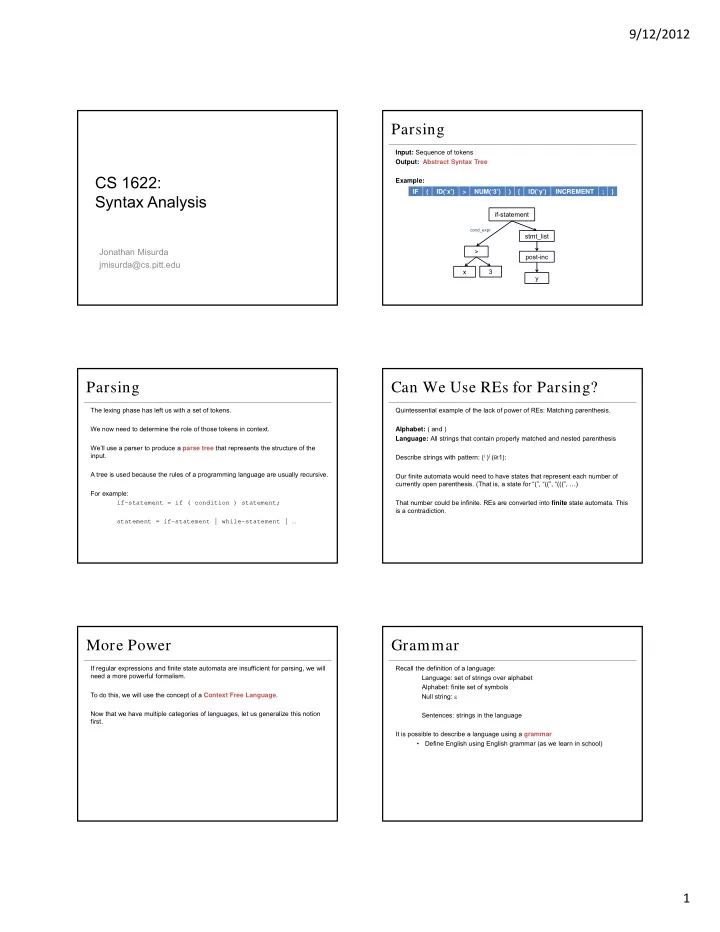
Input: Sequence of tokens Output: Abstract Syntax Tree Example: IF ( ID(‘x’) > NUM(‘3’) ) { ID(‘y’) INCREMENT ; } if-statement > x 3 stmt_list post-inc y
cond_expr
Parsing
The lexing phase has left us with a set of tokens. We now need to determine the role of those tokens in context. We’ll use a parser to produce a parse tree that represents the structure of the input. A tree is used because the rules of a programming language are usually recursive. For example: if-statement = if ( condition ) statement; statement = if-statement | while-statement | …
Can We Use REs for Parsing?
Quintessential example of the lack of power of REs: Matching parenthesis. Alphabet: ( and ) Language: All strings that contain properly matched and nested parenthesis Describe strings with pattern: (i )i (i≥1): Our finite automata would need to have states that represent each number of currently open parenthesis. (That is, a state for “(”, “((”, “(((”, …) That number could be infinite. REs are converted into finite state automata. This is a contradiction.
More Power
If regular expressions and finite state automata are insufficient for parsing, we will need a more powerful formalism. To do this, we will use the concept of a Context Free Language. Now that we have multiple categories of languages, let us generalize this notion first.
Grammar
Recall the definition of a language: Language: set of strings over alphabet Alphabet: finite set of symbols Null string: Sentences: strings in the language It is possible to describe a language using a grammar
- Define English using English grammar (as we learn in school)