Physics of Light and Color Its all electromagnetic (EM) radiation - - PDF document

physics of light and color
SMART_READER_LITE
LIVE PREVIEW

Physics of Light and Color Its all electromagnetic (EM) radiation - - PDF document

Physics of Light and Color Its all electromagnetic (EM) radiation Different colors correspond to different wavelengths Intensity of each wavelength specified by amplitude Frequency = 2 / long wavelength is low


slide-1
SLIDE 1

1

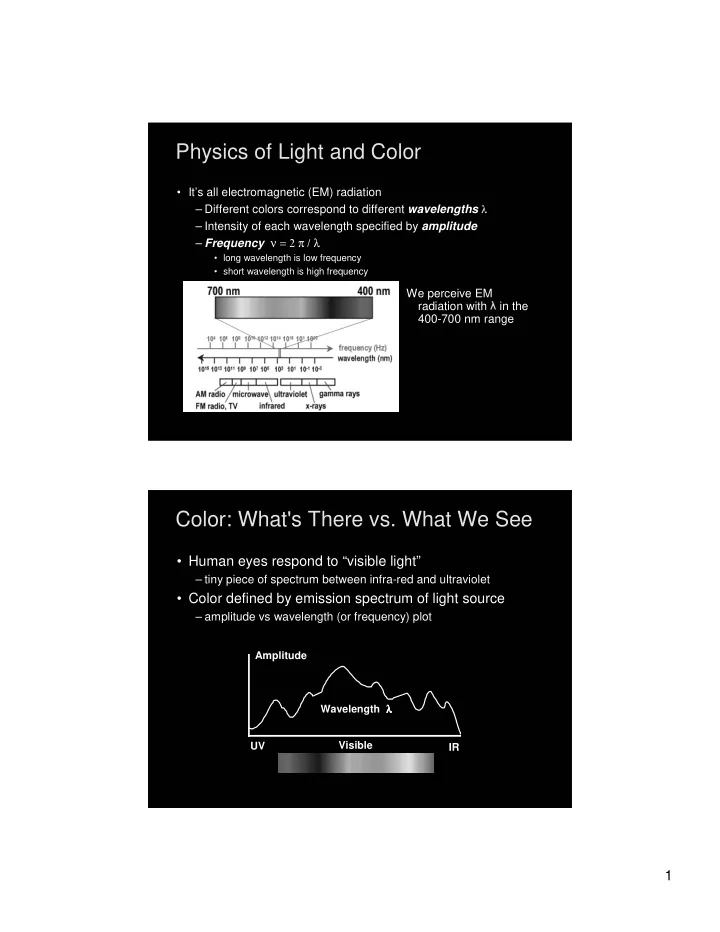
Physics of Light and Color

  • It’s all electromagnetic (EM) radiation

– Different colors correspond to different wavelengths λ – Intensity of each wavelength specified by amplitude – Frequency ν = 2 π / λ

  • long wavelength is low frequency
  • short wavelength is high frequency

We perceive EM radiation with

in the

400-700 nm range

Color: What's There vs. What We See

  • Human eyes respond to “visible light”

– tiny piece of spectrum between infra-red and ultraviolet

  • Color defined by emission spectrum of light source

– amplitude vs wavelength (or frequency) plot

UV IR Visible Wavelength λ λ λ λ Amplitude

slide-2
SLIDE 2

2

The Eye The Eye

  • The image is formed on the retina
  • Retina contains two types of cells: rods and cones
  • Cones measure color (red, green, blue)
  • Rods responsible for monochrome night-vision

The Fovea The Fovea

Cones are most densely packed within a region of the retina called the fovea

  • Three types of cones: S,M,L
  • Corresponds to 3 visual pigments
  • Roughly speaking:
  • S responds to blue
  • M responds to green
  • L responds to red
  • Note that these are not uniform
  • more sensitive to green than red
  • Colorblindness
  • deficiency of one cone/pigment type
slide-3
SLIDE 3

3

Color Filters Color Filters

  • Rods and cones can be thought of as filters

– Cones detect red, green or blue parts of spectrum – Rods detect average intensity across spectrum

  • To get the output of a filter

– Multiply its response curve by the spectrum, integrate over all wavelengths

  • A physical spectrum is a complex function of wavelength

– But what we see can be described by just 3 numbers—the color filter outputs – How can we encode a whole function with just 3 numbers?

  • A: we can’t! We can’t distinguish certain colors--metamers

B G R Wavelength Amplitude