SLIDE 1 Plan de presentation Collide Geneva – Arts At CERN 25 avril 2017
1- Introduction Good evening, I am Cassandre Poirier-Simon, an in- dependant interaction designer here in Geneva. Myth_n, Mythes Numeriques (digital myths in French) is a digital communication agency I foun- ded. Myth_n specialises in narrations and digital expe- riences, and I work with cultural and educational institutions, or businesses to help them tell their
- stories. I work in difgerent teams depending on the
project, write the story, construct the universes, or adapt clients’ stories to a digital experience. 2- Working thematic I am particularly interested in the shape stories can take. This shape is linked to our understanding
- f the world, of the world’s structure.
Where are the stories? They are, for example, in
- books. At the scale of the “book” object, the reading
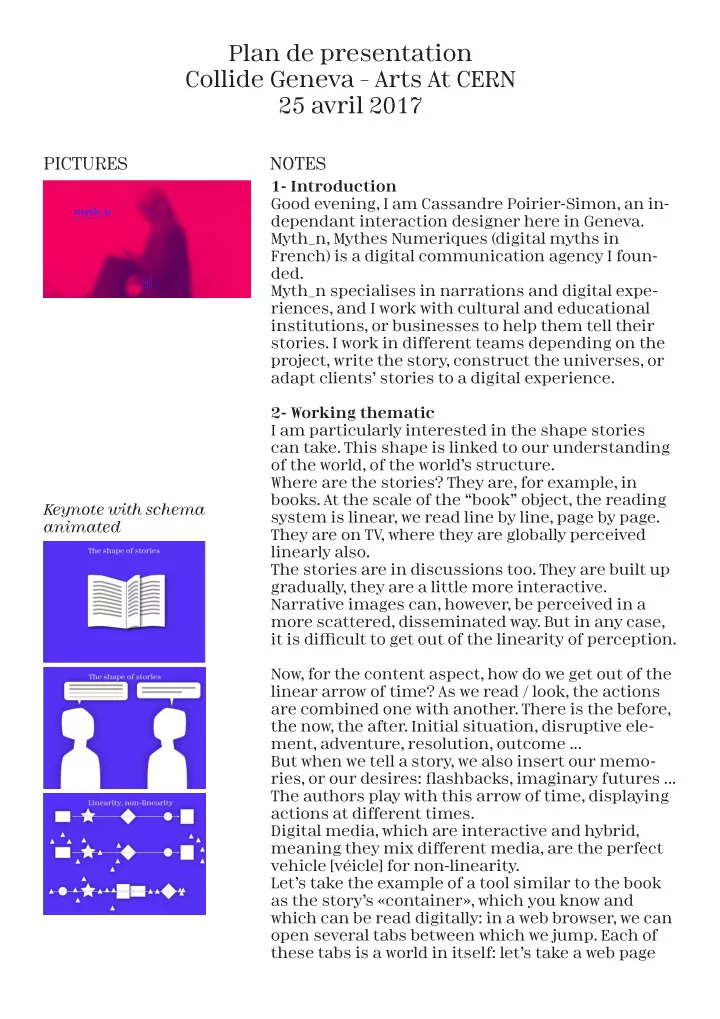
system is linear, we read line by line, page by page. They are on TV, where they are globally perceived linearly also. The stories are in discussions too. They are built up gradually, they are a little more interactive. Narrative images can, however, be perceived in a more scattered, disseminated way. But in any case, it is diffjcult to get out of the linearity of perception. Now, for the content aspect, how do we get out of the linear arrow of time? As we read / look, the actions are combined one with another. There is the before, the now, the afuer. Initial situation, disruptive ele- ment, adventure, resolution, outcome ... But when we tell a story, we also insert our memo- ries, or our desires: fmashbacks, imaginary futures ... The authors play with this arrow of time, displaying actions at difgerent times. Digital media, which are interactive and hybrid, meaning they mix difgerent media, are the perfect vehicle [véicle] for non-linearity. Let’s take the example of a tool similar to the book as the story’s «container», which you know and which can be read digitally: in a web browser, we can
- pen several tabs between which we jump. Each of
these tabs is a world in itself: let’s take a web page Keynote with schema animated
NOTES PICTURES
SLIDE 2 2000 pixels high for example, we will not read each item of text that is on it, we can also click on a link and be transported elsewhere before fjnishing ; This web page can also be viewed in 2mn if there is
- nly text, or in 20 if there is a video, or if text ele-
ments open between the lines, pop over, etc. The tablet has a relationship with the landscape, it is a framework on a larger space. In this, it has much more logical relation to the image than with the text. When I came to CERN, I wanted to have another ap- proach to the space-time structure. I wanted to ap- prehend his pace, to map stories into it. Something more fmuid and unexpected than the page afuer page
- r even tangible structure. We are in digital space.
What do we learn from the world and from human relationships if by stretching out the fjnger (faire le geste) we reach a parallel universe, or if our fjn- gertips have already disappeared in the number of years? If temporalities disintegrate? I will now illustrate my point in a peculiar way, through three projects of mine : luna’s earth, the road companion and wrist watch. It will be a little bit like an experiment, in Google Street View. You’ll then understand why. So let’s begin with a book, but a digital one. 3- Three projects La Terre de Luna We start our journey in China, where the fjrst book
- f Luna’s Earth takes place.
Luna and her grandfather are travelling around the world in scientifjc expeditions, inspired by expedi- tions that really occurred. The fjrst is set in China where the grandfather goes on an expedition to see the last remaining river dolphins on the Yangsé, that’s why we are here near this river. Luna’s Earth is a saga for teenagers about the envi- ronment published in paper and digital formats. The app show Luna’s universe through a series of continents, each representing a volume of the se- ries and reproducing the country where the story takes place. The difgerent chapters are located on the map of the continent, so when reading one of the books, the user zooms into the corresponding continent and can follow Luna’s adventures. So the structure shown of this story is linear but seen from above. We advance zone by zone, and we don’t see the micro-shifuings. Demo in Google Street View + drawing on Google Maps
SLIDE 3
Le compagnon de route We are in a little road in Drôme, where I grew up. Le compagnon de route (The road companion) is a story to be read [red] online, and it is not a road mo- vie but a road story. You just need to print a windshield in paper and to glue it on your computer screen to transform it into a car. Then you can navigate into the story with the arrows on your keyboard. There is a crossroads, and you choose which way you want to drive. Like in a video game, we’ll go on the roads, with the driver and his companion, to pick up fmowers, like little treasures. The fact of choosing paths will not allow us to change the story, but more to unders- tand difgerently the relationship between the two people in the car, depending on the information we’ll get. This web project has been exhibited the fjrst time as a website in the National Library of France in 2015 during a conference about digital literature, and the second time it has been exhibited here, in the Contemporary Arts Center as an installation. This story is the literal representation of what a hy- perfjction is. You know, the Choose Your Own Adven- ture Books? This is the same structure, with branch lines. Wrist Watch Tissot wanted a display to show their T-Touch digi- tal watches. The one I proposed and was exhibited at Baselworld in 2012, consisted of a series of four terminals, arranged like quartz, open to the public. Visitors were encouraged to put their hand in each terminal as a mimic of the gesture of looking at their watch. By inserting their hand in the terminal visitors triggered the appearance of a miniature world that clung around the wrist. The world is reduced to a sphere. We trigger the sto- ries and we watch them interacting together. 4- The residency So, as you know, I have been awarded the Arts At CERN award for digital literature and spent three months as an artist in-residence at CERN. When I came here, my fjrst idea was, in short, to de-velop a digital book that translates physicists’ understanding of time and space to both its story and navigation system. For example, a book that is in perpetual expansion: (we begin from a little room, then other rooms and characters appear, etc.) It could be also a book that contains no pages, but another form of basic structure. So what would be the elementary element of a book? The page, the
SLIDE 4 word, the letter, the ink, the sounds, the meaning, the ideas? It could also be a story where sometimes you can follow an event lasting one second then an event lasting a thousand years, and where you can zoom in and out of space and time. Once upon a time there was a princess…then she dies. You can follow during several paragraphs the water in a glass warmed by the sun, then in one line, an entire dy[ï]nasty has gone extinct! The residency was about meeting people, speaking, and exploring the expe[i]riences. At the beginning, I thought it would have been diffjcult to come to CERN for nearly three months without producing any- thing from what I was learning. Fortunately, I was asked to run a blog. So I was able to react to some of the inputs. Soon came the idea of doing something at CERN, fjrst to have an exchan[é]ge and propose something
- f my own to them, and secondly to have a lon-
ger discussion with scientists as a brainstorming around a precise subject. That’s why a writing workshop came to my mind, to pick up impres- sions, ideas, and space-time representations from the scientists. I also wanted to propose my vision of writing, which is writing for a specifjc context and, a specifjc device. You are not writing only text. There is also a reading experience. But what tool could I furnish? I then began to explore the CERN. The spaces there were like theaters for me. (It is important to know also that my father is an actor, and when I spent holidays with him, it was in a theatre during his re-
- hearsals. So I explored thea[ae]ters a lot.)
Then Claire Adam Bourdarios, a physicist working at ATLAS, told me that the Google Street Car spent time in CERN, photographing the places. I began wonde- ring what it would be like to tell stories or create visits in this space. I met Jean- Yves Le Meur to gain more input on the Invenio Sofuware that runs the Cern Document Server and that interests me be- cause all the grey literature of the CERN is there. He told me that there was an API, and also a lot of archive pictures of the CERN. So they could really be injected in Google Street View. I spoke also with Maximilien Brice, who took care of the Google Car team in CERN, and explained to me how they did it and how the project developed further: a similar tool has been included in the GIS portal, which is the CERN internal cartographic system.
SLIDE 5 But the more usable tool in the short term was Goo- gle Street View, because it has an API ready and the public can see it while the GIS is restricted to people inside CERN. 5- The workshop I am more accustomed to longer workshops, but here, the 2 times 3 hours’ duration that I wanted to propose was too much commitment, so I reduced this to 2 hours. There were twelve participants, and they worked in 3-people teams. I proposed that they use Google Street View as a playground where they’ll place their stories. Since we didn’t have much time, I asked them to jump on the fjrst idea they had. I will now present you the four projects : 1 - Past building blocks of the future I will read the team’s presentation note composed by Tamara Vasquez Shroeder, Mélissa Gaillard and Nicole Cremel “The physics that can be done nowadays at CERN is only conceivable thanks to the gigantic break- throughs that previous scientists have made in the understanding of nature. CERN celebrates the work from our predecessors, naming various streets inside of CERN afuer scientists that have lefu their impact in the history of particle physics. With this project based on Google Maps inspired by Cassandre Poirier-Simon, the virtual visitor is guided from Entrance B to Restaurant 1 (the usual meeting point for physicists to discuss over cofgee) meeting the outstanding personalities from the past that are remembered by the street names, from difgerent times and difgerent places, all re- lated to particle physics as in a multi-dimensional puzzle. ” 2 - Future visitors for a contemporary visit Jeremi Niedziela, Natalia Karina Juszka, Steven gold- farb and Maria Dimou’s idea was to create a visit
- f the CERN in 2017, by visitors from the future.
So they wrote a dialogue between “us” (the physi- cists from the future) and “them” (CERN workers from 2017). We learn a lot of interesting things, for example that they fjnished with particle physics around 2165 (twenty one sixty-fjve) and that ALICE discovered via their research in the gluon plasma the explanation of dark matter and dark energy. This is called the “white rabbit discovery” , that al- lows for reaching places through teleportation (into the rabbit holes).
SLIDE 6 3 - Street View Game I’ll read the presentation note by Heather Gray, Kitti Lai and Hannah Short : “Our fjnal idea was to collect pieces around CERN which lead us to a Physics theme. The idea behind it is to have an interactive and en- tertaining approach to capture interests. To do that, we collected our ideas together and added maps with clues on these places:
- a. Starting point from the Globe with clues of CERN.
- b. Clues for cofgees in R1
- c. Clues to fjnd the biggest detector? (ATLAS)
- d. Clues to fjnd the bubble chamber in S’Cool LAB /
Microcosm graveyard. (Right outside)
- e. Clues to fjnd the fjrst proton accelerator? (Proton
Synchrotron) –> this is the fjnal part where fjnders teleport to the CMS experiments control room in Cessy, Point 5. ” In this video, we see a rapid demo of their work. 4 - The Early Days Finally, the last team, represented by Maria Alandes Pradillo, Gavin Salam and Yuri Tanaka, focused
- n the localisation of timelines in space, as a real
space-time entanglement. I read their text : «Our idea was to represent in Google street view the difgerent timelines that appear in the CERN web. We started with the accelerator timeline. Our idea was to have a picture of the director general at the time at CERN next to the relevant building, where the information would be presented. ” It may be a direct answer to a question I asked at the beginning: how can we build a map by integra- ting the notion of time? It was a very short but interesting workshop, and I’m glad to have received positive feedback from the
- participants. For the moment, what we have done
is really embryonic, but I am sure we can create a much more developed tool in Google Street View, for
- utreach, but also for real poetry and stories in it.
The equations To fjnish, and at the same time continue with the idea of opening spaces like accordions and conduct research on the various media that could possibly tell stories, I was very interested in the system of writing equations. Indeed, they are not read linear-
- ly. So I will therefore continue to study how they are
structured, perhaps to be inspired for other forms
- f narrative structures. I even found a «choose your
SLIDE 7
- wn lesson book» around the equations, by chance,
in the CERN library! Let me now present Maria Dimou: she was one the workshop participants, but she was also from the
- ther side : I had the chance to have her as my
scientifjc partner, and she helped me a lot to orga- nize the workshop and to meet the people I wanted to speak with. We saw each other every week of my
- residency. She has been working for many years
- n the Worldwide LHC Computing Grid, and at the
beginning I was also interested by the near “data deluge” and all the consequences it would imply. She also helped evangelize this crazy thing that is the volunteer computing, via short technical videos in her IT e-learning project, but she will tell you more about all of this.