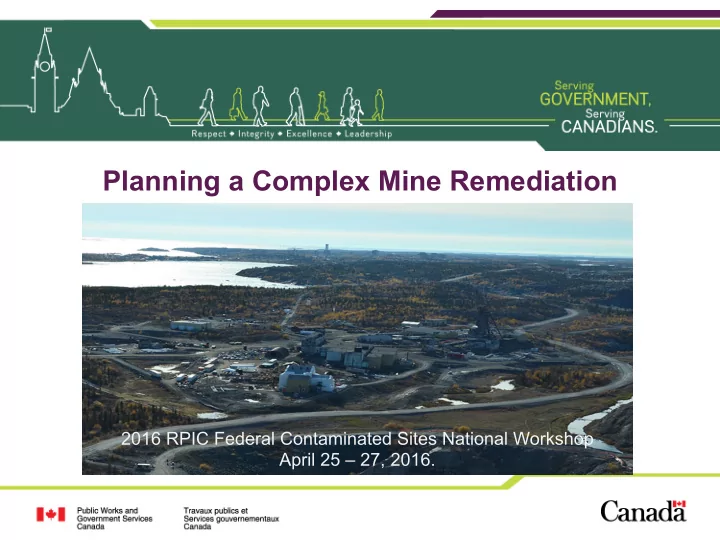
Planning a Complex Mine Remediation 2016 RPIC Federal Contaminated - - PowerPoint PPT Presentation

planning a complex mine remediation
SMART_READER_LITE
LIVE PREVIEW

Planning a Complex Mine Remediation 2016 RPIC Federal Contaminated - - PowerPoint PPT Presentation

Planning a Complex Mine Remediation 2016 RPIC Federal Contaminated Sites National Workshop April 25 27, 2016. Objective Discuss Giant Mine Remediation Projects unique complexities Giant Mine Background History Jurisdictions


slide-1
SLIDE 1

Planning a Complex Mine Remediation

2016 RPIC Federal Contaminated Sites National Workshop April 25 – 27, 2016.

slide-2
SLIDE 2

Objective

  • Giant Mine Background

– History – Jurisdictions

  • Planning the Remediation

– Site management & risk mitigation during planning – Overview of remediation components – Design interdependencies – Contracting

Discuss Giant Mine Remediation Project’s unique complexities

slide-3
SLIDE 3

History of Giant Mine

  • Giant Mine operated

1948 to 1999

  • Many owners
  • Royal Oak Mines Inc.

declared bankruptcy in 1999

  • 846-hectare property in

custody of Indigenous and Northern Affairs Canada (INAC)

slide-4
SLIDE 4

Jurisdictions

  • Government of

Canada

  • Government of the

Northwest Territories

  • City of Yellowknife
  • First Nations and

Métis land claims

  • Others
slide-5
SLIDE 5

Site Management & Risk Mitigation During Planning

  • Care and Maintenance

– Water management and treatment – Inspection and maintenance of underground infrastructure(i.e. arsenic bulkheads) – Dust suppression – Site security

  • Urgent Risk Mitigation

– 2006 Baker Creek realignment – 2011 JoJo Lake Tailings Cap construction – 2013-15 Roaster Complex deconstruction – 2015 C1 Pit buttress construction – 2014 & 2015 underground stope backfilling – 2015 C-Shaft had frame deconstruction

slide-6
SLIDE 6

Overview of Remediation Components

  • Infrastructure

Deconstruction and Disposal

  • Surface Water

Management

  • Tailings Rehabilitation
  • Openings to Surface
  • Contaminated Soil
  • Open Pits
  • Borrow/Quarry

Development

  • Underground Stabilization
  • Freeze Program
  • Baker Creek Realignment
  • New Effluent Treatment Plant
  • Common Site Infrastructure
slide-7
SLIDE 7

On-site waste streams:

  • 60,000 m3 non-hazardous building

waste

  • 16,000 m3 arsenic trioxide waste
  • 7,000 m3 hazardous (non-arsenic)

waste

Waste Disposal:

  • Non-hazardous waste – on-site

landfill or recycled

  • Arsenic trioxide waste –

underground within the freeze zone

  • Hazardous Waste – off-site at

licensed facility

Infrastructure Deconstruction and Disposal

slide-8
SLIDE 8

Surface Water Management

  • Construction of

drainage channels, storage ponds and spillways to direct surface water into Baker Creek

  • Baker Creek

discharge must meet site specific water quality

  • bjectives
slide-9
SLIDE 9
  • 95 hectares of

tailings: variable depth; quality

  • Tailings cap

requirements: informed by engagement process

  • Graded to promote

drainage of clean surface water

Tailings Rehabilitation

South Pond Central Pond North Pond Northwest Pond

slide-10
SLIDE 10
  • 37 mine openings

to surface

  • Adits, raises, shaft,

portals, stope breakthroughs

  • Capping achieved

by engineered concrete caps or rock fill

Openings to Surface

slide-11
SLIDE 11
  • Arsenic contaminated

material: 900,000 m3 ; waste rock; disturbed soils

  • Petroleum hydrocarbon-

contaminated soil: 3000 m3

Contaminated Soil

slide-12
SLIDE 12

Open Pits

  • Eight open pits
  • B1 Pit will be backfilled

to support freeze solution

  • Open pit closure

remediation under discussion after EA Report

slide-13
SLIDE 13
  • Borrow material needed

for contaminated soil cover, tailings cap, and landfill cover

  • Estimated fine-grained

soil needed: 950,000 m3

  • Estimated coarse-

grained needed: 1,150,000 m3

Borrow/Quarry Development

slide-14
SLIDE 14
  • Objectives:

─ Maintain ground surface ─ Maintain Baker Creek ─ Ensure stability around arsenic trioxide stopes and chambers

  • Backfilling near surface stopes,

voids: 400,000 m3

  • Investigations on-going;

confirming scope of stabilization activities

  • Stabilization requirements highly

dependent on final mine water level

Underground Stabilization

slide-15
SLIDE 15
  • Four freeze areas for

13 arsenic containing stopes and chambers

  • 60,000 m of drilling to

support thermosyphon installation

  • Freeze Optimization

Study (FOS) built in 2010 to better define design parameters

Freeze Program

slide-16
SLIDE 16

Arsenic trioxide storage areas to freeze

slide-17
SLIDE 17

Yellowknife office building vs. frozen chamber

slide-18
SLIDE 18
  • Poor hydraulic capacity; high

seasonal flow variability

  • Fish habitat
  • Historic tailings and

contaminated sediments

  • Potential risk of flooding

underground workings

  • Realignment being reviewed

after EA Report

Baker Creek Realignment

slide-19
SLIDE 19

New Effluent Treatment Plant

  • Arsenic removed by iron co-

precipitation and adsorptive technology; meets Canadian Drinking Water Quality guidelines

  • Year-round operation; near-

shore outfall into Yellowknife Bay

  • Replaces existing seasonal

plant treating to Metal Mining Effluent Regulations

slide-20
SLIDE 20

Giant Mine Remediation Plan

N N

2 2 2 2 2 3 3 1 1 1 1 3 3 2 2 2 2 4

4

#1 > Chamber Freezing & U/G Works #2 > Pits, Baker Creek & Tailings Covers #3 > Infrastructure Deconstruction #4 > Long Term Water Treatment

2002 Air Photograph

slide-21
SLIDE 21

Interdependent Remediation Components

Baker Creek Open Pit Closure Freeze Program Surface Water Drainage

slide-22
SLIDE 22

Interdependent Remediation Components

Tailings Rehabilitation Effluent Treatment Surface Water Drainage Borrow Requirements Contaminated Surface Material Underground Stabilization

slide-23
SLIDE 23

Interdependent Remediation Components

Effluent Treatment Tailings Rehabilitation Open Pit Closure As2O3 Waste Disposal Underground Stabilization

slide-24
SLIDE 24

Government of Canada Contracting Priorities

  • Open, fair, transparent procurement
  • Establish a clear understanding of the government procurement

process;

  • Maximize competition and obtain value for money;
  • Consult with Industry to solicit ideas and recommendations for

consideration in the development of specific procurement strategies;

  • Assess market capacity; and
  • Maximize aboriginal participation in accordance with Land Claim
  • bligations

2 4

slide-25
SLIDE 25

Questions?

Planning a Complex Mine Remediation