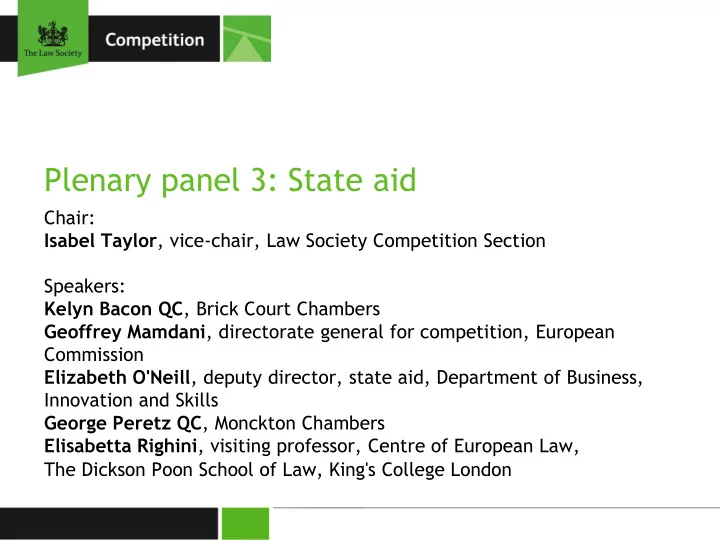
Plenary panel 3: State aid Chair: Isabel Taylor , vice-chair, Law - - PowerPoint PPT Presentation

plenary panel 3 state aid
SMART_READER_LITE
LIVE PREVIEW

Plenary panel 3: State aid Chair: Isabel Taylor , vice-chair, Law - - PowerPoint PPT Presentation

Plenary panel 3: State aid Chair: Isabel Taylor , vice-chair, Law Society Competition Section Speakers: Kelyn Bacon QC , Brick Court Chambers Geoffrey Mamdani , directorate general for competition, European Commission Elizabeth O'Neill , deputy


slide-1
SLIDE 1

Plenary panel 3: State aid

Chair: Isabel Taylor, vice-chair, Law Society Competition Section Speakers: Kelyn Bacon QC, Brick Court Chambers Geoffrey Mamdani, directorate general for competition, European Commission Elizabeth O'Neill, deputy director, state aid, Department of Business, Innovation and Skills George Peretz QC, Monckton Chambers Elisabetta Righini, visiting professor, Centre of European Law, The Dickson Poon School of Law, King's College London

slide-2
SLIDE 2

State Aid Modernisation in practice: what has changed?

Geoffrey Mamdani DG Competition

London, 13 May 2015

Any opinions expressed are personal and do not necessarily reflect the views of the Commission

slide-3
SLIDE 3

A lot!

  • 4 regulations
  • Enabling regulation, procedural regulation, de

minimis regulation, general block exemption regulation (GBER)

  • 10 sets of guidelines
  • Broadband, regional aid, short-term export credit,

cinema, risk finance, aviation, energy and environment, R&D&I, IPCEI, rescue and restructuring

  • 2 other documents
  • Transparency, evaluation
slide-4
SLIDE 4

What is "modernisation"?

  • Self assessment and decentralisation?
  • SAM is not the younger brother of antitrust

modernisation, but its cousin:

  • Not self assessment, but more block exemption
  • Not decentralisation, but greater responsibility of

Member States

  • Procedural streamlining
  • Plus, alignment of compatibility rules to broader EU

priorities

slide-5
SLIDE 5

Priorities of SAM

  • Communication on State Aid Modernisation, 8

May 2012:

  • Foster sustainable, smart and inclusive growth in a

competitive internal market;

  • Focus Commission ex ante scrutiny on cases with

the biggest impact on internal market whilst strengthening the Member States cooperation in State aid enforcement;

  • Streamline the rules and provide for faster

decisions

slide-6
SLIDE 6

SAM in practice

  • Extended scope of General Block Exemption

Regulation (GBER)

  • Guidelines aligned to common principles
  • Better procedures
  • Transparency and evaluation
slide-7
SLIDE 7

Extended scope of GBER

Exemption areas GBER extension (new types and categories) GBER extension (notification and intensity threshold) GBER extension De minimis Type of aid

(aid amount)

  • Notified aid
  • Block-exempted
  • De minimis
slide-8
SLIDE 8

Extended scope of GBER: impact

slide-9
SLIDE 9

Common principles

  • Contribution to a well-defined objective of

common interest

  • Need for State intervention
  • Appropriateness of the aid measure
  • Incentive effect
  • Proportionality of the aid
  • Avoidance of undue negative effects on

competition and trade between Member States

  • Transparency of aid
slide-10
SLIDE 10

Better procedures

  • Changes to the procedural regulation
  • More efficient handling of complaints
  • Better scope to obtain information (eg sector

inquiries).

  • Further work with Member States on improving

cooperation

slide-11
SLIDE 11

Transparency and evaluation

  • Transparency: publication online of state aid

grants above EUR 500 000 from 1 July 2016

  • Evaluation: GBER aid schemes in certain fields

with annual budget over EUR 150 million and schemes under guidelines that are large or novel

  • r where significant changes are expected:
  • Has the aid achieved its purpose?
  • Has the aid led to unforeseen negative effects?
slide-12
SLIDE 12

Conclusions

  • Aim of SAM is a faster, more rational, more

proportionate system

  • Major changes have been made, but the key will

be implementation in practice, in close cooperation with Member States

  • For full references, see SAM website:

http://ec.europa.eu/competition/state_aid/moder nisation/index_en.html

slide-13
SLIDE 13

State aid modernisation in practice: what has changed?

Geoffrey Mamdani DG Competition

London, 13 May 2015

slide-14
SLIDE 14

State aid modernisation

Elizabeth O’Neill BIS Legal

slide-15
SLIDE 15

Why does effective state aid regulation matter?

  • State aid rules bite on state expenditure in

key sectors – transport, infrastructure, R&D, energy, services in the general economic interest

  • This expenditure is legitimate and an

appropriate facet of effective public policy

  • The tax payer – and Ministers - expect swift

and effective state action.

slide-16
SLIDE 16

What were the key problems?

  • Slow system
  • Sometimes opaque rules – and therefore lack of

legal certainty

  • Limited ability of the Commission to

investigate/obtain independent information

  • Some criticism on extent the economic analysis

underpinning Commission reasoning

slide-17
SLIDE 17

Procedural changes

  • More levers enabling the state to act swiftly

without Commission pre-approval (risk finance, GEBR)

  • Excellent that the Commission has the

means to compel production of independent market information(MIT)

  • Yet to see an improvement in case-handling

speed

slide-18
SLIDE 18

Substantive changes

  • More critical analytical /economic approach in

the revised guidelines and in practice – e.g. enhanced emphasis on incentive effective effect

  • More versatile rules allow lighter touch better

honed instruments of intervention

  • Proposed communication on the Notion of aid

brings more clarity on the application of the rules –including gauging what is standard commercial activity by the state

slide-19
SLIDE 19

Evaluation and monitoring

  • Understanding the impact of past measures on the

market assists in establishing effectiveness and proportionality of aid

  • Monitoring and good housekeeping are important,

and Member States have a role to play

  • However– beyond a duty of loyal cooperation -

the Member States do not have the Commission’s role (or powers) under the Treaty with respect to state aid

slide-20
SLIDE 20

State aid modernisation

Elizabeth O’Neill BIS Legal

slide-21
SLIDE 21

State aid and Tax – the tax ruling cases and Santander

Law Society Competition Section conference 13.5.2015

George Peretz QC Monckton Chambers

www.monckton.com +44 (0)20 7405 7211

slide-22
SLIDE 22

www.monckton.com +44 (0)20 7405 7211

The investigations

slide-23
SLIDE 23
  • Duration of ruling
  • Why was TNMM adopted?
  • Understatement of cost base
  • Profit-dependent royalty structures
  • Lack of due diligence by tax authority
  • “Smoking gun”

www.monckton.com +44 (0)20 7405 7211

Issues

slide-24
SLIDE 24

www.monckton.com +44 (0)20 7405 7211

Spot the difference

slide-25
SLIDE 25

www.monckton.com +44 (0)20 7405 7211

Case T-399/11 Santander Which is it?

slide-26
SLIDE 26

George Peretz QC Monckton Chambers

gperetz@monckton.com

slide-27
SLIDE 27

State aid and taxation –

the Aer Lingus and Ryanair cases

Law Society Competition Section Annual Conference, 13 May 2015

Kelyn Bacon QC

brickcourt.co.uk +44 (0)20 7379 3550

slide-28
SLIDE 28

brickcourt.co.uk +44 (0)20 7379 3550

Case T-473/12 Aer Lingus and Case T-500/12 Ryanair

slide-29
SLIDE 29

brickcourt.co.uk +44 (0)20 7379 3550

Key issues in the cases

Determination of the ‘normal’ reference rate of tax Right to reimbursement of the higher rate, rather than recovery against beneficiaries of the lower rate (Boiron) Passing on to end-consumers  quantification of aid to be recovered

slide-30
SLIDE 30

brickcourt.co.uk +44 (0)20 7379 3550

The Irish air travel tax 2009–2011

€2 per passenger for flights to destinations  300 km from Dublin airport €10 per passenger for all

  • ther flights
slide-31
SLIDE 31

brickcourt.co.uk +44 (0)20 7379 3550

Commission investigations

  • Investigation by DG MOVE  letter of formal notice to Irish

authorities, considering tax to be breach of Regulation 1008/2008 and Article 56 TFEU Irish authorities introduced single rate of €3 per passenger from March 2011

  • Investigation by DG COMP under Article 107(1) TFEU in

respect of period of differential tax Unlawful State aid,

  • rdered recovery of €8

per passenger differential

slide-32
SLIDE 32

brickcourt.co.uk +44 (0)20 7379 3550

Be careful what you wish for ...

slide-33
SLIDE 33

brickcourt.co.uk +44 (0)20 7379 3550

Arguments in General Court

  • Incorrect characterisation of lower rate as State aid, given that

higher rate was unlawful (Ground 1a)

  • Incorrect characterisation of lower rate as State aid, in light of

Boiron right to reimbursement (Grounds 1b and 2)

  • Unlawfulness of recovery order, when higher rate liable to be

repaid (Ground 2)

  • Failure to take account of passing on of tax to passengers

(Grounds 3 and 4)

  • Reasons challenge (Ground 5)
slide-34
SLIDE 34

brickcourt.co.uk +44 (0)20 7379 3550

Arguments in General Court

  • Incorrect characterisation of lower rate as State aid, given that

higher rate was unlawful (Ground 1a)  rejected

  • Incorrect characterisation of lower rate as State aid, in light of

Boiron right to reimbursement (Grounds 1b and 2)  rejected

  • Unlawfulness of recovery order, when higher rate liable to be

repaid (Ground 2) not decided

  • Failure to take account of passing on of tax to passengers

(Grounds 3 and 4)  upheld

  • Reasons challenge (Ground 5)  rejected
slide-35
SLIDE 35

brickcourt.co.uk +44 (0)20 7379 3550

Ground 1a: unlawfulness of higher rate

Common difficulty in differential tax cases: what is the ‘normal’ or reference rate?

  • Central argument: since it was a breach of Regulation

1008/2008 and Article 56 TFEU for flights of >300 km to be subject to a higher passenger tax, higher rate could not properly be described as the ‘normal’ reference rate  lower rate not State aid.

  • Rejected on basis that higher rate not in itself unlawful.

Rather, unlawfulness arose from differentiation, which could be remedied in different ways (e.g. the uniform €3 rate from March 2011).

slide-36
SLIDE 36

brickcourt.co.uk +44 (0)20 7379 3550

Ground 1b: Boiron analogy

Another common differential tax question: can the aid be remedied by reimbursing the higher rate taxpayers?

  • Argument: since Commission acknowledged that higher and

lower rates inseparable, higher rate liable to be reimbursed pursuant to Boiron and therefore cannot be regarded as ‘normal’ reference rate.

  • Rejected on grounds that Boiron distinguishable: aid here took

form of two different tax rates rather than single rate levied on some but not other operators.

slide-37
SLIDE 37

brickcourt.co.uk +44 (0)20 7379 3550

Grounds 3/4: passing on

But what if the tax is a passenger tax, intended to be (and actually was) passed on to consumers?

  • Argument: since Commission did not dispute that the tax was

intended to be passed on and was included in the ticket prices, it ought to have taken passing in into account when quantifying the aid.

  • Upheld: Commission required to assess properly the actual

value of the benefit of the aid, and could not presume that the advantage to the airlines amounted in all cases to €8 per passenger.

slide-38
SLIDE 38

brickcourt.co.uk +44 (0)20 7379 3550

Appeals

  • Case C-164/15 P Commission v Aer Lingus
  • Case C-165/15 P Commission v Ryanair
  • Both appeals lodged on 9 April 2015
  • Average timescale for appeals to ECJ currently running at

14.5 months

slide-39
SLIDE 39

brickcourt.co.uk +44 (0)20 7379 3550

Commentary

  • Unresolved tension between Article 56 TFEU infringement

decision and State aid decision – can higher tax simultaneously be basis of unlawful differentiation (per Article 56) and a ‘normal’ reference rate?

  • Restrictive interpretation of Boiron – soundness of the

distinction between (1) differential tax rates imposed on two groups and (2) single tax imposed on one group but not another?

  • Important analysis of passing on – no ‘one size fits all’

quantifica-tion of aid, but requirement to carry out proper identification of (1) aid beneficiary and (2) actual advantage to that beneficiary.

slide-40
SLIDE 40

brickcourt.co.uk +44 (0)20 7379 3550

Kelyn Bacon QC

Any questions?

www.brickcourt.co.uk