Pool strategy of an electricity producer with endogenous formation - - PowerPoint PPT Presentation

pool strategy of an electricity producer with
SMART_READER_LITE
LIVE PREVIEW

Pool strategy of an electricity producer with endogenous formation - - PowerPoint PPT Presentation

Pool strategy of an electricity producer with endogenous formation of clearing prices Antonio J. Conejo, Carlos Ruiz University of Castilla-La Mancha, Spain, 2011 Contents Background and Aim Approach Model Features Model


slide-1
SLIDE 1

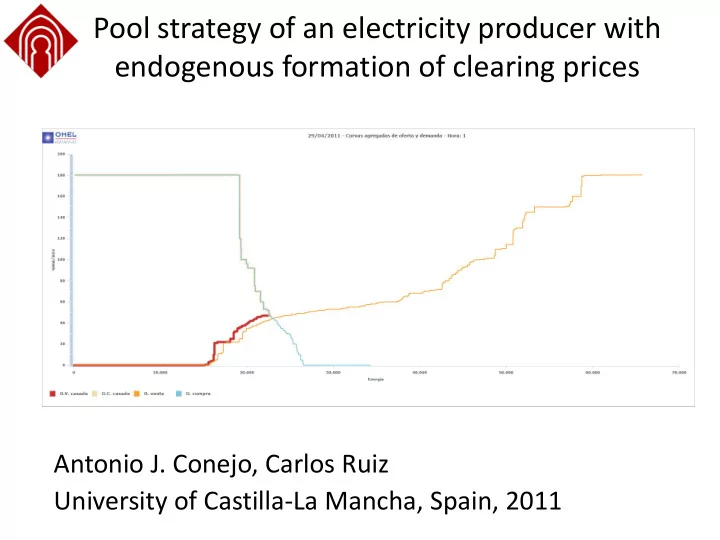
Pool strategy of an electricity producer with endogenous formation of clearing prices

Antonio J. Conejo, Carlos Ruiz University of Castilla-La Mancha, Spain, 2011

slide-2
SLIDE 2

Contents

  • Background and Aim
  • Approach
  • Model Features
  • Model Formulation

– Deterministic – Stochastic

  • Examples
  • Conclusions

29/04/2011 2

slide-3
SLIDE 3

Contents

  • Background and Aim
  • Approach
  • Model Features
  • Model Formulation

– Deterministic – Stochastic

  • Examples
  • Conclusions

29/04/2011 3

slide-4
SLIDE 4

Background and Aim

  • Comparatively large number of generating units
  • Units distributed throughout the power network

29/04/2011 4

Strategic power producer

slide-5
SLIDE 5

Background and Aim

  • Cleared once a day, one-day ahead and on a

hourly basis

  • DC representation of the network including first

and second Kirchhoff laws

  • Hourly Locational Marginal Prices (LMPs)

29/04/2011 5

Pool-based electricity market

slide-6
SLIDE 6

Background and Aim

4/29/2011 6

Pool-based electricity market Strategic power producer

Best offering strategy to maximize profit

slide-7
SLIDE 7

Background and Aim

  • Considering the market: MPEC

formulation

  • Considering the real-world: Stochastic

formulation

  • Stochastic MPEC!

29/04/2011 7

slide-8
SLIDE 8

Contents

  • Background and Aim
  • Approach
  • Model Features
  • Model Formulation

– Deterministic – Stochastic

  • Examples
  • Conclusions

29/04/2011 8

slide-9
SLIDE 9

Approach

4/29/2011 9

Social Welfare Maximization (Market Clearing)

Profit Maximization

Upper-Level Lower-Level

Bilevel model:

subject to

LMPs Offering curve Dual Variables

slide-10
SLIDE 10

Approach

  • Bilevel model: Optimization problem

constrained by other optimization problem (OPcOP)!

slide-11
SLIDE 11

OPcOP

11

slide-12
SLIDE 12

Approach

4/29/2011 12

Profit Maximization

Upper-Level

MPEC:

LMPs

KKT Conditions

Offering curve

subject to

slide-13
SLIDE 13

MPEC

13

slide-14
SLIDE 14

MPEC

14

slide-15
SLIDE 15

Contents

  • Background and Aim
  • Approach
  • Model Features
  • Model Structure

– Deterministic – Stochastic

  • Examples
  • Conclusions

29/04/2011 15

slide-16
SLIDE 16

Features

1) Strategic offering for a producer in a pool with endogenous formation of LMPs. 2) Uncertainty of demand bids and rival production

  • ffers.

3) MPEC approach under multi-period, network- constrained pool clearing. 4) MPEC transformed into an equivalent MILP.

29/04/2011 16

slide-17
SLIDE 17

Contents

  • Background and Aim
  • Approach
  • Model Features
  • Model Formulation

– Deterministic – Stochastic

  • Examples
  • Conclusions

29/04/2011 17

slide-18
SLIDE 18

Deterministic Model

4/29/2011 18

Upper-Level → Profit Maximization:

Costs - Revenues Ramping Limits Price = Balance dual variable

slide-19
SLIDE 19

Deterministic Model

29/04/2011 19

Upper-Level → Profit Maximization:

Dual variable

slide-20
SLIDE 20

Deterministic Model

29/04/2011 20

Lower-Level → Market Clearing

Maximize Social Welfare Power Balance

slide-21
SLIDE 21

Deterministic Model

29/04/2011 21

Lower-Level → Market Clearing

Price

slide-22
SLIDE 22

Deterministic Model

4/29/2011 22

Production / Demand Power Limits Transmission Capacity Limits Angle Limits

Lower-Level → Market Clearing

slide-23
SLIDE 23

Deterministic Model

29/04/2011 23

Lower-Level → Market Clearing

slide-24
SLIDE 24

Deterministic Model

29/04/2011 24

Lower-Level → Market Clearing → KKT conditions

slide-25
SLIDE 25

Deterministic Model

29/04/2011 25

Lower-Level → Market Clearing → KKT conditions

slide-26
SLIDE 26

Deterministic Model

29/04/2011 26

KKT Lower-Level

MPEC model

slide-27
SLIDE 27

Deterministic Model

4/29/2011 27

The MPEC includes the following non-linearities: 1) The complementarity conditions ( ). 2) The term in the objective function.

Linearizations

   b a

slide-28
SLIDE 28

Deterministic Model

4/29/2011 28

 

1 , ) 1 (           u M u b uM a b a b a

M Large enough constant (but not too large)

Linearizations → Complementarity Conditions

Fortuny-Amat transformation

slide-29
SLIDE 29

Deterministic Model

29/04/2011 29

Based on the strong duality theorem and some of the KKT equalities

Linearizations → Term:

slide-30
SLIDE 30

Contents

  • Background and Aim
  • Approach
  • Model Features
  • Model Formulation

– Deterministic – Stochastic

  • Examples
  • Conclusions

29/04/2011 30

slide-31
SLIDE 31

Stochastic Model

  • Consumers’ bids
  • Rival producers’ offers

29/04/2011 31

Uncertainty incorporated using a set of scenarios modeling different realizations of:

slide-32
SLIDE 32

Pairs of production quantities ( ) and market prices ( ).

Stochastic Model

4/29/2011 32

Deterministic model for each scenario

tn Building of the optimal offering curve

S tib

P 

slide-33
SLIDE 33

Stochastic Model

29/04/2011 33

Optimal

  • ffering

curve

slide-34
SLIDE 34

Stochastic Model

4/29/2011 34

To ensure that the final offering curves are increasing in price some additional constraints are needed: These constraints link the individual problems increasing the computational complexity of the model.

slide-35
SLIDE 35

Stochastic Model Math Structure

4/29/2011 35

slide-36
SLIDE 36

Stochastic Model Math Structure

4/29/2011 36

slide-37
SLIDE 37

Stochastic Model Math Structure

4/29/2011 37

  • 1. Direct solution: CPLEX, XPRESS
  • 2. Decomposition procedures (Lagrangian Relaxation)
slide-38
SLIDE 38

Contents

  • Background and Aim
  • Approach
  • Model Features
  • Model Formulation

– Deterministic – Stochastic

  • Examples
  • Conclusions

29/04/2011 38

slide-39
SLIDE 39

Examples

29/04/2011 39

Six-bus test system→ electricity network

slide-40
SLIDE 40

Examples

29/04/2011 40

Six-bus test system→ demand curve

slide-41
SLIDE 41

Examples

29/04/2011 41

Six-bus test system→ generating units

slide-42
SLIDE 42

Examples

4/29/2011 42

The maximum power flow through lines 2-4, 3-6 and 4-6 are 269.62, 229.44 and 39.6933 MW respectively

Six-bus test system→ uncongested network results

slide-43
SLIDE 43

Examples

29/04/2011 43

Six-bus test system→ uncongested network results

slide-44
SLIDE 44

Examples

29/04/2011 44

Capacity of line 3-6 limited to 230 MW:

Six-bus test system→ congested network results

slide-45
SLIDE 45

Examples

29/04/2011 45

Capacity of line 3-6 limited to 230 MW:

Six-bus test system→ congested network results

slide-46
SLIDE 46

Examples

29/04/2011 46

Capacity of line 4-6 limited to 39 MW:

Six-bus test system→ congested network results

slide-47
SLIDE 47

Examples

  • Uncongested network case
  • 8 equally probable scenarios
  • They differ on the rival producer offers ( ) and
  • n the consumer bids ( )
  • Selected to obtain a wide range of prices

29/04/2011 47

Six-bus test system→ stochastic model

D tdk

O tjb

slide-48
SLIDE 48

Examples

29/04/2011 48

Six-bus test system→ stochastic model results

slide-49
SLIDE 49

Examples

29/04/2011 49

Six-bus test system→ stochastic model results

Offering curves for strategic generator 1

slide-50
SLIDE 50

Examples

29/04/2011 50

Six-bus test system→ stochastic model results

Offering curves for strategic generator 1

slide-51
SLIDE 51

Examples

  • 24 Nodes
  • 8 strategic units
  • 24 non-strategic

units

  • 17 consumers
  • 24 hours

29/04/2011 51

IEEE One Area Reliability Test System

slide-52
SLIDE 52

Examples

29/04/2011 52

IEEE One Area Reliability Test System → Results

slide-53
SLIDE 53

Examples

29/04/2011 53

IEEE One Area Reliability Test System → Results

Marginal cost offer Strategic offer

slide-54
SLIDE 54

Examples

  • Model solved using CPLEX 11.0.1 under GAMS on a

Sun Fire X4600 M2 with 4 processors at 2.60 GHz and 32 GB of RAM.

4/29/2011 54

Model 6-bus uncongested 6-bus congested 6-bus stochastic IEEE RTS CPU Time [s] 2.91 5.82 204.77 449.33

Computational issues

slide-55
SLIDE 55

Contents

  • Background and Aim
  • Approach
  • Model Features
  • Model Formulation

– Deterministic – Stochastic

  • Examples
  • Conclusions

29/04/2011 55

slide-56
SLIDE 56

Conclusions

  • Procedure to derive strategic offers for a power

producer in a network constrained pool market.

– LMPs are endogenously generated: MPEC approach. – Uncertainty is taken into account. – Resulting MILP problem.

  • Exercising market power results in higher profit and

lower production.

  • Network congestion can be used to further increase

profit.

29/04/2011 56

slide-57
SLIDE 57

29/04/2011 57

Thanks for your attention!

http://www.uclm.es/area/gsee/web/antonio.htm

slide-58
SLIDE 58

Appendix A Computational Issues

  • Model has been solved using CPLEX 11.0.1 under GAMS on a

Sun Fire X4600 M2 with 4 processors at 2.60 GHz and 32 GB

  • f RAM.
  • The computational times are highly dependent on the values
  • f the linearization constants M.

4/29/2011 58

Model 6-bus uncongested 6-bus congested 6-bus stochastic IEEE RTS CPU Time [s] 2.91 5.82 204.77 449.33

slide-59
SLIDE 59

Appendix A Computational Issues

  • 1. Solve a (single-level) market clearing considering that

all the producers offer at marginal cost.

  • 2. Obtain the marginal value of each relevant constraint.
  • 3. Compute the value of each relevant constant as:

4/29/2011 59

  100

1 value variable dual    M

Heuristic to determine the value of M:

slide-60
SLIDE 60

Appendix B Stochastic model

29/04/2011 60

slide-61
SLIDE 61

Appendix B Stochastic model

29/04/2011 61

slide-62
SLIDE 62

Appendix B Stochastic model

29/04/2011 62