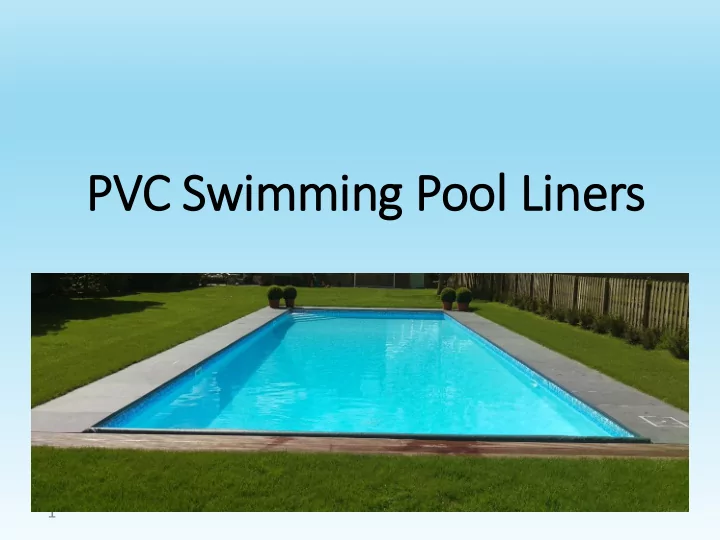
PVC Swimming Pool Lin iners 1 PVC Swimming Pool Lin iners In - - PowerPoint PPT Presentation

pvc swimming pool lin iners
SMART_READER_LITE
LIVE PREVIEW

PVC Swimming Pool Lin iners 1 PVC Swimming Pool Lin iners In - - PowerPoint PPT Presentation

PVC Swimming Pool Lin iners 1 PVC Swimming Pool Lin iners In ground pre-tailored pool liners A pool engineers guide to their manufacture, fitting and care An ISPE & SPATA Workshop 2 Welcome 1. Background 2. The basics of


slide-1
SLIDE 1

PVC Swimming Pool Lin iners

1
slide-2
SLIDE 2

PVC Swimming Pool Lin iners

In ground pre-tailored pool liners A pool engineer’s guide to their manufacture, fitting and care

2

An ISPE & SPATA Workshop

slide-3
SLIDE 3

Welcome

1. Background 2. The basics of liners and what they do 3. How liners are made 4. What is required of me as an installer? 5. Surveying the pool 6. Installing pool liners 7. Common mistakes and problems 8. Care and maintenance

3

slide-4
SLIDE 4

In Introduction

  • Welcome, this course is about PVC swimming pool liners,

specifically in ‘domestic’ pool settings.

  • As a course attendee, you will be asked what previous

experience you have had with installing liners.

  • You will be given invaluable, impartial information about the

important factors influencing liners, their installation and care.

  • The course will refer to other resources such as the SPATA

Member Factsheets 80a and 80b and ISPE Training Manuals.

  • This course can be used as part of the Continuing

(Continuous) Professional Development (CPD) scheme for staff employed in the Pool Industry.

4

slide-5
SLIDE 5

5

Background on liner pools

slide-6
SLIDE 6
  • History
  • Bag liner (pre-fabricated)
  • Onsite liner
  • Advantages and disadvantages over a tiled pool

6

Background on liner pools

slide-7
SLIDE 7

History ry

  • Humble beginnings in USA

7

slide-8
SLIDE 8

History ry

  • Humble beginnings in USA
  • Water proof membrane into a basic structure

8

slide-9
SLIDE 9

History ry

  • Humble beginnings in USA
  • Water proof membrane into a basic structure
  • Poly-Vinyl Chloride (PVC) pool liners have now

become much more sophisticated

9

slide-10
SLIDE 10

History ry

  • Humble beginnings in USA
  • Water proof membrane into a basic structure
  • Poly-Vinyl Chloride (PVC) pool liners have now

become much more sophisticated

  • PVC material itself is specifically mixed

10

slide-11
SLIDE 11

History ry

  • Humble beginnings in USA
  • Water proof membrane into a basic structure
  • Poly-Vinyl Chloride (PVC) pool liners have now

become much more sophisticated

  • PVC material itself is specifically mixed
  • Patterns and materials and accuracy of the

modern pool liner manufacturing process are a world away from where it first started

11

slide-12
SLIDE 12

History ry

  • Humble beginnings in USA
  • Water proof membrane into a basic structure
  • Poly-Vinyl Chloride (PVC) pool liners have now

become much more sophisticated

  • PVC material itself is specifically mixed
  • Patterns and materials and accuracy of the

modern pool liner manufacturing process are a world away from where it first started

  • Primary function remains unchanged.

12

slide-13
SLIDE 13

Why use a PVC Liner?

  • Build costs in labour and materials
  • Time on site
  • Refurbishment

13

slide-14
SLIDE 14

Why use a PVC Liner?

  • Build costs in labour and materials
  • Time on site
  • Refurbishment
  • Disadvantages
  • Physical limitations
  • Life expectancy
  • Temperatures
  • Bathing Load

14

slide-15
SLIDE 15

Why use a PVC Liner?

  • Build costs in labour and materials
  • Time on site
  • Refurbishment
  • Disadvantages
  • Physical limitations
  • Life expectancy
  • Temperatures
  • Bathing Load
  • Choose the right liner

15

slide-16
SLIDE 16

Advantages Disadvantages

  • Low price of build
  • Low price of finish
  • Soft finish
  • Easily changeable
  • Lower bathing loads
  • Lower temperatures
  • Daily/Weekly care
  • Longevity of structure

16

slide-17
SLIDE 17

Liner Beading

17

slide-18
SLIDE 18

Other installation types

18

slide-19
SLIDE 19

Other installation types

19

slide-20
SLIDE 20

Domestic Thin Foil Liners

  • Temperature – Max 29°C (84°F)
  • Bathing load – Domestic

20

slide-21
SLIDE 21

Liner Type Defi finitions

  • Pre-fabricated Liners
  • Thin foil
  • Bag Liner
  • Hung Liner
  • On Site Lining
  • Rolls of material brought to site

21

slide-22
SLIDE 22

Limitations of f Details

  • Curves – Dishing & Coves
  • Made from flat sheets so can only curve in one plane
  • Steps & Shallow areas
  • Lack of water pressure makes these vulnerable to slip
  • Steps, pits & dividing walls
  • The tolerances can be too tight to work to
  • Overflow – Deck level – Infinity edges
  • Water tightness has to be carefully designed and sealed

22

slide-23
SLIDE 23

On Site Lining

  • Has better longevity
  • Suitable for semi commercial applications
  • Old pool / refurbishment compatibility

23

slide-24
SLIDE 24

24

How liners are made

slide-25
SLIDE 25
  • PVC Material
  • Reductions
  • Working Drawing
  • Cutting
  • Welding
  • Packing

25

How liners are made

slide-26
SLIDE 26

Liner Material

26

  • 60% PVC (Polyvinyl Chloride)
  • 35% Plasticiser
  • 5% Additives
  • Pigments
  • Fungicides
  • Anti-oxidants
  • Processing aids and lubricants
  • UV and Heat Stabilisers
slide-27
SLIDE 27

27

slide-28
SLIDE 28

Calendering Process Video

28 https://www.youtube.com/watch?v=NzvomFA FVuw

slide-29
SLIDE 29

PVC Material & Temperature

29

5°C 20°C 100°C 118°C

slide-30
SLIDE 30

The Correct Temperature

30

5°C Too Little stretch 15°C Just right 100°C

>117°C

117°C is the Vicat softening point of PVC

slide-31
SLIDE 31

31

Measuring a Pool

slide-32
SLIDE 32

Measuring a Pool Continued

32

slide-33
SLIDE 33

Liner Reductions

  • Liners are pre-fabricated from flat sheets
  • 10mm (½”) tolerance
  • 2% vertical, 1% horizontal
  • Goal is to get even tension

33

slide-34
SLIDE 34

Liner Manufacturing

  • Dimensions reduced
  • Shape flattened
  • Split into sheet widths
  • Drawn & dimensioned

34

slide-35
SLIDE 35

Liner Manufacturing

35

slide-36
SLIDE 36

Making the Liner

  • 1. Wall

1.Tileband 2.Beading

  • 2. Floor

1.Shaped pieces joined 2.Flat sheet pieced up & shaped

  • 3. Wall joined to floor

36

slide-37
SLIDE 37

Working drawings

37

slide-38
SLIDE 38

Welding

  • The material is supplied to the liner

manufacturer in ‘roll form’

  • Floor is welded into a single section

usually using high frequency welding

  • The wall is manufactured separately

including tile band and beading

  • Main sections are joined together

38

slide-39
SLIDE 39

39

slide-40
SLIDE 40

40

slide-41
SLIDE 41

Welding

  • High frequency welding
  • Similar to microwave technology
  • Required heat and pressure
  • Hot wedge welding
  • Speed and temperature control vital
  • Hot air welding
  • Usually manual
  • Solvent welding
  • Rarely used. Can damage print

41

slide-42
SLIDE 42

Packing

  • Careful inspection
  • Fan-folded and rolled
  • Wrapped and packed
  • Easily unfolded on site

42

slide-43
SLIDE 43

Checking

43

slide-44
SLIDE 44

Packing

44

slide-45
SLIDE 45

Liner Manufacturing - Summary ry

  • The liner is pre-fabricated in a factory
  • Therefore all the information is from the site

survey

  • Give all the information possible – if in doubt,

measure more, photograph and contact the manufacturer to discuss

  • Customer expectations must be considered

45

slide-46
SLIDE 46

Break

46

slide-47
SLIDE 47

Liner Manufacturing - Summary ry

  • The liner is pre-fabricated in a factory
  • Therefore all the information is from the site survey
  • Give all the information possible – if in doubt,

measure more, photograph and contact the manufacturer to discuss

  • Customer expectations must be considered

47

slide-48
SLIDE 48

48

What is required as an an installer?

slide-49
SLIDE 49

What is required as an an installer?

  • Surveying the pool
  • Installing pool liners
  • Care and maintenance

49

slide-50
SLIDE 50

Surveying the pool

  • Requirements
  • Tolerances
  • Equipment
  • With or without water in the pool?
  • Importance of accuracy

50

slide-51
SLIDE 51

Surveying the pool

  • Requirements
  • Ability to re-draw
  • Horizontal & vertical only
  • It must add up!
  • Tolerances
  • ½” or 10mm overall

51

slide-52
SLIDE 52

Surveying your pool

  • Equipment
  • Tapes
  • Spirit level & plumb line
  • Chalk and markers
  • Steel Pegs
  • Laser measure
  • Pen and paper!

52

slide-53
SLIDE 53

Surveying your pool - discussion

  • With or without water in the pool?
  • Importance of accuracy

53

slide-54
SLIDE 54

Fitting the PVC Liner

54

slide-55
SLIDE 55

Liner Fitting - Topics

  • PVC Material & Temperature
  • The procedure
  • Fitting creases
  • Tools required
  • Filling the pool
  • Tips & Warnings

55

slide-56
SLIDE 56

The Procedure

  • Prepare shell
  • CLEAN
  • Prepare the fittings & liner
  • CLEAN
  • Hang liner
  • Vacuum & Adjust
  • Vacuum & Adjust
  • Fill and cut in

56

slide-57
SLIDE 57

The Procedure

  • Fill then cut in

57

slide-58
SLIDE 58

Liner Fitting - Topics

  • Aims and Expectations
  • Fitting creases
  • Tools required
  • Filling the pool
  • Tips & Warnings

58

slide-59
SLIDE 59

Liner Fitting Tips

  • Sweep deck and pick entry spot
  • Check and clean tracking/coping
  • Work from top down
  • Fit gaskets – mark screw holes
  • CLEAN AGAIN!
  • Do not fit without GOOD vacuum
  • Never drag liner when folded

59

slide-60
SLIDE 60

Liner Fitting Tips

  • NEVER

drag liner when folded

60

slide-61
SLIDE 61

Summary ry so far

  • Types
  • Benefits & Limitations
  • Surveying the pool
  • Manufacture
  • Installing the liner
  • Liner care

61

slide-62
SLIDE 62

Liner care and maintenance

  • Liner care
  • Pool running conditions
  • Water Balance
  • Bathing Loads
  • Surrounding environment
  • Life expectancy
  • Problem diagnosis

62

slide-63
SLIDE 63

Liner care and maintenance

  • Pool running conditions
  • Water Balance
  • SPATA
  • Bathing Loads
  • ISPE
  • Surrounding environment

63

slide-64
SLIDE 64

Liner care and maintenance

  • Pool running conditions
  • Water Balance

64

Cyanuric acid (mg/l) Minimum free Chlorine (mg/l) Normal operating Parameters (mg/l) 25 1.5 1.5 - 3 50 2.0 2.0 - 4 100 2.5 2.5 - 5

pH

Temperature

7.2-7.8

29°C

slide-65
SLIDE 65

Liner care and maintenance

  • Pool running conditions
  • Bathing Loads - DOMESTIC
  • ISPE – A domestic pool is a pool designed to be for the primary use
  • f the owner, their family and invited guests.
  • Health and Safety Executive - private swimming pools in domestic

premises while being used solely by the owner, family and guests. 65

slide-66
SLIDE 66

Liner care and maintenance

  • Pool running conditions
  • Surrounding environment
  • Geography & geographic location
  • Weather
  • Exposure
  • Trees
  • Maintenance personnel
  • Affluence
  • Roads
  • Factories
  • Etc……………

66

slide-67
SLIDE 67

Liner care and maintenance

  • Liner care
  • Pool running conditions
  • Water Balance
  • Bathing Loads
  • Surrounding environment
  • Life expectancy
  • Three to fifteen years
  • Indoor:- three to ten
  • Outdoor:- five to fifteen
  • Problem diagnosis

67

slide-68
SLIDE 68

Problems

  • Creasing
  • Wrinkles
  • Staining
  • Bleaching
  • Leaking

68

slide-69
SLIDE 69

Creasing

69

Temperature pH

  • Excess water absorption will cause creasing
slide-70
SLIDE 70

Creasing

  • Force to move liner – ABILITY
  • Uneven tension
  • Heat
  • Water absorption
  • Flotation
  • Lack of friction – OPPORTUNITY
  • Water table
  • Condensation, water migration

70

slide-71
SLIDE 71

Creasing

  • When is a crease just a ripple?
  • Liner needs tension
  • Little or a lot
  • Must be even
  • Let a liner settle for few months
  • Customer expectation

71

slide-72
SLIDE 72

Recognising Creasing Types

  • Liner tramp
  • Pruning
  • Liner float

72

slide-73
SLIDE 73

Staining & Bleaching

  • Metals & Minerals
  • Algae
  • Oils & cleaning

products

  • Bleaching

73

slide-74
SLIDE 74

How to avoid common mistakes

  • Confusion over the pattern
  • Measurements not tallying up or missing
  • Wall to floor radii not mentioned
  • Liner size too big / too small
  • Liner is wrapped in a protective layer
  • Liner fitted the wrong way round!
  • Holes in the liner
  • Creasing
  • Leaking

74

slide-75
SLIDE 75

Any questions?

75

slide-76
SLIDE 76

Conclusion

  • PVC liner pools are here to stay
  • Vacuum fits - Water locks
  • There is no ABC to fitting a liner
  • It is worth getting the liner right as it turns a

hole in the ground into a swimming pool

76

slide-77
SLIDE 77

77

slide-78
SLIDE 78

Lunch

78

slide-79
SLIDE 79

Refresher

  • Background, history and types
  • Materials, reductions and manufacturing
  • Surveying, installation and maintenance

79

slide-80
SLIDE 80

Reviewing the common mistakes

  • Confusion over the pattern
  • Measurements not tallying up or missing
  • Wall to floor radii not mentioned
  • Liner size too big / too small
  • Liner is wrapped in a protective layer
  • Liner fitted the wrong way round!
  • Holes in the liner
  • Creasing
  • Leaking

80

slide-81
SLIDE 81

Test!

  • The test can be conducted as an “open book” exercise, so

you are permitted to refer to the relevant course materials.

  • Please do not confer with anyone else on the course during

the test, but you can chat with a tutor.

  • Should any candidate require assistance with reading the

questions, please liaise with the tutor before the test starts.

  • There are twenty questions to answer and the pass mark is

90%.

  • Scores above 60% can be re-tested verbally on the day,

while scores below 60% will require a re-test on a different day.

81

slide-82
SLIDE 82

Test feedback

  • As each of the results become known to the

tutor, they will (anonymously) note any questions that are answered wrongly.

  • Group feedback will then be given.
  • Individual feedback will be provided, where

applicable.

  • Attendance certification will be provided,

where applicable

82

slide-83
SLIDE 83

Any fi final questions?

83

slide-84
SLIDE 84

Thank you for your attendance

84