
SLIDE 1
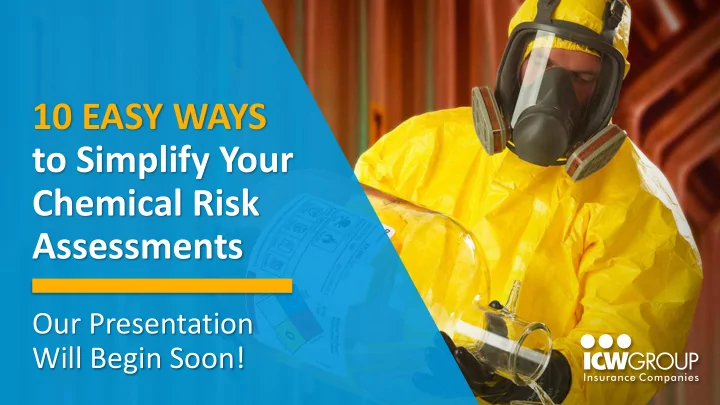
Our Presentation Will Begin Soon!
10 EASY WAYS to Simplify Your Chemical Risk Assessments
10 EASY WAYS to Simplify Your Chemical Risk Assessments Our - - PowerPoint PPT Presentation
10 EASY WAYS to Simplify Your Chemical Risk Assessments Our Presentation Will Begin Soon! 10 EASY WAYS to Simplify Your Chemical Risk Assessments Presented by ICW Group Risk Management TODAYS SPEAKER Mark A. Yeck , CIH, CSP, MS
Our Presentation Will Begin Soon!
10 EASY WAYS to Simplify Your Chemical Risk Assessments
Presented by ICW Group Risk Management
10 EASY WAYS to Simplify Your Chemical Risk Assessments
TODAY’S SPEAKER
Mark A. Yeck, CIH, CSP, MS Technical Specialist, IH ICW Group
ICW Group Occupational Disease Data
Cost of Claims?
Additional indirect costs up to 10x as much!
TOPICS:
Ways to Simplify Risks
Resources
& Posters
TOPICS:
Ways to Simplify Risks
Resources
Chemical Safety: 10 Ways to Simplify Risks
Chemical handling is risky.
assessments and comprehensive training so everyone is aware of safe practices.
with your efforts!
1
KNOW WHAT YOU WORK WITH
Know the Chemicals & Properties
― Most frequently used. ― Highest quantity. ― Most hazardous.
1
KNOW WHAT YOU WORK WITH
Know the Chemicals & Properties
― Corrosive ― Flammable ― Toxic ― Reactive ― Regulated ― Special hazards
1
KNOW WHAT YOU WORK WITH
Know the Chemicals & Properties
― Compatibility ― Type of process (aggressive) ― Unique conditions (confined space) ― Upset potentials ― Emergency preparedness
1
KNOW WHAT YOU WORK WITH
References:
1
KNOW WHAT YOU WORK WITH
What it means to YOU:
2
UNDERSTAND AND USE THE GHS
The Global Harmonized System
identity and hazard warning (label new format)
2
UNDERSTAND AND USE THE GHS
The Global Harmonized System
― Physical & health hazards ― SOPs ― Personal protection ― Special equipment ― Labeling ― SDS
2
UNDERSTAND AND USE THE GHS
Helpful resources:
webinar)
resources/ghs-answer- center/ghs-101-history-ghs/
2
UNDERSTAND AND USE THE GHS
What it means to YOU:
hazard warnings in both training and labeling!
3
PRACTICE SAFE HANDLING
How do we move, transfer, and work with chemicals?
― Grind ― Cut ― Weld ― Spray ― Heat
3
PRACTICE SAFE HANDLING
How do we move, transfer, and work with chemicals?
― Vacuum transfer
― Water shielding ― Low volume spray applications
3
PRACTICE SAFE HANDLING
What it means to YOU:
much as possible.
― Less dust ― Less odor ― Less spilling ― Less risk!
4
PERFORM HAZARD ANALYSIS
SOP and Job Hazard Analysis
― Job Hazard Analysis ― SOP ― 5S ― Efforts to substitute with less toxic chemistry.
4
PERFORM HAZARD ANALYSIS
SOP and Job Hazard Analysis
― Who’s authorized? ― Specific safe use procedures. ― Hazard controls and mitigations. ― Upset procedures.
Goal is to ensure performance in the field
4
PERFORM HAZARD ANALYSIS
What it means to YOU:
5
BE READY WITH CONTROLS
What's that smell?
5
BE READY WITH CONTROLS
It’s getting dirty in here!
changes.
5
BE READY WITH CONTROLS
What it means to YOU:
practices like spraying water to help reduce it?
6
USE APPROPRIATE EQUIPMENT
Working with regulated or unique chemicals may require special equipment.
maintenance and material mapping can help control hazards.
― Wet blasting ― Bag in bag out HEPA vacuums ― Ventilated hand and power tools
6
USE APPROPRIATE EQUIPMENT
Working with regulated or unique chemicals may require special equipment.
6
USE APPROPRIATE EQUIPMENT
What it means to YOU:
handling and equipment requirements.
by substituting something safer.
and provide extra training.
7
WEAR PERSONAL PROTECTION
fit, poor storage or condition, not used.
permeability (Can it get through the glove?)
― Use manufacturer’s chart plus SDS or chemical
manufacturer’s information.
― Your distributor or representative can help.
7
WEAR PERSONAL PROTECTION
that require PPE .
― This needs to be updated periodically and when
changes occur.
7
WEAR PERSONAL PROTECTION
What it means to YOU:
― It won’t work ― It won’t be used
― Extra important with gloves and respirators.
8
STORE CHEMICALS PROPERLY
Common mistakes storing chemicals include:
― Organic material ― Flammables ― Combustibles ― Strong reducing agents such as zinc, alkaline
metals and formic acid
8
STORE CHEMICALS PROPERLY
Common mistakes storing chemicals include:
safety issues (Dangerous locations etc.)
8
STORE CHEMICALS PROPERLY
― https://www.graco.com/content/dam/graco/ip
d/literature/misc/chemical-compatibility- guide/Graco_ChemCompGuideEN-B.pdf
― Quantities and storage methods. ― Dispensing safety including grounding and
bonding.
― Wiring Means for hazard class.
8
STORE CHEMICALS PROPERLY
Combustible Liquids Code.
― Published by National Fire Protection Association. ― Provides safeguards to reduce hazards associated
with storage, handling and use of flammable and combustible liquids.
8
STORE CHEMICALS PROPERLY
What it means to YOU:
explode, burn, or make poisonous smoke.
9
BE AWARE OF REGULATED CHEMICALS
OSHA Substance Specific Standards = Regulated Chemicals
chemicals OSHA regulates as carcinogens or potential carcinogens:
Asbestos 4-Nitrobiphenyl alpha-Naphthylamine Methyl chloromethyl ether 3,3'- Dichlorobenzidine (and its salts) bis-Chloromethyl ether beta-Naphthylamine Benzidine 4-Aminodiphenyl Ethyleneimine beta-Propiolactone 2- Acetylaminofluorene 4-Dimethylaminoazobenzene N-Nitrosodimethylamine Vinyl chloride Inorganic arsenic Cadmium Benzene Coke oven emissions 1,2-dibromo-3- chloropropane Acrylonitrile Ethylene oxide Formaldehyde Methylenedianiline 1,3- Butadiene Methylene Chloride
9
BE AWARE OF REGULATED CHEMICALS
OSHA Substance Specific Standards = Regulated Chemicals
and permissible exposure limit.
monitoring requirements.
urine, or other testing mandated.
is another common provision.
9
BE AWARE OF REGULATED CHEMICALS
What it means to YOU:
by OSHA or others.
chemical.
10 KNOW WHAT’S IN THE AIR
OSHA wants employers to evaluate and ID respiratory hazards. “Reasonable Estimate”
C) The employer shall identify and evaluate the respiratory hazard(s) in the workplace; this evaluation shall include a reasonable estimate of employee exposures to respiratory hazard(s) and an identification of the contaminant's chemical state and physical form. Where the employer cannot identify or reasonably estimate the employee exposure, the employer shall consider the atmosphere to be IDLH. (A) The employer shall provide a respirator that is adequate to protect the health of the employee and ensure compliance with all other OSHA statutory and regulatory requirements, under routine and reasonably foreseeable emergency situations.
listed in Table 1 to select a respirator that meets or exceeds the required level of employee
purifying filter), employers must ensure that the assigned protection factor is appropriate to the mode of operation in which the respirator is being used.
exposure to the hazardous substance, when measured outside the respirator, at or below the MUC.
https://www.red-on-line.com/hse/2019/09/24/us-ninth-circuit-holds-osha-respiratory-protection-standard-requires- employers-evaluate-workplace-respiratory-hazards-determine-whether-respirators-necessary-005606
10 KNOW WHAT’S IN THE AIR
What it means to YOU:
― OSHA requires ‘a reasonable estimate’ of
exposures to respiratory hazards.
― Technically, if respirators are required, you need
to know what the chemical exposure level is.
Respirators have ability to protect to certain levels. Technically, you can’t select until you know what’s in the air!
TOPICS:
Ways to Simplify Risks
Resources
Industrial Hygiene Resources
All links will be made available after webinar!
accreditation-programs/find-an-accredited-lab
Industrial Hygiene Resources
What it means to YOU:
Industrial Hygiene resources.
― Help you perform compliance based air
sampling when needed.
― With basic chemical risk assessment
before you sample
― In select cases, can do more detailed risk
assessment when warranted
TOPICS:
Ways to Simplify Risks
Resources
ICW Group Policyholder Website!
Find all resources!
Management area
Your Chemical Risk Assessments
icwgroup.com/safety
ICW Group Policyholder Website!
Find all resources!
icwgroup.com/safety
ICW Group Policyholder Website!
Log into myResource
to find relevant meeting materials and training
icwgroup.com/safety
Our Presentation Will Begin Soon!
10 EASY WAYS to Simplify Your Chemical Risk Assessments