Post EPS Initial Satellite (PEPSIS) National User Workshop on - - PowerPoint PPT Presentation

post eps initial satellite pepsis
SMART_READER_LITE
LIVE PREVIEW

Post EPS Initial Satellite (PEPSIS) National User Workshop on - - PowerPoint PPT Presentation

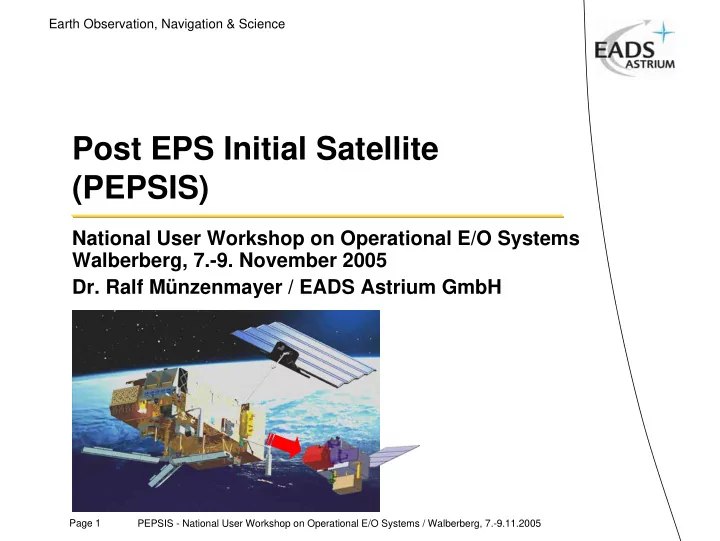
Earth Observation, Navigation & Science Post EPS Initial Satellite (PEPSIS) National User Workshop on Operational E/O Systems Walberberg, 7.-9. November 2005 Dr. Ralf Mnzenmayer / EADS Astrium GmbH Page 1 PEPSIS - National User Workshop


slide-1
SLIDE 1

Page 1 PEPSIS - National User Workshop on Operational E/O Systems / Walberberg, 7.-9.11.2005

Earth Observation, Navigation & Science

Post EPS Initial Satellite (PEPSIS)

National User Workshop on Operational E/O Systems Walberberg, 7.-9. November 2005

  • Dr. Ralf Münzenmayer / EADS Astrium GmbH
slide-2
SLIDE 2

Page 2 PEPSIS - National User Workshop on Operational E/O Systems / Walberberg, 7.-9.11.2005

Earth Observation, Navigation & Science

Post EPS Initial Satellite (PEPSIS) Contents

  • 1. Introduction – Early Need of PEPSIS?
  • 2. P/L Requirements and Options

2.1 Overview 2.2 Infrared Sounder 2.3 Microwave Sounder 2.4 Imaging Radiometer 2.5 Reference P/L – Budgets

  • 3. System Concept

3.1 Mission Architecture and Candidate Launcher 3.2 Satellite Concept and Options 3.3 Compatibility to the EPS G/S

  • 4. Recommended Solution for PEPSIS and

Possible Implementation Scenario

slide-3
SLIDE 3

Page 3 PEPSIS - National User Workshop on Operational E/O Systems / Walberberg, 7.-9.11.2005

Earth Observation, Navigation & Science

1 Introduction

slide-4
SLIDE 4

Page 4 PEPSIS - National User Workshop on Operational E/O Systems / Walberberg, 7.-9.11.2005

Earth Observation, Navigation & Science

1 Introduction IJPS- and JTA Agreement

  • EUMETSAT NOAA Agreements concerning polar
  • rbiting systems for meteorology
  • Initial Joint Polar System (IJPS)

Agreement dated Nov. 1998

  • EUMETSAT
  • MetOp 1 & 2
  • morning orbit
  • Launch 2006
  • NOAA
  • NOAA N & N´

Polar Orbiting Environmental Satellites (POES)

  • afternoon orbit
  • Launch of NOAA N was May 2005
slide-5
SLIDE 5

Page 5 PEPSIS - National User Workshop on Operational E/O Systems / Walberberg, 7.-9.11.2005

Earth Observation, Navigation & Science

1 Introduction Need for a Gap Filler / Post EPS Initial Satellite

  • JTA requires sounding data from MetOp-3 (after 2014)
  • Need of a backup for MetOp-3
  • Post-EPS is too late

MSG MSG-1 MSG-2 MSG-3 MSG-4 MTG Phase 0 Phase A Phase B Phase CD MTG-1 Need Date POES/NPP/NPOESS NOAA-N (14:30) NOAA-N' (14:30) NPP (10:30) C1 (21:30) C4 (21:30) C2 (13:30) C5 (13:30) C3 (17:30) C6 (17:30) EPS METOP-A (09:30) METOP-B (09:30) METOP-C (09:30) Potential Gap EPS Gap Filler Requirements Design Phase C, D Gap Filler Post EPS Phase 0 Phase A Phase B Phase C, D Post-EPS Need Date '00 '01 '02 '03 '04 '05 '06 '07 '08 '09 '10 '11 '12 '13 '14 '15 '16 '17 '18 '19 '20 '21 '22 '23 '24 '25

slide-6
SLIDE 6

Page 6 PEPSIS - National User Workshop on Operational E/O Systems / Walberberg, 7.-9.11.2005

Earth Observation, Navigation & Science

1 Introduction Post-EPS Definition Process

Initial Scope of Tentative Missions Introduction of Tentative Missions at MTG 2nd UC Workshop Atmospheric Sounding & Wind Profiling AEG Ocean Topography & Imaging AEG Cloud, Precipitation & Land Surface Imaging AEG Atmospheric Chemistry AEG Consolidation of Application Requirements UC Consolidation Workshop Observation Mission Req. Support Mission Req. Assess METOP Commissioning Results Programmatic Requirements Mission Definition Review RSE Support to AEGs

  • Obs. Techniques Consolidation

Sensor Concepts & System Architecture Sensor Concepts & System Architecture MTR Pre-Developments TRL-2 J F M A M J J A S O N D J F M A M J J A S O N D J F M A M J J A S O N D J F M A M J J A S O N D

2004 2005 2006 2007

User Consultation Mission Requirements Architecture Concepts

slide-7
SLIDE 7

Page 7 PEPSIS - National User Workshop on Operational E/O Systems / Walberberg, 7.-9.11.2005

Earth Observation, Navigation & Science

2 P/L Requirements and Options

slide-8
SLIDE 8

Page 8 PEPSIS - National User Workshop on Operational E/O Systems / Walberberg, 7.-9.11.2005

Earth Observation, Navigation & Science

IASI IASI IASI Minimum Imager Medium Imager Maximum Imager PEPSIS Optional Microwave Payload

2.1 Payload Overview Payload Options for PEPSIS

  • Core payload:

IR Sounder - IASI

  • Imaging Radiometer (required as

supporting imager for IASI)

  • Minimum Imager (VIRI-M requirements)
  • Modular Concept (Kayser Threde GmbH)
  • METimage B1 (Jena-Optronik GmbH)
  • Medium Imager
  • METimage B2 (Jena-Optronik GmbH)
  • Maximum Imager (dual view)
  • EADS Astrium Future Imager concept
  • Microwave Sounder (optional)
  • ATMS (provision by NOAA unclear)
  • CTS concept from SULA Systems Ltd.
  • LEOMIS concept from EADS Astrium SAS
  • Optional GRAS (GNSS Receiver for

Atmospheric Sounding) Core Payload Supporting Imager Optional Payload

slide-9
SLIDE 9

Page 9 PEPSIS - National User Workshop on Operational E/O Systems / Walberberg, 7.-9.11.2005

Earth Observation, Navigation & Science

Imager (VIIRS):max. 1km IASI:12km MW Sounder (ATMS):10-37km

  • IASI data product generation require Co-registration

in time and space:

  • Timeliness between IASI and imager < +/-10s
  • Spatial co-registration < 1 km
  • Spectral and Radiometric Requirements for Imagers
  • Depending on “atmospheric mission” (not driven by IASI needs)

Relation of pixel sizes at Nadir

2.1 Payload Overview Co-registration requirements

VIIRS: 3000km ATMS: 2300km IASI: 2052km

slide-10
SLIDE 10

Page 10 PEPSIS - National User Workshop on Operational E/O Systems / Walberberg, 7.-9.11.2005

Earth Observation, Navigation & Science

2.2 Infra-Red Sounder IASI Main Data

Characteristic Value Unit Scan type Stepp and stare

  • Scan rate

8 s Stare interval 151 ms Step interval 8/37 s Number of earth scans / line - EFOV 30

  • Swath

+/- 48.333 deg Swath width +/- 1100 km IFOV - shape at nadir circular

  • IFOV - size at nadir

12 km IFOV - size at edge of scan line across track 39 km IFOV - size at edge of scan line along track 20 km Volume 120 x 108 x 134 cm Mass 230kg Power 200W Data Rate 1.5Mb/s Cooling passive

slide-11
SLIDE 11

Page 11 PEPSIS - National User Workshop on Operational E/O Systems / Walberberg, 7.-9.11.2005

Earth Observation, Navigation & Science

2.3 Microwave Sounder Spectral Range

Observation of water vapour line at 183GHz and O2 line at 53GHz is mandatory.

slide-12
SLIDE 12

Page 12 PEPSIS - National User Workshop on Operational E/O Systems / Walberberg, 7.-9.11.2005

Earth Observation, Navigation & Science

2.3 Microwave Sounder MetOp and NPOES Instruments

AMSU-A will no longer be

available after MetOp

MHS is limited to frequencies of

89 GHz and higher, thus no

  • bservation of the O2 line at 53

GHz is possible

ATMS currently under

development for NPOES by Northrop Grumman has less radiometric performance compared to AMSU-A and MHS but combines both spectral ranges

Instrument l * b * h (mm) Mass (kg) Power (W) ATMS 700 600 400 66 85

slide-13
SLIDE 13

Page 13 PEPSIS - National User Workshop on Operational E/O Systems / Walberberg, 7.-9.11.2005

Earth Observation, Navigation & Science

2.3 Microwave Sounder Candidate Instrument Concepts

ESA has initiated Pre-Phase A studies resulting

in two interesting instrument alternatives:

  • Cross-Track Scanner from SULA Systems Ltd
  • Single aperture across track scanner
  • Conical Scanner from EADS Astrium SAS
  • Conical scan imager with two dishes

Instrument Size (l * b * h) (mm) Mass (kg) Power (W) Main Module 1425 700 550 Electronics Module 580 400 400 80 140 83 112 1400 1200 LEOMIS Power (W) Mass (kg) Size dia x height (mm) Instrument

Earth Scanning Earth Scanning

slide-14
SLIDE 14

Page 14 PEPSIS - National User Workshop on Operational E/O Systems / Walberberg, 7.-9.11.2005

Earth Observation, Navigation & Science

2.3 Microwave Sounder Instrument Capabilities

cross-track scanner conical scanner

Frequency range 22.9 – 229 GHz 23.8 – 220 GHz Beam width 2.5° - 1.1° 1.0° - 0.7° Radiometric resolution 0.15 K – 1.6 K 0.16 K – 0.88 K polarisation V, single (V) dual

  • Cross-Track scanner offers improvements in radiometric

and spatial resolution, allowing to derive more precise temperature/moisture profiles

  • The conical scan offers similar sounding capabilities as a

cross-track scan with additional advantages:

  • constant horizontal resolution
  • fixed polarisation state
  • Due to its scan concept and the polarisation

measurement capability a conical scan instrument can deliver additional information of climatological relevance, e.g. surface moisture content and precipitation data

slide-15
SLIDE 15

Page 15 PEPSIS - National User Workshop on Operational E/O Systems / Walberberg, 7.-9.11.2005

Earth Observation, Navigation & Science

2.4 Imaging Radiometer VIRI-M Requirements – Minimum Concept (P0)

Channel Priority Central WL FWHM Reference Scene Expected scene range SNR/NEDT (Minimum) Absolute Accuracy Minimum / Goal Polarisation Sensitivity Threshold/ goal D/ N Target ME443 P3 443nm 20nm 0.5% albedo 0%-100% albedo 20 @ 0.5% albedo 10% / 5% 5% / 2% D Aerosol detection over land. Blue channel providing correction for air molecular scattering to improve

  • bservation of aerosol and of land surface radiative

parameters. AH1 P0 670nm 20nm 0.5% albedo 0%-100% albedo 20 @ 0.5% albedo 10% / 5% 5% / 2% D Continuity of AVHRR data with im-prove-ment of cirrus clouds and aerosols detection (centred on minimum brightness of vegetation). AH2 P0 865nm 20nm 0.5% albedo 0%-100% albedo 20 @ 0.5% albedo 10% / 5% 5% / 2% D Continuity of AVHRR data with im-provement of cirrus clouds and aero-sols detection (cleaner window). VI1.38 P2 1.375um 0.03um 0.5% albedo 0%-100% albedo 40 @ 0.5% albedo 10% / 5% 5% / 2% D Cirrus and high level aerosols. Water vapour absorption band masking the surface improving the contrast of cirrus clouds and high level aerosols. AH3A P0 1.61um 0.03 0.5% albedo 0%-100% albedo 40 @ 0.5% albedo 10% / 5% 5% / 2% D Continuity of AVHRR data with improvement of cirrus clouds and aerosols detection (cleaner window). AH3B P0 3.74um 0.38um 300K 180-335K 0.1K @ 300K 0.5K

  • DN Continuity of AVHRR data.

MO6.7 P1 6.7um 0.36um 250K 180-280K 0.3K @ 250K 0.5K

  • DN

Water vapour channel to derive winds in Polar Regions (MODIS heritage) and to improve height assignment. SE8.7 P1 8.7um 0.3um 300K 180-335K 0.1K @ 300K 0.5K

  • DN Cirrus and synergy with SEVIRI.

AH4 P0 10.8um 1um 300K 180-335K 0.1K @ 300K 0.5K

  • DN Continuity of AVHRR data. Split window channels.

AH5 P0 12.0um 1um 300K 180-335K 0.1K @ 300K 0.5K

  • DN Continuity of AVHRR data. Split window channels.

SE13.4 P2 13.4um 0.3um 270K 180-300K 0.2K @ 270K 0.5K

  • DN Height assignment by CO2 slicing.
slide-16
SLIDE 16

Page 16 PEPSIS - National User Workshop on Operational E/O Systems / Walberberg, 7.-9.11.2005

Earth Observation, Navigation & Science

2.4 Imaging Radiometer Spectral Channels Medium & Maximum Concept

Similar bands on Channel Application Center of band Bandwidth Dual View channel AVHRR VIIRS VIRI 1 LAN/OC 442.5 20 nm yes VIIRS VIRI 2 OC/(LAN) 490 20 nm VIIRS VIRI 3 LAN/OC 554 20 nm VIIRS VIRI 4 LAN/ATM/(OC) 670 20 nm yes AVHRR VIIRS VIRI 5 LAN/(OC) 708 20 nm VIIRS VIRI 6 OC/(LAN) 750 14 nm VIIRS VIRI 7 LAN/OC/(ATM) 877 35 nm AVHRR VIIRS VIRI 8 EUM 1375 30 nm VIIRS VIRI 9 SST/ATM 1610 60 nm yes AVHRR VIIRS VIRI 10 ATM/(LAN) 2250 60 nm VIIRS VIRI 11 SST/ATM 3700 150 nm* yes AVHRR VIIRS VIRI 12 EUM 6300 1000 nm VIRI 13 ATM 8550 1000 nm VIIRS VIRI 14 ATM/SST/LAN 10800 950 nm yes AVHRR VIIRS VIRI 15 ATM/SST/LAN 12000 1000 nm yes AVHRR VIIRS VIRI 16 EUM 13400 600 nm** SEVIRI

LAN = Land OC = Ocean Colour ATM =Atmosphere SST =Sea Surface Temperature EUM =Eumetsat (ATM) Additional OC, LAN, ATM channel Compared to VIRI-M Specification Dual view channels for maximum concept

slide-17
SLIDE 17

Page 17 PEPSIS - National User Workshop on Operational E/O Systems / Walberberg, 7.-9.11.2005

Earth Observation, Navigation & Science

Modular Push Broom concept from

5.1 Imaging Radiometer - Overview Imager Classes for PEPSIS

METimage concept from

  • The AVHRR type (METimage A) is not further

investigated due to is low potential for future

  • perational use
  • The only difference between METimage C and

METimage B is an additional polarisation scrambler for low priority P3 channels (METimage C unattractive as size and mass impact very high)

Imager Class Instrument Concepts Performance Budgets Minimum (METimage A) METimage B1 Modular Concept 1 km GSD 6-11 channels 40-60kg Medium METImage B2 17 channels 85kg Maximum (VIIRS) FI-VIRI* (METimage C) 200-500m GSD 16 channels *(Dual View) 120-160kg

Reference concept per imager class , (not considered for implementation)

Derotator TMA Telescope 3 FEE Units Active Cooling System (2 Units) Dual View Scanner TIR Black Bodies 2 Instrument Control Units

Nad ir

33 ° 33 ° 33 ° F D Opt. Bench & FPA 3x1 Optics

Nad ir

33 ° 33 ° 33 ° F D Opt. Bench & FPA 3x1 Optics In- Field Separation Spectral Detector Line 36° 2300 km flight direction 6.8 km/sec viewing angle 110° 36° 36° 3 x Optics

Future Imager (FI) Study Concept VIRI from

slide-18
SLIDE 18

Page 18 PEPSIS - National User Workshop on Operational E/O Systems / Walberberg, 7.-9.11.2005

Earth Observation, Navigation & Science

2.4 Imaging Radiometer Data products from Different Concepts

Modular Concept METimage B1 METimage B2 FI-VIRI Concept Size minimum minimum medium maximum Products AVHRR Level AVHRR continuation

With significantly improved SNR (respectively spatial sampling)

AVHRR continuation

With significantly improved SNR (respectively spatial sampling)

AVHRR continuation

With significantly improved SNR (respectively spatial sampling)

AVHRR continuation

With significantly improved SNR (respectively spatial sampling)

VIRI-M Level Threshold Level: Aerosol detection over land Cirrus and high level aerosols Water vapour to derive winds in polar regions Cirrus and synergy with MTG (SEVIRI)

Cloud height assignment

Threshold Level: Aerosol detection

  • ver land

Med.- Goal Level: Cirrus and high level aerosols Water vapour to derive winds in polar regions Cirrus and synergy with MTG (SEVIRI)

Cloud height assignment

Goal Level: Aerosol detection

  • ver land

Cirrus and high level aerosols Water vapour to derive winds in polar regions Cirrus and synergy with MTG (SEVIRI)

Cloud height assignment

FI-VIRI Level climate Threshold Level: Climate observation Goal Level: Climate observation FI-VIRI Level Land Application Potential for goal Land products Land Application LAI, f-cover, etc. Land Application LAI, f-cover, etc. FI-VIRI Level Ocean Colour Potential Ocean Colour Products Ocean Colour Products Ocean Colour Products Comments Due to high achieved SNR if additional VIS channels are implemented VIRI-M atmosphere products due to additional channels Goal levels achieved due to radiometric sizing All goal levels achieved due to dual view and polaris. sensitivity < 2% all MCT detectors
slide-19
SLIDE 19

Page 19 PEPSIS - National User Workshop on Operational E/O Systems / Walberberg, 7.-9.11.2005

Earth Observation, Navigation & Science

2.4 Imaging Radiometer Principle Performance and Products

200 m 400 m 600 m 800 m 1000 m

BreakThrough SNR/NedT Goal SNR/NedT Threshold SNR/NedT MINIMUM

Climate/LAN/OC Meteorology

MEDIUM

Climate / Land Ocean Colour

MINIUM

Meteorology Meteorology

M A X I M U M

Climate / Land Ocean Colour

slide-20
SLIDE 20

Page 20 PEPSIS - National User Workshop on Operational E/O Systems / Walberberg, 7.-9.11.2005

Earth Observation, Navigation & Science

2.4 Imaging Radiometer Concept Selection

  • AVHRR continuation
  • METimage A
  • Minimum EUMETSAT user needs

(VIRI-M requirements)

  • Modular Concept (good SNR but only P0 channels)
  • METimage B1 (P0, P1, P2 & P3 channels)
  • Additional channels for ocean and

land applications and better performance (radiometry, spatial resolution)

  • METimage B2
  • Climate monitoring (goal requirements) and

better ocean and land products (polarisation)

  • FI-VIRI

Optimum considering system impact I n c r e a s e d p e r f

  • r

m a n c e b u t a l s

  • i

n c r e a s e d i n s t r u m e n t b u d g e t s ( m a s s , v

  • l

u m e , p

  • w

e r , c

  • s

t ! )

slide-21
SLIDE 21

Page 21 PEPSIS - National User Workshop on Operational E/O Systems / Walberberg, 7.-9.11.2005

Earth Observation, Navigation & Science

2.5 Reference Payload Instrument Bugets

IR Interferometer Imager Microwave Sounder IASI Modular Concept 540x420x360 71 80 800-4400 METimage B2 FI-VIRI SULA MS Volume [mm3] 1200x1080x1340 ATMS 650x680x700 85 155 Mass [kg] 230 1425x700x550 1500-23800 700x600x400 1200x920x610 80 110 140 66 85 1400-34000 140 50 27,5 Power [W] 210 Data Rate [kbit/s] 1527

slide-22
SLIDE 22

Page 22 PEPSIS - National User Workshop on Operational E/O Systems / Walberberg, 7.-9.11.2005

Earth Observation, Navigation & Science

3 System Concept

slide-23
SLIDE 23

Page 23 PEPSIS - National User Workshop on Operational E/O Systems / Walberberg, 7.-9.11.2005

Earth Observation, Navigation & Science

3.1 Mission Architecture & Candidate Launcher

  • Maximum reuse of EPS ground segment
  • Ground station in Svalbard is considered
  • Reuse of hard- & software as much as

possible from MetOp and ASTROBUS concept (e.g. Cryosat, TerraSAR,…)

  • Identical orbit as for MetOp

(800 km, 9:30 LTDN)

  • Candidate low cost launcher for this orbit are

Rockot, Angara 1.1 and VEGA

  • Vega selected as a reference as
  • European Launch Service Provider
  • Best performance within the ‘low cost’ launchers
  • Fairing comparable to Rockot / Angara 1.1
  • Soyuz is best candidate in case performance (e.g. fairing

envelope) of low cost launcher is not sufficient

Sun 9,30h LTDN SSO Deep Space

slide-24
SLIDE 24

Page 24 PEPSIS - National User Workshop on Operational E/O Systems / Walberberg, 7.-9.11.2005

Earth Observation, Navigation & Science

3.2 Satellite Concept and Options Invetigated Satellite Options

Config. Number Modular Concept (minimum) METimage B2 (medium) FI-VIRI (maximum)

1: IASI + Imager

1_KT 1_B2 2_1_B2 2_3_B2 1_FI

2.1: IASI + Imager + ATMS

2_1_KT 2_1_FI

2.3: IASI + Imager + SULA MS

2_3_KT 2_3_FI

slide-25
SLIDE 25

Page 25 PEPSIS - National User Workshop on Operational E/O Systems / Walberberg, 7.-9.11.2005

Earth Observation, Navigation & Science

3.2 Satellite Concept and Options Configuration 2_3_B2 (IASI+Medium Imager+MS)

Launch (X) IASI S/C Main Body X=2175 mm Y=1550 mm Z=1025 mm (1400 mm) X-Band Antenna HRPT Antenna MetImage B2 Nadir (Z) Flight (-Y) LRPT Antenna GPS Antennas S-Band Antennas Solar Array 9,9 m2 Star Tracker Sun Sensors Sula MS

  • IASI instrument defines the overall configuration (due to

mounting interface, launch direction, FoV requirements)

slide-26
SLIDE 26

Page 26 PEPSIS - National User Workshop on Operational E/O Systems / Walberberg, 7.-9.11.2005

Earth Observation, Navigation & Science

3.2 Satellite Concept and Options GRAS Implementation Impact - Configuration

  • GRAS instrument can be implemented without major

impact (mass and volume) in all options

  • Total mass of GVA, GAVA and GZA:

about 20 kg compatible with Vega

  • Accommodation at positions similar to MetOp

GZA GAVA GVA

1122 1165 1205 1296 1337 1382 1309 1353 1395 200 400 600 800 1000 1200 1400 1600 A 1 _ K T A 1 _ B 2 A 1 _ L S A 2 _ 1 _ K T A 2 _ 1 _ B 2 A 2 _ 1 _ L S A 2 _ 3 _ K T A 2 _ 3 _ B 2 A 2 _ 3 _ L S Type Launch Mass [kg]

Vega Angara 1.1 Rockot Soyuz

>>2000

slide-27
SLIDE 27

Page 27 PEPSIS - National User Workshop on Operational E/O Systems / Walberberg, 7.-9.11.2005

Earth Observation, Navigation & Science

3.3 Compatibility to the EPS G/S Comparison PEPSIS / METOP

Meteorological Payload

IASI: unchanged GRAS: unchanged SAR:

unchanged

DCS:

unchanged

Imager: new Optional New Microwave Sounder

Space Segment Command and Control

TC Uplink Frequency and Data Rate: no change OBC: different (similar to TS-X) Operational Concept: some differences TTC Databases: different

Instrument Data Downlink to Polar Station

Downlink Frequency: no change for baseline Downlink Formats: all unchanged Downlink Data Rate: no change for baseline Several Options require Downlink Data Rate

increase Instrument Data Downlink to LRPT and (A)HRPT

No change

Data Transfer Svalbard - Darmstadt

Unchanged for “low rate” Several Options require data rate increase

slide-28
SLIDE 28

Page 28 PEPSIS - National User Workshop on Operational E/O Systems / Walberberg, 7.-9.11.2005

Earth Observation, Navigation & Science

3.4 System Concept Conclusions

  • Astrobus (e.g. TerraSAR-X) provides platform concept with

high degree of re-usability but still offers the required flexibility to support specific system needs

  • Additionally maximum re-use of MetOp downlink equipment

(Imager data-rate driving for S/C and G/S)

  • Restriction to minimum data-rates => Full re-usability of MetOp

downlink equipment and G/S

  • Higher data rates => Change to higher modulation

schemes / compression and resulting impact on G/S

  • Astrobus and MetOp heritage provides very cost efficient P/F

solution with no critical elements relying on existing equipment

  • Schedule uncritical (P/L pre-developments are already initiated)
  • Re-use of existing EPS G/S to a large extent. Changes on product

processing, generation and distribution as well as mission simulator and mission planning facility are independent from selected scenario

  • All configurations except IASI + maximum imager + Sula MS

(Option 2_3LS) feasible on Vega launcher => Option 2_3LS requires Soyuz launch or distribution on separate platforms

slide-29
SLIDE 29

Page 29 PEPSIS - National User Workshop on Operational E/O Systems / Walberberg, 7.-9.11.2005

Earth Observation, Navigation & Science

4 Recommendation & Implementation Scenario

slide-30
SLIDE 30

Page 30 PEPSIS - National User Workshop on Operational E/O Systems / Walberberg, 7.-9.11.2005

Earth Observation, Navigation & Science

4 Recommendation & Implementation Scenario Candidate Payload

  • Apart from IASI no existing European instruments are suitable

for PEPSIS

  • Imager:
  • VIIRS (US) existing but price and availability not clear
  • no large cost difference between minimum and medium concept
  • medium concept proposed as a baseline for PEPSIS
  • Microwave Sounder
  • ATMS offers reduced performance and is not European
  • ATMS-like MS found to be no design driver – implementation

uncritical

  • Sula -CTS feasible option but leads to a more complex structure

design (structure cost no major contributor to overall cost)

  • LEOMIS concept not compatible with IASI onboard a low-cost

platform – dedicated Sounder platform recommended

  • Sula MS proposed as a baseline for PEPSIS
  • Implementation of GRAS uncritical for all options (no design

driver)

slide-31
SLIDE 31

Page 31 PEPSIS - National User Workshop on Operational E/O Systems / Walberberg, 7.-9.11.2005

Earth Observation, Navigation & Science

4 Recommendation & Implementation Scenario Proposed Baseline (1/2)

  • Obviously the minimum cost are achieved with the minimum

system but there is no significant step in system cost due to higher instrument complexity etc. as long as a low cost launcher can be maintained

  • IASI + Minimum Imager (e.g. Modular Concept from KT) or
  • IASI + Medium Imager (e.g. METImage B2 from DJO)
  • IASI + Maximum Imager (e.g. FI-VIRI from EADS Astrium)
  • Dedicated platform for microwave

sounder mandatory if an conical microwave sounder (LEOMIS) is envisaged – not detailed within this study

slide-32
SLIDE 32

Page 32 PEPSIS - National User Workshop on Operational E/O Systems / Walberberg, 7.-9.11.2005

Earth Observation, Navigation & Science

4 Recommendation & Implementation Scenario Proposed Baseline (2/2)

  • Due to the user need of IR and MW sounding option 2_3B2

(IASI + Sula MS + METImage B2) is proposed as baseline

  • Compatible to launch with Vega
  • Imager and Microwave Sounder with good performance
  • Adaptation of data downlink to higher modulation schemes to

support higher data rate

  • Implementation of GRAS possible without major system impact

ID Activity 1

Pre-Phase A

2

Phase A

3

Phase B

4

Milestones

5

System PDR

6

System CDR

7

Flight Acceptance Review (FAR)

8

Pre-ship Review

9

Launch

10

Phase C/D

11

Detailed design & specification

12

Manufacturing and Procurement

13

PFM structure AIT

14

Realtime test bed activities

15

Flat sat AIT

16

PFM AIT

17

Instrument FM Need Date

18

Environmental test program

19

System validation tests

20

Contingency

21

Launch campaign

22

LEOP & bus commissioning

23

Instrument commissioning

System PDR System CDR Flight Acceptance Revie Pre-ship Review Launch Instrument FM Need Date Q1 Q2 Q3 Q4 Q1 Q2 Q3 Q4 Q1 Q2 Q3 Q4 Q1 Q2 Q3 Q4 Q1 Q2 Q3 Q4 Q1 Q2 Q3 Q4 Q1 Q2 Q3 Q4 Q1 Q2 Q3 Q4 Q1 Q2 Q3 Q4 Q1 Q2 Q3 Q4 2006 2007 2008 2009 2010 2011 2012 2013 2014 2015