SLIDE 1
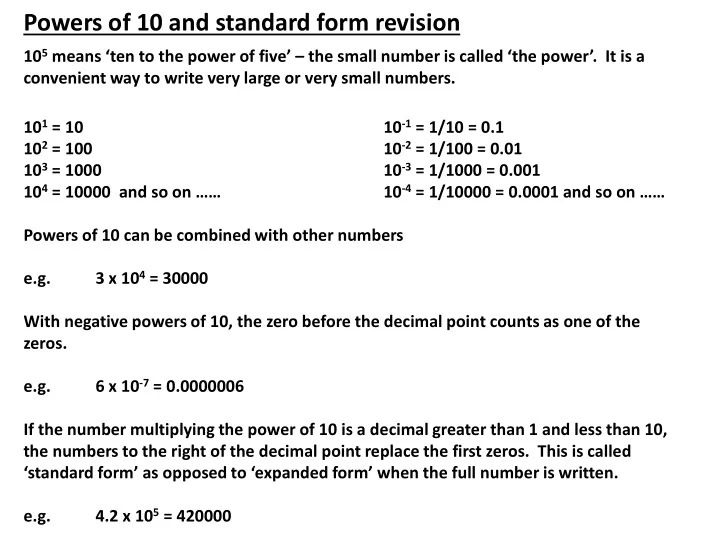
105 means ‘ten to the power of five’ – the small number is called ‘the power’. It is a convenient way to write very large or very small numbers. 101 = 10 10-1 = 1/10 = 0.1 102 = 100 10-2 = 1/100 = 0.01 103 = 1000 10-3 = 1/1000 = 0.001 104 = 10000 and so on …… 10-4 = 1/10000 = 0.0001 and so on …… Powers of 10 can be combined with other numbers e.g. 3 x 104 = 30000 With negative powers of 10, the zero before the decimal point counts as one of the zeros. e.g. 6 x 10-7 = 0.0000006 If the number multiplying the power of 10 is a decimal greater than 1 and less than 10, the numbers to the right of the decimal point replace the first zeros. This is called ‘standard form’ as opposed to ‘expanded form’ when the full number is written. e.g. 4.2 x 105 = 420000
Powers of 10 and standard form revision
SLIDE 2
Size of a typical bacteria = 2 x 10⁻⁶ m = 0.000002 m Amount of profit Tesco makes every minute = £ 7 x 103 = £ 7000 Distance between Norwich and Hollywood = 8.7 x 10⁶ m = 8700000 m Amount of energy stored in 1 tonne of coal = 32000000000 J = 3.2 x 10¹⁰ J Questions: 1) Write 4000000 m in standard form 2) Write 86000 Hz in standard form 3) What is 9.1 x 10⁸ J written in expanded form
Powers of 10 and standard form revision
SLIDE 3
Answers: 1) 4.0 x 10⁶ m 2) 8.6 x 10⁴ Hz 3) 910000000 J
SLIDE 4 Physics calculations often require you to multiply or divide powers of 10. Errors are
- ften made during division calculations involving negative powers of 10, so take care.
To multiply powers of 10 together, you add the powers. e.g. 102 x 107 = 109 To divide powers of 10, you subtract the powers. e.g. 1012 / 104 = 108
- be careful with negative powers in the denominator
Questions: 1) 106 x 108 = ? 2) 2.1 x 103 x 4 x 107 = ? 3) 3 x 10-8 x 2 x 10-3 = ? 4) 1012 / 109 = ? 5) 10-6 / 107 = ? 6) (5 x 10² )/(2 x 10-5 ) = ?
Powers of 10 and standard form revision
SLIDE 5
Answers: 1) 106 x 108 = 1014 2) 2.1 x 103 x 4 x 107 = 8.4 x 10¹⁰ 3) 3 x 10-8 x 2 x 10-3 = 6 x 10-11 4) 1012 / 109 = 103 5) 10-6 / 107 = 10-13 6) (5 x 10² )/(2 x 10-5 ) = 2.5 x 10⁷
Powers of 10 and standard form revision
SLIDE 6
Watch the following short video – note down as many powers of 10 prefixes as you can e.g. m (milli), k (kilo), M (Mega), G (Giga)
Powers of 10 and the scale of the universe
https://www.youtube.com/watch?v=5AAR7bNSM_s
SLIDE 7
Certain powers of 10 have their own prefixes, some of which you have met before. You need to be able to recall and interconvert between the following powers of 10 for the A Level course:
Powers of 10 prefixes
Example: How many nanometres are there in a kilometre? Answer: 103 / 10-9 = 1012
SLIDE 8
- 1. How many micrometres are there in a gigametre?
- 2. How many kilograms are there in a teragram?
- 3. Calculate 1 pm x 1 Mm (give your answer using a power of 10 prefix)
- 4. Calculate 10 kg / 0.1 µg (give your answer using a power of 10 prefix)
- 5. A grain of stardust travels 2.3 km in 8.1 ms. Calculate its average speed in m/s
using standard form. Round your answer to 1 decimal place.
Complete the following questions
SLIDE 9
- 1. How many micrometres are there in a gigametre? 109 / 10-6 = 1015
- 2. How many kilograms are there in a teragram? 1012 / 103 = 109
- 3. Calculate 1 pm x 1 Mm (answer using a power of 10 prefix) 10-12 x 106 = 10-6 = 1µm
- 4. Calculate 10 kg / 0.1 µg (answer using a power of 10 prefix) 104 / 10-7 = 1011 = 100 Gg
- 5. A grain of stardust travels 2.3 km in 8.1 ms. Calculate its average speed in m/s using
standard form. Round your answer to 1 decimal place. average speed = (2.3 x 1000) / (8.1 x 10⁻³) = 2.8 x 10⁶ m/s
Answers