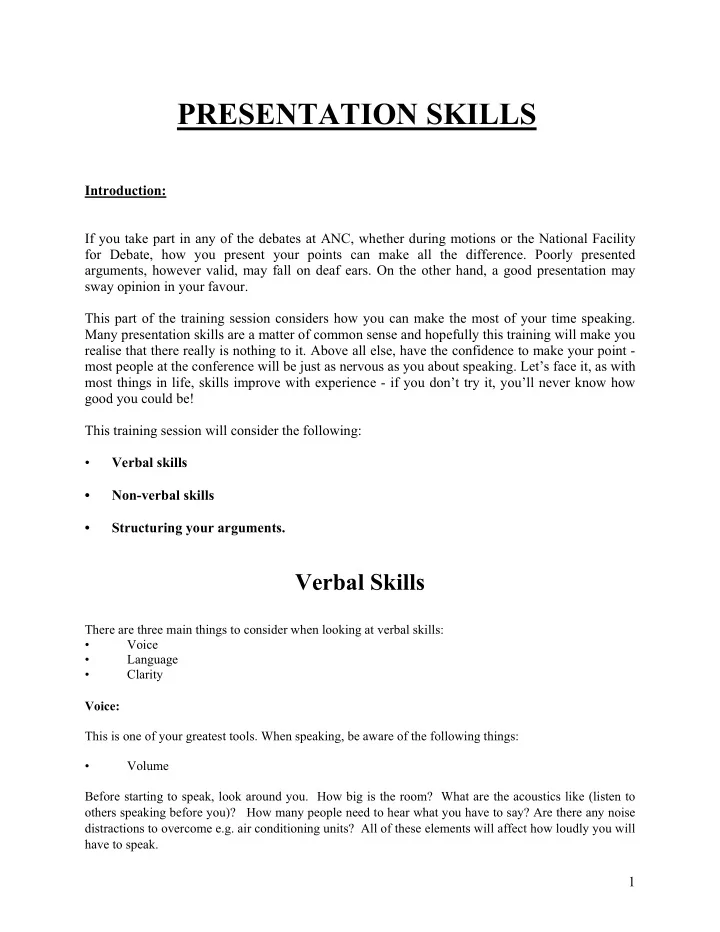
PRESENTATION SKILLS Introduction: If you take part in any of the - - PDF document

presentation skills
SMART_READER_LITE
LIVE PREVIEW

PRESENTATION SKILLS Introduction: If you take part in any of the - - PDF document

PRESENTATION SKILLS Introduction: If you take part in any of the debates at ANC, whether during motions or the National Facility for Debate, how you present your points can make all the difference. Poorly presented arguments, however valid, may


slide-1
SLIDE 1

1

PRESENTATION SKILLS

Introduction: If you take part in any of the debates at ANC, whether during motions or the National Facility for Debate, how you present your points can make all the difference. Poorly presented arguments, however valid, may fall on deaf ears. On the other hand, a good presentation may sway opinion in your favour. This part of the training session considers how you can make the most of your time speaking. Many presentation skills are a matter of common sense and hopefully this training will make you realise that there really is nothing to it. Above all else, have the confidence to make your point - most people at the conference will be just as nervous as you about speaking. Let’s face it, as with most things in life, skills improve with experience - if you don’t try it, you’ll never know how good you could be! This training session will consider the following:

  • Verbal skills
  • Non-verbal skills
  • Structuring your arguments.

Verbal Skills

There are three main things to consider when looking at verbal skills:

  • Voice
  • Language
  • Clarity

Voice: This is one of your greatest tools. When speaking, be aware of the following things:

  • Volume

Before starting to speak, look around you. How big is the room? What are the acoustics like (listen to

  • thers speaking before you)? How many people need to hear what you have to say? Are there any noise

distractions to overcome e.g. air conditioning units? All of these elements will affect how loudly you will have to speak.

slide-2
SLIDE 2

2

Increasing your volume will introduce a greater variety of pitch and tone, adds enthusiasm and communicates confidence. Too much volume, on the other hand, can sound overbearing. The key is to use sufficient volume without shouting. If you are normally a quiet speaker, try increasing the volume at home (when everyone else is out!) to see how much noise you can really make. Alternatively ask a friend to listen to you from a distance away so that you can practice. Finally try to ensure that your volume remains constant. Very often speakers will start well and then, as they tire, the volume reduces. This may give the impression that you do not have much confidence in the points you are making and you may lose the audience’s attention just as you are about to hit them with your killer lines!

  • Pitch

As we have already seen, your pitch is likely to be more varied if you increase the volume at which you speak. Be careful however to ensure that you don’t start introducing high and low notes too much. The pitch should be varied, but not too much.

  • Enunciation

Each word should be pronounced clearly so that the audience hears everything. If you are using difficult to pronounce words, practice saying them out loud first. Better still replace them with simpler versions - whilst using long words can be impressive, mispronouncing them definitely is not. Simplest is the best!

  • Tone

Tone is the emotional quality of your voice, the feeling it communicates. If you are speaking on a motion chances are you feel passionately for or against it. Try to get that feeling across - people will respond to that and hopefully will succumb more easily to your arguments. However, do not allow yourself to be over-emotional or disapproving of other arguments.

  • Pace

As a general rule, try to slow down your speech. Presentations will normally require a slower delivery than, for example, one to one conversations where the other person is likely to be paying more attention and can ask you to repeat something if they miss what you said. Your audience needs to hear every word you say and digest it. Give them time to do that. Again, if you have a prepared speech, ask a friend to listen to you deliver it before the day - they will soon be able to tell you whether you need to slow down. Be wary of written speeches – if you are reading from a pre-prepared

sheet, the temptation will be to speed up. Make a conscious effort to slow yourself down. You should also try to vary the pace a little to add interest or emphasis – for example slow down even more when you get to your main conclusion. Remember that the length of your pauses between sentences also counts as

  • pace. Make them too short and people get left behind. Too long and they will

lose interest. Watch for nodding heads (in either direction!) or puzzled looks as a way of ascertaining if your pace is right or not.

slide-3
SLIDE 3

3 Language: Be precise. Use basic correct grammar (if you are preparing a pre-written speech and you know your grammar is not brilliant, ask a friend to check it for you). Choose simple, common words - you may know more complex ones but your audience may not! Avoid jargon and terminology where you can - if you can’t then define it. Remember that you may know 18 Plus acronyms and terms but there may be members present who haven’t had as much experience as you.

Clarity:

Concentrate on making what you are saying make sense, and link the different parts of your speech together. Consider summarising briefly at the beginning what your arguments are so the audience knows what to expect. The clearer you can make your points, the more effective they will be.

Non-Verbal Skills

The following all count as non-verbal skills:

  • Eye contact
  • Facial expressions
  • Body position
  • Feet and hip movement
  • Arm movement

Eye Contact This is a very powerful tool when used effectively. Eyes can give away a great deal - interest, acceptance, disapproval, concern, confidence, and panic! Effective eye contact can be achieved by keeping your focus on one member of the audience for a certain amount of time - 3 to 5 seconds or a complete thought. Continually look at the audience, person by

  • person. Clearly you may not be able to see everyone in the conference hall, but ensure you do vary who

you look at amongst those you can see. Very often looking at someone will ensure they remain attentive. If reading from notes, try not to be glued to them. Glance at them and then look up to make your point. This will also help you keep the pace slower and make you look and sound more confident. Facial expressions Some facial expression can be helpful to express emotion and belief in what you are saying. However, don’t overdo it! Also keep an eye on your audience’s expressions - they can give good clues as to whether you need to change pace and whether your arguments are making sense. Of course the other side to this is when listening to others speak try to be polite - everyone has the right to say what they think, even if you

  • disagree. Try not to make expressions which may disconcert or offend the speaker - they may return the

favour when you are next speaking!

slide-4
SLIDE 4

4

Body Position Contrast the following two speakers. The first slouches and constantly fidgets and moves around. The second stands upright and, whilst not rigid, moves very little. Who would you listen most to? The first speaker may believe passionately in what they are saying, but this isn’t being communicated to you by their body language and their constant movement distracts you from their speech. Generally it is best to stand tall (especially if short so people can see you over the podium!) and only use movement to emphasis a point. Avoid small movements as they will resemble fidgeting and suggest anxiety. Don’t lean on the podium! Feet and hip movement Keep them still is the golden rule! If you shift your feet, this will distract the audience. Keeping your feet still (but with knees flexed rather than locked) you will also stay more balanced and save your energy for your speech rather than movement. Arm movement Find a comfortable position for your arms and hands - perhaps loosely by your sides or with your hands placed on the lectern. Whatever you do, ensure that your arms are not crossed or folded in any way - basic body language which communicates hostility, fear and closed attitudes. Try to keep gestures and waving hands around to a minimum, as this can be very distracting.

slide-5
SLIDE 5

5

Structuring Your Arguments

A well structured argument will always make more impact than one which wanders all over the place, repeats points and doesn’t have a set ending. Some arguments you may be able to prepare in advance, for example in response to motions on the agenda on which you have an initial view. Others may be more off the cuff during the debate in response to someone else’s arguments or due to the fact that something said has sparked an idea. Pre-prepared arguments There is no excuse for any pre-prepared argument to be poor. You will have had sufficient time to think through your points, how to present them and to do your research. As well as thinking about your arguments, consider what possible responses there may be from other members to them. If you include these in your speech and then set out the reasons why they do not hold water you will have pre-empted those arguments and raised in the audience’s minds reasons why they do not work, before your opponents have even spoken. First make a list of your points, the possible arguments against you and your responses. Then try to

  • rganise them into a logical order, for example if one point needs to be made before another would make
  • sense. Try to keep the list as short as possible - your time is limited and the shorter the speech, the more

impact it is likely to make as the audience has less to take in and remember. Once you know which order you are going to tackle the points in, start writing your speech (in note form

  • r in full, whichever you prefer). Don’t forget that you need to tell the audience who you are, which group

you belong to, whether you are a group delegate or observer and whether you are speaking for or against the motion. Consider starting with your conclusions and then expanding on each reason in more detail. Do not assume a high level of experience or knowledge of 18 Plus amongst the audience - many will have both, but some will not and you must always set the content to the lowest level of experience. Explain what has happened in the past briefly if this is relevant so those newer members understand the basis for your opinion. State each argument at the beginning of each section so that the audience realises which point you are making before you start. Think about using examples or hypotheses if these can be kept short and to the point and are appropriate. Once you have finished making your speech consider including a short summary again at the end of your speech e.g. ‘I urge you to vote against this motion - it is undemocratic, would be ineffective and is not appropriate for an organisation like 18 Plus’. Leave the audience remembering what your key points are. Quick tips on the physical notes for your speech - it is preferable for these to be typed on double line spacing for easy reading. If you do not have access to typing facilities then handwritten notes are OK but ensure that you can read your own writing and again set it out double spaced so you do not cross lines by mistake. Off the cuff speeches If you decide that you wish to answer someone’s point or think of an argument during the conference

slide-6
SLIDE 6

6

debates, try as much as possible to prepare what you are going to say before you head off to the podium. Listen very carefully to the speaker in case they make the same point or answer it. The audience will quickly lose respect for you if you merely repeat what has gone before and may ignore you when you stand up again, even though on that occasion your points are highly pertinent and valid. Sometimes it is worth listening to several speakers to gain a full list of the points you wish to answer - remember you can

  • nly speak once on a motion so don’t burn your bridges too soon!

If you have several points to make, try to have them written as neatly as possible on one sheet of paper, with a note of what the argument to which you are responding is, if any, and who made it. If you refer back to specific speeches and members who made them this shows that you have been attentive to the debate and earns you respect from the audience. Once you have your list, decide quickly in which order you should make your points and note this on your paper (e.g. by simple numbering). If a point is quite detailed try to note down the main elements so you don’t forget them (suddenly realising halfway through the next point that you missed the vital element out of the previous argument is incredibly disconcerting and you will be tempted to backtrack, thus confusing everyone including yourself!). The same rules for delivery apply. The speech may not be as slick as a pre-prepared one, but this is

  • understandable. Do not be tempted to rattle on once you have made your points, try to conclude as you

would have done if you had prepared the speech earlier. Whatever you do, do not make derisory comments about previous speakers. If you are really going to tear their argument apart, the addition of the words ‘with respect’ can make all the difference e.g. ‘with respect to the delegate from xxxx group, I do not believe their argument stands up to scrutiny...’ NEVER make a speech an attack on individuals or specific committees unless you can be subtle about it e.g. ‘I am afraid that I do not understand why the NEC has not done this already...’ rather than ‘the NEC is so crap it can’t even do this right...’ Constructive criticism delivered in a positive way is encouraged, negativity and apportioning blame will achieve nothing but making the speaker look bad themselves. On a final note, think KISS: Keep It Short & Simple This applies to words as well as sentences and the speech in general whether prepared in advance or done

  • ff the cuff.

Prepared by Jarrett Smith Midland Area Pre-ANC Training Day.