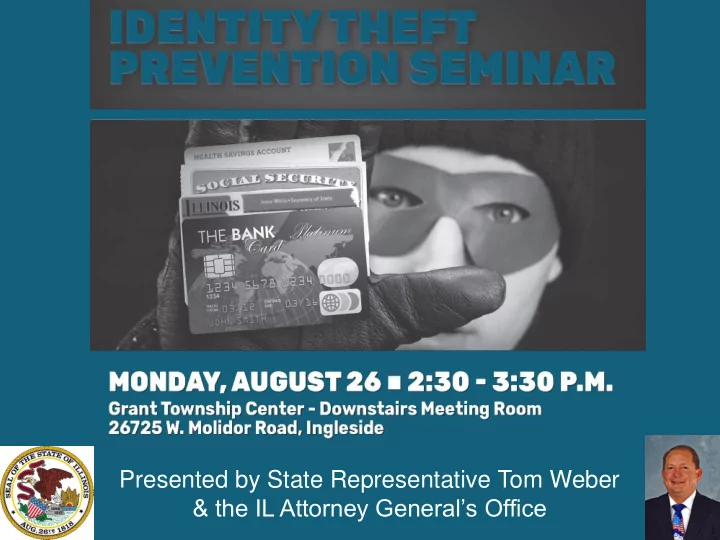
SLIDE 1
Presented by State Representative Tom Weber & the IL Attorney General’s Office
SLIDE 2 WARNING NING SIGN IGNS S OF ID IDENTITY NTITY THE HEFT FT
- Failing to receive bills or other mail. Follow up with
creditors if your bills do not arrive on time. A missing bill could mean an identity thief has taken over your account and changed your billing address to cover his or her tracks.
- Receiving credit cards for which you did not apply.
- Being denied credit, or being offered less favorable credit
terms, like a high interest rate, for no apparent reason.
- Getting calls or letters from debt collectors or businesses
about merchandise or services you did not buy.
Identity Theft Prevention Seminar
SLIDE 3 GENERAL NERAL SAF AFEGUARDS EGUARDS
- Place passwords on your credit card, bank, and phone
- accounts. Avoid using easily available information like
your mother’s maiden name, your birth date, the last four digits of your SSN or your phone number, or a series of consecutive numbers.
- Secure personal information in your home, especially if
you have roommates, employ outside help, or are having work done in your home.
- Ask about security procedures in your workplace or at
businesses, doctor’s offices, or other institutions that collect your personally identifying information. Find out if your information will be shared with anyone else.
Identity Theft Prevention Seminar
SLIDE 4 GENERAL NERAL SAF AFEGUARDS EGUARDS Con
t.
- Don’t give out personal information on the phone,
through the mail, or on the Internet unless you’ve initiated the contact or are sure you know who you’re dealing with. Before you share any personal information, confirm that you are dealing with a legitimate
- rganization. Check an organization’s website by typing
its URL in the address line, rather than cutting and pasting it, or call customer service using the number listed on your account statement or in the telephone book.
Identity Theft Prevention Seminar
SLIDE 5 GENERAL NERAL SAF AFEGUARDS EGUARDS Con
t.
- Treat your mail carefully. Deposit your outgoing mail in
post office collection boxes or at your local post office, rather than in an unsecured mailbox. If you are planning to be away from home and cannot pick up your mail, call the U.S. Postal Service at 1-800-275-8777 to request a vacation hold.
- Dispose of trash carefully. To thwart an identity thief who
may pick through your trash or recycling bins to capture your personal information, tear or shred your charge receipts, copies of credit applications, insurance forms, physician statements, checks and bank statements, expired charge cards that you are discarding, and credit
- ffers you get in the mail.
Identity Theft Prevention Seminar
SLIDE 6 GENERAL NERAL SAF AFEGUARDS EGUARDS Con
t.
- To opt out of receiving offers of credit in the mail, call: 1-
888-5-OPTOUT (1-888-567-8688). The three nationwide credit reporting agencies use the same toll-free number to let consumers choose not to receive credit offers based
- n their lists. Note: You will be asked to provide your SSN,
which the credit reporting agencies need to match you with your file.
- Do not carry your SSN card; leave it in a secure place.
- Ask to use other types of identifiers besides your SSN.
Give your SSN out only when absolutely necessary. Illinois law prohibits your SSN from being used as your policy number for health insurance purposes.
Identity Theft Prevention Seminar
SLIDE 7 GENERAL NERAL SAF AFEGUARDS EGUARDS Con
t.
- Carry only the identification information and the credit
and debit cards that you’ll actually need when you go out.
- Be cautious when responding to promotions. Identity
thieves may create phony promotional offers to get you to give them your personal information.
- Keep your purse or wallet in a safe place at work; do the
same with copies of administrative forms that have your sensitive personal information.
Identity Theft Prevention Seminar
SLIDE 8 KE KEEPING EPING YO YOUR COM OMPUTER PUTER AN AND THE HE PERSONAL RSONAL INF NFORMATION ORMATION IT STORES ORES SAF AFE
- Virus protection software should be updated regularly,
and patches for your operating system and other software programs should be installed. The Windows operating system also can be set to automatically check for patches and download them to your computer.
- Do not open files sent to you by strangers, or click on
hyperlinks or download programs from people you don’t
- know. Unknown files may contain “spyware,” which could
capture your passwords or any other information as you type it into your keyboard.
Identity Theft Prevention Seminar
SLIDE 9 KE KEEPING EPING YO YOUR COM OMPUTER PUTER AN AND THE HE PERSONAL RSONAL INF NFORMATION ORMATION IT STORES ORES SAFE E Cont. nt.
- Use a firewall program, especially if you use a high-speed
Internet connection like cable, DSL, or T-1 that leaves your computer connected to the Internet 24 hours a day. The firewall program will allow you to stop uninvited access to your computer.
- Use a secure browser—software that encrypts or
scrambles information you send over the Internet—to guard your online transactions.
Identity Theft Prevention Seminar
SLIDE 10 KE KEEPING EPING YO YOUR COM OMPUTER PUTER AN AND THE HE PERSONAL RSONAL INF NFORMATION ORMATION IT STORES ORES SAFE E Cont. nt.
- Try not to store financial information on your computer
unless absolutely necessary. If you do, use a strong password—a combination of letters (upper and lower case), numbers, and symbols. Do not use an automatic log-in feature that saves your user name and password, and always log off when you’re finished. That way, if your computer is stolen, it is harder for a thief to access your personal information.
Identity Theft Prevention Seminar
SLIDE 11 KE KEEPING EPING YO YOUR COM OMPUTER PUTER AN AND THE HE PERSONAL RSONAL INF NFORMATION ORMATION IT STORES ORES SAFE E Cont. nt.
- Before you dispose of a computer, delete all the personal
information it stored. Use a “wipe” utility program to
- verwrite the entire hard drive.
- Look for website privacy policies. They should answer
questions about maintaining accuracy, access, security, and control of personal information collected by the site, how the information will be used, and whether it will be provided to third parties. If you don’t see a privacy policy—or if you can’t understand it—consider doing business elsewhere.
Identity Theft Prevention Seminar
SLIDE 12 PROTECTING OTECTING YOUR SOCIA CIAL L SECU ECURITY RITY NUMB MBER ER
You cannot always avoid giving out your Social Security
- number. Your employer and financial institutions, for
instance, will need your SSN for wage and tax reporting purposes. Other businesses may ask you for your SSN to do a credit check if you are applying for a loan, renting an apartment,
- r signing up for utilities. Sometimes, however, they simply
want your SSN for general record keeping.
Identity Theft Prevention Seminar
SLIDE 13 PROTECTING OTECTING YOUR SOCIA CIAL L SECU ECURITY RITY NUMB MBER ER Con
t.
- If someone asks for your SSN, ask:
- Why do you need my SSN?
- How will my SSN be used?
- How do you protect my SSN from being stolen?
- What will happen if I don’t give you my SSN?
If you don’t provide your SSN, some businesses may not provide you with the service or benefit you want. Getting satisfactory answers to these questions will help you decide whether you want to share your SSN with the
- business. The decision to share is yours.
Identity Theft Prevention Seminar
SLIDE 14 PROTECTING OTECTING YOUR SOCIA CIAL L SECU ECURITY RITY NUMB MBER ER Con
Illin linoi
The Illinois Consumer Fraud and Deceptive Business Practices Act has recently been amended to afford you the following protections:
- A person may not print your SSN on an insurance card,
but rather must select an identification number unique to the holder of the card.
- A person may not publicly post or publicly display your
SSN.
- A person may not print your SSN on any card required for
you to access products or services provided by that person or entity.
Identity Theft Prevention Seminar
SLIDE 15 PROTECTING OTECTING YOUR SOCIA CIAL L SECU ECURITY RITY NUMB MBER ER Con
Illin linoi
- is Law
- A person may not require you to transmit your SSN over
the Internet, unless the connection is secure or your SSN will be encrypted.
- A person may not require you to use your SSN to access
an Internet website, unless a password or unique personal identification number or other authentication device is also required to access the Internet website.
- A person may not print your SSN on any materials that are
mailed to you, unless state or federal law requires your SSN to be on the document to be mailed.
Identity Theft Prevention Seminar
SLIDE 16 PROTECTING OTECTING YOUR SOCIA CIAL L SECU ECURITY RITY NUMB MBER ER Con
Illin linoi
The Department of Revenue is now required to directly notify you, as a taxpayer, if they suspect another person has used your SSN to register a business or pay taxes and fees. The Department of Natural Resources is phasing in new Conservation ID (CID) numbers to replace your SSN on hunting and fishing licenses. Your SSN will be on file with DNR but will not appear on the actual license.
Identity Theft Prevention Seminar
SLIDE 17 MY Y IDENTITY NTITY WA WAS STOL OLEN EN - WH WHAT T DO O I DO DO?
- 1. Report the fraud to your creditors.
- 2. Place a fraud report on your credit report and
request a copy of your credit report.
- 3. File a report with your local police department.
- 4. Place a security freeze on your credit report.
- 5. Remain alert.
Identity Theft Prevention Seminar
SLIDE 18 MY Y IDENTITY NTITY WA WAS STOL OLEN EN - WH WHAT T DO O I DO DO? Cont.
. Report the fraud to your creditors.
Call and speak with someone in the security or fraud department of each company supplying your credit. Follow up in writing, and include copies (NOT originals) of supporting documents. It is important to notify credit card companies and banks in writing. Send your letters by certified mail, return receipt requested, so you can document what the company received and when. Keep a file
- f your correspondence and enclosures.
Identity Theft Prevention Seminar
SLIDE 19 MY Y IDENTITY NTITY WA WAS STOL OLEN EN - WH WHAT AT DO O I DO DO? Cont.
. Place a fraud report on your credit report and request a copy of your credit report.
Fraud alerts can help prevent an identity thief from opening any more fake accounts. Contact the toll-free fraud number
- f any of the three credit reporting agencies to place a
fraud alert on your credit report. You need to contact only
- ne of the three companies to place an alert. The company
you call is required to contact the other two, and they will also place an alert on their versions of your report. As of September 21, 2018, an initial fraud alert will last for one year, and you can renew the initial alert for 7 more years.
Identity Theft Prevention Seminar
SLIDE 20 MY Y IDENTITY NTITY WA WAS STOL OLEN EN - WH WHAT AT DO O I DO DO? Cont.
. Place a fraud report on your credit report and request a copy of your credit report.
Once you place the fraud alert in your file, you are entitled to order free copies of your credit reports.
- Equifax: 1-800-525-6285; www.equifax.com; P.O. Box
740241, Atlanta, GA 30374-0241
- Experian: 1-888-EXPERIAN (397-3742);
www.experian.com; P.O. Box 9532, Allen, TX 75013
- TransUnion: 1-800-680-7289; www.transunion.com;
Fraud Victim Assistance Division, P.O. Box 2000, Chester, PA 19016
Identity Theft Prevention Seminar
SLIDE 21 MY Y IDENTITY NTITY WA WAS STOL OLEN EN - WH WHAT T DO O I DO DO? Cont.
. File a report with your local police department.
You should initiate a law enforcement investigation by contacting the local law enforcement agency, which will take a police report of the matter, provide you with a copy
- f that report, and begin an investigation of the facts.
Illinois law requires police departments to accept and provide reports. Get a copy of the police report or, at the very least, the number of the report. It can help you deal with creditors who need proof of the crime.
Identity Theft Prevention Seminar
SLIDE 22 MY Y IDENTITY NTITY WA WAS STOL OLEN EN - WH WHAT T DO O I DO DO? Cont.
. Place a security freeze on your credit report.
A security freeze prevents third parties from accessing your credit report without your express authorization. To place a freeze, you must contact each of the credit bureaus directly. You may contact them in writing via U.S. mail, telephone, or secure electronic method. Before using the credit bureaus’ websites to place a security freeze, please ensure that your antivirus software and firewall protection are up to date, and that you are accessing the internet via a secure internet connection as opposed to an
Identity Theft Prevention Seminar
SLIDE 23 MY Y IDENTITY NTITY WA WAS STOL OLEN EN - WH WHAT T DO O I DO DO? Cont.
. Place a security freeze on your credit report.
Write to all addresses below:
P.O. Box 105788 Atlanta, GA 30348
P.O. Box 9554 Allen, TX 75013
- TransUnion Security Freeze
P.O. Box 2000 Chester, PA 19016
Identity Theft Prevention Seminar
SLIDE 24 MY Y IDENTITY NTITY WA WAS STOL OLEN EN - WH WHAT T DO O I DO DO? Cont.
. Place a security freeze on your credit report.
Include this information to each credit bureau:
- Provide your full name (including middle initial as well as
Jr., Sr., II, III, etc.), address, Social Security number, and date of birth;
- If you have moved in the past 5 years, supply the
addresses where you have lived over the prior 5 years;
- Provide proof of current address, such as a current utility
bill or phone bill; and
- Send a photocopy of a government issued identification
card (state driver’s license or ID card, military identification, etc.).
Identity Theft Prevention Seminar
SLIDE 25 MY Y IDENTITY NTITY WA WAS STOL OLEN EN - WH WHAT T DO O I DO DO? Cont.
. Place a security freeze on your credit report.
Placing a security freeze via credit bureau websites:
- Link to Equifax website: www.equifax.com/personal;
navigate to the security freeze link and follow the instructions.
- Link to Experian website: www.experian.com; navigate to
the security freeze button and follow the instructions.
- Link to TransUnion website: www.transunion.com;
navigate to the security freeze option and follow the instructions.
Identity Theft Prevention Seminar
SLIDE 26 MY Y IDENTITY NTITY WA WAS STOL OLEN EN - WH WHAT T DO O I DO DO? Cont.
. Remain alert.
There are many precautionary measures you can take to ensure that your personal information remains protected. One of the most important steps is to monitor your own credit report and look for suspicious activity. Get a free copy of your credit report from each of the three credit reporting agencies per year. Request a report from one of the reporting companies every four months and carefully review this report for suspicious activity.
Identity Theft Prevention Seminar
SLIDE 27 MY Y IDENTITY NTITY WA WAS STOL OLEN EN - WH WHAT T DO O I DO DO? Cont.
. Remain alert.
To obtain the free reports, call 1-877-322-8228 or order
- nline at www.annualcreditreport.com.
Free reports can also be accessed by going to www.illinoisattorneygeneral.gov, clicking on the section labeled “Protecting Consumers,” and then clicking on the link titled “How to Obtain a Free Credit Report.”
Identity Theft Prevention Seminar
SLIDE 28
Additiona itional l Resourc sources es
Identity Theft Hotline: 866-999-5630 TTY: 1-877-844-5461 Fax: 217-557-6343 www.IllinoisAttorneyGeneral.gov http://www.illinoisattorneygeneral.gov/consumers/hotline. html http://www.illinoisattorneygeneral.gov/consumers/index.ht ml
Identity Theft Prevention Seminar
SLIDE 29
Ad Additio itiona nal l Resources sources Cont. nt.
This complete presentation can be accessed at RepWeber.com. Feel free to contact Rep. Weber’s for assistance with this issue, or any other, at: 74 E. Grand Ave. Suite 104 Fox Lake, IL 60020 (847) 629-5439
Identity Theft Prevention Seminar
SLIDE 30
Questions?
Identity Theft Prevention Seminar
SLIDE 31
Thank you to Grant Township for allowing us to use their facilities today! Thank you for attending!
Identity Theft Prevention Seminar