SLIDE 1
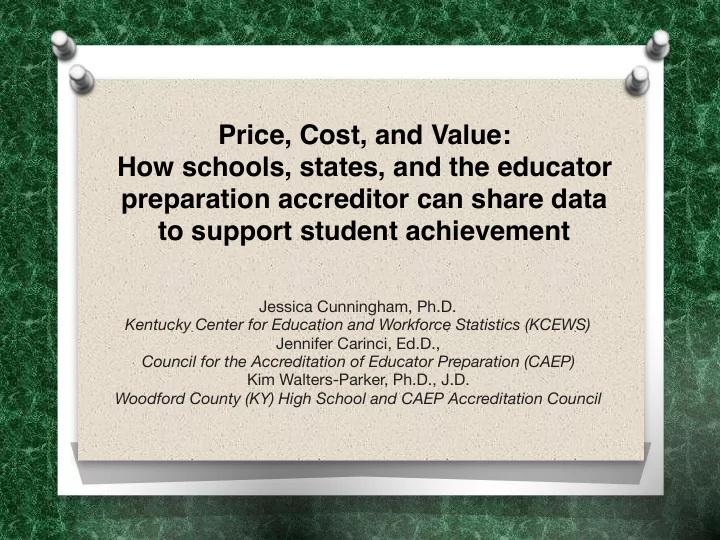
Price, Cost, and Value:
How schools, states, and the educator preparation accreditor can share data to support student achievement
Jessica Cunningham, Ph.D. Kentucky Center for Education and Workforce Statistics (KCEWS) Jennifer Carinci, Ed.D., Council for the Accreditation of Educator Preparation (CAEP) Kim Walters-Parker, Ph.D., J.D. Woodford County (KY) High School and CAEP Accreditation Council
SLIDE 2
Session Objectives
➢ Broaden participants’ appreciation and
understanding of data sharing opportunities across schools, districts, states, and educator preparation providers (EPPs)
➢ Demonstrate how Kentucky’s data system
informs many stakeholders by analyzing the same data in different ways for different purposes.
➢ Inform participants of how to leverage CAEP’s
standards for educator preparation providers to drive growth in P-12 student achievement.
SLIDE 3
What is CAEP?
➢ Council for the Accreditation of Educator Preparation ➢ Formed by consolidation of NCATE & TEAC ➢ CHEA-recognized accreditor of ed prep ➢ CAEP’s mission and vision ➢ CAEP is governed by a Board of Directors, whose
members represent stakeholder groups
➢ Accreditation decisions are made by the Accreditation
Council, whose members represent stakeholder groups
➢ #HelpUsHelpYou
SLIDE 4
Flip or Flop?
➢ Buy a house in need of repairs. ➢ Fix it up and stage it for potential buyers. ➢ Sell the fixed-up house for a profit. ➢ Genius! What could possibly go wrong?
SLIDE 5 Why are price, cost, and value distinctions important?*
➢ The price of an assessment: $100 ➢ The cost of an assessment: $100 plus everything
you are giving up in order to use the assessment.
➢ The value of an assessment: What am I going to
get from this assessment that I would not have had I not spent the $100?
➢ IOW, we want to flip, not flop.
➢ *We are using informal definitions, not strict economic definitions.
SLIDE 6
Why avoid an assessment data flop?
➢ Leverage data for improved student achievement ➢ Especially when spending public funds, we need
a fiduciary perspective.
➢ PLUS, kids deserve the most effective and
efficient education experience we can offer them.
SLIDE 7
Kentucky had some budget issues….
➢ State Senator Morgan McGarvey ➢ What did Senator McGarvey mean by that?
SLIDE 8
A little data
➢ Widely cited estimate of spending for state P-12
assessments: $1.7 billion per year.
➢ $550 per teacher? ➢ That’s just price: What is the cost? ➢ What about the value? ➢ Does it provide a good ROI? ➢ Who is asking about ROI for assessment dollars? ➢ If we are using assessments others chose for us,
what can we do to improve the ROI at our own level— state, district, or school?
SLIDE 9 Preview of an Example
➢ In Kentucky, public school juniors take a state-
funded ACT.
➢ Price: ________ ➢ Cost: _________ ➢ Value: Who gets an ROI on Kentucky’s $$ spent
➢ Students and families ➢ Schools ➢ State ➢ Postsecondary education, employers, etc.
SLIDE 10
EPPs use, collect, and report data
➢ EPP-level data ➢ Program-level data ➢ Candidate-level date when possible ➢ States, EPPs & CAEP: How can we leverage
ACT data?
➢ Candidate data ➢ EPP effectiveness/ value-add
SLIDE 11
CAEP Standards
SLIDE 12 Cost of Ineffective Teacher
➢ "Errors made in the selection process have direct and far
reaching consequences for students, administrators, other teachers, and the functioning of the school as a whole.“
➢
(Ebmeier & Ng, 2005, p. 202)
➢ Students assigned to different teachers experience substantial/
persistent variation in achievement growth has further underscored the importance of recruiting high quality teachers.
➢
(e. g., Aaronson, Barrow, & Sander, 2007; Kane, McCaffrey, Miller, & Staiger, 2013; Kane, Rockoff, & Staiger, 2008; Rivkin, Hanushek, & Kain, 2005)
➢ Opportunity: state data to link teacher quality with factors
- bservable at the time of hire.
➢
(Rockoff, Jacob, Kane, & Staiger, 2011)
SLIDE 13 Cost of Teacher Turnover
➢ Explicit costs: large estimates
(e.g., advertising, interviewing, and onboarding) associated with replacing a teacher who leaves
➢
costs generally over $3,000 per teacher hired
➢
(Barnes, Crowe, & Schaefer, 2007; Milanowski & Odden, 2007)
➢ Implicit costs: negative impact on student achievement,
➢ independent of relative effectiveness of outgoing/incoming staff
➢
(Atteberry, Loeb, & Wyckoff, 2017; Ronfeldt, Loeb, & Wyckoff, 2014)
➢ Opportunity: state data to explore connection between
teacher education/induction and teacher retention
SLIDE 14 Teacher Preparation Research Gaps
➢ Unclear the ways in which programs affect the
quality of teacher candidates.
➢
“If the primary mechanism is teacher development, then improvement in the actual training of prospective teachers depends on knowing something about the efficacy of that training.”
➢
“If the primary mechanism is through selection processes then we could probably find ways to select effective teacher candidates faster and at a lower cost than we do currently.”
➢ Opportunity: need appropriate state data to
disentangle program versus selection effects
Goldhaber, D., & Ronfeldt, M. (in press). Toward Causal Evidence on Effective Teacher
- Preparation. In Carinci, J., Meyer, S., & Jackson, C. (Eds.) (in press). Linking Teacher Preparation
Program Design and Implementation to Outcomes for Teachers and Students. Charlotte, NC: Information Age Publishing.
SLIDE 15 Strength in Numbers
State Collaboration
➢ Even with the seemingly large 1.7 billion dollar annual price tag,
➢
State assessment spending = only 0.25% of K-12 education spending.
➢ Suggests quality/utility of assessments more pressing than cost
itself
➢ Opportunity: collaboration within and across states to form
assessment consortia
➢
Advantage of costs savings (e.g., estimated 25% for state of 500,000 students)
➢
Greater resources to invest in improving assessment effectiveness
➢
Parallel experimentation to advance high –quality design/implementation
SLIDE 16
Strength in Partnership
Opportunity: Mutual Benefit State / Teacher Preparation Programs / CAEP
Continuum Area Addressed by Data Relevant to CAEP Standards Recruitment to Prep Components 3.1 and 3.2, if at entry
Standard 2 Standard 5
Preparation Standards 1 and 3, Component 2.3 Licensure Standard 1 Recruitment to School Standards 1-3 (per candidate), Standard 4 (past results) Induction Standard 4 (results from Standard 1 and 3, Component 2.3) Retention Components 4.3 and 3.1 Renewal/Recognition Components 4.1, 4.2, and 4.3
SLIDE 17
Opportunity: data sharing for stakeholder transparency
SLIDE 18 Return on Investment
➢
Increased when the following stakeholders/partners may be engaged in designing, implementing, analyzing data from, and sharing:
➢
Various departments in your state
(workforce, P-12, educator preparation, CIO, etc.)
➢
Across states
(e.g, where educators come from or go to;
assessment consortia)
➢
CAEP Accreditation
(better data = better decisions)
➢
Educator Preparation Programs
(for both teacher and administrators)
➢
Potential candidates
(transparency in choosing programs)
➢
Teachers
(professional development, retention, effectiveness)
➢
Public
(more informed policies, transparency,
understanding of investment, etc.)
SHARED GOALS:
Increased P-12 student achievement & stewardship
SLIDE 19 Resources
➢
Multistate Educator Lookup System (MELS) – consider joining this NASDTEC
initiative where benefits include tracking completers across states
➢
Accountability in Teacher Preparation: Policies and Data in the 50 States & DC (Council of Chief State School Officers & Teacher Preparation Analytics)
➢
Getting To Better Prep: A State Guide for Teacher Preparation Data Systems (TNTP)
➢
Approaches to Evaluating Teacher Preparation Programs in Seven States (Regional Education Laboratory Central)
➢
Using Data to Improve Teacher Effectiveness: A Primer for State Policymakers (The Data Quality Campaign) ➢
A c c r e d i t a t i
R e s
r c e s p a g e
C A E P w e b s i t e
➢
C A E P S t a n d a r d 4 e v i d e n c e : A r e s
r c e f
E P P s
➢
C A E P E v a l u a t i
F r a m e w
k f
E P P
r e a t e d A s s e s s m e n t s
➢
F a m i l y E n g a g e m e n t M i n i C
r s e f
c a n d i d a t e s a n d a c c
p a n y i n g r e s
r c e s f
f a c u l t y
SLIDE 21
Contact Us
➢ Kim Walters-Parker
➢ kwaltersparker@gmail.com ➢ @KimW_P
➢ Jessica Cunningham
➢ jessica.cunningham@ky.gov Education
Professional Standards Board ➢ Jennifer Carinci
➢ jennifer_carinci@yahoo.com