process in electronic health records 10th Biennal Conference of - - PowerPoint PPT Presentation

process in electronic health records
SMART_READER_LITE
LIVE PREVIEW

process in electronic health records 10th Biennal Conference of - - PowerPoint PPT Presentation

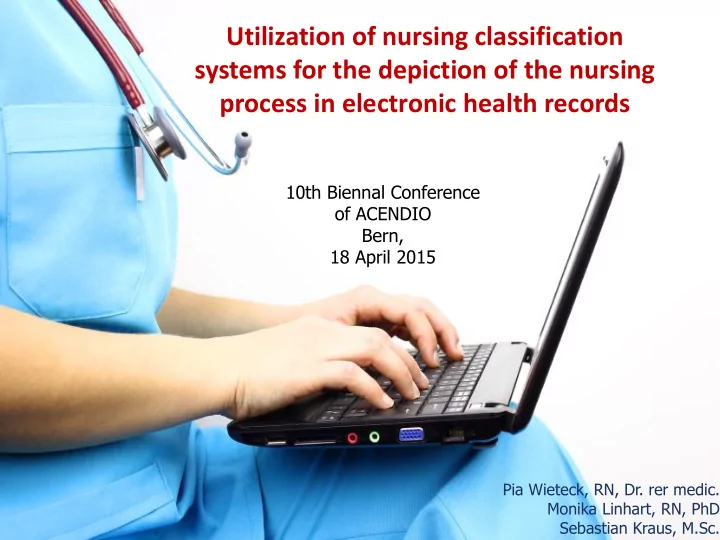
Utilization of nursing classification systems for the depiction of the nursing process in electronic health records 10th Biennal Conference of ACENDIO Bern, 18 April 2015 Pia Wieteck, RN, Dr. rer medic. Monika Linhart, RN, PhD Sebastian


slide-1
SLIDE 1

Pia Wieteck, RN, Dr. rer medic. Monika Linhart, RN, PhD Sebastian Kraus, M.Sc.

Utilization of nursing classification systems for the depiction of the nursing process in electronic health records

10th Biennal Conference

  • f ACENDIO

Bern, 18 April 2015

slide-2
SLIDE 2

Overview of the presentations

Aims of utilization nursing process data in electronic health/patient records Monika Linhart, RN, PhD Which granulation of nursing classification systems is needed to enable nursing documentation in electronic patient records?

  • Dr. Pia Wieteck

European Nursing care Pathways Giving Nursing a Language Sebastian Kraus M.Sc.

slide-3
SLIDE 3

EHRs were classified on the basis of the International Organization for Standardization (ISO) definition. According to this definition, the EHR means a repository

  • f patient data in digital form, stored and exchanged

securely, and accessible by multiple authorized users. It contains retrospective, concurrent, and prospective information and its primary purpose is to support continuing, efficient and quality integrated health care. ISO also gives a number of other terms commonly used to describe different types of EHRs.

Hayrinen, K., Saranto, K., & Nykanen, P. (2008). Definition, structure, content, use and impacts of electronic health records: a review

  • f

the research literature. Int J Med Inform, 77(5), 291-304. doi: 10.1016/j.ijmedinf.2007.09.001 ISO/DTR 20514, Health Informatics – Electronic Health Record – Definition, Scope, and Context, 2004

Electronic Health Record – What is it?

slide-4
SLIDE 4

Examples from the literature:

  • Quality dimensions, such as compliance with standards and

defined processes, as well as computer-aided reminder functions and the support of decision making come into awareness (Chaudhry et al. 2006)

  • Computer-assisted identification of high-risk patients leads to a

decrease of complications e.g. in the areas of deep vein thrombosis and pulmonary embolism (Kucher et al. 2005)

  • A longitudinal study showing a decline of pressure ulcers by the

support of IT in the area of pressure ulcer management (Willson et al. 1995)

  • The IT-based screening of prescribed drugs revealed, that about

2,5% of all prescriptions were not ideal and led to a prolonged hospital stay, higher costs and an almost twice higher risk of dying (Classen et al. 1997)

Proven benefits of an EHR

slide-5
SLIDE 5

Implicit rationing of nursing services in the German health care system

I‘m afraid I‘ve got no time for pneumonia- prophylaxis this time…

Survey results from an international study (RN4CAST): On average, 4.7 of 13 selectable care activities were rationed. Germany is thus one of the countries, along with Belgium, England and Greece, where more care activities remain "undone" compared with the mean values of other countries (Zander et al., 2014).

slide-6
SLIDE 6

Result:

Reference: Zander B et al. Gesundheitswesen 2014, p. 731

82% 54% 54% 43% 40% 37% 29% 28% 24% 22% 21% 19% 15% 0% 10% 20% 30% 40% 50% 60% 70% 80% 90%

Zeit für Zuwendung/Gespräche Aktualisierung von Pflegeplänen/Pflegebehandlungspfaden Beratung/Anleitung von Patienten Planung der Pflege Adäquate Dokumentation der Pflegearbeit Patientenüberwachung Mundpflege Hautpflege Vorbereitung auf die Krankenhausentlassung Regelmäßiges Umlagern Zeitgerechte Medikation Schmerzmanagement Behandlung und Prozeduren

Frequency of implicit rationing

From 13 areas of activity registered nurses (n = 1511 from 49 hospitals) selected the activities which could not be done in their shift, although this would have been necessary.

Treatment and procedures Pain management Timed medication periodic repositioning Preparing for the hospital discharge Skin care Oral care Patient monitoring Adequate documentation of the work done Care planning Advice/instructions of patients Updating care plans Time for affection/talks

slide-7
SLIDE 7

The consequences of implicit rationing for patients/residents are largely unknown

However, there are indications of: Falls, nosocomial infections, clinical incidents, pressure sores, pneumonia, fixation, death, ...

Studies show that a negative impact on the outcome has to be expected when there is an imbalance between the patients needs and factual satisfied care needs.

References: Schubert et al., 2012, Aiken et al., 2011, Aiken et al., 2014, McGahan et al., 2012, Ball et al., 2014, Staggs and Dunton, 2014, Patry et al., 2014, Assadian et al., 2007, Rogowski et al., 2013, Isfort, 2008b, Lang et al., 2004

slide-8
SLIDE 8

National

Nursing management Nursing practice

  • Basis for policy decisions
  • Shifts in the perfomance spectrum
  • Support/funding of Outcome research and

EBN

  • Just and reasonable personal management
  • Data for risk management
  • Data for quality management and marketing
  • Data für outcome measure
  • Simplified and more correct nursing

documentation

  • Support for decision-making
  • Systematic documentation of patient status
  • ver time
  • Support of process, information and

communication flow

EHR standadisied Nursing Terminologie

slide-9
SLIDE 9

EHR/ENP Nursing process Controlled vocabulary

Ne Next question – Which nursing classification system? System of terms, involving, e.g., definitions, hierarchical structure, and cross-references, that is used to index and retrieve a body of literature in a bibliographic, factual, or

  • ther database. (NICHSR, 2008)

e.g. ENP or NANDA and Nic and NOC or….

slide-10
SLIDE 10

Example for a nursing care plan with standardized terminology (ENP)

slide-11
SLIDE 11

Pia Wieteck, RN, Dr. rer medic.

Which granulation of nursing classification systems is needed to enable nursing documentation in electronic patient records?

slide-12
SLIDE 12

Overview

Requirements of nursing classification systems for a useful application in electronic health records Accuracy and abstraction level of various nursing classifications Potential impact of granularity on accuracy and explanatory power of nursing classification systems in relation to the nursing care process

slide-13
SLIDE 13

Useful application of nursing classification systems in electronic health records

Requirements for nursing classifications

"A precise and unambiguous illustration of the patient's situation and nursing intervention is a requirement"

  • Completeness to fully illustrate the nursing care process (Zielstorff 1998; Henry

et al. 1997, Bakken et al. 1998, von Krogh et al. 2012)

  • Representation of the current nursing knowledge in the form of

practice guidelines to support decision making (Gordon 1998)

slide-14
SLIDE 14

Accuracy – granularity of nursing classifications

„Presence of terms that represent a fairly coarse—and hence somewhat ambiguous and inconsistent—level

  • f

data abstraction that often blurs many of the clinical details essential to accurately capturing nursing practice in a “data-reuse- friendly” form;”

(vgl. Henry & Mead 1997)

“Whether nursing classification systems provide sufficient granularity to adequately capture nursing practice is controversial.”

(vgl. Moss et al. 2005)

slide-15
SLIDE 15

Useful application of nursing classification systems in electronic health records

Authors claim for example:

  • Complete and comprehensive depth and level of detail with sufficient

granularity to illustrate the clinical process; clinical benefit (Bakken Henry et al. 1998,

Zielstorff 1998, Gordon 1998, Von Krogh et al. 2012)

  • Unambiguity of the concepts without redundancy, avoidance of overlaps,

management of synonyms, definitions (Bakken Henry et al. 1998, Zielstorff 1998)

  • Hierarchies and inheritance with clear references to parent-child

relationships (Bakken Henry et al. 1998, Zielstorff 1998)

  • Attributes such as modifiers to illustrate eg severity (Bakken Henry et al. 1998, Zielstorff

1998)

  • Context-free terms/concepts (Bakken Henry et al. 1998, Zielstorff 1998)
  • Each term of the classification has a unique identifier (Zielstorff 1998)
  • Reliability and validity of the concepts (Gordon 1998)
slide-16
SLIDE 16

Useful application of nursing classification systems in electronic health records

Authors claim for example:

  • Complete and comprehensive depth and level of detail with sufficient

granularity to illustrate the clinical process; clinical benefit (Bakken Henry et al. 1998,

Zielstorff 1998, Gordon 1998, Von Krogh et al. 2012)

  • Unambiguity of the concepts without redundancy, avoidance of overlaps,

management of synonyms, definitions (Bakken Henry et al. 1998, Zielstorff 1998)

  • Hierarchies and inheritance with clear references to parent-child

relationships (Bakken Henry et al. 1998, Zielstorff 1998)

  • Attributes such as modifiers to illustrate eg severity (Bakken Henry et al. 1998, Zielstorff

1998)

  • Context-free terms/concepts (Bakken Henry et al. 1998, Zielstorff 1998)
  • Each term of the classification has a unique identifier (Zielstorff 1998)
  • Reliability and validity of the concepts (Gordon 1998)
slide-17
SLIDE 17

Granularity – abtraction level What exactly is meant by that?

Comprehensive depth and level

  • f

detail with sufficient granularity to illustrate the clinical process and to ensure a clinical benefit

slide-18
SLIDE 18

Granularity of nursing classifications and its meaning Broad granularity: Is the statement "France is hexagonal" correct?

Definition: Semantic clarity/accuracy of a linguistic expression (linguistics) degree of aggregation of data (computer science)

slide-19
SLIDE 19

Granularity of nursing classifications and its meaning

Fine granularity:

In a detailed and fine description

  • f France in regard to the form,

the statement France has the shape of a hexagon would be false.

slide-20
SLIDE 20

Attempt at definition: fine versus broad granularity

Self-care deficit washing in a patient after stroke

Bathing self-care deficit

Defining characteristics>

  • Inability to dry body
  • Inability to get bath supplies
  • Inability to obtain water

source Related factor:

  • Neuromuscular impairment

Wash the entire body

  • Severely impaired

Dry the entire body

  • Severely impaired

The patient is unable to carry out personal hygiene independently due to a hemiplegia/hemiparesis

Characteristics:

  • Is unable to wash/dry certain

parts of the body

  • Flaccid paralysis of the affected

side

  • Ignores the affected side
  • Disturbed balance when sitting

Etiology:

  • Cerebral vascular accident

The granularity (latin 'granum', grain) of a linguistic expression provides information on its (semantic) clarity (expressiveness, unambiguity of terms).

fine broad

slide-21
SLIDE 21

Granularity of nursing classifications and its meaning

Fine granularity versus broad granularity Specific formulation versus abstract formulation How accurate must nursing diagnoses describe the patient's condition or reflect what we observe/perceive/diagnose?

slide-22
SLIDE 22

Nursing care plan with NCS #1

Nursing diagnosis Defining characteristic Related factor

Oral swallowing

  • Problem moderate
  • Mr. Schuster
slide-23
SLIDE 23

Nursing care plan with NCS #2

Nursing diagnosis Defining characteristics Related factor

Impaired swallowing

  • Choking
  • Cough

Cerebral palsy

  • Mr. Schuster
slide-24
SLIDE 24

Nursing diagnosis Characteristics Etiologies

The patient only chokes when drinking, swallowing is impaired in the oral transport/pharyngeal stage

  • Expresses fear of drinking
  • Cough/throat cleaning

during/after swallowing fluids

  • Refuses the food/fluid

intake

  • Wet/gurgling voice quality

after swallowing Bolus slides predeglutitive (before the actual swallowing) into the throat Dementia

  • Mr. Schuster

Nursing care plan with NCS #3

slide-25
SLIDE 25

Case study Mr. Schuster

As a result of progressive dementia, Mr. Schuster chokes when drinking. He often coughs after drinking or clears his throat. He often refuses drinking and prefers eating soups with a creamy consistency. Because of the increase of the nursing problem and concerns about pneumonia as a result of microaspiration, you carry out a case review. In addition, there are signs of fluid deficit of Mr. Schuster due to avoidance attitude.

  • Mr. Schuster
slide-26
SLIDE 26

What do you think about Mrs. Meier's care plan? Please discuss the various care plan excerpts 1, 2, 3. AND Answer the question: which level of information is necessary to plan adequate nursing interventions?

slide-27
SLIDE 27

Excerpt from a cross-mapping study NANDA-I and ENP

Bi-directional cross-mapping

  • f NANDA-I

and ENP nursing diagnoses Expert rating of the cross mappings in terms of completeness, expressiveness and unambiguity RESEARCH METHOD

RESEARCH DESIGN

Non experimental, descriptive, comparative cross-sectional study

slide-28
SLIDE 28

Evaluation Category: ENP  NANDA-I Mapping according to Zielstorff (1998)

ENP NANDA-I NANDA-I NANDA-I

Same source vocabulary is identical in wording Similar source vocabulary is comparable, or alike in substance to the term in the target vocabulary Broader source vocabulary is larger in scope, or less specific Narrower source vocabulary is smaller in scope, or more specific Not Mapped (Extension of the Evaluation Catagories according to Zielstorff 1998)

slide-29
SLIDE 29

RESULTS: ENP  NANDA-I mapping

ENP

The patient is at risk of an allergic reaction NANDA-I Danger of an allergic reaction caused by latex ENP The patient is unable to carry out personal hygiene independently due to a hemiplegia/hemiparesis NANDA-I Self care deficit: personal hygiene ENP The patient is at risk of hyperglycemia/hypoglyce mia

ENP NANDA-I NANDA-I NANDA-I

ENP total 515

ENP

The patient has a spontaneous release of urine at regular intervals at a given bladder volume (reflex incontinence) NANDA-I Reflex urine incontinence

slide-30
SLIDE 30

Results: Expert Evaluation – Clarity/unambiguity

Bar chart: allocation of the rater judgment in percent

Compared to NANDA-I

higher unambiguity of ENP same / similar unambiguity

  • f ENP

Lower unambiguity

  • f ENP
slide-31
SLIDE 31

Compared to NANDA-I

Bar chart: allocation of the rater judgment in percent

RESULTS: expert evaluation - expressiveness

higher expressiveness

  • f ENP

same / similar expressiveness of ENP Lower unambiguity Expressiveness

  • f ENP
slide-32
SLIDE 32

Summary of partial results of the study

It was shown in the study that a finer granularity contributes to an increase in expressiveness and clarity/accuracy. NANDA-I: Dysfunctional ventilatory weaning response (Narrower) ENP: The patient is ventilated, there is a risk of complications (Broader) NANDA-I: Ineffective therapeutic regimen management (Broader) ENP: The patient is at risk of not achieving health related aims due to a lack of information/skills associated with diabetes (Narrower)

slide-33
SLIDE 33
slide-34
SLIDE 34

10th Biennal Conference

  • f ACENDIO

Bern, 18 April 2015

European Nursing care Pathways

Giving Nursing a Language

Sebastian Kraus

(RN, B.A., M.Sc.)

1

slide-35
SLIDE 35

Str truct ctured ill llustr trati tion of f th the nursi sing process ss in in th the context t of f docu cumentati tion in in a standardized professional la language

  • Support of the communication process
  • Support of processes and transitional care
  • Support of performance transparency in nursing
  • Structuring of the current nursing knowledge
  • Support of quality development, nursing staff calculation and
  • utcome measurement
  • Support of decision-making processes and critical thinking

References: Figosky & Downey 2006, Bartholomeyczik 2000, Bates et al. 2003, Titler et al. 2005, Gordon 2001, Gordon 2010, Johnson 2006

Aims of ENP

2

slide-36
SLIDE 36

Outline of the ENP history

  • 1989: Beginning of the inductive

development in three stages

  • 1994: Publication of the first catalogue

Containing nursing problems, outcomes and interventions

  • 1996: Representation of the ENP catalogue in IT
  • 1998: Establishment of a research department
  • from 2000: evidence-based development

(validation studies, cross-mapping, systematic reviews, ...)

3

slide-37
SLIDE 37

Division into three sections The structure of ENP

Pictures: www.istockphoto.com

  • ENP... as pre-combination of

the elements of this nursing classification system

  • ENP... as practice guidelines

developed from the pre- combination

  • ENP... as a nursing

classification system for a total

  • f seven groups

4

slide-38
SLIDE 38
  • Nursing problems / phenomena
  • Characteristics
  • Etiologies
  • Resources
  • Nursing objectives
  • Interventions
  • Intervention specifications

Seven groups: : components ENP classifies... across sectors!

5

slide-39
SLIDE 39

ENP pre-combines

Nursing problem (P)

+

Etiologies

Characteristics/ Symptoms

  • r
  • Nursing diagnosis

The patient is impaired in verbal communication due to motor aphasia (Broca's aphasia)

Impaired verbal communication Motor aphasia (Broca's aphasia)

Picture: P. Vaclavek (www.fotolia.com)

6

slide-40
SLIDE 40

Characteristics/Symptoms

  • Strongly pronounced

agrammatism

  • Strongly halting speech flow
  • Uses commonplace phrases
  • Uses meaningless phrases

and/or stereotypes

Reference points and standardized syntax of the nursing diagnoses in ENP

The patient is impaired in verbal communication due to motor aphasia (Broca's aphasia)

Etiologies

Pathophysiologic causes

  • Degenerative process of the brain
  • Congenital vascular malformations
  • ...

Disease-related causes

  • Cerebral vascular accident
  • Encephalitis

Individual Specification (here: etiology) Nursing problem / phenomenon

7

slide-41
SLIDE 41

Result: practice guidelines for decision-making

Nursing diagnoses

Characteristics/Symptoms

Etiologies

Nursing

  • bjectives

Interventions

Detailed instructions Resources Scales References Indexation Illustration of the nursing process in the form of a care pathway representing the current knowledge, individualized for each patient!  Invitation to critical thinking!  Practice guidelines as (short range) modified practical theories Normative time values

References: Dickoff et al. 1968a & 1968b, Walker & Avant 1998

8

slide-42
SLIDE 42

The structure of ENP: Clear definitions Examples:

A nursing diagnosis in ENP is the term nurses use, if possible, together with a person affected based

  • n

the systematic assessment/evaluation with regard to the health status and his/her mental, physiological and developmental state, or his reaction to health problems that provide the basis for decision-making regarding nursing outcomes and interventions that must be selected. ENP characteristics are indicators, symptoms and expressions

  • f

the person

  • affected. These help to identify

the nursing diagnosis/problems

  • r

to differentiate the nursing diagno- sis/problem from each

  • ther.

These indicators can describe symptoms, further features

  • f

the problem, biographic

  • r

historical, physiological or psychological indicators, a described verbal expression of the person affected regarding the problem, reported reactions of a human being or risk factors.

9

slide-43
SLIDE 43

ENP: a monohierarchical classification system

Domain Class Category Subcategory

Functional/ physiological area

Definition: Includes all ENP practice guidelines, which lead to restrictions and / or loss of self-care skills to meet the basic physiological needs and / or health risks as a consequence of changes in body functions and structures.

Personal hygiene/clothing

Self-care deficit washing Self-care deficit oral hygiene Self-care deficit hair care Self-care deficit dressing

Respiration

Definition: Includes the respiratory functions of ventilation (inspiration and expiration, function of the muscles of respiration), gas exchange between air and blood, as well as the self-cleaning function of the respiratory tract.

Ineffective self-cleansing function

  • f the respiratory tract

Insufficient respiration The patient has insufficient respiration due to dyspnoea Risk of respiration insufficiency The patient is ventilated, there is a risk of insufficient respiration Risk of suffocation The patient has serous foamy sputum associated with acute dyspnea, there is insufficient respiration Risk of aspiration

Risk of atelectasis/pneumonia Risk of impaired respiration postoperatively

Group: Nursing problems / phenomena

10
slide-44
SLIDE 44

The structure of ENP: Summary

11

slide-45
SLIDE 45

Current status: scope and evidence level of ENP

Terms/concepts of the group Items v2.5 Items v2.6 Items v2.7 Items v2.9

Nursing diagnoses 521 542 548 552 Characteristics / Symptoms 2230 2719 2905 3984 Etiologies 1799 2282 2426 3526 Ressources 379 457 473 648 Nursing objectives 1435 1683 1724 1852 Nursing interventions 2494 2511 2558 2615 Intervention specifications 3652 4285 4461 4797

  • Systematic literature-based revision of about 1/5 of all practice guidelines
  • Growing number of ENP validation studies (completed and in progress):
  • Implementation and evaluation in nursing practice
  • Securing content and criteria validity
  • Cross-mapping, expert rating
  • Student theses

References: Baltzer et al. 2006, Kossaibati & Berthou 2006, Del Negro 2012, Berger 2010, Schmitt 2010, Wieteck 2008

Each item has a unique and unchangeable ID number!

12

slide-46
SLIDE 46

Each systematically revised nursing diagnoses is supported by a definition:

New elements since 2014

The patient is impaired in verbal communication due to motor aphasia (Broca's aphasia)

Impaired or lacking ability to actively participate in verbal communication after completion of language acquisition due to a central speech disorder with the lack of grammatical structures in the sentence structure as a leading symptom.

(DGN 2012, Wehmeyer et al. 2006, ICNP Aphasia [10002438], ICF Communicating with - receiving - spoken messages [d310], ICF Speaking [d330])

The revision history and the level of evidence (based on NANDA-I) is shown for the respective ENP nursing diagnosis:

Revision history: 1991, 1994, 2004, 2008, 2014

ENP practice guideline ENP nursing diagnosis

Level of evidence: LoE 3.2 LoE 3.2

13

slide-47
SLIDE 47

Systematic further development today

Analysis of user databases New scientific findings (studies, guidelines, etc.) Practice projects with institutions Findings of previous ENP validation studies Feedback from end users European Nursing care Pathways (ENP), starting version

Influencing factors on the further development Elements of the systematic further development

  • a. Determination of the topics to be revised
  • b. Determination of a revision strategy
  • c. Systematic literature review and analysis
  • d. Revision of the ENP catalogue and consensus
  • e. Validation of the additions/changes/deletions

European Nursing care Pathways (ENP), new version Systematic translation of ENP (English, Italian, French, Spanish) Hypotheses for nursing research Current topics in public health

14

slide-48
SLIDE 48

References: Wieteck 2007, Wieteck 2004, Berger 2010

Limits of ENP

  • ENP can (and should) not replace the nurses expert knowledge
  • ENP is not complete:

– i.e about 23% of the NANDA-I nursing diagnoses can not be illustrated with ENP – About 18% of formulations in nursing care plans had to be added individually (2007)

  • Currently, there are only a few validation studies which include a

review of an entire practice guideline

  • The operationalized scales for outcome measurement are partly

not yet validated (e.g. own developments)

  • ENP is not yet tested in some areas in practical use (e.g. recovery

room, operating theatres, neonatal intensive care unit)

  • Not all important questions for management, research and

education can be answered from the data obtained with ENP

15

slide-49
SLIDE 49

www.recom.eu/get-enp/

slide-50
SLIDE 50

Thank you for your attention!

Sebastian Kraus (skraus@recom.eu)

16

slide-51
SLIDE 51

Any questions?