process or show I ng a product tha tell c I ts from the studen t s, - - PDF document

process or show i ng a product tha tell
SMART_READER_LITE
LIVE PREVIEW

process or show I ng a product tha tell c I ts from the studen t s, - - PDF document

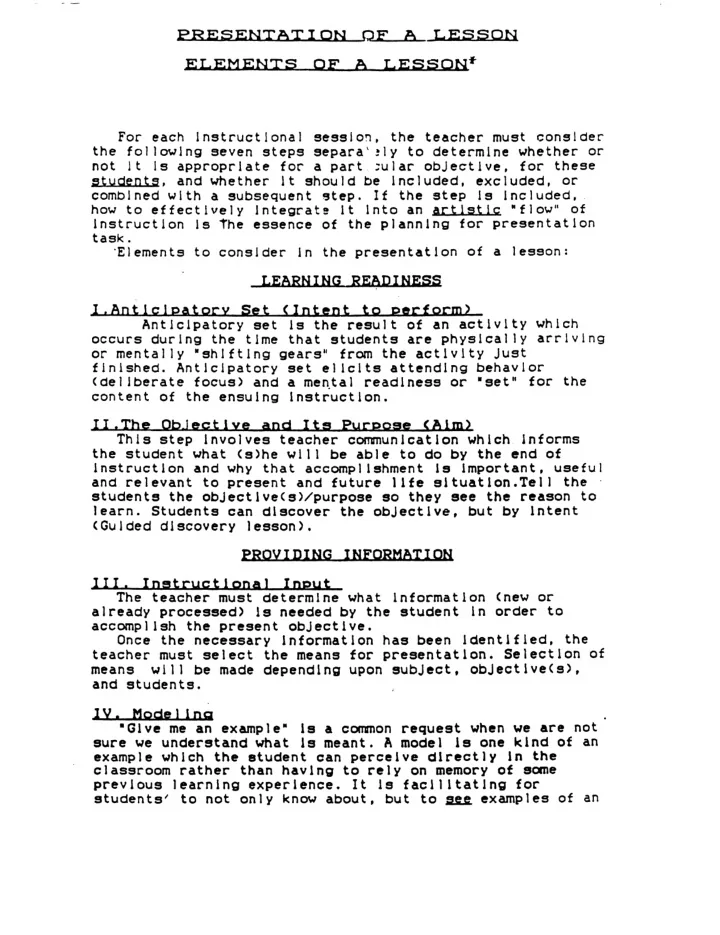
seslo~. PRESENTATION OF A LESSON ELEMENTS OF A LESSON* For each Instructional the teacher must consider the following seven steps separa l !Iy to determine whether or not Jt Is approprIate for a part ;ular obJective. for these students. and whether


slide-1
SLIDE 1

PRESENTATION OF A LESSON ELEMENTS OF A LESSON*

For each Instructional

seslo~.

the teacher must consider the following seven steps separa l !Iy to determine whether or not Jt Is approprIate for a part ;ular obJective. for these

  • students. and whether it should be included. excluded. or

combined with a subsequent 9tep. If the step Is Included. how to effectively Integrate It Into an artistic "flow" of

Instruction Is the essence of the planning for presentation task.

"Elements to consider In the presentatIon of a lesson: LEARNING RE~DINES

1.AntlcIpatory Set (Intent to perfocm)

Anticipatory set Is the result of an actIvIty which

  • ccurs during the tIme that students are physIcally arriving
  • r mentally ·shifting gears·' from the activity Just
  • finished. AntIcipatory set elicits attending behavior

(delIberate focus) and a me~tal readiness or ·set" for the content of the ensuIng Instruction.

II.Tbe ObjectIve and Its Pyrpose (Aim)

This step involves teacher communIcatIon which Informs the student what (s)he wII I be able to do by the end of

instruction and why that accomplIshment Is Important, useful

and relevant to present and future lIfe situatlon.Tell the

students the obJective(s)/purpose so they see the reason to

  • learn. Students can discover the obJective, but by Intent

(Guided dIscovery lesson).

PROVIDING INFORMATION I I I. r net

Cy c t 1 on

a 1 ropy t The teacher must determine what information (new or

already processed) 1s needed by the student In order to accomplish the present obJective.

Once the necessary InformatIon has been IdentIfied, the

teacher must select the means for presentation. Selection of

means wIll be made depending upon subject, obJectlve(s), and students. I y. Mode 1 1

DC

·Give me an example" Is a common request when we are not sure we understand what Is meant. A model Is one kind of an

example whIch the student can perceive directly In the

classroom rather than havIng to rely on memory of some previous learning experience. It Is facIlItatIng for

students' to not only know about, but to ~

examples of an

slide-2
SLIDE 2

acceptable finished product (story, pcem, model, dJagram,graph, problem) or a process (how to IdentIfy the

maIn Idea, artIculate thinking whIle proceeding In the

assignment, kick a ball). Model)ng is

demo~stratlng

a

process or show I ng a product tha tell

c I ts from the studen t s,

  • I see what you mean! A model may

b~

concrete, such as a

model of thl human heart or a model of a miniature clly. A model may be a replicatIon such as a pIcture, or symbolIc such as a diagram or map. Or a model may be verbal, written,

  • r spoken, such as a paragraph, sonnet or al I IteratIon, or

math example. ASSESSMENT

  • y. Checking for Understandln9-

The teacher needs to check for students' possession of

essential Information and also needs to observe students'

performance to make sure they exhibit the skll Is necessary

to achieve the Instructional objective.

PRACTICE

  • VI. Gylded Practice

Guiding Initial practlce.The beginning stages of

learnIng are crItical In the determination of future successful performance. Consequently, the student's Initial attempts In new learning should be carefully guided so they are accurate and successful.

  • VII. Independent PractIce

Students work independently. Once the student can perform without major errors, discomfort or confusion. (s)he is ready to develop fluency by practicing without the

avaIlability of the teacher. Only then student~

can be given a written or verbal aSSignment to practice the new

skill with little or no teacher direction. Students can be

assigned seatwork or homework can be started in this part.

The Input, Hodellng. Checking for Understanding, and when approprIate, Guided Practice parts of the lesson are

cyclical and repeated several times during the lesson. Input

and ModelIng) are always followed by Checking for Understanding (assessment). GuIded Practice may be

appropriate In the cycle. Do not teach much without assessing extent of learnIng. ReteachIng wll I fol low. If necessary.

A summary or closure 1 e a re··sta temen t of what has been

learned and is considered to be either a part of Checking for UnderstandIng or Input. It mai occur at the end or during the lesson (medial), as appropriate. *Materlal extracted from Mastery TeachIng

by MadelIne Hunter and ·Plannlng for Effective Instruction Lesson Degign" by Doug Russell and Madel ine Hunter

slide-3
SLIDE 3

, l ,

CXlJRSE CXDE

ELED

SPRIN:i 2002

PAGE

511

SlMt1ARY FOR ENTIRE DEPARTMENT/PREFIX PERCENT RESPQII)If\.G INDIVIDUAL ITEMS 1 SUBVECT MASTERY

2 PRESENTATIOII

3 SlU)ENT PARTICIPATICJ\I 4 WESTICJ\I El'mJRAGEMENr 5

RESPCJIISE TO WESTICJ\IS

6

CLEAR GRADII'IG

7 FAIR GRADII'IG 8

FEEDBACK WALITV

9

PACE OF COURSE

10 OFFICE I-DJRS 11 INSTRUCTOR REca.t.1ENDATICJ\I 12 CLASS ATTEN:>ANCE 13 DIFFIQJLTV 14 I<NlWLEDGE 15 READING MATERIAL 16 EXAMS BASED CJ\I COVERED MATERIAL 17 DEVELOPMENT OF WRITING SKILLS 18 LEARN FID'I GRADED PAPERS/EXAMS 19 EXAM!PAPER DEMAND 20 <DJRSE REca.t.1ENDATICJ\I 21 <DJRSE/INSTRUC'T!lR RECDtt@IDATICJ\I

SCALE SCORES (CJJTSTANDIf\.G) (ALWAYS CLEAR) (ALWAYS) (ALWAYS) (CLEAR) (ALWAYS) (ALWAYS) (CJJTSTANDIf\.G) (TOO FAST) (ALWAYS) (CJJTST AfollIf\.G)

(ESSENTIAL)

(EXTREMELY DIFFIQJLT) (INCREASED.GREATLY)

(DIFFIQJLT)

(ALWAYS) (A GREAT DEAL) (A GREAT DEAL) (TOO DIFFIQJLT) (CJJTSTANDIf\.G) (CJJTSTANDII'IG )

123 4

73 18 . 7 1 61 23 13 3 81 12

6 1

73 17 8 1 65 21 10 2 58 22 13 5 63 21

11

4 57 25

11

5 4 16 74 3 75 15 9 1 59 22 12 5 59 22 13 3 4 26 56 10 55 24 13 4 3 21 66 7 54 18 24 2 36 31 24 5

5026184

3 21 71 4 49 27 17 4 58 21 13 5 5 1 (BELOW AVERAGE) 1 (ALWAYS lJIK:LEAR)

  • (NEVER)
  • (NEVER)

1 (

CCJ\IFUSIf\.G)

2 (NEVER)

1 (NEVER)

2 (lJIK:LEAR) 2 (TOO SL.OW) 1 (NEVER) 2 (BELOW AVERAGE) 3 (lNIIECESSARY) 4 (EXTREMELY EASY) 4 (REMAINED 1l£ SAME)

4 (EASY)

2 (NEVER) 4 (NDT AT ALL) 2 (tIDT AT ALL) 1 (TOO EASY) 2 (BELOW AVERAGE) 3 (BELOW AVERAGE)

1) OVERALL EVALUATICJ\I OF INSTRUCTOR AND caJRSE(ITEMS " 2, 5, ii, 14, 18, 20, 21)

2) ~/DIFIQJLTV (ITEMS 9, 13, 15, 19) 3) GRADI~FEtBACX QJALITV (ITEMS 6, 7, 8, 16) 4) INTERACTIIl'I/El'mJRAGEMENr (ITEMS 3, 4)

NOTE: FOR SCALES " 3, AND 4, LOWER SCORES REFLECT BETTER RA TIf\.GS, w-fEREAS FOR SCALE 2, THE OPTIMAL RESPQIISE IS A 3. BACXGRa.NJ INFORMATIOII (PERCENT RESPtHIIf\.G) 22 I!HV TAKIf\.G COURSE INTEREST: 5 REWIRED: 92 RECDII: 2

FITS sa-i: 23 CLASS STANDIf\.G

FRESH: 2 SOPH: 3

... l.MOR:

23 SENIOR: 20 24 TRANSFER SlU)ENT YES: 21

ND:

79 25 OOERGRAOUATE DEGREE BA: 73

85:

3 BS IN ED: 23 BBA: 26 GRADJA TE DEGREE MASTERS: 100 CERTIFICATE: PO: DOCTORATE: 27 t-DFSTRA GPA

3.51-4.0: 62 3.01-3.5:

29

2.51-3.0:

8

2.01-2.5: 28 CLASS ATTENDMCE

ALWAYS:

81 MJSTLY: 18 StNETIMES: RARELY: 29 to1E'ItORK TIME < 2: 22 2 TO < 5: 46 5 TO < 9: 22 9 TO < 12: 6 30 DESERVED GRADE A TO A-: 91 B+ TO B-: 9 C+ TO c-: D+ TO D-: 31 EXPECTED GRADE A TO A-:

85 B+ TO B-: 14 C+ TO C-: D+ TO D-: OTHER: GRADUATE: BFA: <= 2: NEVER: => 12:

F: F:

MEAN

1.4 1.6 1.3 1.4 1.6 1.7 1.6 1.7 2.8 1.4 1.7 1.7 2.9 1.8 2.9 1.8 2.1 1.8 2.8 1.8 1.7

52 5 1.7

2.9 1.7 1.4