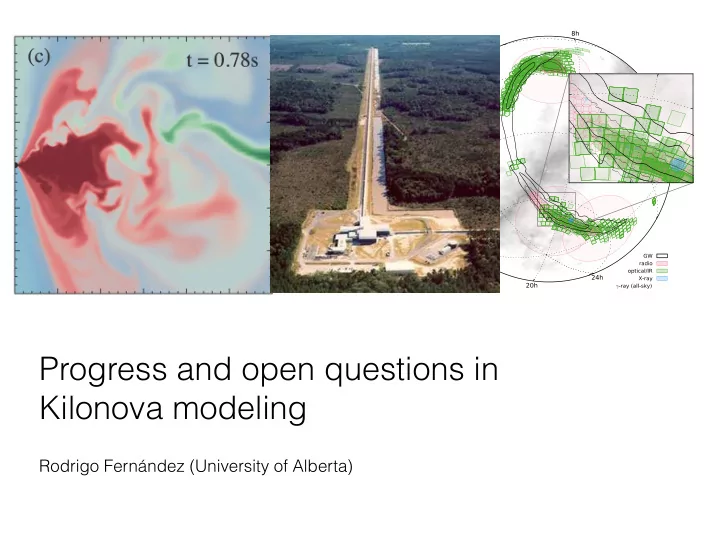
Progress and open questions in Kilonova modeling Rodrigo Fernndez - - PowerPoint PPT Presentation

progress and open questions in kilonova modeling
SMART_READER_LITE
LIVE PREVIEW

Progress and open questions in Kilonova modeling Rodrigo Fernndez - - PowerPoint PPT Presentation

Progress and open questions in Kilonova modeling Rodrigo Fernndez (University of Alberta) Overview 1. Neutron star merger ejecta and r-process 2. Kilonova properties 3. Current and Future directions Neutron Star Mergers RF & Metzger


slide-1
SLIDE 1

Progress and open questions in Kilonova modeling

Rodrigo Fernández (University of Alberta)

slide-2
SLIDE 2

Overview

  • 1. Neutron star merger ejecta and r-process
  • 3. Current and Future directions
  • 2. Kilonova properties
slide-3
SLIDE 3

Neutron Star Mergers

RF & Metzger (2016)

slide-4
SLIDE 4

NS mergers dynamics

  • inspiral
  • merger

Rezzolla+ (2010)

Unequal mass NS-NS merger:

Phases:

  • remnant + ejecta
slide-5
SLIDE 5

NS mergers: Basic Elements

Rezzolla+ (2010)

Unequal mass NS-NS merger: dynamical ejecta accretion disk central

  • bject
  • inspiral
  • merger

Phases:

  • remnant + ejecta
  • relativistic jet (?)

Large body of work: MPA, Kyoto, Caltech-Cornell-CITA Princeton, Frankfurt, Stockholm, etc.

slide-6
SLIDE 6

Ejecta Geometry depends on Binary Type

Rezzolla+ (2011) Foucart+ (2015)

NS-NS mergers NS-BH mergers

slide-7
SLIDE 7

NS mergers: EM emission

Metzger & Berger (2012)

1) SGRB if on-axis 2) Orphan afterglow 3) Magnetospheric precursor 5) Late-time radio transient 4) Kilonova

Paczynski (1986), Eichler+ (1989) e.g. van Eerten+ (2010), Nakar & Piran (2011) e.g., Hansen & Lyutikov (2001), Palenzuela+ (2013) Metzger & Zivancev (2016) Nakar & Piran (2011), Hotokezaka+(2016) Li & Paczynski (1998), Metzger+(2010), Roberts+(2011) Reviews: Rosswog (2015), Tanaka (2016), Metzger (2016)

slide-8
SLIDE 8

r-Process Nucleosynthesis

llnl.gov

~50% of elements heavier than Zinc (Z=30) require formation by ‘rapid’ neutron capture (r-process)

Neutron Proton Electron (+neutrino) Rapid neutron capture Unstable neutron-rich nucleus Beta decay to new element

tn−capture tβ−decay Astrophysical site not determined yet. Candidate sites: 1) Neutron Star Mergers 2) Core-Collapse Supernovae

Nuclear Chart & Solar System abundances: Burbidge et al. (1957), Cameron (1957) Möller, Nix, & Kratz (1997)

slide-9
SLIDE 9

NS mergers: Sub-Relativistic Ejecta

NS NS/BH

HMNS or BH + Disk + Dynamical Ejecta Neutron-rich ejecta undergoes radioactive decay: power-law

Metzger+(2010), Roberts+(2011), Korobkin+ (2012), Tanaka et al. (2014), Grossman+ (2014), Hotokezaka+(2016), Barnes+(2016), Rosswog+(2017) Metzger+(2010)

Merger outcome:

  • 1. Central HMNS or BH
  • 2. Material ejected dynamically
  • 3. Remnant disk

∼ t−1.3

slide-10
SLIDE 10

Kilonova (aka Macronova)

Supernova-like transient, but: 1) smaller ejecta mass 2) higher velocity 1) shorter duration 2) dimmer

(iron-like) (r-process A > 130) (Arnett’s rule) κ ∼ 10 − 100 cm2 g−1 κ ∼ 1 cm2 g−1 (Kasen) 100 − 104 cm2 g−1 (Fontes) (see also Kulkarni 2005)

slide-11
SLIDE 11

Optical opacity of Lanthanides (A>130)

Lanthanides have many more atomic levels Much higher opacity than iron Kasen+ (2013)

(The opacity sets the diffusion time: duration and luminosity)

See also: Fontes+ (2017) Fontes+ (2015) Tanaka & Hotokezaka (2013)

slide-12
SLIDE 12

Dynamical Ejecta

Composition dominated by heavy r-process (BH-NS) Roberts+ (2017) Korobkin+ (2012) See also: Bauswein+ (2013) Radice+ (2016) Wanajo+ (2014) Goriely+ (2013) Sekiguchi+ (2016) NS-NS

slide-13
SLIDE 13

Dynamical Ejecta: r-process kilonova

r-process Fe-like Theoretical kilonova spectra & light curves: Kilonova models from Barnes & Kasen (2013) (dynamical ejecta) Tanvir+ (2013) Berger+ (2013)

r-process-dominated material generates IR transient (large number of lines in optical)

see also Tanaka & Hotokezaka (2013)

slide-14
SLIDE 14

Wind from remnant accretion disk

  • Neutrino cooling shuts down as disk

spreads on accretion timescale (~300ms)

  • Viscous heating & nuclear

recombination are unbalanced

  • Fraction ~10% of initial disk mass

ejected, ~1E-3 to 1E-2 solar masses

  • Material is neutron-rich (Ye ~ 0.2-0.4)

RF & Metzger (2013), MNRAS

  • Wind speed (~0.05c) is slower than

dynamical ejecta (~0.1-0.3c)

Just et al. (2015), MNRAS RF et al. (2015), MNRAS Siegel & Metzger (2017), arXiv: 1705.05473 (GRMHD) Lee, Ramirez-Ruiz, & Lopez-Camara (2009) Metzger (2009)

slide-15
SLIDE 15

Disk wind vs. Dynamical Ejecta

RF & Metzger (2016) Hotokezaka+ (2013) Oechslin & Janka (2006) Just+ (2015) East+ (2012) Foucart+ (2014)

slide-16
SLIDE 16

Hypermassive NS versus BH

Metzger & RF (2014)

slide-17
SLIDE 17

HMNS lifetime and kilonova

Metzger & RF (2014) Longer lifetime more neutrino irradiation less neutrons smaller opacity bluer emission Kasen, RF, & Metzger (2015) Light curve in 3500-5000 A filter GRB 080503 (Perley+ 2009) z = 0.25

slide-18
SLIDE 18

Viewing angle dependence

3500 - 5000 A light curve as fn. of viewing angle BH-NS merger remnant: RF, Quataert, Schwab, Kasen & Rosswog (2015) Kasen, RF, & Metzger (2015)

slide-19
SLIDE 19

Interplay of disk wind and dynamical ejecta

RF, Foucart, Kasen, Lippuner, et al. (2016)

  • 1

1 2 z [107 cm] (a) t = 0 (b) 0.7 ms (c) 2.2 ms (d) 6.5 ms 1 2 3 x [107 cm]

  • 2
  • 1

1 z [107 cm] (e) 11 ms 1 2 3 x [107 cm] (f) 15 ms 1 2 3 x [107 cm] (g) 22 ms 1 2 3 4 x [107 cm] (h) 43 ms 105 107 109 1011 disk [g cm−3] 105 107 109 1011 fallback [g cm−3] 105 107 109 1011 unbound tail [g cm−3]

slide-20
SLIDE 20

Interplay of disk wind and dynamical ejecta

RF, Foucart, Kasen, Lippuner, et al. (2016)

  • 1

1 2 z [107 cm] (a) t = 0 (b) 0.7 ms (c) 2.2 ms (d) 6.5 ms 1 2 3 x [107 cm]

  • 2
  • 1

1 z [107 cm] (e) 11 ms 1 2 3 x [107 cm] (f) 15 ms 1 2 3 x [107 cm] (g) 22 ms 1 2 3 4 x [107 cm] (h) 43 ms 105 107 109 1011 disk [g cm−3] 105 107 109 1011 fallback [g cm−3] 105 107 109 1011 unbound tail [g cm−3]

slide-21
SLIDE 21

RF, Foucart, Kasen, Lippuner et al. (2016)

Early Optical Emission even for Dynamical Ejecta dominated kilo nova

Barnes & Kasen (2013) See also: Tanaka & Hotokezaka (2013) Rosswog+ (2017) Grossman+ (2014) Wollaeger+ (2017) effect also discussed in Kasen+ (2013)

slide-22
SLIDE 22

Effect of viewing angle

RF, Foucart, Kasen, Lippuner et al. (2016)

slide-23
SLIDE 23

Diversity of Outcomes & Transients

Kasen, RF, & Metzger (2015) (Metzger+ 2015)

slide-24
SLIDE 24

Future Kilonova Issues (Theory)

  • 1. Optical & IR opacities of r-process elements
  • 2. MHD & neutrino transport in merger/remnant simulations
  • 4. Interplay with jet & SGRB
  • 3. Improved r-process calculations: abundances & opacities
  • 5. Other sources of energy?

Kisaka, Ioka, & Nakar (2016)

slide-25
SLIDE 25

Summary

Thanks to:

  • 1. The Kilonova is the most easily detectable EM counterpart

from a NS merger. The transient is powered by the radioactive decay of r-process elements made in the merger ejecta.

  • 3. The dynamical ejecta and the disk outflow contribute to the

Kilonova with different compositions. The resulting differences can be used to diagnose the physical conditions in the system.

  • 2. The optical opacity is very sensitive to the composition of the

ejecta, in particular if heavy r-process elements are made: this can make the difference between an optical or infrared transient