PROTON CERAMIC ELECTRODICS T. Norby, a R. Strandbakke, a E. Vllestad, - PowerPoint PPT Presentation
IDHEA, Nantes, France, 2-4 November 2016 PROTON CERAMIC ELECTRODICS T. Norby, a R. Strandbakke, a E. Vllestad, a Min Chen, a S.A. Robinson, a C. Kjlseth b a University of Oslo, Department of Chemistry, SMN, FERMiO, Gaustadallen 21, NO-0349
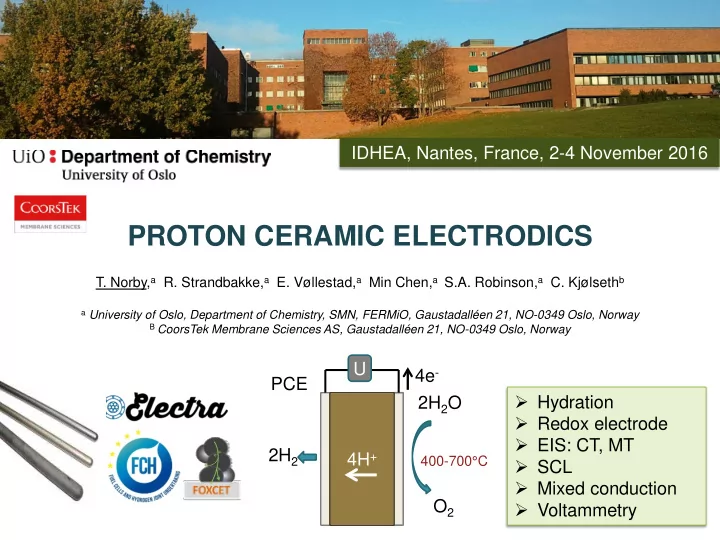
IDHEA, Nantes, France, 2-4 November 2016 PROTON CERAMIC ELECTRODICS T. Norby, a R. Strandbakke, a E. Vøllestad, a Min Chen, a S.A. Robinson, a C. Kjølseth b a University of Oslo, Department of Chemistry, SMN, FERMiO, Gaustadalléen 21, NO-0349 Oslo, Norway B CoorsTek Membrane Sciences AS, Gaustadalléen 21, NO-0349 Oslo, Norway U 4e - PCE Hydration 2H 2 O Redox electrode EIS: CT, MT 2H 2 4H + 400-700°C SCL Mixed conduction O 2 Voltammetry
The electrolyte; example Y-doped BaZrO 3 Doping reaction • • + → + + BaZrO / x 2BaO Y O 2Y v 5O 3 2 3 Zr O O Hydration • • • + + = x H O ( g ) v O 2 OH 2 O O O Note: This is not an electrode redox reaction. The charge carriers do not enter via an electrode reaction They are present in equilibrium with H 2 O(g)
Electrode redox reactions H 2 -side reaction − − − + ↔ + 2 H (g) 2O 2OH 2e 2 O O O 2 +H 2 O-side reaction − − − + + ↔ + 2 O (g) 4OH 4e 2H O(g) 4O 2 O 2 O
Electrode reaction pathways
H 2 -side + ↔ H (g) v H 2 ads 2, ads + ↔ H v 2 H 2, ads ads ads + ↔ + H v H v | 2 ads i i ads ↔ H H | 2 Diffusion i i, int + ↔ H (g) v H 2 ads 2, ads + ↔ H v 2 H 2, ads ads ads ↔ H H | 2 Diffusion ads ads, tpb + − ↔ + − + − 2 H O v OH e | 2 CT ads, tpb/i, int O ads, tpb/i, int O
O 2 +H 2 O side + ↔ O (g) v O 2 ads 2 , ads + ↔ O v 2 O 2 ads ads , ads ↔ O O | 2 Diffusion ads ads, tpb − − − − + + ↔ + + 2 O OH 2 e v OH O | 2 ads, tpb O ads, tpb ads, tpb O − − ↔ CT OH OH | 2 Diffusion ads, tpb ads − + − ↔ − + 2 OH OH O H O | 2 ads O O 2 ads ↔ + H O H O(g) v | 2 2 ads 2 ads
Charge transfer (CT) − − − + ↔ + + 2 H O v OH e ads, tpb/i, int O ads, tpb/i, int O 2 n Fi ( ) n F β − β = = 0 , 1 eq red red 0 red p H 2 - (and p H 2 O?)- G k Q Q red red , , , , ct red ct red react red prod red RT RT dependencies − − − − + + ↔ + + 2 O OH 2 e v OH O ads, tpb O ads, tpb ads, tpb O 2 n Fi ( ) n F β − β = = 0 , 1 eq ox ox 0 ox G k Q Q p O 2 - and pH 2 O- ox ox , , , , ct ox ct ox react ox prod ox RT RT dependencies
Cu and Pt point electrodes on BZCY in H 2 +H 2 O S.A. Robinson, C. Kjølseth, T. Norby, “Comparison of Cu and Pt point-contact electrodes on proton conducting BaZr 0.7 Ce 0.2 Y 0.1 O 3−d “, in pub.
Mass transfer (MT) Adsorption Dissociation Dissolution Diffusion 2 ( 2 ) F = 0 1 / 2 eq G K p , , mt red mt red H RT 2 2 ( 4 ) F = 0 eq n m G K p p , , mt ox mt ox O H O RT 2 2
Cu and Pt point electrodes on BZCY in H 2 +H 2 O + − ↔ + − + − 2 H O v OH e ads, tpb/i, int O ads, tpb/i, int O 2 n Fi ( ) n F β − β = = 0 , 1 eq red red 0 red G k Q Q red red , , , , ct red ct red react red prod red RT RT CT MT 2 ( 2 ) F = 0 1 / 2 eq G K p mt , red mt , red H RT 2 S.A. Robinson, C. Kjølseth, T. Norby, “Comparison of Cu and Pt point-contact electrodes on proton conducting BaZr 0.7 Ce 0.2 Y 0.1 O 3−d “, in pub.
Electrode space charge layer (SCL) ∆ ϕ 2 ( 0 ) F red Fc u Fc u + + H H + + RT = ≈ eq H H G λ ∆ ϕ , ∆ ϕ scl red ( 0 ) F ( ) F x ∫ λ exp red exp dx RT RT 0
B+GB+SCL+CT for nanograined Ni on BZY in H 2 +H 2 O Min Chen, T. Norby, “Space Charge Layer Effect at the Ni/BaZr 0.9 Y 0.1 O 3- δ Electrode Interface in Proton Ceramic Electrochemical Cells”, under publication
Mixed conduction – example O 2 +H 2 O-side electrode Typical Ideal H + Ideal H + Ideal Model Typical PCFC PCFC oxide H + conductor PCFC conductor cathode cathode cathode conductor e - e - 4e - 4e - 2O 2- 2O 2- O 2 4e - 4H + 4H + 4e - O 2 O 2 4H + 4H + O 2 2H 2 O 2H 2 O 2H 2 O
PCFC oxygen electrodes (cathodes) Mixed conductivity: protons, oxide ions, electrons (holes) Typical Typical PCFC oxide H + cathode conductor e - e - 4e - 2O 2- 2O 2- O 2 4e - 4H + O 2 R. Strandbakke, V. Cherepanov, A. Zuev, D.S. Tsvetkov, C. Argirusis, G. Sourkouni-Argirusis, 2H 2 O S. Prünte, T. Norby, “Gd- and Pr-based double perovskite cobaltites as oxygen side electrodes for proton ceramic fuel cells and electrolyser cells”, Solid State Ionics , 278 (2015) 120.
Perovskite electrode on BaZr 0.7 Ce 0.2 Y 0.1 O 3 (BZCY) Impedance spectra yield apparent -1.2 electrode polarisation resistances -1.0 -0.8 Z // ( Ω cm 2 ) Electrolyte Electrode -0.6 -0.4 S1 S2 S0 R p 2 R p 1 -0.2 0.0 14.0 14.5 15.0 / ( Ω cm 2 ) Z
Perovskite electrode on BaZr 0.7 Ce 0.2 Y 0.1 O 3 (BZCY) …but a more correct treatment is required -1.2 needs more input parameters and assumptions -1.0 -0.8 Z // ( Ω cm 2 ) Electrolyte Electrode -0.6 -0.4 S1 S2 S0 R p 2 R p 1 -0.2 0.0 14.0 14.5 15.0 / ( Ω cm 2 ) Z Recipe: Get individual R v ’s from conductivity data Calibrate to R v at S0 Calculate properly R v +R p,1 at S1 Calculate properly R v +R p,1 +R p,2 at S2 Express and fit 4 unknown R p ’s to variations in T , p O 2 , p H 2 O
Perovskite electrode on BaZr 0.7 Ce 0.2 Y 0.1 O 3 (BZCY) Modelling by fitting all data T ( ° C) Protons vs oxide ions 700 600 500 400 Effect of electronic conduction 1 10 CT and MT(d) 0 1 2 )) 2 ) log( R ( Ω cm R ( Ω cm R p ,O 2- R p,H + -1 0.1 R p,d,H + R p,ct,H + R p R p,app -2 0.01 1.0 1.2 1.4 1.6 -1 ) 1000/T (K
Voltammetry Tafel plot displays the kinetics of only the forward or backward reaction Yields β , n, i 0 May require EIS to deconvolute R ’s and η ’s Example: Ni on BZY
Summary • • • + + = x Hydration H O ( g ) v O 2 OH 2 O O O + − ↔ − + − 2 H (g) 2O 2OH 2e Redox-reactions 2 O O − − − + ↔ + + 2 Reaction paths and CT H O v OH e ads, tpb/i, int O ads, tpb/i, int O EIS Separate into G+GB, (SCL?), CT, MT Pre-exponential: Microstructure Activation energy: Kinetics pH 2 , pH 2 O, pO 2 dependencies: Mechanistics D. Poetzsch, R. Merkle, J. Maier, J. Electrochem. Soc., 162 [9] (2015) F939. Mixed conduction Voltammetry
Acknowledgements The research leading to these results has received funding from the European Union's Seventh Framework Programme (FP7/2007-2013) for the Fuel Cells and Hydrogen Joint Technology Initiative under grant agreement n° 621244, and from the Research Council of Norway through the PROTON (225103), FOXCET (228355), and ROMA (219194) projects.
Recommend
More recommend
Explore More Topics
Stay informed with curated content and fresh updates.