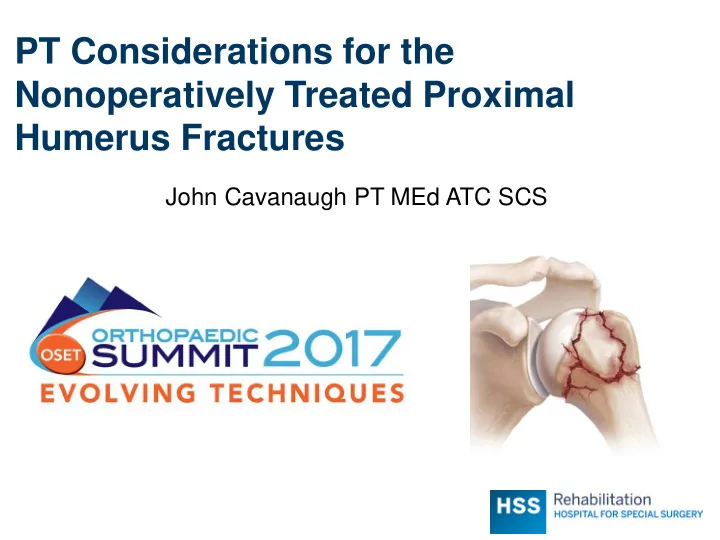
PT Considerations for the Nonoperatively Treated Proximal Humerus - PowerPoint PPT Presentation
PT Considerations for the Nonoperatively Treated Proximal Humerus Fractures John Cavanaugh PT MEd ATC SCS 2 3 Proximal Humerus Fractures - Intro Incidence: 4-6% of all fractures 3rd most common fx pattern seen in elderly Injury
PT Considerations for the Nonoperatively Treated Proximal Humerus Fractures John Cavanaugh PT MEd ATC SCS
2
3
Proximal Humerus Fractures - Intro Incidence: 4-6% of all fractures 3rd most common fx pattern seen in elderly Injury ratio: 2:1 female to male ↑’ ed age correlates with increasing fracture risk in women Mechanism of injury: Low-energy falls elderly with osteoporotic bone High-energy trauma young individuals Concomitant soft tissue and neurovascular injuries (axillary nerve) 4
Non-Operative Management 85% PHF are minimally displaed & managed non-operatively 1, 2, 3 part surgical neck fractures Greater tuberosity fractures displaced < 5mm Good to Excellent outcomes ~85% – Koval KJ J Bone Joint Surg Am. 1997 – Gaebler C, Acta Orthop Scand. 2003 – Kruithof RN J Orthop Traumatol 2017 5
Non-Operative Management Fracture healing : Rehabilitation: 3 distinct but overlapping 3 distinct but overlapping stages phases Inflammatory stage Maximum Protection Phase Repair stage Moderate Protection Phase Late remodeling stage Return to Function Phase 6
Proximal Humerus Fracture Non-Operative Rehabilitation Guielines General Principles Phyisician directed Radiograph evidence of healing Realistic Goals Early Mobilization – Hodgson J Shld Elbow Surg 2007 – Lefevre-Colau JBJS 2007 7
Randomized, prospective/controlled trial of minimally displaced PHF Group A: (N 44) Immediate ROM Group B: (N 42) 3 weeks of immobilization Craft Shoulder Disability Questionnaire Group A 42.8% (1 year) 43.2% (2 year) Group B 72.5% (1 year) 59.5% (2 year ) – Reported 3x more pain on movement, 2x night disturbance 8
RCT: 74 patients with an impacted PHF (1,2,3 part) Group A: 37 passive mobilization within 3 days of frx Group B: 37 sling immobilization x 3 weeks Constant Global Score (3 months f/u) (A) 71 vs (B) 61.1 Mean change in pain (6 weeks →3 mo) (A) 34.9 vs (B) 19.2 Fracture-healing rate 100% (A & B) Compliance to PT sessions = 70% (A & B) 9
Proximal Humerus Fracture Non-Operative Rehabilitation Guielines General Principles Physical Therapist guided – MD directed clinical guideline Individualized Criteria based progression Communication w/MD 10
Maximum Protection Phase (0-6 weeks) Goals : Control pain and swelling Protect fracture site / Allow for healing Maintain ROM/Function distal extremity Improve AAROM: Elevation to 110 ° and ER to 30 ° Independent with home exercise program 11
Maximum Protection Phase (0-6 weeks) Treatment Interventions: Modalities (Ice / TENS ) (Moist Heat after 10 days) Sling immobilization (duration / schedule per MD) Cervical & distal extremity AROM Postural correction (as indicated) Codman’s / Pendulum execises (when tolerated) 12
Maximum Protection Phase (0-6 weeks) Treatment Interventions: PROM: Elevation / ER AAROM (when tolerated): – Elevation / ER Aquatic therapy 13
Re-education for dyssynergic shoulders Adjunct to traditional therapeutic exercise Proprioceptive input 14
Maximum Protection Phase (0-6 weeks) Treatment Interventions Scapular and Deltoid strengthening (when tolerated) Soft Tissue Massage Home exercise program – consider insurance situation 15
Maximum Protection Phase (0-6 weeks) Criteria for Advancement Tolerating sling discontinuation with self-care, ADL’s AAROM: Elevation to 110° ER to 30° 16
Moderate Protection Phase (4-12 weeks) AAROM: Wand FF/ER Pulleys (when appropriate) 120 degrees FF Humeral Head Control Active IR ROM (Towel pass) 17
Moderate Protection Phase (4-12 weeks) Glenohumeral mobilization Scapular stabilization exercises 18
Moderate Protection Phase (4-12 weeks) Airdyne Bike Upper Body Ergometer Scapular and Deltoid PRE’s 19
Moderate Protection Phase (4-12 weeks) Rototor cuff Isometrics Dictated by gains in ER ROM Scaption (PRE) 20
Moderate Protection Phase (4-12 weeks) Criteria for Advancement / Goals AAROM : Elevation to 150° ER to 65°, IR to 70° Improve scapulohumeral rhythm to WNL < 90° elevation (scapular plane) Improve muscle strength to > 4/5 Independent with home exercise program as instructed 21
Strengthening / Function Phase (10-? Weeks) Goals: Improve scapulohumeral rhythm to WNL < 120°elevation (scapular plane) Improve muscle strength to 5/5 Maximize ROM, strength, flexibility so to meet the demands of ADL and/or sports participation where indicated Independent with home exercise program as instructed 22
Strengthening / Function Phase (10-? Weeks) Treatment Interventions Towel Stretch (IR) Posterior capsule stretching Pect Minor Streching Rototor cuff Isotonics 23
Strengthening / Function Phase (10-? Weeks) Treatment Interventions PNF (Manual resistance → theraband) Sport Specific Activites (if and when indicated) – e.g. golf, tennis, etc) 24
Summary Rehabilitation Guidelines: PHF Directed by MD, Guided by PT Radiological evidence of healing Early Mobilization Criteria for advancement Succesful Outcome 25
Recommend
More recommend
Explore More Topics
Stay informed with curated content and fresh updates.