Pumping and Ogden Properties of Multiple Context-Free Grammars - - PDF document

pumping and ogden properties of multiple context free
SMART_READER_LITE
LIVE PREVIEW

Pumping and Ogden Properties of Multiple Context-Free Grammars - - PDF document

Pumping and Ogden Properties of Multiple Context-Free Grammars Makoto Kanazawa National Institute of Informatics and SOKENDAI Japan 1994: Ph.D. in Linguistics, Stanford University 1994:


slide-1
SLIDE 1

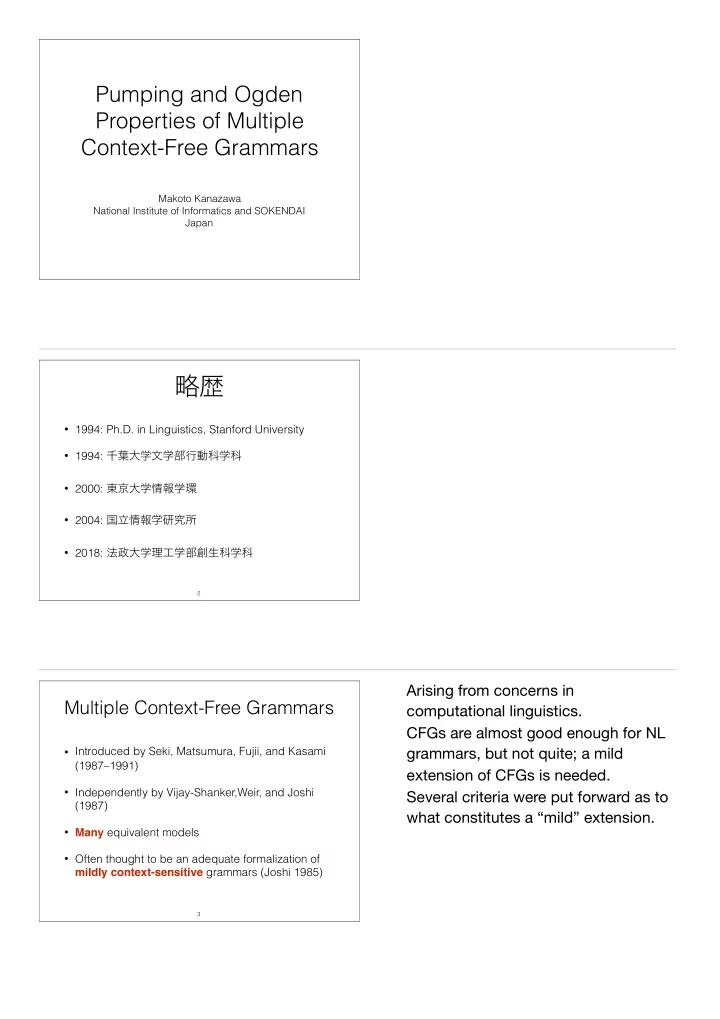
Pumping and Ogden Properties of Multiple Context-Free Grammars

Makoto Kanazawa National Institute of Informatics and SOKENDAI Japan

略歴

  • 1994: Ph.D. in Linguistics, Stanford University
  • 1994: 千葉大学文学部行動科学科
  • 2000: 東京大学情報学環
  • 2004: 国立情報学研究所
  • 2018: 法政大学理工学部創生科学科

2

Multiple Context-Free Grammars

  • Introduced by Seki, Matsumura, Fujii, and Kasami

(1987–1991)

  • Independently by Vijay-Shanker,Weir, and Joshi

(1987)

  • Many equivalent models
  • Often thought to be an adequate formalization of

mildly context-sensitive grammars (Joshi 1985)

3

Arising from concerns in computational linguistics. CFGs are almost good enough for NL grammars, but not quite; a mild extension of CFGs is needed. Several criteria were put forward as to what constitutes a “mild” extension.

slide-2
SLIDE 2

Context-Free Grammars

4

A → w0 B1 w1 … Bn wn Bi ∈ N, wj ∈ Σ* S ⇒G* S S ⇒G* β A γ A → α ∈ P S ⇒G* β α γ L(G) = { w ∈ Σ* | S ⇒G* w }

production top-down derivation

Bottom-Up Interpretation

5

Bi ⇒G* vi (i = 1,…,n) A → w0 B1 w1 … Bn wn ∈ P A ⇒G* w0 v1 w1 … vn wn L(G) = { w ∈ Σ* | S ⇒G* w }

CFGs as Logic Programs on Strings

6

A → w0 B1 w1 … Bn wn A(w0 x1 w1 … xn wn) ← B1(x1),…,Bn(xn)

Horn clause

L(G) = { w ∈ Σ* | G ⊢ S(w) }

slide-3
SLIDE 3

Multiple Context-Free Grammars

A(α1,…,αq) ← B1(x1,1,…,x1,q1),…,Bn(xn,1,…,xn,qn) n ≥ 0, q, qi ≥ 1, αk ∈ (Σ ∪ { xi,j | i ∈ [1,n], j ∈ [1,qi] })* each xi,j occurs exactly once in (α1,…,αq)

  • q = dim(A) (dimension of A)
  • dim(S) = 1
  • L(G) = { w ∈ Σ* | G ⊢ S(w) }

7

It’s best to think of an MCFG as a kind of logic program. Each rule is a definite clause. Nonterminals are predicates on strings.

S(x1#x2) ← D(x1, x2) D(ε, ε) ← D(x1y1, y2x2) ← E(x1,x2), D(y1,y2) E(ax1ā, āx2a) ← D(x1,x2) { w#wR | w ∈ D1* } S(aaāāaā#āaāāaa) D(aaāāaā, āaāāaa) E(aaāā, āāaa) D(aā, āa) E(aā, āa) D(ε, ε) D(ε, ε) D(aā, āa) E(aā, āa) D(ε, ε) D(ε, ε)

2-MCFG 2-ary branching

8

derivation tree

m-MCFG = MCFG with nonterminal dimension not exceeding m 1-MCFG = CFG Derivation tree for w = proof of S(w)

S(x1…xm) ← A(x1,…,xm) A(ε,…,ε) ← A(a1 x1 a2,…,a2m−1 xm a2m) ← A(x1,…,xm)

non-branching m-MCFG

{ a1n a2n … a2m−1n a2mn | n ≥ 0 }

m-MCFL (m−1)-MCFL 2-MCFL = CFL 1-MCFL

9

Seki et al. 1991

The languages of MCFGs form an infinite hierarchy.

slide-4
SLIDE 4

Chomsky Hierarchy

10

Rewriting Grammars Machines Logic Programs on Strings Languages Unrestricted Turing Elementary Formal Systems (Smullyan 1961) r.e. Context- Sensitive LBA Length-Bounded EFS (Arikawa et al. 1989) CSL = NSPACE(n) Poly-time Turing Simple LMG (Groenink 1997) / Hereditary EFS (Ikeda and Arimura 1997) P MCFG MCFL Context-Free PDA Simple EFS (Arikawa 1970) CFL Right-Linear FA Reg

Which Properties of CFGs Are Shared by/ Generalize to MCFGs?

  • Membership in LOGCFL
  • Semilinearity

11

Pumping

S(aaāāaā#āaāāaa) D(aaāāaā, āaāāaa) E(aaāā, āāaa) D(aā, āa) E(aā, āa) D(ε, ε) D(ε, ε) D(aā, āa) E(aā, āa) D(ε, ε) D(ε, ε)

12

S(x1#x2) ← D(x1, x2) D(ε, ε) ← D(x1y1, y2x2) ← E(x1,x2), D(y1,y2) E(ax1ā, āx2a) ← D(x1,x2)

Derivation trees of MCFGs are similar to those of CFGs. When the same nonterminal occurs twice on the same path of a derivation tree,…

slide-5
SLIDE 5

13

S(y1#y2) D(ax1āaā, āaāx2a) E(ax1ā, āx2a) D(aā, āa) E(aā, āa) D(ε, ε) D(ε, ε) D(aā, āa) E(aā, āa) D(ε, ε) D(ε, ε) D(y1, y2) D(x1, x2) anaā(āaā)n#(āaā)nāaan ∈ L(G)

You can decompose the derivation tree into three parts, and the middle part can be iterated any number of times, including zero times. In the overall derivation tree, the variables x1, x2, y1, y2 are instantiated by … The number of iterated substrings (factors) larger than two.

Iterative Properties

14

∃p ∀z ∈ L(|z| ≥ p ⇒ ∃u1…uk+1 v1…vk( z = u1v1…ukvkuk+1 ∧ v1…vk ≠ ε ∧ ∀n ≥ 0(u1v1n…ukvknuk+1 ∈ L)) L is k-iterative iff L ∈ CFL ⇒ L is 2-iterative L ∈ m-MCFL ⇒ L is 2m-iterative?

wrong claim in 1991

For MCFGs, need to consider a generalized form of the condition of the puming lemma. Not straightforward; open question for a long time.

A(v1x1v2, v3x2v4) A(x1, x2) A(v1x1v2, v3x2v4) A(x1, x2) A(v12x1v22, v32x2v42)

Difficulty with Pumping

15

The middle part of the derivation tree may look like this.

slide-6
SLIDE 6

A(v1x1v2x2v3, v4) A(x1, x2) A(v1x1v2x2v3, v4) A(x1, x2) A(v12x1v2x2v3v2v4v3, v4)

Difficulty with Pumping

16

“uneven pump”

Or like this.

S(x1#x2#x3) ← A(x1, x2, x3) A(ax1, y1cx2c̄dy2d̄x3, y3b) ← A(x1, x2, x3), A(y1, y2, y3) A(a, ε, b) ←

not k-iterative for any k

Kanazawa et al. 2014

17

m-MCFL 2-MCFL = CFL 1-MCFL 3-MCFL

The pumping lemma fails for 3- MCFGs.

Pumping Lemma for Subclasses

18

m-MCFLwn 2-MCFLwn = CFL 1-MCFLwn 2m-iterative Kanazawa 2009 m-MCFL 2-MCFL = CFL 1-MCFL 4-iterative

well-nested MCFGs

Pumping possible for special cases. Well-nested MCFGs.

slide-7
SLIDE 7

Well-Nestedness

S(x1#x2) ← D(x1, x2) D(ε, ε) ← D(x1y1, y2x2) ← E(x1,x2), D(y1,y2) E(ax1ā, āx2a) ← D(x1,x2)

{ w#wR | w ∈ D1* }

S(x1#x2) ← D(x1, x2) D(ε, ε) ← D(x1y1, x2y2) ← E(x1,x2), D(y1,y2) E(ax1ā, ax2ā) ← D(x1,x2)

{ w#w | w ∈ D1* } well-nested non-well-nested { w#w | w ∈ D1* } ∉ MCFLwn

Kanazawa and Salvati 2010

19

Has a natural equivalent characterization: yCFTsp

A(v1x1v2x2v3, v4) A(x1, x2) A(v1x1v2x2v3, v4) A(x1, x2) A(v12x1v2x2v3v2v4v3, v4)

Difficulty with Pumping

20

“uneven pump”

Pumping not easy to prove even form well-nested MCFGs: this situation can still arise.

21

S(x1x2) ← A(x1, x2) A(ax1bx2c, d) ← A(x1, x2) A(ε, ε) ←

non-branching ⊆ well-nested

S(ε) A(ε, ε) A(abc, d) A(ε, ε) S(abcd) A(abc, d) A(ε, ε) A(aabcbdc,d) S(aabcbdcd) A(abc, d) A(ε, ε) A(aabcbdc,d) A(aaabcbdcbdc,d) S(aaabcbdcbdc,d) { ε } ∪ { ai−1abc(bdc)i−1d | i ≥ 1 }

i=0 i=1 i=2 i=3

A very simple example. The only choice you can make is the number of times you use the second rule. Actually 2-iterative, but no straightforward connection between the iterated substrings and parts of derivation trees.

slide-8
SLIDE 8
  • If G is a well-nested m-MCFG,

{ T | T is a derivation tree of G without even m-pumps } may not be finite.

  • But there is a well-nested (m−1)-MCFG

generating { yield(T) | T is a derivation tree of G without even m-pumps }.

B B (x1,…,xm) (v1x1v2,…,v2m−1xmv2m) “even m-pump”

22

If the derivation tree contains an even m-pump, the string is 2m- pumpable. Otherwise, the string is in the language of some w.n. (m-1)- MCFG, and therefore is 2(m-1)- pumpable (disregarding finitely many exceptions). Proof by induction on m.

Pumping Lemma for Subclasses

23

m-MCFLwn 2-MCFLwn = CFL 1-MCFLwn 2m-iterative Kanazawa 2009, by grammar splitting and transformation

What about Ogden’s Lemma?

m-MCFL 2-MCFL = CFL 1-MCFL 4-iterative

My proof of the pumping lemma for m-MCFLwn and 2-MCFL is not straightforward.

Ogden’s Lemma for CFL

24

∃p ∀z ∈ L(at least p positions of z are marked ⇒ ∃u1u2u3 v1v2( z = u1v1u2v2u3 ∧ (u1, v1, u2 each contain a marked position ∨ u2, v2, u3 each contain a marked position) ∧ v1u2v2 contains no more than p marked positions ∧ ∀n ≥ 0(u1v1nu2v2nu3 ∈ L)) L ∈ CFL ⇒

Ogden 1968

Can be used to show inherent ambiguity of some CFLs, e.g., { am bn cp | m = n ∨ n = p }.

slide-9
SLIDE 9

25

∃p ∀z ∈ L(at least p positions of z are marked ⇒ ∃k ≥ 1 ∃u1…uk+1 v1…vk( z = u1v1…ukvkuk+1 ∧ ∃i(vi contains a marked position) ∧ ∀n ≥ 0(u1v1n…ukvknuk+1 ∈ L)) L has the weak Ogden property iff

There are various ways of generalizing Ogden’s lemma suitable for MCFGs. At least this much should be implied.

The Failure of Ogden’s Lemma

26

The weak Ogden property fails for 3-MCFLwn and 2-MCFL.

m-MCFLwn 2-MCFLwn = CFL 1-MCFLwn 2m-iterative m-MCFL 2-MCFL = CFL 1-MCFL 4-iterative 3-MCFLwn 6-iterative

This is the first new result in this talk.

27

2-MCFLwn CFL 3-MCFLwn 2-MCFL

{ ai1bi0$ai2bi1$ai3bi2$…$ainbin−1 | n ≥ 3, i0,…,in ≥ 0 }

A language for which the weak Ogden property fails.

slide-10
SLIDE 10

28

A(ε) ← A(bx1) ← A(x1) B(x1, ε) ← A(x1) B(ax1, bx2) ← B(x1, x2) C(x1, x2, ε) ← B(x1, x2) C(x1, ax2, bx3) ← C(x1, x2, x3) C(x1$x2, x3, ε) ← C(x1, x2, x3) D(x1$x2, x3) ← C(x1, x2, x3) D(x1, ax2) ← D(x1, x2) S(x1$x2) ← D(x1, x2) A(ε) ← A(bx1) ← A(x1) B(x1, ε) ← A(x1) B(ax1, bx2) ← B(x1, x2) C(ax1, bx2) ← C(x1, x2) D(x1$y1x2, y2) ← B(x1, x2), C(y1, y2) E(x1, x2) ← D(x1, x2, x3) E(x1, ax2) ← E(x1, x2) S(x1$x2) ← E(x1, x2) C(ε, ε) ← D(x1$y1x2, y2) ← D(x1, x2), C(y1, y2)

non-branching 3-MCFG 2-MCFG

{ ai1bi0$ai2bi1$ai3bi2$…$ainbin−1 | n ≥ 3, i0,…,in ≥ 0 }

29

{ ai1bi0$ai2bi1$ai3bi2$…$ainbin−1 | n ≥ 3, i0,…,in ≥ 0 } is 2-iterative a$a2b$a3b2$…$ap+1bp

Mark the positions of $.

Weir’s (1992) Control Language Hierarchy

30

Ck ⊆ 2k−1-MCFL

Kanazawa and Salvati 2007

Generalization of Ogden’s lemma

Palis and Shende 1995 = CFL C2 = 2-MCFLwn C1 Ck

Subclasses of MCFL that are known to have an Ogden property.

slide-11
SLIDE 11

Control Grammars

31

1: S → aSāS 2: S → bSb̄S 3: S → ε

CFG with child selection

K = { 1n2n3 | n ≥ 0 } G:

control set S ā S a ε S ā a S ā S a ε S b̄ S S b ε ε S b̄ S b ε S b̄ S S b ε ε

1 1 2 2 3 3 3 3 3 3 3 2 1

L(G, K) = D2* ∩ ({ anbn | n ≥ 1} b̄ {ā,b̄}*)*

Languages in each level of the control language hierarchy are given by “control grammars”.

Control Language Hierarchy

32

C1 = CFL Ck+1 = { L(G, K) | K ∈ Ck }

Ogden’s Lemma for Ck

33

∃p ∀z ∈ L(at least p positions of z are marked ⇒ ∃u1…u2k+1 v1…v2k( z = u1v1…u2kv2ku2k+1 ∧ ∃i(ui, vi, ui+1 each contain a marked position) ∧ v2k−1u2k−1v2k−1+1 contains no more than p marked positions ∧ ∀n ≥ 0(u1v1nu2v2n…u2kv2knu2k+1 ∈ L)) L ∈ Ck ⇒

Palis and Shende 1995

  • k = 1 gives Ogden’s (1968) original lemma.

It is quite straightforward to prove an Ogden’s lemma for Ck.

slide-12
SLIDE 12

Proper MCFGs

34

A(α1,…,αq) A(x1,…,xq)

dimension ≥ q

⇒ αi contains xi Approach this existing result from the MCFG formalism. Sufficient condition for an Ogden property.

35

S(x1x2) ← A(x1, x2) A(ax1c, d) ← B(x1) A(ε, ε) ← B(x1bx2) ← A(x1, x2)

proper 2-MCFG B(abcbd) A(abc, d) A(aabcbdc,d) S(aabcbdcd) B(b) A(ε, ε) B(ax1cbd) A(ax1c, d) B(x1) dimension ≥ 1 B(x1bx2) A(x1, x2) A(ax1bx2c,d) dimension < 2

Slight variation of an earlier example.

Ogden’s Lemma for m-MCFLprop

36

∃p ∀z ∈ L(at least p positions of z are marked ⇒ ∃u1…u2m+1 v1…v2m( z = u1v1…u2mv2mu2m+1 ∧ ∃i(ui, vi, ui+1 each contain a marked position) ∧ v1u2v2,v3u4v4,…,v2m−1u2mv2m together contain no more than p marked positions ∧ ∀n ≥ 0(u1v1nu2v2n…u2mv2mnu2m+1 ∈ L)) L ∈ m-MCFLprop ⇒

  • m = 1 gives Ogden’s (1968) original lemma.

Constrain all of v1,…,v2m

slide-13
SLIDE 13

Ck ⊆ 2k−1-MCFLprop

37

1: S → aSāS 2: S → bSb̄S 3: S → ε K = { 1n2n3 | n ≥ 0 } G: l(1) = a, r(1) = āS l(2) = b, r(2) = b̄S l(3) = ε, r(3) = ε K(x13) ← E(x1) E(1x12) ← E(x1) E(ε) ← K(x1l(3), r(3)x2) ← E(x1, x2) E(l(1)x1l(2), r(2)x2r(1)) ← E(x1, x2) E(ε, ε) ← Kʹ(x1x2) ← K(x1, x2) K ⟨(1,R), l, r⟩(K) = { l(w)r(wR) | w ∈ K}

homomorphic replication homomorphisms 2m-MCFG m-MCFG

The earlier result is subsumed by the present result.

38

S ā S a ε S ā a S ā S a ε S b̄ S S b ε ε S b̄ S b ε S b̄ S S b ε ε

1 1 2 2 3 3 3 3 3 3 3 2 1

K(x1l(3), r(3)x2) ← E(x1, x2) E(l(1)x1l(2), r(2)x2r(1)) ← E(x1, x2) E(ε, ε) ← Kʹ(x1x2) ← K(x1, x2) ⟨(1,R), l, r⟩(K) = { l(w)r(wR) | w ∈ K} l(11223)r(32211) = aabbb̄Sb̄SāSāS l(3)r(3) = ε l(123)r(321) = abb̄SāS K(x1, x2) ← E(x1, x2) E(ax1b, b̄Sx2āS) ← E(x1, x2) E(ε, ε) ← Kʹ(x1x2) ← K(x1, x2)

=

Generates strings with nonterminals.

39

S ā S a ε S ā a S ā S a ε S b̄ S S b ε ε S b̄ S b ε S b̄ S S b ε ε

1 1 2 2 3 3 3 3 3 3 3 2 1

⟨(1,R), l, r⟩(K) = { l(w)r(wR) | w ∈ K} K(x1, x2) ← E(x1, x2) E(ax1b, b̄Sx2āS) ← E(x1, x2) E(ε, ε) ← Kʹ(x1x2) ← K(x1, x2) K(x1, x2) ← E(x1, x2) E(ax1b, b̄yx2āz) ← E(x1, x2), Kʹ(y), Kʹ(z) E(ε, ε) ← Kʹ(x1x2) ← K(x1, x2)

L(G, K) S ← Kʹ iterated

substitution 2m-MCFG

∩ Σ*

The construction doubles the dimension, preserves properness.

slide-14
SLIDE 14

40

= CFL C2 = 2-MCFLwn C1 Ck = CFL 2-MCFLprop 1-MCFLprop m-MCFLprop

Ck ⊊ 2k−1-MCFLprop z = u1v1u2v2u3v3u4v4u5

≤ p ≤ p

The different requirement shows the properness of the inclusion.

Summary

  • Pumping doesn’t imply Ogden: There is no Ogden-

like theorem for 3-MCFLwn ∩ 2-MCFL

  • There is a natural Ogden’s lemma for m-MCFLprop
  • Covers Weir’s control language hierarchy

41

Reference: Makoto Kanazawa. 2016. Ogden’s lemma, multiple context-free grammars, and the control language

  • hierarchy. In Adrian-Horia Dediu, Jan

Janoušek, Carlos Martín-Vide, and Bianca Truthe, editors, Language and Automata Theory and Applications: 10th International Conference, LATA 2016, pages 371-383. Lecture Notes in Computer Science 9618. Cham: Springer.