Putting a historic view in molecular perspective Potato wart - - PowerPoint PPT Presentation

putting a historic view in molecular perspective
SMART_READER_LITE
LIVE PREVIEW

Putting a historic view in molecular perspective Potato wart - - PowerPoint PPT Presentation

Putting a historic view in molecular perspective Potato wart disease workshop 26-6-2019 Presentation outline Spread of potato wart disease in the last century Putting the historical collection to use Towards molecular


slide-1
SLIDE 1

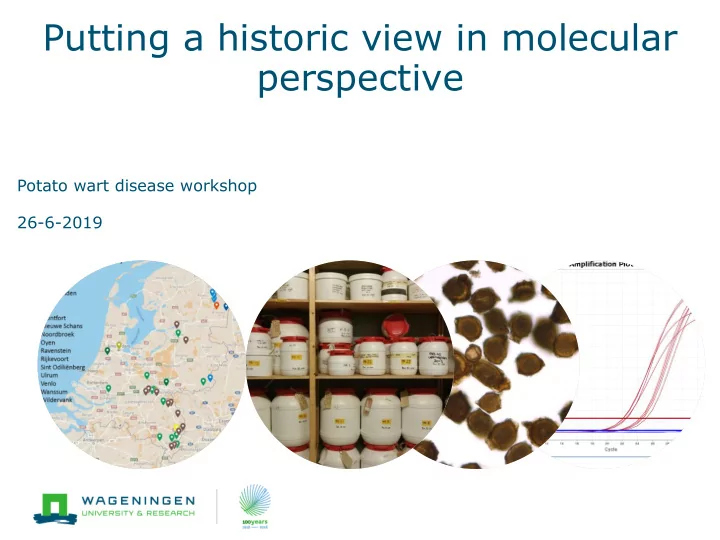
Putting a historic view in molecular perspective

Potato wart disease workshop 26-6-2019
slide-2
SLIDE 2

Presentation outline

▪ Spread of potato wart disease in the last century ▪ Putting the historical collection to use ▪ Towards molecular characterization of the Dutch isolates ▪ Optimization of zonal centrifuge for the extraction of spores from

soils and composts

▪ DNA/RNA extraction and quality control ▪ Sequencing and haplotyping

2

slide-3
SLIDE 3

Potato wart disease was first found in 1915

▪ Found in Winschoten (Groningen) in a private garden on “‘t Zandpad” ▪ Found by Mr. Uil who was a teacher at an agricultural school ▪ Poverty-stricken part of town: home-grown food for own use

3

Stichting Oud-Winschoten, ‘t Zandpad ~1930

slide-4
SLIDE 4

Timelapse 1915 - 1927

4

slide-5
SLIDE 5

Rapid spread in 1926 – 1927 along the course of the river Meuse following massive floods

5

Beneden Leeuwen 1926 Gennep 1926 Roermond 1926 Tegelen 1926

slide-6
SLIDE 6

First

  • utbreaks

vs current risk zones

Current zones of increased vigilance are shown in red

6

slide-7
SLIDE 7

Brief period of absence and rediscovery

7

▪ Strict phytosanitary measures led to a brief reported absence of the

pathogen in 1970

▪ Re-discovery of the pathogen in 1973 in the north of the Netherlands

  • Before this was pathotype 1(D1), new findings were 2(G1)

▪ In 1990, pathotype 6(O1) was reported from north-east Netherlands ▪ In 2001, pathotype 18(T1) was reported from N-E Netherlands ▪ In 1990 also rediscovery of the pathogen in south-east Netherlands

  • In contrast to northern provinces, only pathotype 1(D1) was

found

slide-8
SLIDE 8

Compost collection at NVWA

8

slide-9
SLIDE 9

Collection (183 pot ID) on tour

9

slide-10
SLIDE 10

Hendrickx zonal centrifuge at PPO-AGV

10

Schematic side view of the Hendrickx centrifuge in operation. 1: separation fluid (CaCl2 1.4 SD ), 2: water, 3: soil suspension, 4: kaolin suspension, 5: overflow A: sediment from soil, B: kaolin, C: CaCl2, D: fluid with sporangia, E: water, F: hollow drive tube, G: bottle with supernatant 15.000 x g

slide-11
SLIDE 11

Optimization of ZC method

11

slide-12
SLIDE 12

Washing & concentrating fluid with sporangia

12

Yield of spores on 20 um Nylon net filter

Filter funnel combined with nylon net

slide-13
SLIDE 13

Differences in yield due to different composts

13

Pot ID 100 Larger pieces after ZC Wart material containing ws

slide-14
SLIDE 14

Remarkable things

14

Pot ID 83 and 96

extra sieving 40uM Spore suspension is very difficult to filtrate through 20uM nylon sieve

Many ws are encapsulated In starch?

slide-15
SLIDE 15

After ZC nicely cleaned up WS

15

slide-16
SLIDE 16

Preparing for nucleic acid extraction

▪ Total of 183 pot ID ▪ Oldest is from the 80s ▪ At least 83 pot ID registered

as NL

▪ 11 pot ID < 100 gr compost ▪ 54 pot ID too low yield of ws

16

slide-17
SLIDE 17

DNA-RNA extraction (cat no 80204)

17

slide-18
SLIDE 18

DNA-RNA extraction (cat no 80244)

18

slide-19
SLIDE 19

Molecular assays

19

slide-20
SLIDE 20

Comparison kits: DNA samples (60ul)

20

AllPrep power fecal AllPrep Avg Ct = 22.31 Sendo Avg Ct = 32.83 COX dCt = 10.52 Avg Ct = 24.69 Sendo Avg Ct = 31.74 COX dCt = 7.05 Sendo COX

slide-21
SLIDE 21

Results of 203 composts in TaqMan assays using MB42 DNA as standard curve

21

Sendo COX

Pot ID 1 - 104 Pot ID 105 - 203

Sendo COX

slide-22
SLIDE 22

Selected isolates for sequencing

22

potID 1 9 17 25 42 49 57 73 81 89 97 2 10 18 27 43 50 65 74 82 90 98 3 11 19 28 47 51 68 75 83 91 99 4 12 20 31 MQ 52 69 76 86 92 100 5 13 21 32 MQ 53 71 77 88 93 101 6 14 22 34 MQ 54 72 78 MQ 94 102 7 15 23 37 MQ 55 MQ 79 MQ 95 104 8 16 24 38 MQ 56 MQ 80 MQ 96 MB42 ng/ul 0.4 0.1 0.2 0.3 0.1 0.4 1.4 0.6 0.2 0.5 0.2 0.1 0.2 0.3 0.1 0.1 0.2 0.6 0.4 0.4 1.1 0.5 0.4 0.1 0.3 0.4 0.1 0.2 0.3 0.2 0.2 0.5 0.8 0.1 0.1 0.3 0.6 0.1 0.3 0.3 0.1 1.3 0.2 0.6 0.1 0.1 0.4 0.1 0.1 0.3 0.3 0.7 0.1 0.2 0.6 0.1 0.1 0.1 0.1 0.1 0.3 0.2 0.2 0.1 0.3 0.1 0.1 0.1 0.2 0.2 0.1 0.6 0.1 0.2 0.1 0.3 1.2 0.1 0.2 0.2 0.2 0.1 0.1 0.1 1.3 0.1 0.5 1.2

Picogreen measurement: Very low DNA concentration

slide-23
SLIDE 23

Different mitochondrial lineages?

23

slide-24
SLIDE 24

Use of historical collection

▪ 183 pot ID (isolates) ▪ Many of them are not viable ▪ Volume reduction by storing collected ws dry ▪ 129 isolates DNA/RNA extracted ▪ 118 are of enough quality ▪ Sequencing ▪ Hope to build a new network and understand the spread

and epidemiology

24

slide-25
SLIDE 25

Co-operation

▪ Wageningen UR, Biointeractions and Plant Health

  • Marga van Gent-Pelzer
  • Theo van der Lee

▪ Dutch National Plant Protection Organization

  • Bart van de Vossenberg
  • Patricia van Rijswick
  • Gerard van Leeuwen

▪ Wageningen UR, Field Crops

  • Olaf Hartsema
  • Andre Ramaker

25