Quantifying sources of methane using light alkanes in the Los Angeles - - PowerPoint PPT Presentation

quantifying sources of methane using light alkanes in the
SMART_READER_LITE
LIVE PREVIEW

Quantifying sources of methane using light alkanes in the Los Angeles - - PowerPoint PPT Presentation

Quantifying sources of methane using light alkanes in the Los Angeles basin, California J. Peischl, 1,2 T. B. Ryerson, 2 J. Brioude, 1,2 K. C. Aikin, 1,2 A. E. Andrews, 3 E. Atlas, 4 D. Blake, 5 B. C. Daube, 6 J. A. de Gouw, 1,2 E. Dlugokencky, 3 G.


slide-1
SLIDE 1

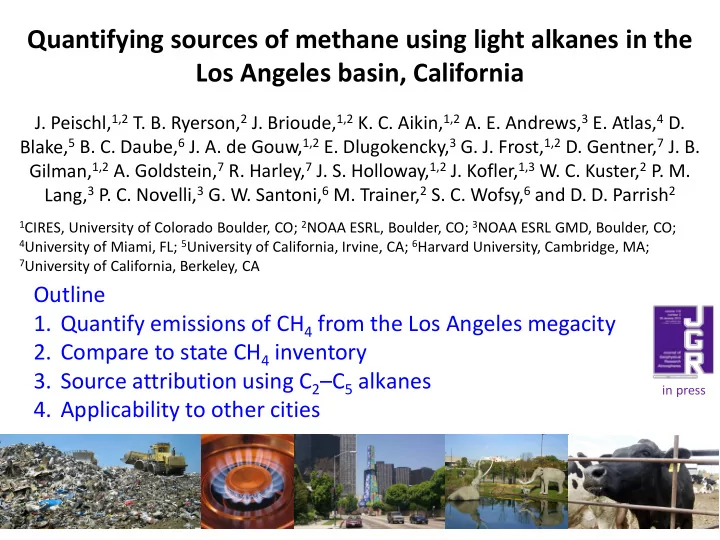
Quantifying sources of methane using light alkanes in the Los Angeles basin, California

  • J. Peischl,1,2 T. B. Ryerson,2 J. Brioude,1,2 K. C. Aikin,1,2 A. E. Andrews,3 E. Atlas,4 D.

Blake,5 B. C. Daube,6 J. A. de Gouw,1,2 E. Dlugokencky,3 G. J. Frost,1,2 D. Gentner,7 J. B. Gilman,1,2 A. Goldstein,7 R. Harley,7 J. S. Holloway,1,2 J. Kofler,1,3 W. C. Kuster,2 P. M. Lang,3 P. C. Novelli,3 G. W. Santoni,6 M. Trainer,2 S. C. Wofsy,6 and D. D. Parrish2

1CIRES, University of Colorado Boulder, CO; 2NOAA ESRL, Boulder, CO; 3NOAA ESRL GMD, Boulder, CO; 4University of Miami, FL; 5University of California, Irvine, CA; 6Harvard University, Cambridge, MA; 7University of California, Berkeley, CA

Outline

  • 1. Quantify emissions of CH4 from the Los Angeles megacity
  • 2. Compare to state CH4 inventory
  • 3. Source attribution using C2–C5 alkanes
  • 4. Applicability to other cities

in press

slide-2
SLIDE 2
  • 1. Urban GHG emissions are significant but not well known

column CH4, CO, and CO2 at JPL (2008)

  • bserved CH4/CO = 0.66 ± 0.12

CARB CO and CO2; EDGAR CO2 Inventory CH4 shortfall of 35% (using CO) to 57% (using CO2)

This issue is the focus of several new or nascent studies:

  • NASA Megacities Carbon Project
  • NIST INFLUX study
  • EDF Well-to-Wheels study

Urban emissions are significant 1/4 of California methane comes from urbanized Los Angeles basin Top-down assessments suggest substantial shortfalls in existing inventories of CH4 in L.A.: Top-down assessments of L.A. CH4

slide-3
SLIDE 3
  • 1. Urban GHG emissions are significant but not well known

in-situ CH4 and CO from Mt. Wilson (2007-2008)

  • bserved CH4/CO = 0.52 ± 0.02

new bottom-up inventory for CH4 Inventory CH4 shortfall of 30%

Revisit this issue with updated inventories and CalNex 2010 data

Top-down assessments of L.A. CH4 This issue is the focus of several new or nascent studies:

  • NASA Megacities Carbon Project
  • NIST INFLUX study
  • EDF Well-to-Wheels study

Urban emissions are significant 1/4 of California methane comes from urbanized Los Angeles basin Top-down assessments suggest substantial shortfalls in existing inventories of CH4 in L.A.:

column CH4, CO, and CO2 at JPL (2008)

  • bserved CH4/CO = 0.66 ± 0.12

CARB CO and CO2; EDGAR CO2 Inventory CH4 shortfall of 35% (using CO) to 57% (using CO2)

slide-4
SLIDE 4
  • 1. Multiple sources complicate CH4

quantification in L.A.

JPL and Mt. Wilson preferentially sample the western basin

e.g., another report in 2012 used Mt. Wilson data to conclude landfills are negligible

  • sources: landfills, dairies, oil and gas production, traffic,

natural gas pipelines, etc.

Hsu Wunch wind

slide-5
SLIDE 5
  • scale obs. CH4 ERs to CARB CO and CO2 inventories

← derive total CH4 for L.A. basin

  • basin-wide sampling and extensive measurements of CH4

and co-emitted species from fourteen NOAA P-3 flights in the daytime boundary layer, May–June 2010

  • 1. Information on L.A. source

location and type

slide-6
SLIDE 6
  • scale obs. CH4 ERs to CARB CO and CO2 inventories

← derive total CH4 for L.A. basin

  • quantify emissions from landfills and dairies directly

← spot-check inventory sectors

  • 1. Information on L.A. source

location and type

  • basin-wide sampling and extensive measurements of CH4

and co-emitted species from fourteen NOAA P-3 flights in the daytime boundary layer, May–June 2010

slide-7
SLIDE 7
  • scale obs. CH4 ERs to CARB CO and CO2 inventories

← derive total CH4 for L.A. basin

  • quantify emissions from landfills and dairies directly

← spot-check inventory sectors

  • use light alkane data to attribute CH4 to sources

← quantify relative contributions

  • 1. Information on L.A. source

location and type

  • basin-wide sampling and extensive measurements of CH4

and co-emitted species from fourteen NOAA P-3 flights in the daytime boundary layer, May–June 2010

slide-8
SLIDE 8
  • 1. Methane emissions derived from observations are

greater than expected from inventories

CH4(total) = (CH4/CO) • COCARB ER accuracy is determined by extent

  • f mixing between emissions from

different sources within the basin enhancement ratio (ER)

slide-9
SLIDE 9
  • 1. Methane emissions derived from observations are

greater than expected from inventories

CH4(total) = (CH4/CO) • COCARB ER accuracy is determined by extent

  • f mixing between emissions from

different sources within the basin Accuracy is also determined by the uncertainties in the 2nd term - CARB inventories of CO and CO2 inventory enhancement ratio (ER)

slide-10
SLIDE 10
  • 1. Methane emissions derived from observations are

greater than expected from inventories

CH4(total) = (CH4/CO) • COCARB ER accuracy is determined by extent

  • f mixing between emissions from

different sources within the basin Accuracy is also determined by the uncertainties in the 2nd term - CARB inventories of CO and CO2

  • observed CO/CO2 = inventory CO/CO2
  • inverse model supports inventory CO2

(Brioude et al., ACP, 2013) inventory enhancement ratio (ER)

slide-11
SLIDE 11
  • 2. Methane emissions derived from observations are

greater than expected from inventories 411 ± 37 Gg CH4 yr–1

(using CO and CO2 gives same value)

  • cf. CARB = 301

Gg CH4 yr–1

inventory enhancement ratio (ER) CH4(total) = (CH4/CO) • COCARB ER accuracy is determined by extent

  • f mixing between emissions from

different sources within the basin Accuracy is also determined by the uncertainties in the 2nd term - CARB inventories of CO and CO2

  • observed CO/CO2 = inventory CO/CO2
  • inverse model supports inventory CO2

(Brioude et al., ACP, 2013)

slide-12
SLIDE 12
  • 3. Use light alkane source fingerprints to determine

sources of CH4

  • ne example:

Five field studies in eight years made atmospheric measurements

  • f propane and ethane in L.A.

Compare with published source composition data

slide-13
SLIDE 13
  • 3. Use light alkane source fingerprints to determine

sources of CH4

  • ne example:

Five field studies in eight years made atmospheric measurements

  • f propane and ethane in L.A.

Compare with published source composition data: Kirchstetter et al. [1996]

slide-14
SLIDE 14
  • 3. Use light alkane source fingerprints to determine

sources of CH4

  • ne example:

Five field studies in eight years made atmospheric measurements

  • f propane and ethane in L.A.

Compare with published source composition data: Kirchstetter et al. [1996] Wennberg et al. [2012]

slide-15
SLIDE 15
  • 3. Use light alkane source fingerprints to determine

sources of CH4

  • ne example:

Five field studies in eight years made atmospheric measurements

  • f propane and ethane in L.A.

Compare with published source composition data: Kirchstetter et al. [1996] Wennberg et al. [2012] Blake et al. [1995]

slide-16
SLIDE 16
  • 3. Use light alkane source fingerprints to determine

sources of CH4

  • ne example:

Five field studies in eight years made atmospheric measurements

  • f propane and ethane in L.A.

Compare with published source composition data: Kirchstetter et al. [1996] Wennberg et al. [2012] Blake et al. [1995] Jeffrey et al. [1991]

slide-17
SLIDE 17
  • 3. Use light alkane source fingerprints to determine

sources of CH4

  • ne example:

Five field studies in eight years made atmospheric measurements

  • f propane and ethane in L.A.

Compare with published source composition data: Kirchstetter et al. [1996] Wennberg et al. [2012] Blake et al. [1995] Jeffrey et al. [1991] Jeffrey et al. [1991]

slide-18
SLIDE 18
  • 3. Use light alkane source fingerprints to determine

sources of CH4

  • ne example:

Five field studies in eight years made atmospheric measurements

  • f propane and ethane in L.A.

Compare with published source composition data: Kirchstetter et al. [1996] Wennberg et al. [2012] Blake et al. [1995] Jeffrey et al. [1991] Jeffrey et al. [1991]

  • The suite of light alkanes

provides essential information to attribute emissions to sources

slide-19
SLIDE 19
  • 3. Use light alkane source fingerprints to determine

sources of CH4

C2 – C5 alkane measurements

(ethane through pentane isomers) permit robust attribution of CH4 to specific source types

Use source composition data to solve for the linear combination of sources that can explain observed abundances in the L.A. atmosphere: Ax = b model-independent quantification of relative contributions to CH4 budget

slide-20
SLIDE 20

Results of a LLS solution using 7 hydrocarbons. Black lines give derived annual totals for L.A. total emissions = (X/CO) • COCARB Colored bars: fraction of the total from each of the 7 source sectors used in the linear analysis. CH4 emission attributed to each source type is written above the colored CH4 bars. Pie charts: relative contributions from each source for each of the 7 hydrocarbons

  • 3. Use light alkanes to apportion

sources of CH4 in L.A.

slide-21
SLIDE 21
  • 3. Conclusions from CH4 source

apportionment

  • Inventories still significantly underpredict

CH4 in the Los Angeles atmosphere.

  • Model-independent attribution of CH4 to

specific sources enabled by use of C2–C5 data.

  • The majority of CH4 is due to leaks from

pipeline dry NG/local seeps and landfills.

  • Leaks from pipeline dry NG/local seeps and

local NG account for the consistent top-down

  • vs. bottom-up discrepancies in CH4.
  • Loss of local NG contributes 8% of CH4 in

L.A. (loss = 17% of local production).

  • later confirmed by CARB industry survey
  • cf. 4% for gas production basins in Colorado

(Petron et al., 2012)

slide-22
SLIDE 22

Required measurements: CH4 C2–C5 alkanes CO CO2 relative attribution; which sources to focus on first + inventory = total emission; provides global context Required platforms:

  • 4. Applicability to
  • ther cities