Quantum Communication: How quantum signals help to maintain privacy - - PDF document

quantum communication how quantum signals help to
SMART_READER_LITE
LIVE PREVIEW

Quantum Communication: How quantum signals help to maintain privacy - - PDF document

Quantum Communication: How quantum signals help to maintain privacy and speed things up Juan Miguel Arrazola, Markos Karasamanis, Dave Touchette, Ben Lovitz, Norbert Ltkenhaus Institute for Quantum Computing University of Waterloo 2


slide-1
SLIDE 1

1

Quantum Communication: How quantum signals help to maintain privacy and speed things up

Juan Miguel Arrazola, Markos Karasamanis, Dave Touchette, Ben Lovitz, Norbert Lütkenhaus Institute for Quantum Computing University of Waterloo

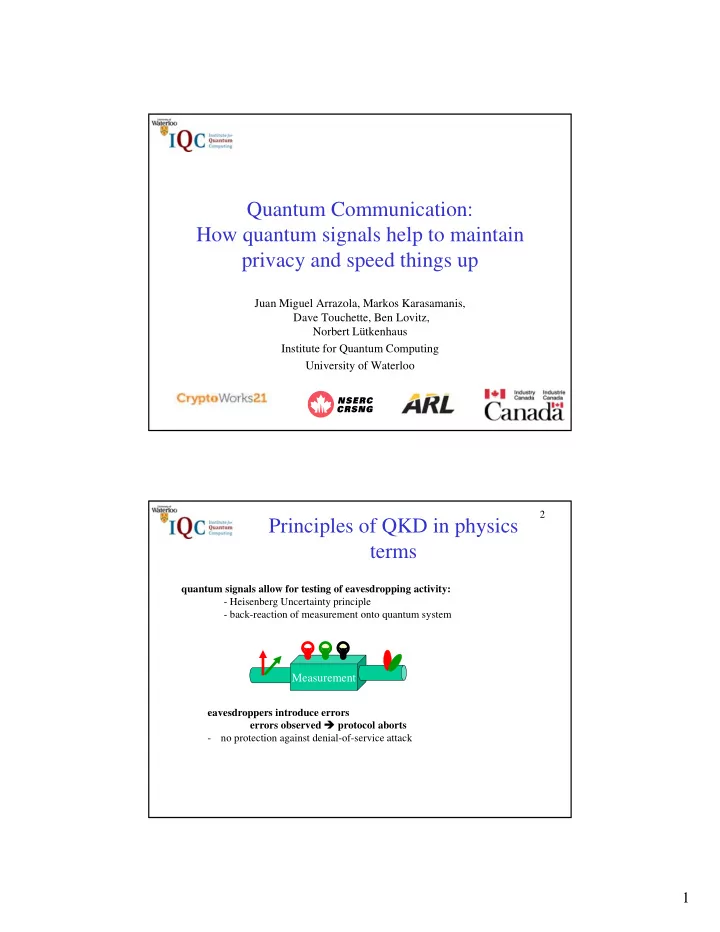
Principles of QKD in physics terms

2 eavesdroppers introduce errors errors observed  protocol aborts

  • no protection against denial-of-service attack

quantum signals allow for testing of eavesdropping activity:

  • Heisenberg Uncertainty principle
  • back-reaction of measurement onto quantum system

Measurement

slide-2
SLIDE 2

2

Quantum Key Distribution Primitive

Alice Bob

key (X): 010110101 010110101

EVE

Authenticated Classical Channel

Alice/Bob devices:

  • trusted (cannot be manipulated by Eve)
  • characterized (QM description known, QM believed to hold)
  • secure perimeter (Eve cannot read internal status of devices)

Quantum Channel

Quantum Communication

using quantum effects in quantum communication

  • qualitative advantage

measurement back-reaction on signal  quantum key distribution (cannot be achieved classically)

  • quantitative advantage

use fewer resources to accomplish a goal leak less information to participants (towards secure multi-party computation)

slide-3
SLIDE 3

3

Quantum Mechanics

Measurement

quantum mechanics predicts probabilities of events to happen …

| Ψ i

the state of the system is described by a

  • complex unit vector |Ψ i

c1 c0

=

X i

ci|uii

Pr(”i”) = |ci|2

The measurement is described by

  • an orthonomal basis { |ui i }

classical communication embedded in quantum mechanics

  • rthogonal states can be perfectly discriminated

 classical signals are embedded into quantum mechanical formalism Non-orthogonal states cannot be perfectly discriminated! Prob(error) ≥ 1 2

µ

1 −

q

1 − |hu|vi|2

but there are measurements that can unambiguously discriminate the two signals with some probability! P rob(success) ≤ 1 − |hu|vi|

slide-4
SLIDE 4

4

How much information can be read out of QM systems?

we can prepare a quantum system in an arbitrary number of different internal states! BUT: if used in a communication context, we can recover at most log2 d number of bits about the input states

Information & Communication complexity Complexity

Information Complexity: (secure multi-party computation) How much does each party learn about the input of the others? multi-party computation a e b d c

  • given input: a,b,c,d,e …
  • evaluate z= f(a,b,c,d,e …)

Communication Complexity: How many signals need to be exchanged to evaluate function? Quantum Communication can offer better performance than classical communication

slide-5
SLIDE 5

5

realizable protocols Useful protocols protocols with quantum advantage before our work

  • ur work

Expectation Management Task Description: Finger Printing

(simultaneous message passing)

Alice Bob

x ∈ {0,1}n

y ∈ {0,1}n

Referee

“x = y” OR “x  y “

  • ne way communication only
  • no shared source of randomness
  • prescribed error level ²

Exponential Gap between classical and quantum classical [Ambainis, Algorithmica 16, 298 (1996)] quantum O(log2 n)

[Buhrman, Cleve, Watrous, de Wolf, PRL 87, 167902 (2001)]

O(√n)

note: If we were to give access to either

  • two-way classical communication, or
  • access to share randomness

 would also give O(log2 n) in classical communication Two different question:

  • how many signals

need to be transmitted to solve the task?

  • how much does the

referee learn about the input?

slide-6
SLIDE 6

6

Mechanism for Quantum Finger Printing

protocol encodes 2n states in a n dimensional Hilbert space!  highly non-orthogonal states! From Alice From Bob all states distinct! Referee: State Comparison!

  • are both states the same?
  • not interested which state …

C-SWAP Test

Tool to give information about two states being in the same state or not …

SWAP

1 √ 2 (|0i + |1i) |Ψi |Φi 1 √ 2 (|0i |Ψi |Φi + |1i |Φi |Ψi)

P rob(” + ”) = 1 2

³

1 + |hΦ|Ψi|2´ Prob(” − ”) = 1 2

³

1 − |hΦ|Ψi|2´

1 √ 2 (|0i + |1i)

|Ψi |Φi

Equal input Unequal input ‘same’ (+) 1 ‘different’ (-) If n repetitions allowed  can quickly reduce

·1

2

³

1 + |hΦ|Ψi|2´¸n 1 −

·1

2

³

1 + |hΦ|Ψi|2´¸n measurement in basis 1 √ 2 (|0i ± |1i)  0 for n  ∞  1for n  ∞

slide-7
SLIDE 7

7

Quantum Finger Printing Protocol

Alice Bob x y Referee “equal” OR “different” 3) Referee: Conditional-SWAP test

SWAP

H H |0i |E(x)i |E(y)i Equal input Unequal input ‘same’ 1 ‘different’ > ½(1-δ2) < ½(1+δ2) 4) k-fold repetition to reduce errors < ² [require repetition: k = O(log 1/²)] 1) Difference amplification (classical error correction code) x  E(x) n bits  m > n bits Hamming weight d(E(x), E(x’)) > (1-δ) m [Buhrman, Cleve, Watrous, de Wolf, PRL 87, 167902 (2001)] 2) Alice, Bob: Quantum encoding

E(x) → |E(x)i := 1 √m

m X i=1

(−1)E(x)i |ii

(we will later on use m = 3 n and δ = 0.92)  one bit difference  8% error difference # qubits: log m

D0 D1

identical inputs

Coherent-state Protocol

[Arrazola and Lütkenhaus, Phys. Rev A 89, 062305 (2014)]

D0 D1

different inputs

  • verall identical inputs: only detector D0 clicks

some differences: some D0 clicks, some D1 clicks

  • ccurrence of D1 detector clicks

 “overall different”  else: “overall identical” Difference amplification

slide-8
SLIDE 8

8

Resource counting

each pulse  make overall mean photon number |α |2  sufficiently large such that at least one click if difference exists  sufficiently low so that utilized Hilbert space is small 1 photon in m modes  dimension Hilbert space m,  log m qubits N photons in m modes  dim is  O(N log m) qubits

µN + m − 1 m − 1 ¶ ≈ mN

Experimental realities

loss between sources and referee?

 simply increase mean photon number to compensate loss  does not affect scaling of resources!

dark count in detectors?

 set optimal threshold scheme to decide ‘overall identical’ or ‘overall different’  will affect scaling for larger input size states:need to maintain signal/noise ratio

mode matching on beam splitter?

 uses again optimal threshold scheme to discriminate ‘identical/different’  does not affect scaling, as errors are proportional to signal

slide-9
SLIDE 9

9

Simulation optical system example of combined effects

Implementation parameters: error amplification δ = 0.92 [m = 3 n] η = 0.1  90% loss!! dark count probability dB = 4 × 10⁻⁹ visibility v = 0.98 target error rate of protocol: < 10-6  realistic protocol uses |α |2 = 6651  starting at n = 1013 one needs to increase |α |2 to balance increasing dark count effects  idealistic protocol uses |α |2 =89 information cost (bit/qubits) best known protocol ∼ 32√n

Implementation

[Xu et al, Nature Communications 6, 8735 (2015) ]

D0

Laser C BS PBS 5 km PMA VO A Sync FM

Alice

BS DL

Bob Referee

PMB

D1

FG TIA FG PR Modified IdQuantique commercial Plug&Play Scheme

slide-10
SLIDE 10

10

Experimental Results

Note: We use roughly 7,000 photons for input size of 108 !

ddet= 3.5 x 10⁻⁶ ηdet = 20% clockrate 5 MHz 5km distance Alice/Referee to Bob

Another experimental realization …

[ Guan, Zhang, Pan et al, Phys. Rev. Lett. 116, 240502 (2016)]

beats not only best known classical protocol, but also best known bound

  • n any classical protocol
slide-11
SLIDE 11

11

Will this convince an optical communication engineer?

BUT: encoding has constant energy (photon number)  number of photons in the channel dramatically decreased

  • reduced cross-talk in fiber
  • fewer detection clicks expected  faster clock rates???

ALSO does not require time resolution in detector! Accumulation of photons would just be fine  allows higher clock rate AND leaks only O(log n) bits about strings x, y to referee  Information Complexity see our paper [Arrazola, Touchette, arXiv:1607.07516] number of pulses: n Dimension: log n classical: number of bits O(√n) Our quantum implementation: [Phys. Rev A 90, 042335 (2014)]

Information Complexity

How much does each party learn about the input of the others? secure multi-party computation a e b d c

  • given input: a,b,c,d,e …
  • evaluate z= f(a,b,c,d,e …)
  • so that all parties know z and their own input
  • but nothing else

For Quantum Fingerprinting:

  • equality function
  • communication constraints: one-way, no shared randomness
  • Bound on classical protocol:

(exact expression known!)  our quantum optical protocol can beat that!

O(√n)

[Arrazola, Touchette, arXiv:1607.07516]

cannot be achieved exactly

[Buhrman, Christandl, Schaffner, |

  • Phys. Rev. Lett. 109, 160501 (2012)]
slide-12
SLIDE 12

12

The story continues …

Encoding scheme can be used to address

  • hidden matching protocol

(needs programmable mode switching)

  • can be translated to other communication complexity protocols maintaining

quantum advantage

  • can be used by other quantum protocols (quantum retrieval games)

[Arrazola, Karasamanis, NL, Phys. Rev. A 93, 062311 (2016) ]

[J.M. Arrazola, N. L, Phys. Rev. A 90, 042335 (2015)]]

appointment scheduling problem

  • has quadratic quantum advantage
  • has an optical implementation shuttling laser pulses for and back
  • is still very susceptible to coupling losses

Summary

  • There is a path to implement scalable quantum

communication complexity protocols!  think about other useful protocols

realizable protocols Useful protocols protocols with quantum advantage current status

  • ur goal for now
  • advantage in use of Hilbert space dimensions, number of photons used
  • entry into world information complexity protocols

(direction of secure multi-party computations)