Quick review of patients are .. pharmacokinetic-based The - - PDF document

quick review of
SMART_READER_LITE
LIVE PREVIEW

Quick review of patients are .. pharmacokinetic-based The - - PDF document

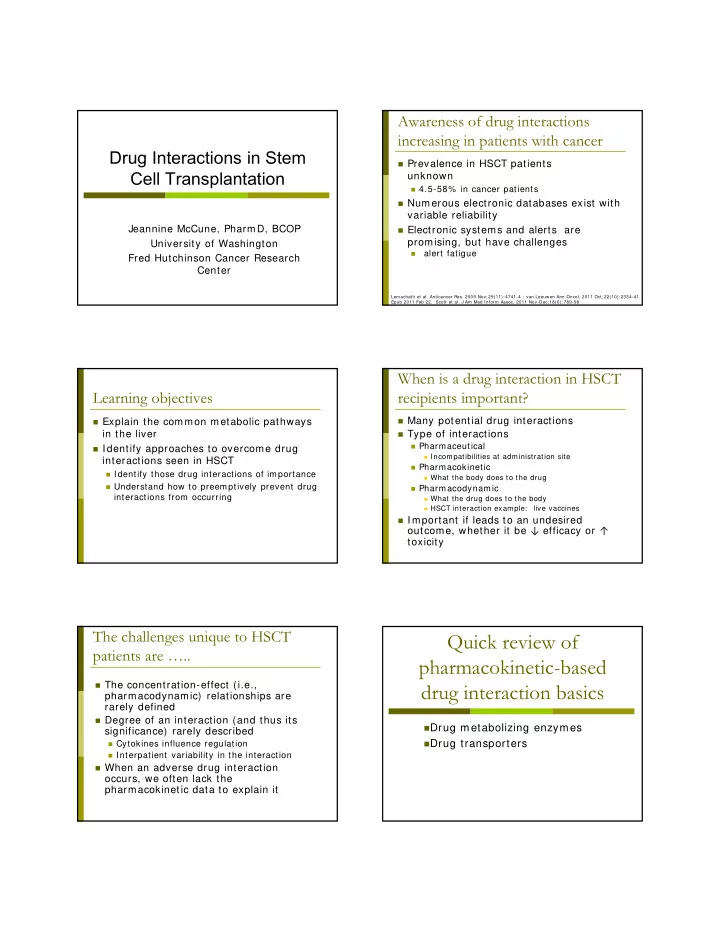
Awareness of drug interactions increasing in patients with cancer Drug Interactions in Stem Prevalence in HSCT patients Cell Transplantation unknown 4.5-58% in cancer patients Numerous electronic databases exist with variable


slide-1
SLIDE 1

Drug Interactions in Stem Cell Transplantation

Jeannine McCune, PharmD, BCOP University of Washington Fred Hutchinson Cancer Research Center

Awareness of drug interactions increasing in patients with cancer

 Prevalence in HSCT patients

unknown

 4.5-58% in cancer patients

 Numerous electronic databases exist with

variable reliability

 Electronic systems and alerts are

promising, but have challenges

alert fatigue

Lemachatti et al. Anticancer Res. 2009 Nov; 29(11): 4741-4 ; van Leeuwen Ann Oncol. 2011 Oct; 22(10): 2334-41. Epub 2011 Feb 22. Scott et al. J Am Med Inform Assoc. 2011 Nov-Dec; 18(6): 789-98

Learning objectives

 Explain the common metabolic pathways

in the liver

 Identify approaches to overcome drug

interactions seen in HSCT

 Identify those drug interactions of importance  Understand how to preemptively prevent drug

interactions from occurring

When is a drug interaction in HSCT recipients important?

 Many potential drug interactions  Type of interactions

 Pharmaceutical

 Incompatibilities at administration site

 Pharmacokinetic

 What the body does to the drug

 Pharmacodynamic

 What the drug does to the body  HSCT interaction example: live vaccines

 Important if leads to an undesired

  • utcome, whether it be ↓ efficacy or ↑

toxicity

The challenges unique to HSCT patients are …..

 The concentration-effect (i.e.,

pharmacodynamic) relationships are rarely defined

 Degree of an interaction (and thus its

significance) rarely described

 Cytokines influence regulation  Interpatient variability in the interaction

 When an adverse drug interaction

  • ccurs, we often lack the

pharmacokinetic data to explain it

Quick review of pharmacokinetic-based drug interaction basics

Drug metabolizing enzymes Drug transporters

slide-2
SLIDE 2

Relationship between pharmacokinetics and pharmacodynamics

Dose

Absorption Distribution Metabolism Excretion

Total serum concentration Receptor Site Unbound serum concentration Pharm acologic Response Protein Bound Concentration Therapeutic Outcom e

Slide courtesy of Gail Anderson, PhD

Pharmacology is multifactorial

 Can affect both the pharmacokinetics and

pharmacodynamics

 Factors include…

 Age  Sex  Ethnicity  Weight  Condition being treated  Pharmacogenetics  Idiosyncrasy  Drug interaction

Pharmacokinetic parameters

 Absorption

 The rate at which a drug leaves the site of

administration and the extent to which it

  • ccurs

 HSCT interaction example: proton pump

inhibitors with mycophenolate mofetil

 Distribution

 Process of reversible transfer of a drug to and

from the site of measurement

 HSCT interaction example: non-steroidal anti-

inflammatory drugs (NSAIDs) with methotrexate (also interacts at kidney)

Pharmacokinetic parameters: elimination

 Metabolism

 Predominately liver  Other sites: kidney, lung, gastrointestinal

tract (GI), plasma

 HSCT interaction example: many

 Excretion

 Kidneys and hepatic/ GI tract  Other sites: milk, sweat, saliva, tears  HSCT interaction example: cyclosporine with

mycophenolic acid

Biotransformation (Metabolism)

 Theory

 Drug inactivation  Increased elimination from the body

 Reality

 Metabolites may have biological activity;

similar or different than parent

 May contribute to toxic and/ or beneficial

effects

 Example: Cyclophosphamide metabolized by

cytochrome P450 (CYP) to 4hydroxycyclophospham ide

Phase I metabolism

 Oxidation, reduction, hydrolysis  Cytochrome P450 family of enzymes

 7 primary enzymes responsible for majority of

drug metabolism

 Can predict drug interactions based on

knowledge of metabolizing enzymes

 Various family, subfamily, individual genes  CYP1A2, CYP2A6, CYP2C9, CYP2C19, CYP2D6,

CYP2E1, CYP3A4/ 5  Inhibition  CYP,  concentration,  dose  Induction  CYP,  concentration,  dose

slide-3
SLIDE 3

Cytochrome P450 (CYP) enzyme system

 Large (but not only) source of drug

interactions

 Many in vitro methods to identify which

CYP metabolizes a drug, and potential drug interactions

 However, magnitude of drug interaction

difficult to predict

 ‘Cocktail’ studies in healthy volunteers  Cytokines (e.g., IL6) affect CYP

Examples of important CYP in HSCT

Drug Substrate Reaction

Cyclosporine 3A4/ 5 Elimination Tacrolimus 3A4/ 5 “ Sirolimus 3A4/ 5 “ Prednisone 3A4/ 5 “ Dexamethasone 3A4/ 5 “ Cyclophos- 2C9, 2C19 Activation to 4hydroxyCY (HCY) phamide (CY) 2 2B6, 3A4/ 5* 3A4/ 5 Detoxification to dechloroCY

  • Hebert. Metabolic Drug Interactions 2000; Shimada Transplant International 2003. Ren Cancer Research

1997; Huang Biochem Pharmacol 2000; Qiu Clin Pharm Ther 2004

Phase II metabolism

 Term coined to represent metabolism

  • ccurring after oxidation, reduction or

hydrolysis associated with bioactivation

 Many drugs don’t require Phase I metabolism

 Functional group created conjugated to less

toxic or inactive compound

Phase II: Relevant conjugation reactions

 Glutathione S-transferase

 Mediate conjugation of electrophilic

compounds to glutathione

 Important detoxifying pathway for alkylating

agents

 Glucuronidation

 Most common conjugation reaction for drugs  UGT (UDP-glucuronosyl transferase)  Conjugation of endogenous substances,

bilirubin, mycophenolic acid, morphine

Drug transporters

 Of the 400 transporters in the human

genome, 30 are relevant to pharmacokinetics

 ATP-binding cassette (ABC) superfamily  Relevant to systemic

pharmacokinetics and intracellular transport

ABC transporters relevant to HSCT patients

Transporter Substrate ABCB1 (MDR1)* calcineurin inhibitors, sirolimus corticosteroids ABCC1 (MRP1) methotrexate ABCC2 (MRP2) cyclophosphamide metabolite mycophenolic acid ABCC3 methotrexate ABCG2 (BCRP) etoposide, topotecan

* codes for pglycoprotein (pgp)

Endres et al. Eur J Pharm Sci. 2006 Apr; 27(5): 501-17

slide-4
SLIDE 4

Additional transporters

 Organic anion transporting polypeptide (OATP)

 methotrexate, opioids, corticosteroid metabolites

 Organic anion transporters (OAT)

 beta-lactams, metabolites of corticosteroids, NSAIDs

 Equilibrative nucleoside transporter 1 (ENT)

 fludarabine

 Concentrative pyrimidine-preferring nucleoside

transporter 1 (CNT)

 fludarabine

Zhang et . Clin Pharmacol Ther. 2011 Apr; 89(4): 481-4; Pauli-Magnus Pharmacogenetics 2003; 13: 189; Sekine Annals of Oncology 2001; 12: 1515; Oleschuk Am J Physiol Gastrointest Liver Physiol 2003 Feb; 284(2): G280;

Excretion

 Drugs are eliminated from the body

unchanged or as metabolites

 Complex, for example renal excretion

involves

 Glomerular filtration  Active tubular transport  Passive tubular absorption

 HSCT interaction example: NSAIDs inhibit

renal tubular secretion of methotrexate and/ or reduce renal blood flow by inhibiting prostaglandin synthesis

Pharmacokinetic parameters

 Clearance measures body’s ability to

eliminate drugs

 Elimination half-life is time it takes for the

amount of drug in the body to be reduced by 50%

 T1/ 2 = 0.693• Vd

Cl

 where Vd = volume of distribution and

Cl = total body clearance

 Impact of CYP interactions on clearance

 Inhibition  CYP,  clearance,  concentration,  dose  Induction  CYP,  clearance,  concentration,  dose

Elimination half-life

Example: Plasma Concentrations Drug with T1/2 = 12 hrs

Dose 100 mg 200 mg C0 20 g/ ml 40 g/ ml C12hr 10 g/ ml 20 g/ ml C24hr 5 g/ ml 10 g/ ml C36hr 2.5 g/ ml 5 g/ ml C48hr 1.2 g/ ml 2.5 g/ ml C60hr < 1 g/ ml 1.2 g/ ml C72hr < 1 g/ ml < 1 g/ ml

Slide courtesy of Gail Anderson, PhD

Steady state

 Css = the concentration at which the rate

  • f drug input is equal to the rate of drug

elimination

 Can be defined as area under the curve/ dosing

interval (busulfan)

 Takes approximately 5 T1/ 2 to reach

steady state

 Take approximately 5 T1/ 2 to completely

eliminate a drug after discontinuation

 Css is dependent on dosage and clearance

Approximate half-lives of relevant immunosuppressants

 Calcineurin inhibitors: 11-35 hours (hr)  Sirolimus: 62 hr  Mycophenolic acid: 0.6-11.9 hr  Methylprednisolone, prednisone: 1.7 to 4.1 hr

slide-5
SLIDE 5

Learning objectives

 Explain the common metabolic pathways

in the liver

 Identify approaches to overcome drug

interactions seen in HSCT

 Identify those drug interactions of importance  Understand how to preemptively prevent drug

interactions from occurring

GVHD Medications

Cyclosporine, Tacrolimus, Sirolimus, Methotrexate, Mycophenolate mofetil, Corticosteroids

Less commonly used GVHD medications

 Immunomodulating modalities mTOR-

inhibitors, thalidomide, hydroxychloroquine, vitamin A analogs, rituximab, alemtuzumab, etanercept

 Cytostatic agents: cyclophosphamide,

pentostatin

Pidala BBMT 2011, 17(10): 1528; 2Ferrara Lancet 2009, 373: 9674; Holler Best Pract Res Clin Haematol. 2007 Jun; 20(2): 281-94, Wolff BBMT 2011; 17(1): 1-17

The interactions discussed

 Pharmacokinetic interactions relevant to GVHD

prophylaxis and treatment

 Will discuss herbal preparations, but recall they are

unique because of potential pill to pill variability in content, for fungal contamination, immunologic properties… ..

 Omitting others not because they are less

important but they may be

 more easily identified (e.g., the opioids because of close

concentration – effect relationship)

 more broad therapeutic index of the medication (e.g.,

most antibiotics)

Effect of food/herbs

 Difficult to know magnitude of problem  Difficult to predict

 Expect grapefruit juice to ↑ absorption of etoposide, a

CYP3A/ pglycoprotein substrate, but it actually ↓ absorption in cancer patients

 Pharmacodynamic (e.g., antioxidant) concerns

reviewed well in Nutrition chapter of Thomas 4th edition

Effect

Grapefruit juice  intestinal CYP3A,  pgp

  • St. John’s wort

 CYP3A4, pgp Garlic  CYP3A4

Cancer Research 2004; 64: 4346; Leather BMT 2004; 33: 137.

Calcineurin inhibitors (CNI)

 Cyclosporine (CyA) and tacrolimus (TAC)

 Considerable pharmacokinetic variability in CNI

concentrations obtained in patients receiving same dose

 CNI concentrations related to clinical

  • utcomes (pharmacodynamics)

 CyA/ TAC risk of acute GVHD  CyA/ TAC nephrotoxicity

Yee; N Engl J Med 1988; 319: 65; Ram et al. Biol Blood Marrow Transplant. 2011 Aug 26

slide-6
SLIDE 6

Personalized dosing of CNIs

 Using pharmacokinetics, CNI doses

personalized to achieve target trough concentrations

 But…

.considerable interpatient variability in efficacy and toxicity remain

Better biomarkers (e.g., calcineurin activity1, pharmacogenomics2) still needed  Drug interactions can be identified, and

doses adjusted as needed

 Important because CNIs are substrates

(metabolized by) CYP3A and p-glycoprotein

1Sanquer S et al. Transplantation 2004; 77(6): 854-8. Pai SY et al, Blood 1994; 84(11): 3974-9; Koefoed-Nielsen

et al. Transplant International 2006; 19: 821-7. 2Woodahl EL et al, Pharmacogenomics J. 2008 Aug; 8(4): 248- 55.

Variability in CYP3A content

Lin et al. Mol Pharmacol 2002; 62: 162-72

P-glycoprotein

 Additional names

 Multidrug resistance protein (MRP1)  ATP-dependent drug transporter (ABCB1)

 Drug interaction potential

 Limits oral drug bioavailability  Transports drugs out of renal tubular epithelial

cells and mesangial cells on the glomerulus

 Blood brain barrier  Intracellular accumulation

Medications that increase CyA or TAC plasma concentrations

Effect Inhibitors CYP3A P-gp Azoles – vary within class (Fluconazole, Itraconazole, Ketoconazole, Voriconazole)   Diltiazem, Verapamil   Chloramphenicol ? ? Norfloxacin  ? Clarithromycin, Erythromycin   Grapefruit Juice  Imatinib  ?

  • Hebert. Metabolic Drug Interactions 2000 Ch 37; Leather HL. Bone Marrow Transplant. 2004 Jan; 33(2): 137-

52

Management: Monitor concentrations,  dose of CNI PRN

Medications that decrease CyA or TAC plasma concentrations

Effect Inducers CYP3A P-gp Enzyme inducing antiepileptics (EIAED) Carbamazepine  Phenobarbital   Phenytoin   Rifampin  

  • St. John’s Wort

 

Management: Monitor concentrations,  dose of CNI PRN

  • Hebert. Metabolic Drug Interactions 2000 Ch 37; Leather HL. Bone Marrow Transplant. 2004 Jan; 33(2): 137-

52

Importance of transporters: Cyclosporine causing interactions

 Interaction with statins

 Unexpected interaction of CyA with two statins

(rosuvastatin and pravastatin)

 Numerous mechanisms: CyA inhibits OATP1B1

(organic anion-transporting polypeptide 1B1), OATP1B3, and BCRP (breast cancer resistance protein)

 Interaction with mycophenolate mofetil

 CyA inhibits ABCC2, which reduces the

enterohepatic recirculation of mycophenolic acid (MPA), and increases MPA clearance

Zhang et . Clin Pharmacol Ther. 2011 Apr; 89(4): 481-4; Endres et al. Eur J Pharm Sci. 2006 Apr; 27(5): 501-17

slide-7
SLIDE 7

Sirolimus

 Substrate for CYP3A &

p-glycoprotein

 Similar drug

interactions as CyA and TAC

 Long half-life

(average: 62 hours)

 Will take 5–7 days for

steady state sirolimus concentrations if drug interaction occurs

Stenton et al. Clin Pharmacokinet. 2005; 44(8): 769-86; Zimmerman. J Clin Pharmacol 2003; 43: 1168

Potential sirolimus interactions

Effect on sirolimus concentrations INCREASE Decrease Azoles (fluconazole, itraconazole, ketoconazole, posaconazole, voriconazole) EIAED (carbamazepine, phenytoin, phenobarbital) Amiodarone

  • St. John’s wort

Diltiazem, Verapamil Nevirapine CyA Rifabutin Amprenavir Rifampin Clarithromycin, Erythromycin Grapefruit Juice

Micromedex

Management: Monitor concentrations, adjust sirolimus dose PRN

Mycophenolate mofetil (MMF)

MMF Mycophenolic acid* MPA glucuronide

esterases UGTs Biliary excretio to intestine (18% of dose)

MPA glucuronide

Similar amount of

pharmacokinetic variability as CNIs

Pharmacodynamic relationships

being identified in HSCT patients

Renal excretion

Potential MMF interactions

 Increase MPA levels

 Rosiglitazone (?)

 Decrease MPA levels

 Select antibiotics (gut decontamination, norfloxacin &

metronidazole, Augmentin)

 Some proton pump inhibitors  Rifampin (?)  Calcium polycarbophil  Cholestyramine  Telmisartan  Sevelamer

Corticosteroids

 In general, steroid

metabolism involves sequential hydroxylation followed by conjugation to water-soluble metabolites

 6 -hydroxylation

  • ccurs via CYP3A4/ 5

but is a relatively minor pathway

 P-glycoprotein

appears to be involved in the transport of some steroids (cortisol, dexamethasone, methylprednisolone)

Corticosteroid drug interactions

 Increase levels

 Ketoconazole  Oral

Contraceptives

 Decrease levels

 Phenytoin  Phenobarbital  Carbamazepine  Rifampin

Hebert Metabolic Drug Interactions Chapter 37; McCune Clin Pharmacol Ther 2000.

slide-8
SLIDE 8

Conclusions

 Drug interactions are frequent in HSCT patients  Changes in CYP cause many pharmacokinetic

drug interactions, but other types of interactions are also relevant

 Considerable interpatient variability in magnitude

  • f a drug interaction

 Management of drug interactions much easier

when pharmacokinetic monitoring is available

 Further data needed to know impact of drug

interactions with sirolimus, mycophenolate mofetil, corticosteroids and post-HSCT cyclophosphamide