' $ r r r r INSTITUT F UR INF ORMA TIK r r r r r r - - PDF document

r r r r institut f ur inf orma tik r r r r r r r r r r r
SMART_READER_LITE
LIVE PREVIEW

' $ r r r r INSTITUT F UR INF ORMA TIK r r r r r r - - PDF document

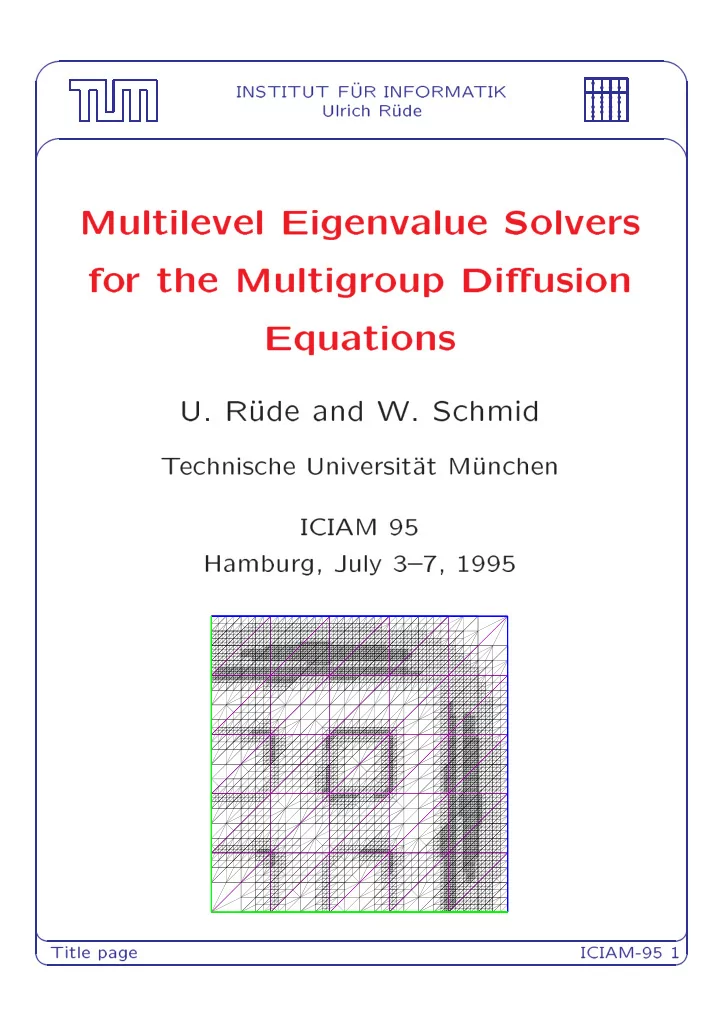
' $ r r r r INSTITUT F UR INF ORMA TIK r r r r r r r r r r r r r Ulrich R ude r r r ' $ Multilevel Eigenvalue Solvers fo r the Multigroup Diusion Equations U. R ude and W. Schmid T


slide-1
SLIDE 1 ' ' $ $ INSTITUT F
  • UR
INF ORMA TIK Ulrich R ude r r r r r r r r r r r r r r r r r r r r Multilevel Eigenvalue Solvers fo r the Multigroup Diusion Equations U. R ude and W. Schmid T echnische Universit
  • at
M unchen ICIAM 95 Hamburg, July 3{7, 1995
  • Title
page ICIAM-95 1
slide-2
SLIDE 2 ' ' $ $ INSTITUT F
  • UR
INF ORMA TIK Ulrich R ude r r r r r r r r r r r r r r r r r r r r Overview
  • the
p roject
  • neutron
diusion equations
  • eigenvalue
p roblem
  • a
va riant
  • f
inverse iteration
  • combination
with iterative solvers
  • numerical
results
  • Overview
ICIAM-95 2
slide-3
SLIDE 3 ' ' $ $ INSTITUT F
  • UR
INF ORMA TIK Ulrich R ude r r r r r r r r r r r r r r r r r r r r The Project Development
  • f
ecient algo rithms fo r the nu- merical solution
  • f
3D neutron transp
  • rt
equa- tions in nuclea r reacto rs Co
  • p
eration b et w een
  • Siemens
KWU
  • Siemens
ZFE
  • Universit
  • at
Augsburg (R.H.W. Hopp e, W. Schmid, F. W agner)
  • T
ech. Univ. M unchen (U. R ude) Goals
  • adaptive
discretization in space b y (noncon- fo rming) nite elements
  • adaptive
timestepping
  • fast
multilevel solution techniques
  • pa
rallelizat i
  • n
  • Project
ICIAM-95 3
slide-4
SLIDE 4 ' ' $ $ INSTITUT F
  • UR
INF ORMA TIK Ulrich R ude r r r r r r r r r r r r r r r r r r r r Nuclea r Reacto r Chain reaction
  • f
nuclea r ssions induced b y free neutrons Critical reacto r Neutron p ro duction and neutron losses balanced: constant energy
  • utput
Neutron sinks
  • abso
rption
  • diusion
Neutron sources
  • ssion
  • external
neutron sources Simulation
  • Behaviour
in a neutron equilib ri um ) stationa ry equations
  • Dynamical
b ehaviour ) transient equations
  • Reacto
r ICIAM-95 4
slide-5
SLIDE 5 ' ' $ $ INSTITUT F
  • UR
INF ORMA TIK Ulrich R ude r r r r r r r r r r r r r r r r r r r r Balance fo r free neutrons neutron ux , dep endent
  • n
direction
  • f
neutron motion, energy , space, time ( ~ r ; E ; ; t) = v
  • n(
~ r ; E ; ; t) leads to transp
  • rt
equations 1 v @
  • @
t +
  • r
+
  • T
  • +
: : : Simplifying assumptions lead to diusion theo ry
  • isotropical
scattering
  • nly
w eak dep endence
  • f
the ux
  • n
the di- rection
  • f
neutron motion
  • Mathematical
mo delling ICIAM-95 5
slide-6
SLIDE 6 ' ' $ $ INSTITUT F
  • UR
INF ORMA TIK Ulrich R ude r r r r r r r r r r r r r r r r r r r r Stationa ry t w
  • group
diusion equations r
  • (D
1 r 1 ) + ( a1 +
  • 12
)
  • 1
= 1
  • 1
( f 1
  • 1
+
  • f
2
  • 2
) r
  • (D
2 r 2 ) +
  • a2
  • 2
  • 12
  • 1
= 1
  • 2
( f 1
  • 1
+
  • f
2
  • 2
)
  • r
" r
  • D
1 r +
  • a1
+
  • 12
  • 12
r
  • D
2 r +
  • a2
# "
  • 1
  • 2
# =
  • "
  • 1
  • f
1
  • 1
  • f
2
  • 2
  • f
1
  • 2
  • f
2 # "
  • 1
  • 2
#
  • r
(L
  • F
)
  • x
= where
  • =
1
  • and
x = [ 1 ;
  • 2
] T
  • Diusion
equations ICIAM-95 6
slide-7
SLIDE 7 ' ' $ $ INSTITUT F
  • UR
INF ORMA TIK Ulrich R ude r r r r r r r r r r r r r r r r r r r r Inverse iteration Given: Initial vecto r x , Estimates ~
  • i
F
  • r
i = 0; 1; 2; : : : x i+1 = (L
  • ~
  • i
F ) 1 F x i ; x i+1 = x i+1 =kx i+1 k;
  • i+1
= < x i+1 ; Lx i+1 > < x i+1 ; F x i+1 > Strategy to chose ~
  • i
(dep ending
  • n
  • i
?), when iterative solvers must b e used. Inverse co rrection iteration (W. Schmid, 94; cf. Hackbusch 85) Given: Initial vecto r x , estimates ~
  • i
initial eigenvalue app ro ximation
  • F
  • r
i = 0; 1; 2; : : : d i = (L
  • i
F )x i v i = I T E R [(L
  • ~
  • i
F ); d i ; 0] x i+1 = x i
  • v
i
  • i+1
= < x i+1 ; Lx i+1 > < x i+1 ; F x i+1 >
  • Inverse
Iteration ICIAM-95 7
slide-8
SLIDE 8 ' ' $ $ INSTITUT F
  • UR
INF ORMA TIK Ulrich R ude r r r r r r r r r r r r r r r r r r r r Analysis
  • f
inverse co rrection Assume x i = e and
  • a
re an eigenvecto r/ eigen- value pair, i.e. Le
  • F
e = Then d i = (L
  • i
F )e = (1
  • i
=
  • )Le
x i+1 = x i + (L
  • ~
  • i
F ) 1 Le = ( i
  • ~
  • i
) (
  • ~
  • i
) | {z } =
  • e:
  • i
=
  • (1
+
  • i
), ~
  • i
=
  • (1
+ ~
  • i
) p erturbations
  • f
  • :
  • =
  • (
~
  • i
  • i
)
  • ~
  • i
= ( ~
  • i
  • i
) ~
  • i
: lim
  • i
!0
  • =
1; indep endent
  • f
~
  • i
6= lim ~
  • i
! i
  • =
0; indep endent
  • f
  • i
6=
  • Analysis
ICIAM-95 8
slide-9
SLIDE 9 ' ' $ $ INSTITUT F
  • UR
INF ORMA TIK Ulrich R ude r r r r r r r r r r r r r r r r r r r r F urther Analyis Consider ~
  • i
=
  • i
fo r constant
  • :
lim
  • i
!0
  • =
lim
  • i
!0
  • i
(
  • 1)
  • i
  • =
  • 1
  • :
Thus
  • 1
= )
  • 1.
General case (fo r symmetric L; F ): x i = n X j =0
  • j
e j ; (e j ;
  • j
eigenvecto rs/ values) x i+1 = n X j =0
  • j
  • j
e j where
  • j
= ( i
  • ~
  • i
) ( j
  • ~
  • i
) =
  • (
i
  • ~
  • i
) ( j
  • (1
+ ~
  • i
)) : Convergence if
  • Both
  • i
and ~
  • i
tend to
  • .
  • Relative
dierence
  • =
~
  • i
  • i
  • 1
  • F
urther analysis ICIAM-95 9
slide-10
SLIDE 10 ' ' $ $ INSTITUT F
  • UR
INF ORMA TIK Ulrich R ude r r r r r r r r r r r r r r r r r r r r T ypical 2D mo del geometry

dPhi = 0 dn dPhi dn Phi = 0 Phi = 0 Region 1 Region 2 Region 3 (Reflector) = 0

T ypical adaptive mesh Computed b y KASKADE
  • 2D
numerical example ICIAM-95 10
slide-11
SLIDE 11 ' ' $ $ INSTITUT F
  • UR
INF ORMA TIK Ulrich R ude r r r r r r r r r r r r r r r r r r r r Numerical example 1
  • 1D
with 129 gridp
  • ints
  • dominating
eigenvalues: 0:9501; 0:9287; 0:8950; : : :
  • Inverse
iteration vs. Inverse Co rrection when combined with multigrid V-cycles
  • 2
p re- and 1 p
  • stsmo
  • thing
Jacobi smo
  • ther
  • n
6 levels.
  • ~
  • i
= 0:995 i .
  • Numerical
example 1 ICIAM-95 11
slide-12
SLIDE 12 ' ' $ $ INSTITUT F
  • UR
INF ORMA TIK Ulrich R ude r r r r r r r r r r r r r r r r r r r r Numerical example 2
  • 3D
with nonconfo rming Rannacher/T urek
  • nite
elements
  • numb
er unkno wns = 6538
  • Blo
ck-ILU p reconditioned CGS as solver
  • Stop
CGS, when residual < 10 4 and < 10 7 fo r inverse co rrection and inverse iteration, resp.
  • ~
  • i
= 0:95 i

0.01 0.1 1 20 40 60 80 100

  • rel. Fehler

CGS-Iterationen

  • Inv. Iter.
  • Inv. Corr.
  • Numerical
example 2 ICIAM-95 12
slide-13
SLIDE 13 ' ' $ $ INSTITUT F
  • UR
INF ORMA TIK Ulrich R ude r r r r r r r r r r r r r r r r r r r r Conclusions
  • further
analysis
  • f
inverse co rrection
  • in
combination with multigrid
  • compa
rison with Davidson metho d
  • compa
rison with Cai/Mandel/McCo rmick
  • multigrid
fo r eigenvalues (Hackbusch/Brandt)
  • multigrid
in 3D
  • adaptivit
y (fo r eigenvalue computation?)
  • transient
calculations
  • Conclusions
ICIAM-95 13