Jan Forbrich Thomas Preibisch Karl M. Menten Max-Planck-Institut für Radioastronomie, Bonn
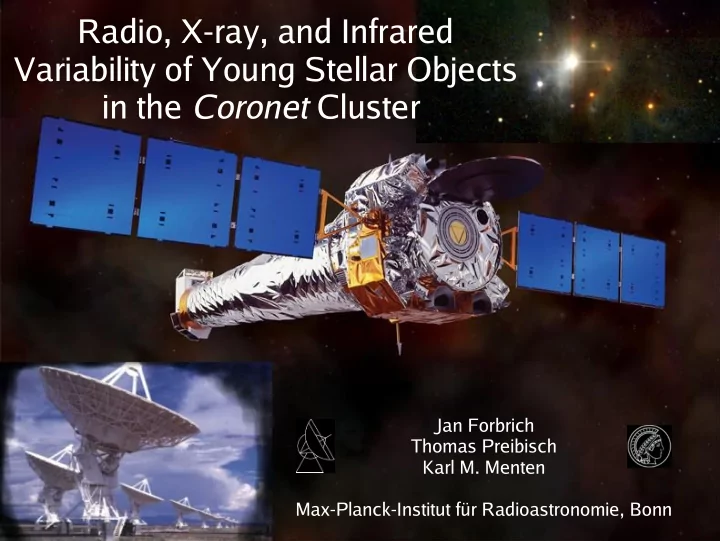
Radio, X-ray, and Infrared Variability of Young Stellar Objects in - - PowerPoint PPT Presentation
Radio, X-ray, and Infrared Variability of Young Stellar Objects in the Coronet Cluster Jan Forbrich Thomas Preibisch Karl M. Menten Max-Planck-Institut fr Radioastronomie, Bonn Outline Introduction Radio and X-ray Emission from YSOs
Outline
- Introduction
– Radio and X-ray Emission from YSOs
- The Coronet Cluster
– 1998 multi-epoch VLA observations – 2000-2003 archival (Chandra & XMM-Newton)
X-ray data, covering >150 ksec in total
– Outlook: simultaneous multi-wavelength
- bservations
S M A R T S
Radio, X-ray, and NIR emission from protostars
- connection to the different
evolutionary stages of protostars is still poorly understood
e.g. gyrosynchrotron, quickly variable, polarized e.g. from shock-induced ionisation, easily optically thick ! Feigelson & Montmerle (1999) magnetospheric bremsstrahlung and/or accretion (e.g. Kastner et al. 2004) circumstellar material observable e.g. in the NIR
- X-ray and radio emission
probe the innermost regions around YSOs
Multi-wavelength variability of protostars
- variability of protostars has mostly been studied at a
single wavelength of the electromagnetic spectrum
- little is known about the relationship of radio, X-ray, and
near infrared variability of protostars
- processes are poorly understood
- few simultaneous multi-wavelength observations
– Bower (2003): serendipitous discovery (WTTS) – systematic attempts: Feigelson et al. (1994),
Guenther et al. (2000) (single TTS), Gagné et al. (2004) (no class 0/I X-ray- and radio-detected)
Wilking et al. (1997), K'
R CrA IRS 2 IRS 1 IRS 5 IRS 7 IRS 6 T CrA IRS 4 IRS 9
The Coronet Cluster
d = 150 pc
Nisini et al. (2005)
The Coronet at NIR wavelengths
(IRS 1)
x x x
IRS1 is the youngest source. IRS2 and IRS5a have about the same age in spite of their different accretion properties.
(variable accretion ?)
Radio Emission from the Coronet
1998 VLA 3.6 cm data, integration of 5x2h
previous studies by Brown (1987) Suters et al. (1996) Feigelson et al. (1998) Choi & Tatematsu (2004) [IRS 7]
(!)
450 mu SCUBA: Nutter et al. (2005) CLASS 0 PRESTELLAR !
analyzed 9 epochs of 1998 VLA data spanning nearly four months
Radio Emission from the Coronet
9 epochs of 1998 VLA data
Forbrich, Preibisch, & Menten (2005, submitted)
BD?
Radio Emission from the Coronet
9 epochs of 1998 VLA data
Forbrich, Preibisch, & Menten (2005, submitted)
The circular polarisation
- f IRS5 is highly
variable. see also the discovery paper “Circularly Polarized Radio Emission from an X- Ray Protostar” (Feigelson, Carkner, & Wilking, 1998)
IRS7E R CrA IRS 9 IRS 6 IRS 7W IRS 5 IRS 1
Analysis of five archival X-ray datasets: XMM-Newton: 2001, 2x2003 Chandra: 2000, 2003
IRS 2 20 ksec (2000) Chandra ACIS observation (blue: 2.5-8 keV, green: 1.5-2.5 keV, red: 0.2-1.5 keV)
X-rays from the Coronet
IRS 2, XMM-Newton
Spectral analysis of the class I protostars IRS 1, 2, and 5 Signs of temporal evolution ?
Forbrich, Preibisch, & Menten (2005, submitted)
Spectra can be explained by highly absorbed hot plasma emission (several 10MK).
Spectral analysis of the class I protostars IRS 1, 2, and 5 The extinction problem The values for the column densities are all at around half the values derived from NIR colors, as
- bserved towards some other YSOs:
L1551IRS5 – Bally et al. (2003) EC95 – Preibisch (2003a) SVS16 – Preibisch (2003b). Maybe the NIR and X-ray emission come from detached regions ?
X-rays from jet shocks close to the protostar ? X-rays scattered towards the observer ? huge coronal structures ?
Luminosity curves for IRS 1, 2, 5
Forbrich, Preibisch, & Menten (2005, submitted)
Oct 00 Apr 01 Mar 03 Jun 03
IRS5 is again the most variable source.
R CrA has X-ray emission from very hot plasma (100 MK !), but no corona and no strong stellar wind... Takami et al. (2003) find some evidence for the presence
- f a companion separated by only 0.1” (i.e. only 10-15 AU).
The Herbig Ae star R CrA
Forbrich, Preibisch, & Menten (2005, submitted)
XMM-Newton XMM-Newton XMM-Newton
Main Results
- IRS5 shows highly variable nonthermal radio emission with
changes in its polarization, also variable X-ray emission
- X-ray spectra of class I protostars IRS 1,2,5 can be ex-
plained by absorbed emission of hot plasma (several 10 MK)
- the high absorbing column densities (several 1022 cm-2) are
at about half the values derived from NIR colors (the extinc- tion problem)
- towards the Herbig Ae star R CrA, surprisingly hot plasma
emission (100 MK!) was observed, possibly due to a com- panion
- the next step: simultaneous observations in August 2005
with R. Neuhäuser (Jena), B. Posselt (MPE/Jena), and F. Walter (SUNY)
S M A R T S