
SLIDE 1
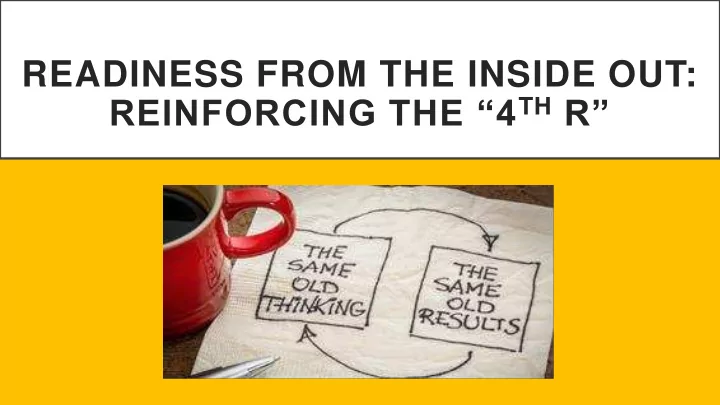
READINESS FROM THE INSIDE OUT: REINFORCING THE 4 TH R Executive - - PowerPoint PPT Presentation
READINESS FROM THE INSIDE OUT: REINFORCING THE 4 TH R Executive Coordinator of Educational Outreach , Access ASU, Arizona State University Faculty Associate , Arizona State University UNI 120 (Academic Success) UNI 220
JENNIFER MURPHY PH.D., NCC
Outreach, Access ASU, Arizona State University
College
College
Twitter: @drmurphyconsult Email: jmurph18@asu.edu
MEET “ERIC”
MEET “ASHLEY”
MEET “ISAAC”
WHAT WERE THESE INDIVIDUALS MISSING?
Growth Mindset Grit Self-Management Empathy Social Skills Resiliency Personal Responsibility Core Beliefs Self-Awareness Interdependence METACOGNITIVE REFLECTION
METACOGNITIVE SKILLS
works
processes
and feeling
METACOGNITION AND NEUROPLASTICITY
“There are things in life you’re not in charge of, but you are in charge of you. When you accept that, your brain changes. And every time your brain changes, you grow.”
CCR AND CURRENT RESEARCH
Johnson, H. & Wiener, R. (2017). This Time, With Feeling: Integrating Social and Emotional Development into College-and Career-Readiness Standards.
K-12 EDUCATION
Class
Good Life
same as being “good at life”
POSTSECONDARY EDUCATION
FORWARD PROGRESS IN EDUCATION
FORWARD PROGRESS IN EMPLOYMENT PRACTICES
and outside an organization
reflect on them with confidence (GM)
Self awareness Identity awareness Social awareness Empathy EQ Core beliefs Communication skills Interdependence Goal Setting Grit Resiliency Growth mindset Personal responsibility Active listening
JOHARI’S WINDOW: A SELF-AWARENESS TOOL
JOHARI’S WINDOW AS AN EDUCATIONAL TOOL
Ask
Known to self Unknown to self
T ell
Known to others
Arena Blind spot
How tall we are How others perceive us Hairstyle Whether you have spinach in Whether or not we wear glasses your teeth Talking too much during meetings
Unknown to others
Façade or hidden Unknown
Secrets, fears, insecurities Future Religious beliefs Hidden talent Dreams for the future Hidden potential
AREAS FOR IMPLEMENTATION
PRACTICAL ACTIVITY DESIGN GOALS
share with others
achievement)
EDUCATOR NEEDS
DELIBERATE PRACTICE
BACK TO “ASHLEY”
“Young people possess the inherent capacity to see what is wrong and to call for change.”
It is our role, as educators, to create opportunities for students to practice reflecting on who they are and how they think in
can lead the charge in building a better world for themselves and our future generations.
Ask
Known to self Unknown to self
T ell
Known to others
Arena Blind spot
How tall we are How others perceive us Hairstyle Whether you have spinach in Whether or not we wear glasses your teeth Talking too much during meetings
Unknown to others
Façade or hidden Unknown
Secrets, fears, insecurities Future Religious beliefs Hidden talent Dreams for the future Hidden potential
Increase the Arena Decrease the Blind Spot The Power of Self-Talk
Interdependence
Who Am I and What Do I Value
Decrease the Facade The Power of Self-Talk
How Do I Choose
Interdependence
Explore/Reveal the Unknown The Power of Self-Talk
Who Am I and What’s My Purpose
NOW, YOU’RE THE HIGH SCHOOL STUDENTS…
HOW DO I CHOOSE
REFLECTION
“things” that affect your decision making?
QUICK WRITE
SMALL GROUP SHARE
WHAT DO THESE MOVIES ALL HAVE IN COMMON?
THE CALL
important?
THE REFUSAL
THE CALL AND THE REFUSAL
MEETING THE MENTOR
TESTS, ALLIES, AND ENEMIES
THE HERO’S JOURNEY TO…
You…
WHO ARE YOUR MENTORS?
REFLECTION
SUPPORT FOR THE HEROES JOURNEY
“It was nice to know that we all go down the same path” The Heroes Journey was meaningful to me because everyone has something special” “It really helped to explain what I can accomplish” “It showed me the obstacles that I will face in high school and how to deal with them” “It motivated me” “It was showing things that we need to see to be set for life” “It changed my perception” “It taught me that I can overcome an obstacle like a hero” “Everything really helped me…It really encouraged me to change” “I think it shows that I can do anything and be who I want to be and I can change lives to be an actual hero for once” “I wish that I had known about this in middle school…things could have really been different for me”
REFERENCES
Adams, J. M. (2017, August). Circle Up: Teaching Social-Emotional Skills Year Round. Retrieved from https://edsource.org/2017/circle-up-teaching-social-emotional-skills-year- round/585641. Adams, S. (2014). The 10 Skills Employers Most Want in 2015 Graduates. Retrieved from forbes.com. Anderson, J. (2018). Top Colleges Like Yale Are Teaching Students to Prioritize Happiness – Not Money and Power. Retrieved from https://qz.com/1192880/harvard-yale-and-other-other- top-universities-are-teaching-students-a-new-skill-happiness/. Barnes, W. & Slate, J. R., (2013). College Readiness Is Not One-Size-Fits-All. Current Issues in Education, Vol. 16 (1), 1-13. Blad, E. (2018). Teachers Say Social-Emotional Learning is Important, but They Can’t Do it Alone. Retrieved from http://mobile.edweek.org/c.jsp?cid=25920011&item=http%3A%2F%2Fapi.edweek.org%2Fv1%2Fblog%2F147%2Findex.html%3Fuuid%3D75623. Brooks, K.S. (2010-2011). Connecting Students to Careers: Training and Instruction Guide. Sacramento, CA: California Community College Chancellor’s Office. Conley, D. T. (2012, May). A Complete Definition of College and Career Readiness. Retrieved from http://www.avid.org/dl/eve_natcon/nc12_four_keys_handout2.pdf. Daskal, L. (2017). 6 Emotional-Intelligence Job Skills Everyone Will Need in the New Few Years. Retrieved from https://www.inc.com/lolly-daskal/6-emotional-intelligence-job-skills-youll- need-in-.html. Fostering Purpose Project. (2018). Retrieved from https://www.fosterpurpose.org/. Ginsburg, K. (2018). A Moment in Time for Teens. Retrieved from https://www.psychologytoday.com/blog/raising-resilient-children-and-teens/201802/moment-in-time-teens. Johari Window Overview. (2016). Individual Leadership and Relationship Development. Retrieved from www.theinnovationcenter.org. Johnson, H. & Wiener, R. (2017). This Time, With Feeling: Integrating Social and Emotional Development into College-and Career-Readiness Standards. Retrieved from http://www.aspendrl.org/portal/browse/DocumentDetail?documentId=2968&download&admin=2968%7C1262432076. Kamenetz, A. (2015). Nonacademic Skills are Key to Success. But What Should We Call Them? Retrieved from http://www.npr.org/sections/ed/2015/05/28/404684712/non-academic skills- are-key-to-success-but-what-should-we-call-them. Knoster, T., Villa, R., & Thousand, J. (2000). A Framework for Thinking About Systems Change. In R. Villa & J. Thousand (Eds.), Restructuring for Caring and Effective Education: Piecing the Puzzle Together (p. 93-128). Baltimore: Paul H. Brookes Publishing Co. Mattern, K., Burrus, J., Camara, W., O’Connor, R., Hanson, M. A., Gambrell, J., Casillas, A., & Bobek, B. (2014). Broadening the Definition of College and Career Readiness: A Holistic Approach (Policy report). Retrieved from http://www.act.org/content/dam/act/unsecured/documents/ACT_RR2014-5.pdf. Newstrom, J. W. & Rubenfeld, S. A. (1983). The Johari Window. A Reconceptualization. Developments in Business Simulation & Experiential Exercises, 10. 117-120.
REFERENCES
Pandolpho, B. (2017). Journaling the Old-School Way. Retrieved from https://www.edutopia.org/article/journaling-old-school-way. Rice Sport Management. (2011, August 11). Anthony Robles ESPY [Video File]. Retrieved from https://www.youtube.com/watch?v=HtmC-R8htc4&t=86s. Rubenstein, G. (2017). Should Emotions be Taught in Schools. Retrieved from https://ideas.ted.com/should-emotions-be-taught-in-schools/. Schwartz, K. (2018). Setting School Cultures with Social and Emotional Learning Routines. Retrieved from https://ww2.kqed.org/mindshift/2018/01/16/setting-school-culture-with-social-and- emotional-learning-routines/. Shimer, D. (2018). Yale’s Most Popular Class Ever: Happiness. The New York Times. Retrieved from https://www.nytimes.com/2018/01/26/nyregion/at-yale-class-on-happiness-draws- huge-crowd-laurie-santos.html. Siciniski, A. (2015). The Ultimate Guide on How to Overcome Obstacles and Setbacks. Retrieved from http://blog.iqmatrix.com/overcome-obstacles. Strauss, V. (2017). The Surprising Thing Google Learned About Its Employees – and What It Means for Today’s Students. Retrieved from https://www.washingtonpost.com/news/answer- sheet/wp/2017/12/20/the-surprising-thing-google-learned-about-its-employees-and-what-it-means-for-todays-students/?utm_term=.eb5663c80d99. Terada, Y. (2017). How Metacognition Boosts Learning. Retrieved from https://www.edutopia.org/article/how-metacognition-boosts-learning?utm_source=twitter&utm_medium=socialflow. Wilson, D. & Conyers, M. (2018). Building a Metacognitive Classroom. Retrieved from https://www.edutopia.org/article/building-metacognitive-classroom. Wong, B. (2018). Why Colleges Should Offer Emotional Intelligence Classes. Retrieved from https://studybreaks.com/college/emotional-intelligence-classes-2/.