Real- Real -Time Systems Time Systems Real- -Time Systems Time - - PowerPoint PPT Presentation

real real time systems time systems
SMART_READER_LITE
LIVE PREVIEW

Real- Real -Time Systems Time Systems Real- -Time Systems Time - - PowerPoint PPT Presentation

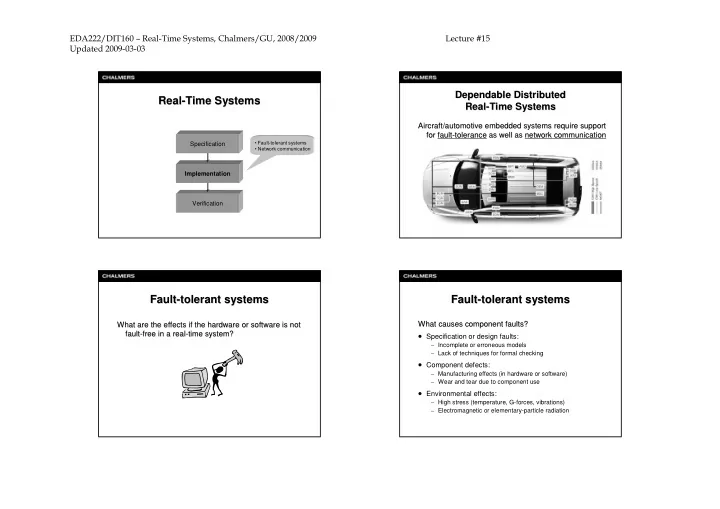
EDA222/DIT160 Real-Time Systems, Chalmers/GU, 2008/2009 Lecture #15 Updated 2009-03-03 Dependable Distributed Dependable Distributed Real- Real -Time Systems Time Systems Real- -Time Systems Time Systems Real Aircraft/automotive


slide-1
SLIDE 1

EDA222/DIT160 – Real-Time Systems, Chalmers/GU, 2008/2009 Lecture #15 Updated 2009-03-03

Real Real-

  • Time Systems

Time Systems

Verification Implementation Specification

  • Fault-tolerant systems
  • Network communication

Aircraft/automotive embedded systems require support Aircraft/automotive embedded systems require support for for fault fault-

  • tolerance

tolerance as well as as well as network communication network communication

Dependable Distributed Dependable Distributed Real Real-

  • Time Systems

Time Systems

What are the effects if the hardware or software is not What are the effects if the hardware or software is not fault fault-

  • free in a real

free in a real-

  • time system?

time system?

Fault Fault-

  • tolerant systems

tolerant systems

What causes component faults? What causes component faults?

  • Specification or design faults:

– Incomplete or erroneous models – Lack of techniques for formal checking

  • Component defects:

– Manufacturing effects (in hardware or software) – Wear and tear due to component use

  • Environmental effects:

– High stress (temperature, G-forces, vibrations) – Electromagnetic or elementary-particle radiation

Fault Fault-

  • tolerant systems

tolerant systems

slide-2
SLIDE 2

EDA222/DIT160 – Real-Time Systems, Chalmers/GU, 2008/2009 Lecture #15 Updated 2009-03-03

What types of faults are there? What types of faults are there?

  • Permanent faults:

– Total failure of a component – Caused by, e.g., short-circuits or corrupted data structures – Remains until component is repaired or replaced

  • Transient faults:

– Temporary malfunctions of a component – Caused by, e.g., ion radiation or power fluctuation

  • Intermittent faults:

– Repeated occurrences of transient faults

Fault Fault-

  • tolerant systems

tolerant systems

How are faults handled at run How are faults handled at run-

  • time?

time?

  • Error detection:

– Erroneous data or program behavior is detected

  • Watchdog mechanism, comparisons, diagnostic tests
  • Error correction:

– The originally-intended data/behavior is restored

  • Intelligent codes used for restoring corrupt data
  • Check-pointing used for restoring corrupt program flow
  • Fault masking:

– Effects of erroneous data or program behavior are ”hidden”

  • Time (re-execute code) or space (replicated hardware) redundancy
  • Voting mechanism (e.g., majority voting) or N-modular redundancy

(i.e., 2m+1 units to mask m faults)

Fault Fault-

  • tolerant systems

tolerant systems

To extend real To extend real-

  • time computing towards fault

time computing towards fault-

  • tolerance,

tolerance, the following issues must be considered: the following issues must be considered:

  • 1. What is the fault model used?

– What type of fault is assumed? – How and when are faults detected?

  • 2. How should fault-tolerance be implemented?

– Using time redundancy (re-execution)? – Using space redundancy (replicated tasks/CPUs/networks)?

  • 3. What scheduling policy should be used?

– Extend existing policies? – Suggest new policies?

Fault Fault-

  • tolerant systems

tolerant systems

Hardware platform

1

μ

2

μ

3

μ

4

μ

Network communication Network communication

message sender receiver

1

τ

2

τ

slide-3
SLIDE 3

EDA222/DIT160 – Real-Time Systems, Chalmers/GU, 2008/2009 Lecture #15 Updated 2009-03-03

Network communication Network communication

message delay

T1 T2

1

τ

2

τ

t t

network

t

1

τ

2

τ

Message delay: Message delay:

  • Message delays are caused by the following overheads:

– Formatting (packetizing) the message – Queuing the message, while waiting for access to medium – Transmitting the message on the medium – Notifying the receiver of message arrival – Deformatting (depacketizing) the message

Formatting/ Formatting/deformatting deformatting overheads are typically included in

  • verheads are typically included in

the execution time of the sending/receiving task. the execution time of the sending/receiving task.

Network communication Network communication

Queuing delay: Queuing delay:

  • The cause of the queuing delay for a message depends
  • n the actual network used. For example:

– Waiting for a corresponding time slot (TDMA) – Waiting for a transmission token (Token Ring) – Waiting for a contention-free transmission (Ethernet) – Waiting for network priority negotiation (CAN)

Network communication Network communication

Transmission delay: Transmission delay:

  • The delay for transmitting the message is a function of:

Network communication Network communication

L t v =

prop

and – Communication distance (m) – Signal propagation velocity (m/s)

N t R =

frame frame

– Message length (bits) – Data rate (bits/s)

slide-4
SLIDE 4

EDA222/DIT160 – Real-Time Systems, Chalmers/GU, 2008/2009 Lecture #15 Updated 2009-03-03

How is the message transferred onto the medium? How is the message transferred onto the medium?

  • Contention-free communication:

– Senders need not contend for medium access at run-time – Time-division, multiple-access (TDMA)

  • Token-based communication:

– Each sender using the medium gets one chance to send its messages, based on a predetermined order

  • Collision-based communication:

– Senders may have to contend for the medium at run-time – Ethernet, CAN

Network communication Network communication

TDMA TDMA-

  • based protocols:

based protocols:

  • One or more dedicated time slots for each processor:

– Example: medium access is divided into minor communication cycles (CC) and major system cycles (SC) – Message queuing delay is bounded (can be made negligible with appropriate scheduling)

  • Examples:

– TTP/C (Time-Triggered Protocol) – FlexRay

Network communication Network communication

Token Token-

  • based protocols:

based protocols:

  • Utilize a token for the arbitration of message transmissions
  • n a shared medium

– The sender is only allowed to transmit its messages when it possesses the token – Message queuing delay is bounded

  • Examples:

– Token Bus (IEEE 802.4) – Token Ring (IEEE 802.5) – FDDI

Network communication Network communication

Ethernet Ethernet-

  • based protocols:

based protocols:

  • Senders attempt to send a complete message

– Collision-detect mechanism is used to determine if there is a need for re-transmission – Message queuing delay can in general not be bounded!

CAN protocol: CAN protocol:

  • Senders transmit a message header (with an identifier)

– Collision-detect mechanism is used to determine who will be allowed to send the entire message – Message queuing delay can be bounded with appropriate identifier assignment

Network communication Network communication

slide-5
SLIDE 5

EDA222/DIT160 – Real-Time Systems, Chalmers/GU, 2008/2009 Lecture #15 Updated 2009-03-03

Controller Area Network (CAN): Controller Area Network (CAN): (Bosch 1991, SAE 1993)

(Bosch 1991, SAE 1993)

The CAN protocol The CAN protocol

collision-detect broadcast bus

1

μ

2

μ

3

μ

4

μ

CAN message frame format: CAN message frame format: (short format)

(short format)

The CAN protocol The CAN protocol

11-bit identifier 0 - 8 bytes of message data error control SOF Ack EOF control

11-bit identifier is used for two purposes:

  • assign a priority to the message (low number ⇒ high priority)
  • enable receiver to filter messages

Wired Wired-

  • AND

AND:

Each node monitors the bus while transmitting. If multiple nodes are transmitting simultaneously and one node transmits a ’0’, then all nodes will see a ’0’. If all nodes transmit a ’1’, then all nodes will see a ’1’.

CAN protocol: CAN protocol: (binary countdown)

(binary countdown)

The CAN protocol The CAN protocol

  • 1. Each node with a pending message waits until bus is idle.
  • 2. The node begins transmitting the highest-priority message

pending on the node. Identifier is transmitted first, in the order

  • f most-significant bit to least-significant bit.
  • 3. If a node transmits a recessive bit (’1’) but sees a dominant

bit (’0’) on the bus, then it stops transmitting since it is not transmitting the highest-priority message in the system.

  • 4. The node that transmits the last bit of its identifier without

detecting a bus inconsistency has the highest priority and can start transmitting the body of the message.

Contemporary communication networks suitable for Contemporary communication networks suitable for dependable distributed real dependable distributed real-

  • time systems

time systems

  • TTCAN:

– Widely used in today's automotive electronic systems

  • TTP/C:

– Operational in civil aircrafts

  • FlexRay:

– Anticipated in next generation automotive electronic systems

Dependable distributed networks Dependable distributed networks

slide-6
SLIDE 6

EDA222/DIT160 – Real-Time Systems, Chalmers/GU, 2008/2009 Lecture #15 Updated 2009-03-03

The TTCAN protocol The TTCAN protocol

– Based on the CAN protocol – Bus topology – Media: twisted pair – 1Mbit/ s

Node 2 Node 7 Node 1 Node 4 Node 3 Node 6 Node 5 A S S S

CPU/mem /CC Node

A second controller is required to implement the redundant bus

The TTCAN protocol The TTCAN protocol

Basic cycle Basic cycle 1 Basic cycle 2 Basic cycle 3

Transmission Columns

t

”Exclusive” – guaranteed service ”Arbitration” – guaranteed service (high I D), best effort (low I D) ”Reserved” – for future expansion...

Time is global and measured in network time units (NTU’s)

The TTP/C protocol The TTP/C protocol

Node 1 Node 4 Node 3 Node 2 Node 6 Node 5

A B

Node 1 Node 2 Node 3 Node 4 Node 5 Node 6

– Double channels (one redundant). Bus topology or ”star” (optical) – Media: twisted pair, fibre – 10 Mbit/ s for each channel

A S S S

CPU/mem /CC Node

A network is built on either twin buses or twin stars.

The TTP/C protocol The TTP/C protocol

Non-periodic messages have to be fitted into static slots by the application

”TDMA-round”

”message slots” t All comm unication is statically scheduled

Guaranteed service

slide-7
SLIDE 7

EDA222/DIT160 – Real-Time Systems, Chalmers/GU, 2008/2009 Lecture #15 Updated 2009-03-03

The The FlexRay FlexRay protocol protocol

Node 1 Node 3 Node 2 Node 6 Node 5

A B

Node 7

Node 4

Redundant channel can be used for an alternative schedule

A S S S

CPU/mem /CC Node

– Double channels, bus or star (even mixed). – Media: twisted pair, fibre – 10 Mbit/s for each channel

The The FlexRay FlexRay protocol protocol

Guaranteed periodical Guaranteed periodical/ aperiodical ”Best-effort” aperiodical 63 62 3 2 1 Network Idle Time Symbol window Static segment (m slots) Dynamic segment (n mini-slots)

Max 64 nodes on a Flexray network.

”Static segment” (compare w/ TTCAN ”Exclusive”) – guaranteed service ”Dynamic segment” (compare w/ TTCAN ”Arbitration”) – guaranteed service (high I D), ”best effort” (low I D)

Facing the written exam Facing the written exam

Real Real-

  • Time Systems

Time Systems

Tuesday 14 Tuesday 14:00 :00 − − 18:00, March 18:00, March 10, 2009 10, 2009 in the in the ” ”V V” ” building building

Note: in case you need to take a re Note: in case you need to take a re-

  • exam, you

exam, you must remember to register in the Student Portal must remember to register in the Student Portal

Facing the exam Facing the exam

Reading guidelines: Reading guidelines:

  • Course book: ”Real-Time Systems …”, Burns & Wellings

Compendium: ”Real-Time Systems …”, Tindell

– Recommended reading (detailed knowledge: very relevant) – Overview reading (general knowledge: less relevant)

  • Lecture notes (”PowerPoint hand-outs”)

– All material are very relevant (guest lecture notes: overview only)

  • Compendium of examples + laboratory assignment

– Good experience in theoretical analysis and Ada programming

  • Ada95 Reference Manual (ARM)

– Permitted to use at the exam (learn how to navigate in ARM)

slide-8
SLIDE 8

EDA222/DIT160 – Real-Time Systems, Chalmers/GU, 2008/2009 Lecture #15 Updated 2009-03-03

Facing the exam Facing the exam

Permitted to use during the exam: Permitted to use during the exam:

  • Chalmers-approved calculator

– Important aid for feasibility analysis problems

  • ”Ada Distilled” (Richard Riehle) + ”Ada vs Java” (Quick Ref.)

– Important aid for understanding basic principles of Ada – Important aid for writing syntax-correct Ada programs

  • Ada95 Reference Manual

– Important aid for writing parallel programs in Ada95 – Important aid for implementing low-level operations in Ada95 – Important aid for expressing real-time properties in Ada95

Facing the exam Facing the exam

Important knowledge areas: Important knowledge areas:

  • Design principles for real-time systems

– Real-time systems: typical properties, misconceptions – Real-time constraints: origin, interpretation (soft/hard) – Design phases: specification, implementation, verification – Verification: methods, difficulties, pitfalls

  • Real-time kernels

– Task management: data structures, task states, task switches – Services: actions taken for different types of system calls – Memory management: fundamental principles – Fault tolerance and data communication

Facing the exam Facing the exam

Important knowledge areas Important knowledge areas (cont (cont’ ’d): d):

  • Principles of parallel programming

– Parallelization: pros & cons – Mutual exclusion: definition, implementation – Deadlock: definition, management – Starvation: definition, management

  • Language constructs for parallel programming in Ada95

– Tasks: creation, synchronization – Shared objects: protected objects, semaphores, monitors – Real-time: concept of time, delays, priorities – Low-level: I/O-addressing, bit manipulation, interrupt handling

Facing the exam Facing the exam

  • Scheduling theory

– Task model: WCET, deadline, period, offset – Scheduling: definitions, priorities, preemption – Feasibility test: purpose, exactness (sufficient/necessary)

  • Static scheduling

– Properties: time table, pros & cons – Scheduling: generation of time tables, run-time behavior

  • Dynamic scheduling (RM, DM, EDF):

– Properties: priority assignment, optimality, pros & cons – Scheduling: run-time behavior, construct timing diagram – Feasibility test: theory, assumptions, exactness, complexity

Important knowledge areas (cont Important knowledge areas (cont’ ’d): d):

slide-9
SLIDE 9

EDA222/DIT160 – Real-Time Systems, Chalmers/GU, 2008/2009 Lecture #15 Updated 2009-03-03

Facing the exam Facing the exam

What type of exam problems will there be? What type of exam problems will there be?

  • Programming problems

– One or two smaller parallel programming problems with synchronization needs, real-time behavior and I/O management – Syntax faults will be considered less serious than fundamental design flaws!

  • Terminology

– A number of problems probing your knowledge of the area

  • Scheduling

– A number of problems on scheduling and associated analysis

Let yourself be inspired, but not controlled, by the Let yourself be inspired, but not controlled, by the contents contents of old exams!

  • f old exams!

… … and then ... and then ...

Real Real-

  • time systems

time systems

… … what to do if you are curious and want to know more? what to do if you are curious and want to know more?

Design of real Design of real-

  • time systems

time systems

What additional issues are there? What additional issues are there?

  • How are aperiodic tasks handled?

– Design of server tasks for aperiodic events

  • How is system overload handled?

– What tasks to execute is not always an easy choice

  • How are tasks assigned to processors?

– New possibilities and difficulties arise with multiple processors

  • How is inter-processor communication scheduled?
  • How is fault tolerance obtained in the system?

These issues (and more) are addressed in the advanced These issues (and more) are addressed in the advanced course in course in ” ”Parallel and Distributed Real Parallel and Distributed Real-

  • Time Systems

Time Systems” ” (EDA421, quarter 2) (EDA421, quarter 2)