Real- Real -time systems time systems Real- Real -time - - PowerPoint PPT Presentation

real real time systems time systems real real time
SMART_READER_LITE
LIVE PREVIEW

Real- Real -time systems time systems Real- Real -time - - PowerPoint PPT Presentation

EDA222/DIT160 Real-Time Systems, Chalmers/GU, 2008/2009 Lecture #2 Updated 2009-01-18 Real- Real -time systems time systems Real- Real -time programming time programming Recommended programming method: Recommended programming method:


slide-1
SLIDE 1

EDA222/DIT160 – Real-Time Systems, Chalmers/GU, 2008/2009 Lecture #2

Updated 2009-01-18

1

Real Real-

  • time systems

time systems

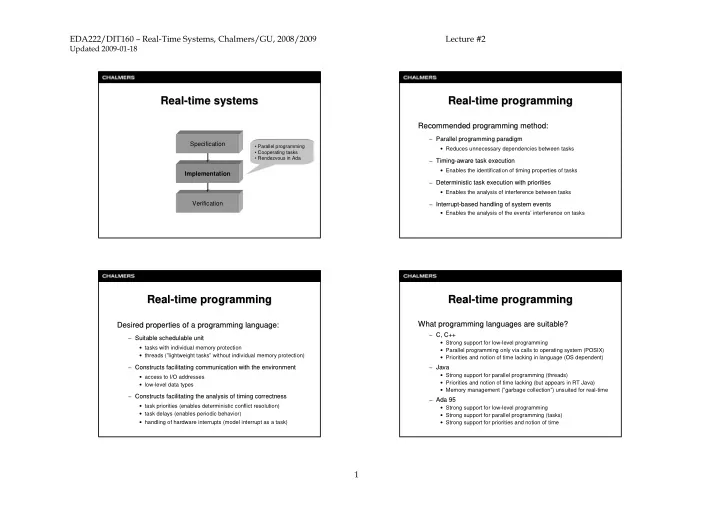
Verification Implementation Specification

  • Parallel programming
  • Cooperating tasks
  • Rendezvous in Ada

Real Real-

  • time programming

time programming

Recommended programming method: Recommended programming method:

– – Parallel programming paradigm Parallel programming paradigm

  • Reduces unnecessary dependencies between tasks

– – Timing Timing-

  • aware task execution

aware task execution

  • Enables the identification of timing properties of tasks

– – Deterministic task execution with priorities Deterministic task execution with priorities

  • Enables the analysis of interference between tasks

– – Interrupt Interrupt-

  • based handling of system events

based handling of system events

  • Enables the analysis of the events’ interference on tasks

Real Real-

  • time programming

time programming

Desired properties of a programming language: Desired properties of a programming language:

– – Suitable schedulable unit Suitable schedulable unit

  • tasks with individual memory protection
  • threads (”lightweight tasks” without individual memory protection)

– – Constructs facilitating communication with the environment Constructs facilitating communication with the environment

  • access to I/O addresses
  • low-level data types

– – Constructs facilitating the analysis of timing correctness Constructs facilitating the analysis of timing correctness

  • task priorities (enables deterministic conflict resolution)
  • task delays (enables periodic behavior)
  • handling of hardware interrupts (model interrupt as a task)

Real Real-

  • time programming

time programming

What programming languages are suitable? What programming languages are suitable?

– – C, C++ C, C++

  • Strong support for low-level programming
  • Parallel programming only via calls to operating system (POSIX)
  • Priorities and notion of time lacking in language (OS dependent)

– – Java Java

  • Strong support for parallel programming (threads)
  • Priorities and notion of time lacking (but appears in RT Java)
  • Memory management (”garbage collection”) unsuited for real-time

– – Ada 95 Ada 95

  • Strong support for low-level programming
  • Strong support for parallel programming (tasks)
  • Strong support for priorities and notion of time
slide-2
SLIDE 2

EDA222/DIT160 – Real-Time Systems, Chalmers/GU, 2008/2009 Lecture #2

Updated 2009-01-18

2

Why parallel programming? Why parallel programming?

Most real Most real-

  • time applications are inherently parallel

time applications are inherently parallel

– events in the target system’s environment often occur in parallel; by viewing the application as consisting of multiple tasks, this reality can be reflected. – while a task is waiting for an event (e.g., I/O or access to a shared resource) other tasks may execute.

System timing properties can be analyzed more easily System timing properties can be analyzed more easily

– first the local timing properties of each task are derived; then, the interference between tasks are analyzed

System can obtain reliability properties System can obtain reliability properties

– redundant copies of the same task makes system fault-tolerant

Problems with parallel programming Problems with parallel programming

Access to shared resources Access to shared resources

– many hardware and software resources can only be used by

  • ne task at a time (e.g., processor, hard disk, display)

– only pseudo-parallel execution is possible in many cases

Information exchange Information exchange

– system modeling using parallel tasks also introduces a need for synchronization and information exchange.

Parallel programming assumes an advanced run Parallel programming assumes an advanced run-

  • time

time system that takes care of the scheduling of shared system that takes care of the scheduling of shared resources and communication between tasks. resources and communication between tasks.

Support for parallel programming Support for parallel programming

Support in the programming language: Support in the programming language:

– program is easier to read and comprehend, which means simpler program maintenance – program code can be easily moved to another operating system – for some embedded systems, a full-fledged operating system is unnecessarily expensive and complicated – examples: Ada 95, Java, Modula, Occam, ...

Example Example:

:

Ada 95 offers support via task, rendezvous & protected objects Java offers support via threads & synchronized methods

Support for parallel programming Support for parallel programming

Support in the operating system: Support in the operating system:

– simpler to combine programs written in different languages whose parallel programming models are incompatible (e.g., C/C++, Java, Pascal, …) – difficult to implement the language’s parallel programming model on top of the operating system’s model – Operating systems become more and more standardized, which makes program code more portable between OS’s (e.g., POSIX for UNIX, Linux and Windows XT)

Example Example:

:

C/C++ offer support via fork, semctl & msgctl (UNIX, Linux)

slide-3
SLIDE 3

EDA222/DIT160 – Real-Time Systems, Chalmers/GU, 2008/2009 Lecture #2

Updated 2009-01-18

3

Example: a simple control system Example: a simple control system

Thermometer Thermometer

Switch

Pressure sensor Pressure sensor

Screen

Heater Heater

S T ADC DAC P ADC

Pump/valve Pump/valve Objective: Keep temperature and Objective: Keep temperature and pressure for a chemical process pressure for a chemical process within given bounds. within given bounds.

Sequential solution Sequential solution

procedure Controller is TR : Temp_Reading; PR : Pressure_Reading; HS : Heater_Setting; PS : Pressure_Setting; begin loop Read(TR);

  • - read temperature

Temp_Convert(TR,HS);

  • - convert to temperature setting

Write(HS);

  • - to temperature switch

Write(TR);

  • - to screen

Read(PR);

  • - read pressure

Pressure_Convert(PR,PS);

  • - convert to pressure setting

Write(PS);

  • - to pressure control

Write(PR);

  • - to screen

end loop; end Controller;

Sequential solution Sequential solution

Drawback: Drawback:

– the inherent parallelism of the application is not exploited

  • procedure Read blocks the execution until a new temperature
  • r pressure sample is available from the ADC
  • while waiting to read the temperature, no attention can be given

to the pressure (and vice versa)

  • if the call for reading the temperature does not return because of

a fault, it is no longer possible to read the pressure

– the independence of the control functions are not considered

  • temperature and pressure must be read with the same interval
  • the iteration frequency of the loop is mainly determined by the

blocking time of the calls to Read.

Improved sequential solution Improved sequential solution

Procedure Controller is ...; begin loop if Ready_Temp then Read(TR);

  • - read temperature

Temp_Convert(TR,HS);

  • - convert to temperature setting

Write(HS);

  • - to temperature switch

Write(TR);

  • - to screen

end if; if Ready_Pres then Read(PR);

  • - read pressure

Pressure_Convert(PR,PS);

  • - convert to pressure setting

Write(PS);

  • - to pressure control

Write(PR);

  • - to screen

end if; end loop; end Controller; The Boolean function Ready_Temp indicates whether a sample from ADC is available

slide-4
SLIDE 4

EDA222/DIT160 – Real-Time Systems, Chalmers/GU, 2008/2009 Lecture #2

Updated 2009-01-18

4

Improved sequential solution Improved sequential solution

Advantages: Advantages:

– the inherent parallelism of the application is exploited

  • pressure and temperature control do not block each other

Drawbacks: Drawbacks:

– processor capacity is unnecessarily wasted

  • the program spends a large amount of time in ”busy wait” loops

to detect new data samples (also complicates verification of correctness)

– the independence of the control functions are not considered

  • if the call for reading the temperature does not return because of

a fault, it is no longer possible to read the pressure

Parallel solution Parallel solution

Procedure Controller is task Temp_Controller; task Pressure_Controller; task body Temp_Controller is begin loop Read(TR); Temp_Convert(TR,HS); Write(HS); Write(TR); end loop; end Temp_Controller; task body Pressure_Controller is begin loop Read(PR); Pressure_Convert(PR,PS); Write(PS); Write(PR); end loop; end Pressure_Controller; begin null;

  • - begin parallel execution

end Controller;

  • A parallel code entity in Ada is

called ”task”

  • A task consists of a specification

and a body Procedure Controller does not terminate until tasks Temp_Controller and Pressure_Controller both have terminated

Parallel solution Parallel solution

Advantages: Advantages:

– the inherent parallelism of the application is fully exploited

  • pressure and temperature control do not block each other
  • the control functions can work at different frequencies
  • no processor capacity are unnecessarily consumed
  • the application becomes more reliable

Drawbacks: Drawbacks:

– the parallel tasks share a common resource

  • the screen can only be used by one task at a time
  • a third task is needed for controlling the access to the screen
  • tasks must be able to communicate with each other, which requires

a run-time system for synchronization and information exchange

Synchronization in Ada 95 Synchronization in Ada 95

Rendezvous: Rendezvous:

– For a task, there may be a number of entries that can be called by other tasks – Entries are declared in the specification of the task:

task P is

  • - specification of P

entry E1 (i : in integer);

  • - one input parameter (i)

entry E2;

  • - no input parameters

end P;

– A specification of a task may only contain declarations of entries – Entries are called from another task using:

P.E1(n);

  • - call with argument (n)

P.E2;

  • - call without argument
slide-5
SLIDE 5

EDA222/DIT160 – Real-Time Systems, Chalmers/GU, 2008/2009 Lecture #2

Updated 2009-01-18

5

Synchronization in Ada 95 Synchronization in Ada 95

Rendezvous (cont Rendezvous (cont’ ’d): d):

– In the body of a task there should be at least one accept construct for each declared entry.

  • When P reaches the accept construct and another task Q has called

the corresponding entry, a rendezvous occurs between P and Q.

  • The tasks simultaneously execute the statements in the accept

construct; the task that arrived first will have to wait.

– Examples of accept constructs:

accept E1 (i : in integer);

  • - for data exchange

accept E2;

  • - only give synchronization
  • - because no common
  • - statements are executed

Synchronization in Ada 95 Synchronization in Ada 95

Rendezvous (cont Rendezvous (cont’ ’d): d):

– Multiple tasks can call a certain entry E in task P.

  • The calling tasks are put into a wait queue in the order of the

made calls (i.e., FIFO, first-in-first-out).

  • Just one task at a time can perform rendezvous with P.
  • Every time the execution in P reaches an accept construct

for E, the first task in the wait queue is selected.

– There may be multiple accept constructs for the same entry in a task. The current point of execution then decides which accept construct will be selected.

  • Should be avoided! The program code becomes more difficult

to understand.

Example: simple buffer Example: simple buffer

Problem: Problem: Write a server task Simple_Buffer that works as a storage

buffer for a data record of type data. Called by client tasks in the following way:

Simple_Buffer.Write(Y);

  • - write buffer

Simple_Buffer.Read(Z);

  • - read buffer

Example: simple buffer Example: simple buffer

Simple_Buffer Process_Y Process_Z Write Read Z Y

Access graph: Access graph:

slide-6
SLIDE 6

EDA222/DIT160 – Real-Time Systems, Chalmers/GU, 2008/2009 Lecture #2

Updated 2009-01-18

6

Example: simple buffer Example: simple buffer

task Simple_Buffer is entry Write(d : in data); entry Read(d : out data); end Simple_Buffer; task body Simple_Buffer is buffer : data; begin loop accept Write(d : in data) do buffer := d;

  • - save client data in buffer

end Write; accept Read(d : out data) do d := buffer;

  • - return buffer data to client

end Read; end loop; end Simple_Buffer;

Example: control system Example: control system

Thermometer Thermometer

Switch

Pressure sensor Pressure sensor

Screen

Heater Heater

S T ADC DAC P ADC

Pump/valve Pump/valve

Synchronized solution Synchronized solution

task Screen_Controller is entry Write_p(PR : in Pressure_Reading); entry Write_t(TR : in Temp_Reading); end Screen_Controller; task body Screen_Controller is begin loop accept Write_p(PR : in Pressure_Reading) do put_p(PR);

  • - write pressure value to screen

end Write_p; accept Write_t(TR : in Temp_Reading) do put_t(TR);

  • - write temperature value to screen

end Write_t; end loop; end Screen_Controller;

Synchronized solution Synchronized solution

Procedure Controller is task Temp_Controller; task Pressure_Controller; task body Temp_Controller is begin loop Read(TR); Temp_Convert(TR,HS); Write(HS); Screen_Controller.Write_t(TR); -- entry call end loop; end Temp_Controller; task body Pressure_Controller is begin loop Read(PR); Pressure_Convert(PR,PS); Write(PS); Screen_Controller.Write_p(PR); -- entry call end loop; end Pressure_Controller; begin null;

  • - begin parallel execution

end Controller;

slide-7
SLIDE 7

EDA222/DIT160 – Real-Time Systems, Chalmers/GU, 2008/2009 Lecture #2

Updated 2009-01-18

7

Synchronized solution Synchronized solution

Drawbacks: Drawbacks:

– the independence of the control functions are not considered

  • the screen task writes pressure and temperature every other

call (predetermined sequences)

  • the sequential coding of the accept constructs in the screen task

introduces a (unnecessary) dependence between the tasks

Temp_Controller and Pressure_Controller

  • this solution works poorly if one of the control functions needs to

write its value more often than the other (i.e., using different iteration frequencies)

  • the screen task need a mechanism for considering available

accept constructs simultaneously

Synchronization in Ada 95 Synchronization in Ada 95

Alternative rendezvous: Alternative rendezvous:

– Multiple accept alternatives can be ”open” at the same time in the called task by enclosing them with select:

select accept E1 ( ... ) do ...

  • r

accept E2 ( ... ) do ... else ...

  • - do something else

end select;

– If rendezvous cannot occur instantly, a task can refrain from waiting and instead choose the else alternative in the select construct.

Synchronization in Ada 95 Synchronization in Ada 95

Alternative rendezvous (cont Alternative rendezvous (cont’ ’d): d):

– A corresponding action can be made for a calling task:

select P.E1 ( ... )

  • - try to establish contact

else ...

  • - perform error handling

end select;

Improved screen task Improved screen task

task Screen_Controller is entry Write_p(PR : in Pressure_Reading); entry Write_t(TR : in Temp_Reading); end Screen_Controller; task body Screen_Controller is begin loop select accept Write_p(PR : in Pressure_Reading) do put_p(PR);

  • - write pressure value to screen

end Write_p;

  • r

accept Write_t(TR : in Temp_Reading) do put_t(TR);

  • - write temperature value to screen

end Write_t; end select; end loop; end Screen_Controller;

slide-8
SLIDE 8

EDA222/DIT160 – Real-Time Systems, Chalmers/GU, 2008/2009 Lecture #2

Updated 2009-01-18

8

Synchronization in Ada 95 Synchronization in Ada 95

Alternative rendezvous with time Alternative rendezvous with time-

  • out:
  • ut:

– If rendezvous does not occur in a select construct within a certain amount of time, the called task can abort its wait:

select accept E1 ( ... ) do ...

  • r

accept E2 ( ... ) do ...

  • r

delay 10;

  • - wait for 10 seconds for contact

...

  • - do something else

end select;

– If no call is made to any of the open accept alternatives within the given amount of time, the delay alternative will be chosen.

Synchronization in Ada 95 Synchronization in Ada 95

Alternative rendezvous with time Alternative rendezvous with time-

  • out (cont
  • ut (cont’

’d): d):

– A corresponding action can be made for a calling task:

select P.E1 ( ... )

  • - try to establish contact ...
  • r

delay 10;

  • - ... for 10 seconds

...

  • - perform error handling

end select;

Synchronization in Ada 95 Synchronization in Ada 95

Conditional rendezvous (with guards): Conditional rendezvous (with guards):

– An accept construct enclosed by select can have a guard:

select when Condition_1 => accept E1 ( ... ) do ...

  • r

when Condition_2 => accept E2 ( ... ) do ... end select;

– Only alternatives where the condition is true are ”open” and can be selected – The conditions are calculated (in arbitrary order) every time the select construct is executed – If no alternatives are open, the program will terminate with error code PROGRAM_ERROR