Regional Climate Change Impacts in the South West: A discussion of - - PDF document

regional climate change impacts in the south west a
SMART_READER_LITE
LIVE PREVIEW

Regional Climate Change Impacts in the South West: A discussion of - - PDF document

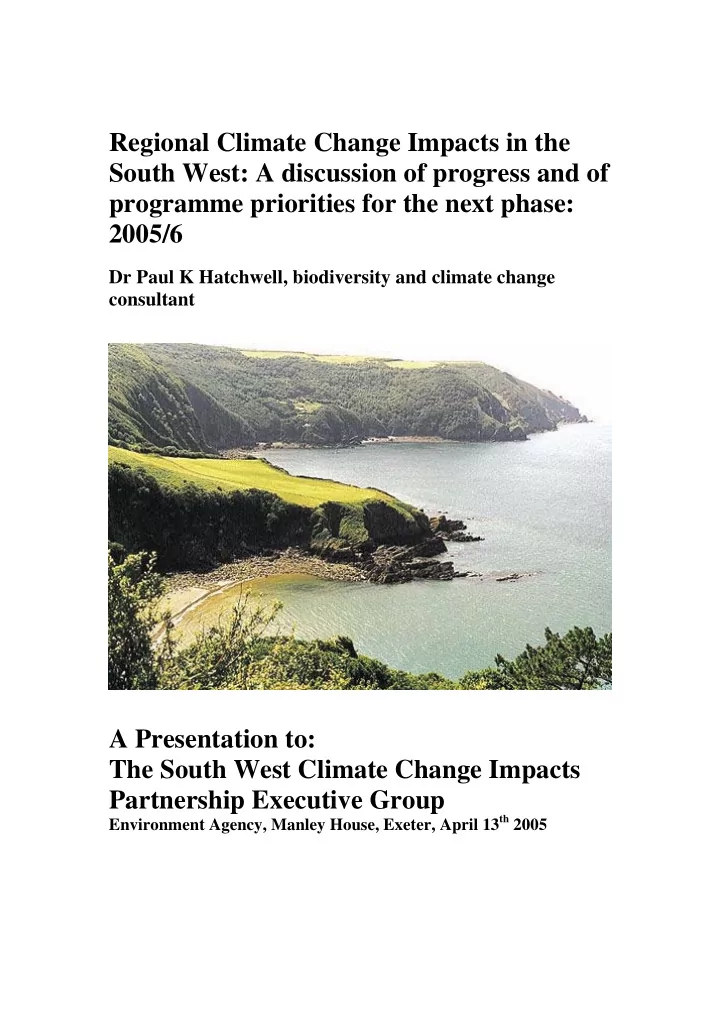
Regional Climate Change Impacts in the South West: A discussion of progress and of programme priorities for the next phase: 2005/6 Dr Paul K Hatchwell, biodiversity and climate change consultant A Presentation to: The South West Climate


slide-1
SLIDE 1

Regional Climate Change Impacts in the South West: A discussion of progress and of programme priorities for the next phase: 2005/6

Dr Paul K Hatchwell, biodiversity and climate change consultant

A Presentation to: The South West Climate Change Impacts Partnership Executive Group

Environment Agency, Manley House, Exeter, April 13th 2005

slide-2
SLIDE 2

Source: Warming to the Idea - Meeting the Challenge of Climate Change in the South

  • West. A Stakeholder-led Scoping Study into the Impacts of Climate Change on the

South West Region of England. January, 2003

slide-3
SLIDE 3

Integrated Response to Climate Change: The UK’s Government Sustainable Development Strategy, 2004

Source: UKSDS, 2004

slide-4
SLIDE 4

Strategic Milestones in National Adaptation

  • UK Climate Change Impacts Programme publishes Climate

Change Scenarios for the United Kingdom (the UKCIP02 Scientific Report): April 2002

  • “Over the next 2–3 years, this climate change scenario

information will be revised, expanded and developed to meet stakeholder needs better” (UKSDS)

  • Scoping studies completed for several regions and Cities,

including the South West by 2003

  • Some Government regions have already published early stage

regional strategy documents on adaptation and mitigation, or integrated them into strategic development plans

  • “A report to be published in 2005 will integrate findings from

all UKCIP studies to provide a national picture of the impacts

  • f climate change and emerging adaptation options as

currently known” (UKSDS)

slide-5
SLIDE 5

Natural Resource and Climate Change Planning in the South West: The Regional Strategy for the South West Environment 2004 - 2014

Extract* *Our Environment: Our Future. South West Regional Assembly in association with the South West Regional Environment Network. The Regional Strategy for the South West Environment 2004 - 2014

slide-6
SLIDE 6

Warming to the Idea: Meeting the challenge

  • f climate change in the South West

Key Recommendations of the January 2003 Scoping Study:

  • Review the role of the South West Climate Change Impacts Partnership to

take forward regional work on climate change.

  • Ensure that the main findings and recommendations of the Scoping Study are

incorporated into current and future strategies and frameworks within the region.

  • Ensure that the South West Climate Change Impacts Partnership continues to

have an overall understanding of South West regional work on climate change impacts and adaptation, and to be a focal point for information.

  • Encourage all organisations to identify appropriate policy frameworks within

which to incorporate adaptation strategies.

  • Increase awareness of the need for climate change adaptation across all
  • sectors. Most stakeholders are ill-informed about, and ill-prepared for, dealing

with the potential impacts of climate change.

  • Ensure that simple messages are conveyed to the media because conflicting

messages can create confusion on the direction and magnitude of climate change.

  • Identify and take forward specific projects for action:
  • Review regional and sub-regional arrangements for emergency

planning in anticipation of extreme weather events.

  • Co-ordinate the development of climate change strategies within local

authorities.

  • Co-ordinate the development of climate change strategies within

sectors in the region.

  • Identify those issues at a regional level where central government

action is required.

  • Undertake further research within selected sectors to better understand

the significance of local impacts.

slide-7
SLIDE 7

Possible next stages in the rollout of SWCCIP

Phase 1: Current Programme Evaluation (First Year: 2005-6)

(a) Assess existing programmes, partnerships, responsibilities, funding, take-up, against agreed indicators and targets (b) Regional conference to establish progress and key barriers, exchange existing ideas and suggestions for future priorities (This to be carried out in parallel with continuing implementation, coordination and monitoring

  • f existing SWCCIP initiatives, to maintain momentum)

Phase 2: Programme Review & Update (First Year: 2005-6)

(a) Review both target groups and targets/indicators, implement changes to programmes where appropriate, with particular reference to identification of vulnerable stakeholders, level of uptake of adaptation measures and tools in target groups, new climatic and other data, communications strategies (Climate Change Communications Initiative, South West Observatory), and problems identified in Phase 1 (b) Use of various indicators of climate change vulnerability or adaptation success (eg, % property at risk from flooding, uninsured; level of awareness, attitudes and of uptake, usefulness of information and tools available such as FloodRanger as used by developers) (public & business surveys/feedback) (c) Set up working groups to address any need for new/modified indicators and targets, funding needs and arrangements and information exchange (d) Regional conference to discuss input from indicator analyses and working groups, with an agreed updated regional Action Plan together with practical guidelines, baseline for future regular assessments and targets wherever appropriate as the deliverables

Phase 3: Action Plan Implementation and Iterative Refinement (Second Year: 2006-7)

(a) Implementation: regional, sectoral, local-scale participants to develop/update adaptation programmes with targets and integrate them wherever possible into their wider functions and programmes (mainstreaming) (b) Report to address regional progress and challenges, including local case studies of good practice and barriers, and recommendations for further action (c) Regional conference to discuss findings of the report, establish agreed indicators and targets, firm local and central budgets and other incentives, dissemination of information, timescales for continuing implementation and continual assessment (d) Repeat steps (a) to (c) annually thereafter

slide-8
SLIDE 8

Overview of priorities and progress for the first year: 2005/6

  • Update regional (UKCIP02) scenarios and associated health, safety and environmental

assessments as refined data becomes available on: higher mean temperatures, altered precipitation, extreme events (heatwaves, droughts, flooding, storm surges), fluvial threats including intra-urban flooding, sea level rise, coastal erosion, wind damage.

  • Assess awareness of climate change / SWCCIP initiatives, particularly all departments

within Local Authorities, business, agriculture, the fishing industry and public in general

  • Ensure that regional and local development planning frameworks take full account
  • f climate change, anticipating modification of national/regional planning guidance
  • Improve media understanding of the wide-ranging impacts of climate change and its

implications; links with sustainable development and planning challenges

  • Need to get across message, esp. to the public and business, that while we are

implementing measures to reduce the risks of dangerous climate change in future, we must still prepare for a bumpy ride in the meantime through adaptation measures

  • This should be closely linked to clear, practical adaptation advice to stakeholders, both

through appropriate sectoral and regional partners and through direct appeals to businesses and the public (for example through wider social agendas on housing conditions, planning, and tax/Council Tax incentives, advertising)

  • Adaptation programmes and projects in the South West must be both broadened to

include new stakeholders, and deepened to increase commitment (incl. through funding

  • pportunities, ‘no regrets’ measures, and identification of new business opportunities).
  • Ensure regional adaptation measures are seen as part of an overarching sustainable

development framework*, consistent with the forthcoming Adaptation Policy Framework/UKCIP scenarios review/Climate Change Programme review

  • More opportunities to showcase good practice must be sought
  • Tools for adaptation (eg those developed by UKCIP, Environment Agency) must be

more widely promoted (UKCIP/EA training workshops, conferences, etc)

  • Controversial adaptation measures must be openly discussed and sensitively

designed to avoid creating new environmental problems and damaging conflicts of interest, particularly in the coastal zone (eg, over sea defences, managed retreat, property/transport infrastructure v. nature conservation)

  • There must be increased, clearly identifiable funds and other incentives for adapting to

climate change, with far better access to information about their availability and new business opportunities. The current CCP review provides major opportunities

  • Coordination of the many existing programmes already making progress through the

SWCCIP needs to be stronger, with improved reporting arrangements, audit and dissemination of results and good practice: standardised Adaptation Index?

  • Liaison with other regional CC partnerships, now covering 7 out of 9 English regions

*Notably: UK Government Sustainable Development Strategy, 2005; Our Environment, Our Future, 2004; A Sustainable Future for the South West, 2001 & 2002 review; Building Sustainable Communities; Creating Sustainable Communities in the South West, 2005; Making Space for Water; Foresight - Future Flooding, 2004; Making a Difference – the Delivery Plan for a Sustainable Farming and Food Industry, 2004
slide-9
SLIDE 9

Some Specific Priorities

  • Funding: a key barrier previously identified for LA participation, but also for other
  • stakeholders. Needs greater commitments, coordination and visibility (possible

contributors – Defra, ODPM, DfT, GOSW, EU structural funds, regional assistance/LIFE, possible UNFCCC project money for CDM and adaptation, joint projects with UK/overseas universities, business partners)

  • More imaginative use of tax, Council Tax/UBR systems to promote adaptation and

hinder poor decisions

  • A coordinated, well-funded communications strategy at regional, local and sectoral level,

based on the Climate Change Communications Initiative & South West Observatory initiatives, but including regular bulletins and conference briefings for key media outlets

  • Greater involvement through trade associations, Chambers of Commerce, community

groups and key NGOs

  • Working with the insurance and investment sectors proactively to influence businesses

and developers, ensuring climate change liabilities are integrated into new ventures. More direct approach by insurance providers towards clients

  • Costing impacts of climate change by sector relative to adaptation costs (incl. CBA) to

encourage business action and creativity

  • Informing stakeholders of legal liabilities regarding climate change adaptation
  • Continuing need to work with the construction industry and research base, particularly
  • n ‘no regret’ commitments to higher specification and design standards: advice and

information sources for architects – urgently needed

  • Addressing cross-linkages with regional greenhouse gas mitigation programmes, notably

promoting diversification of traditional energy suppliers and equipment manufacturers into energy efficiency services (eg white trading certificates) and renewable markets. Deliverables – regionally and locally reduced risk of structural unemployment, new employment, as well as mitigating climate change

  • Addressing increasing water shortages through management, investment; link-up with

the South West Region Drought Plan

  • Tourism: stronger linkages with the industry (eg, South West Tourism) to promote best

practice in adaptation for existing businesses (water use, flood protection, etc), and to encourage appropriate leisure activities as diversification for hard-hit sectors (eg declining fisheries, drought-stricken arable areas, energy-intensive heavy industry)

  • Alternative land uses for vulnerable growers – eg, heat/drought resistant varieties, new

crops, woodland, leisure. Cooperation with Defra, NFU, FWAG

  • Biodiversity: Urgent need to address impacts of climate change on design, scale and

location of nature reserves, wildlife corridors and protected species measures, integrating these concerns into strategic planning decisions and coordinating them with local Biodiversity Action Plans.

  • An urgent conference to address issues arising from extreme events, including possible

rapid climate change for the South West, involving strategic planners, emergency planners and services, representatives from high risk industrial and waste facilities (incorporating lessons from Project Triton and other studies)

slide-10
SLIDE 10

Assessing adaptation progress: indicators

  • Proportion and degree of public concern over climate change
  • % dwellings at substantially increased risk from (i) future flooding (ii) building

subsidence (a measure of robust design/planning strategy of avoidance: PPG25)

  • % existing dwellings threatened by coastal erosion over the next 50-100 years (to

assess coverage by and effectiveness of coastal defences); % new dwellings approved that will be threatened annually by coastal erosion over the next 50- 100 years (assessing integration of CC into planning decisions/managed retreat)

  • Levels of awareness among architects and civil engineers of climate change
  • % that have integrated these concerns in (i) project design and (ii) delivery
  • % Length of strategic roads and railways threatened by future (i) flooding (ii)

and landslides (iii) settlement

  • Cost of wind damage (actual/insured loss) to residential and commercial

property sectors relative to long term mean (agreed baseline) /

  • Cost of air conditioning use in residential and commercial properties relative to

long term mean (agreed baseline)

  • Proportion of business by sector that has:

(a) understood the reality of climate change (b) assessed climate change threats and opportunities (c) developed an Action Plan (d) budgeted for and initiated an Action Plan

  • % of pension funds and other large investors responding to climate change

threats in their regional and sectoral investment strategies

  • Biodiversity: % designated areas by category/habitat likely to decrease/increase

in extent/status, % allowing habitat/species shifts/managed coastal retreat

  • % of farmers that are willing to shift to (i) less water-intensive crops/more

efficient irrigation/alternative land uses (ii) more tolerant livestock / % fishermen moving to increasingly abundant warm water species

  • Water intensity of (i) residential and (ii) commercial users; water companies: %

reduction in leakages, % shortfall in future supplies precipitation changes

  • % of Local Authorities with (i) clear and (ii) fully funded emergency planning

strategies to deal with the public/power, water in extreme weather events

  • % of Local Authorities with (i) clear and (ii) fully funded strategies to minimise

risks from toxic and/or hazardous facilities (nuclear, toxic waste landfills, etc) due to (i) long-term flooding/groundwater saturation (ii) sudden, extreme events

  • Number of hospital trusts and GPs surgeries with contingency plans to deal with

increased incidence of (a) heat stroke (b) asthma attacks and cardiovascular emergencies arising from increased summer smog (c) new zoonoses: increased food poisoning, possibly dysentery, malaria

slide-11
SLIDE 11

The Long Term Vision

  • A rolling climate change adaptation programme that captures

the imagination of the public and business

  • Integrated into the wider socio-economic and environmental

agenda of the South West

  • With sufficient momentum and buy-in that components

become increasingly self-financing

  • Iterative, continual refinement of the emerging Action Plan
  • Standardised reporting methodology as far as possible
  • Standardised Adaptation Index/indices that headline/s

progress, boosting peer pressure by permitting regional, sectoral or even organisational comparisons

  • Seen as core principle of good governance, sustainable

development, planning, CSR and environmental management

  • Equal priority to greenhouse gas mitigation policy….

The Challenge

…Sustained, broadly supported, coherent implementation

slide-12
SLIDE 12

Civil engineers don’t always see eye to eye with environmentalists… …while others take matters into their own hands

slide-13
SLIDE 13

Closing thoughts

"I cannot say whether things will get better if we change; what I can say is they must change if they are to get better." G. C. Lichtenberg "The art of progress is to preserve order amid change and to preserve change amid order." Alfred North Whitehead "Everyone thinks of changing the world, but no one thinks of changing himself." Leo Tolstoy "When one door closes another door opens; but we so often look so long and so regretfully upon the closed door, that we do not see the

  • nes which open for us." Alexander Graham Bell