
SLIDE 1
AUTOMATED REASONING SLIDES 3: RESOLUTION The resolution rule Unification Refutation by resolution Factoring Clausal Form and Skolemisation
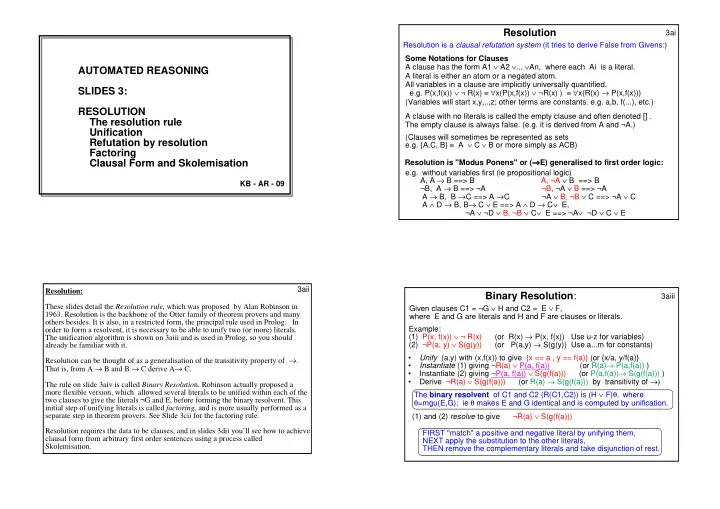
KB - AR - 09 3ai Some Notations for Clauses A clause has the form A1 ∨ A2 ∨... ∨An, where each Ai is a literal. A literal is either an atom or a negated atom. All variables in a clause are implicitly universally quantified. e.g. P(x,f(x)) ∨ ¬ R(x) ≡ ∀x(P(x,f(x)) ∨ ¬R(x) ) ≡ ∀x(R(x) → P(x,f(x))) (Variables will start x,y,..,z; other terms are constants. e.g. a,b, f(...), etc.) A clause with no literals is called the empty clause and often denoted [] . The empty clause is always false. (e.g. it is derived from A and ¬A.) (Clauses will sometimes be represented as sets e.g. {A,C, B} ≡ A ∨ C ∨ B or more simply as ACB) Resolution is a clausal refutation system (it tries to derive False from Givens:) Resolution is "Modus Ponens" or (→ → → →E) generalised to first order logic: e.g. without variables first (ie propositional logic) A, A → B ==> B A, ¬A ∨ B ==> B ¬B, A → B ==> ¬A ¬B, ¬A ∨ B ==> ¬A A → B, B →C ==> A →C ¬A ∨ B, ¬B ∨ C ==> ¬A ∨ C A ∧ D → B, B→ C ∨ E ==> A ∧ D → C∨ E, ¬A ∨ ¬D ∨ B, ¬B ∨ C∨ E ==> ¬A∨ ¬D ∨ C ∨ E
Resolution
3aii Resolution: These slides detail the Resolution rule, which was proposed by Alan Robinson in
- 1963. Resolution is the backbone of the Otter family of theorem provers and many
- thers besides. It is also, in a restricted form, the principal rule used in Prolog. In
- rder to form a resolvent, it is necessary to be able to unify two (or more) literals.
The unification algorithm is shown on 3aiii and is used in Prolog, so you should already be familiar with it. Resolution can be thought of as a generalisation of the transitivity property of →. That is, from A → B and B → C derive A→ C. The rule on slide 3aiv is called Binary Resolution. Robinson actually proposed a more flexible version, which allowed several literals to be unified within each of the two clauses to give the literals ¬G and E, before forming the binary resolvent. This initial step of unifying literals is called factoring, and is more usually performed as a separate step in theorem provers. See Slide 3cii for the factoring rule. Resolution requires the data to be clauses, and in slides 3dii you’ll see how to achieve clausal form from arbitrary first order sentences using a process called Skolemisation. Given clauses C1 = ¬G ∨ H and C2 = E ∨ F, where E and G are literals and H and F are clauses or literals. Example: (1) P(x, f(x)) ∨ ¬ R(x) (or R(x) → P(x, f(x)) Use u-z for variables) (2) ¬P(a, y) ∨ S(g(y)) (or P(a,y) → S(g(y)) Use a...m for constants) 3aiii FIRST "match" a positive and negative literal by unifying them, NEXT apply the substitution to the other literals, THEN remove the complementary literals and take disjunction of rest.
Binary Resolution:
(1) and (2) resolve to give ¬R(a) ∨ S(g(f(a)))
- Unify (a,y) with (x,f(x)) to give {x == a , y == f(a)} (or {x/a, y/f(a)}
- Instantiate (1) giving ¬R(a) ∨ P(a, f(a)) (or R(a)→ P(a,f(a)) )
- Instantiate (2) giving ¬P(a, f(a)) ∨ S(g(f(a))) (or P(a,f(a))→ S(g(f(a))) )
- Derive ¬R(a) ∨ S(g(f(a))) (or R(a) → S(g(f(a))) by transitivity of →)