SLIDE 1
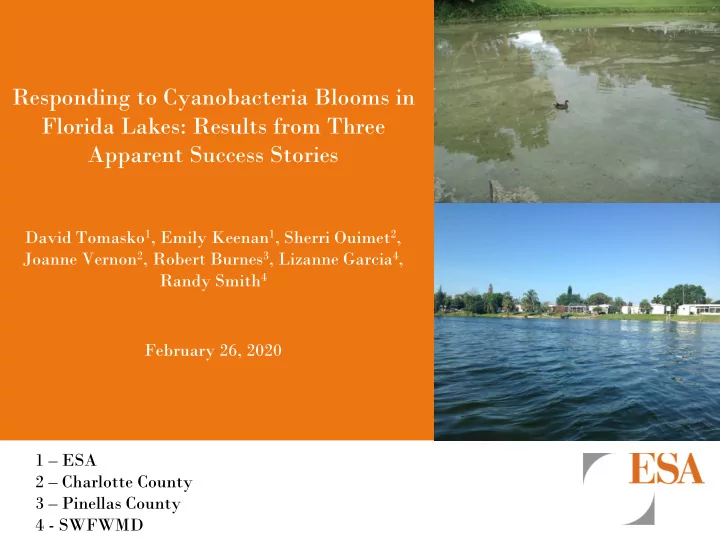
Responding to Cyanobacteria Blooms in Florida Lakes: Results from Three Apparent Success Stories
David Tomasko1, Emily Keenan1, Sherri Ouimet2, Joanne Vernon2, Robert Burnes3, Lizanne Garcia4, Randy Smith4 February 26, 2020 1 – ESA 2 – Charlotte County 3 – Pinellas County 4 - SWFWMD
SLIDE 2
In coastal systems in SW FL, some great success stories
Seagrass increase of over 40 square miles in SW FL All 6 systems healthier than 20 years ago
SLIDE 3 What about lakes?
- Apopka demonstrably cleaner than 20 years ago
– Massive efforts on multiple fronts
- Other less-well known examples
– Lake Hartridge – Banana Lake – Lake Persimmon – Lake Trafford
– Sunshine Lake (Charlotte County) – Lake Tarpon (Pinellas County) – Lake Hancock (Polk County)
SLIDE 4
Why aren’t more lakes doing better, since phosphorus concentrations have declined state-wide?
State-wide annual average TP concentrations (Figure from FDEP)
SLIDE 5 Because other factors need to be taken into account (Terrell et al. 2000)
5
- Data from 127 Florida lakes (1967-1997)
- Overall decrease in phosphorus
- No overall trend in nitrogen
- But…overall increase in chlorophyll-a
- Altered hydrology and aquatic weed control efforts could
be more important than nutrients alone
- Lake management – and management of cyanobacteria
– requires more than nutrient management alone
SLIDE 6
Sunshine Lake
SLIDE 7
Homeowners convinced the lake was lowered – actually filled up from the bottom
SLIDE 8
Logistically challenging field work
SLIDE 9 What is this stuff in the lake?
cyanobacteria
– Predominantly Aphanothece conglomerata
- Can fix nitrogen from air
and store phosphorus
as bacteria
SLIDE 10 County decided to dredge the lake – over budget (> $3 million) and twice as long as expected – they don’t want to repeat that effort
10
SLIDE 11 11
Management plan based on data collection
STWR-1 STWR-2 STWR-3
SLIDE 12 Stormwater Normal Undeveloped Lower Range Developed Elevated Developed Excessive Developed TN (mg/L) 0.070 - 1.52 1.02 - 2.07 2.07 - 3.99 > 3.99 TP (mg/L) 0.002 - 0.100 0.102 - 0.327 0.327 - 0.510 > 0.510
Existing literature to determine what is “normal”
SLIDE 13 Stormwater runoff
13
Total nitrogen Total phosphorus What’s with all the phosphorus??
SLIDE 14 Surface Geology
14
From Scott et al. 2001
SLIDE 15 Proposed remedial actions
15
- Focus on lake itself
- Whole lake circulation
– Mix water column, enhance sequestration of P in sediments
– Supplementing inflows with lower nutrient source water
- Floating treatment wetland islands
– Beware of turtles!
SLIDE 16 Whole-lake circulation device
16
SLIDE 17
It worked – no recurrence of cyanobacteria mat, and not impaired for Chl-a or nutrients, using NNC
Before After
SLIDE 18
Lake Tarpon
SLIDE 19
Massive cyanobacteria blooms in the 1980s, and earlier conclusions of an “increasing trend in chlorophyll-a”
SLIDE 20
Actually, it’s a phase shift after 1993
Pre-1993, Chl-a exceedance only in July and August 1993 to 2002, Chl-a exceedance in every month, and no trend over time
What happened in 1993? 500 acres of Hydrilla treated with herbicides
SLIDE 21
Nitrogen-limited lake
SLIDE 22
But Chl-a not related to external nitrogen loads
SLIDE 23
What does influence Chl-a levels?
Inverse with water elevation Positive with variation in lake level
SLIDE 24
How about Hydrilla control efforts?
SLIDE 25 Lake management paradigm
- Maintain high water level
– Keeps deeper waters from becoming new habitat for Hydrilla – Keeps lake in contact with adjacent wetlands
- Reduce variability in lake level due to human activity
– No need to supplement lake, but no need for artificial lowering
- Manage Hydrilla populations
– Reduced abundance expected via not lowering lake – When found, minimal use of herbicides
- Targeted stormwater retrofits
– Focus on dry retention
SLIDE 26 Did it work?
- No recurrence of cyanobacteria blooms since initiating
current control schedule for lake level
- Hydrilla less than 3% of current SAV in the lake
- Water quality non-trending over last 20 years
– Not impaired for TN or TP using NNC – “impaired” for Chl-a, but paleolimnology work suggests in-line with historical conditions
- Currently listed as one of Florida’s top ten bass fishing
lakes
– (http://myfwc.com/fishing/freshwater/sites-forecast/sw/lake-tarpon/)
SLIDE 27
Lake Hancock
SLIDE 28
For some lakes, reducing algal levels might have more to do with “tannins” than nutrients
10 20 30 40 50 60 70 0.05 0.1 0.15 0.2 Chlorophyll a_comb (ug/L) Total Phosphorus (mg/L) Henry Lulu
20 PCU
225 PCU
“Low” TP, high Chl-a High TP, low Chl-a
SLIDE 29
Lulu is 4 ½ feet lower than it used to be, Henry is not. Lulu is disconnected from its historical swamp shoreline.
Lake Henry Lake Lulu
SLIDE 30
Stormwater retrofits aren’t focused on water quality impacts associated with altered hydrology
SLIDE 31
How to improve Hancock?
SLIDE 32
Wetland compounds can reduce Chl-a levels…
Most immediate response from L-lysine, greatest longer term response from cypress needles
SLIDE 33
Without concurrent reductions in N or P
SLIDE 34 However…
- Do we really want to base lake management on
an aquarium study?
- Fortunately, an ecosystem-level experiment is
already being run
SLIDE 35
Lake Hancock lake level modification project
SLIDE 36
Short term response - decrease in chlorophyll-a of 66% (p< 0.01)
SLIDE 37
Short term response -decrease in TN of 61% (p < 0.01)
Range of values indicating N- fixation
SLIDE 38
Continued benefits over time…
SLIDE 39 Can we reduce cyanobacteria in lakes?
- If it can be done in Hancock, it can be done
- Reduce point source loads
- But, equal effort into quantifying and acting upon
internal loads
- Hydrologic restoration when needed
- Alternative techniques for invasive aquatic
species control
- Let science take the lead, not a complex water
quality model or preconceived notions
SLIDE 40
Questions?