HENRY OJOBO
(PB113096) PhD Candidate
Supervisors
- Dr. Sapura Mohamad
- Assoc. Prof. Dr. Ismail Said
Faculty of Built Environment, Universiti Teknologi, Malaysia
9th December 2015
RESTORATION AND STRESS MITIGATION HENRY OJOBO (PB113096) PhD - - PowerPoint PPT Presentation
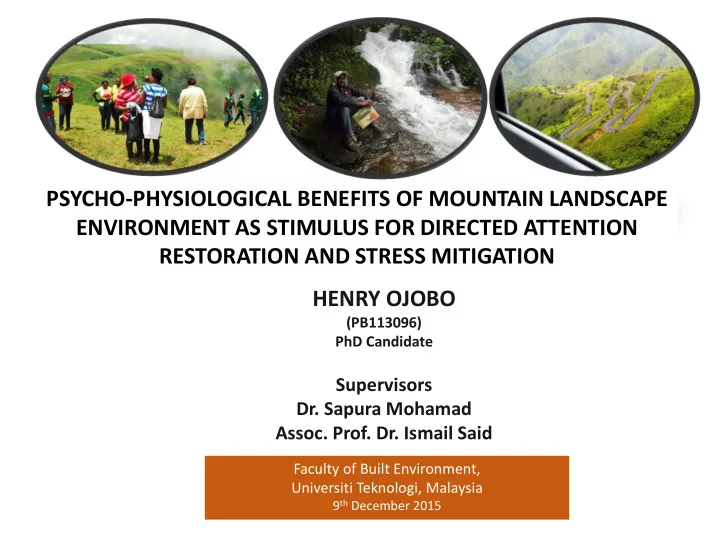
PSYCHO-PHYSIOLOGICAL BENEFITS OF MOUNTAIN LANDSCAPE ENVIRONMENT AS STIMULUS FOR DIRECTED ATTENTION RESTORATION AND STRESS MITIGATION HENRY OJOBO (PB113096) PhD Candidate Supervisors Dr. Sapura Mohamad Assoc. Prof. Dr. Ismail Said Faculty of
(PB113096) PhD Candidate
Faculty of Built Environment, Universiti Teknologi, Malaysia
9th December 2015
Directed attention phenomenon plays a major role in human capacity and its restoration is dependent upon the components of the environment. Kaplan (1995) mental stress results from interactions between persons and their environment that are perceived as straining or exceeding their adaptive capacities and threatening their well being (Annerstedt et
Healthcare management cardiovascular diseases, anxiety disorders, obesity and depression (Lee and Oh, 2010; Probst, 2013) landscape studies urbanization, lifestyle changes, ameliorating potentials of nature related environments (Hartig et al., 2014) 2
suite everyday living and working which offer less restorative health benefits (Thompson, 2010), 3
RESEARCH MILIEU
QUASI/LABORATORY
White (2013), Berto et al (2010), Han, K.
Chang et al.(2008), Berto, (2007), Han, K.
Vries et al. (2003), Herzog et al. (2003), Laumann et al. (2003), Staats et al. (2003), Herzog et al. (2002), Laumann et
REAL SITE
Tsunetsugu et al. (2013), Martens et al. (2011), Annerstedt et al. (2010), Cole & Hall (2010), Hartig et al. (2003), Tennessen & Cimprich (1995)
MIX MILIEU
Berman et al. (2008), Kaplan,
Hartig, T. et al. (1997)
environments have merely been mentioned as part of picture slides or video simulations.
human response to environmental stimuli. Very few combined both psychological and physiological measures.
mix of real site and psycho-physiological mode of measurement. No study was found on the restorative benefits of contact with mountain landscape environment. 4
AIM
To examine the mechanism and intricacies of the link between restorative environments, human response and wellbeing in a mountain landscape environment.
RQ2
What degree would the mountain landscape environment influence recovery from directed attention and stress?
OBJECTIVE 2
To investigate the magnitude to which mountain environments can stimulate human psychological and physiological well-being
RQ1
What feature of the mountain environment yield higher restorative benefits in terms of psychological wellbeing?
OBJECTIVE 1
To identify the feature(s)
landscape environment potentially influential to human perception and psychological response
RQ3
What aspects of the ambient mountain environment conditions combine to elicit human physiological wellbeing?
OBJECTIVE 3
To determine the significance of the ambient mountain environment conditions
wellbeing. 5
An encounter with most unthreatening natural environment by stressed individuals would yield restorative benefits while many urban environment will mitigate recovery (Ulrich et al. 1991). Its focus is mainly on the psychological and physiological stress reduction benefits
Natural environments play an essential role in human functioning through the process of restorative experience (Kaplan, 1992). The theory focuses on:
environment and
likely to contribute to restorative experience AESTHETIC-AFFECTIVE THEORY AAT Visual contact with most natural settings by a stressed individual is likely to foster positive feelings, hold interest and mitigate stressful thoughts resulting in recuperation. Related to visual perceptions of natural environments. Ulrich (1986) 6
7
8
PREFERENCE River, Forest, Built, Waterfall, Mountain vantage point, Artificial water park PERCEPTION Calmness, Stress relief, Excitement, Anxiousness
AMBIENT CONDITIONS Temperature Humidity
PSYCHOLOGICAL Perceived stress Perceived Restorativeness PHYSIOLOGICAL Blood pressure, Pulse Rate and Respiratory Rate
9
PSYCHOLOGICAL MEASURES Perceived Stress Scale (PSS) Cohen et al. (1983). Perceived restorativeness scale (PRS) Hartig et al. (1997) PHYSIOLOGICAL MEASURES Standard Mercury Sphygmomanometer, Clock AMBIENT ENVIRONMENT CONDITIONS Data Logger PREFERENCE AND PERCEPTION Photo questionnaire
10
with the structured features and not innate human characteristics is responsible for their preference.
mountain landscape environment varies across age groups 11
12.4 16.5 2.6 7.1 4.7 21.8 20.6 8.2 10.2 10.9 24.4 27.8 11.2 11.7 5.7 28.5 24.7 40.3 39.3 20.2 13 10.3 37.8 31.6 58.5
10 20 30 40 50 60 70 River feature Forest feature Water fall feature mountain vantage point Water park Participants response % Obudu mountain attributes Not prefered Slightly prefered Neutral Prefered Highly prefered
mitigation leading to wellbeing with regards to mountain landscape environments.
does not indicate restoration from stress.
components of restorative environment.
pulse rate decreased both in individuals and across age groups.
individuals and across the age groups.
slightly while male respiratory rate decreased.
individual’s ability to attain a relaxed state through the reduction of their diastolic blood pressure and pulse rate.
100 105 110 115 120 125 130 135 20-25 26-30 31-35 36-40 Systolic blood pressure(mmhHg) Age group of respondents Urban Mountain 20 40 60 80 100 20-25 26-30 31-35 36-40 Diastolic blood pressure(mmHg) Age group of respondents Urban Mountain 5 10 15 20 25 male female Respiratory rate (c/m) Gender Urban environment Mountain environment
12
environment conditions that combine to influence human physiological wellbeing.
decrease in both diastolic blood pressure and pulse rate.
combined psychological and physiological feeling. SEEN AND UNSEEN
Ambient condition Environment Mean Std. Deviation t
tailed) Temperature Urban 30.5536 4.22536 21.313 .000 Mountain 21.8662 2.26017 Humidity Urban 44.9367 20.10641
.000 Mountain 75.0163 10.47910
13
study affirms the aspect of the AAT which asserts that visual contact with natural environments would enhance positive feelings, arouse interest and alleviate stress leading to restoration of wellbeing. ART-The outcome of this study supports being away and compatibility phenomenon as components of a restorative mountain landscape environment but did not support fascination and extent. This study supports the general aspect of SRT which advocates that contact with particular natural environments stimulates physiological makeup resulting in stress reduction. The second aspect linking stress recovery in natural landscape environments to human innate configuration found no support in this study.
14
natural environments are typically distinct from the everyday urban environments in terms of health benefits. contact with mountain landscape environments promotes recovery from stress and restoration of directed attention. Empirical evidence of the psycho-physiological benefits of mountain landscape environments. The scope of environments: landscape types and restorative benefits. The link between nature experience and human wellbeing: samples from Nigeria in Africa region. 15
Monitoring the long term changes of physiological outcomes which will provide important data on the effect of contact with mountain landscape environment on chronic stress. Patients with historical stress challenges, the elderly and children. Ambulatory measurements of physiological indices: variations influenced by fluctuations in blood pressure and ambient environment conditions. Recruiting females: menstrual status should be included as a variable. 16
INDEXED JOURNALS
1.Henry O., Sapura M. & Ismail S. (2014). Validating the Measures of Perceived
Restorativeness in Obudu Mountain Resort, Cross River State, Nigeria. Open journal of Social Sciences. 2(11), 1-6.
2.Henry O., Sapura M. & Ismail S. (2015). Gender Variations in Wellbeing Indicators
between Urban and Mountain Landscape Environments. Environment and Natural Resources Research. 5(4), 63-71.
Restorative Benefits of Obudu Mountain Landscape, Nigeria. Jurnal Teknologi. 77(15), 103-108. ARTICLES UNDER REVIEW
1.
Physiological and psychological effects of mountain landscape environment on human wellbeing (LANDSCAPE ONLINE JOURNAL) 17
18