SLIDE 1
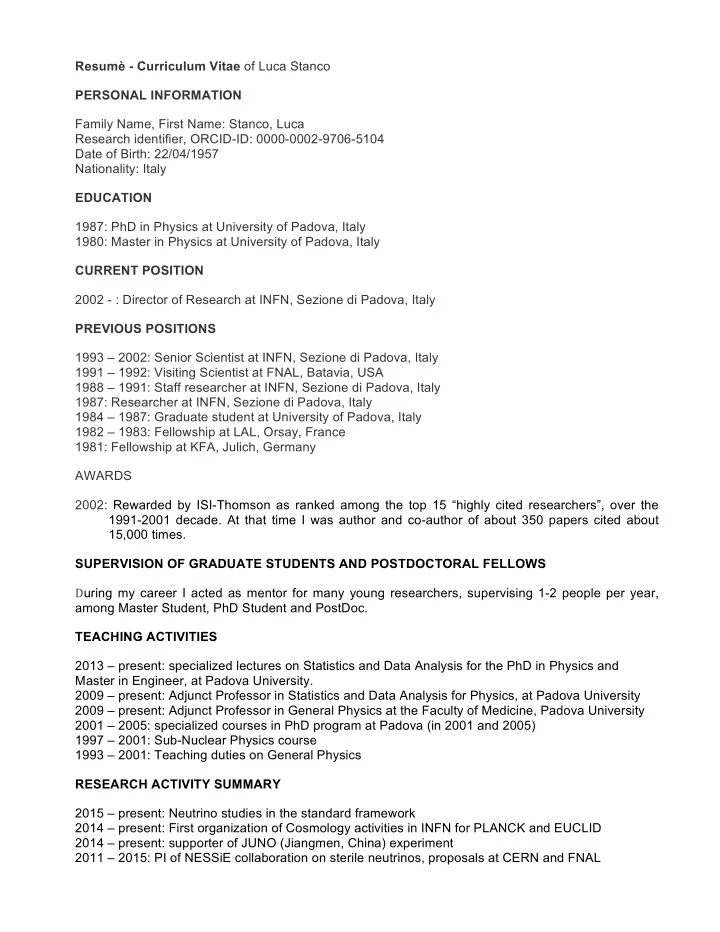
Resumè - Curriculum Vitae of Luca Stanco PERSONAL INFORMATION Family Name, First Name: Stanco, Luca Research identifier, ORCID-ID: 0000-0002-9706-5104 Date of Birth: 22/04/1957 Nationality: Italy EDUCATION 1987: PhD in Physics at University of Padova, Italy 1980: Master in Physics at University of Padova, Italy CURRENT POSITION 2002 - : Director of Research at INFN, Sezione di Padova, Italy PREVIOUS POSITIONS 1993 – 2002: Senior Scientist at INFN, Sezione di Padova, Italy 1991 – 1992: Visiting Scientist at FNAL, Batavia, USA 1988 – 1991: Staff researcher at INFN, Sezione di Padova, Italy 1987: Researcher at INFN, Sezione di Padova, Italy 1984 – 1987: Graduate student at University of Padova, Italy 1982 – 1983: Fellowship at LAL, Orsay, France 1981: Fellowship at KFA, Julich, Germany AWARDS 2002: Rewarded by ISI-Thomson as ranked among the top 15 “highly cited researchers”, over the 1991-2001 decade. At that time I was author and co-author of about 350 papers cited about 15,000 times. SUPERVISION OF GRADUATE STUDENTS AND POSTDOCTORAL FELLOWS During my career I acted as mentor for many young researchers, supervising 1-2 people per year, among Master Student, PhD Student and PostDoc. TEACHING ACTIVITIES 2013 – present: specialized lectures on Statistics and Data Analysis for the PhD in Physics and Master in Engineer, at Padova University. 2009 – present: Adjunct Professor in Statistics and Data Analysis for Physics, at Padova University 2009 – present: Adjunct Professor in General Physics at the Faculty of Medicine, Padova University 2001 – 2005: specialized courses in PhD program at Padova (in 2001 and 2005) 1997 – 2001: Sub-Nuclear Physics course 1993 – 2001: Teaching duties on General Physics RESEARCH ACTIVITY SUMMARY 2015 – present: Neutrino studies in the standard framework 2014 – present: First organization of Cosmology activities in INFN for PLANCK and EUCLID 2014 – present: supporter of JUNO (Jiangmen, China) experiment 2011 – 2015: PI of NESSiE collaboration on sterile neutrinos, proposals at CERN and FNAL
SLIDE 2
2007 – present: Setup of GERDA (LNGS, Italy) experiment in Padova 2006 – present: several supervisions/coordinations in OPERA, against release of first results on neutrino velocity 2000 – 2006: Experiment in neutrino: setup/organization of OPERA (LNGS, Italy) (group leader) 1998 – 2009: several supervisions/coordination in ZEUS (group leader), coordination Exotics Physics group 1994 – 1997: Experimental activities in CMS (CERN, Switzerland) 1991 – 1998: Physics Analyses in CDF (FNAL, USA), pp collider, pivotal searches in hadr. Top 1988 – 1991: Monte Carlo simulation, member of the multipurpose HERWIG MC 1985 – 1998: Experimental works in ZEUS (Hamburg, Germany), ep collider, many fields 1982 – 1987: Experimental works in DM2 (Orsay, France), e+e- accelerator, J/psi analysis 1980 – 1981: Theoretical studies on the problem of orbit stability in accelerators PRESENTATIONS TO CONFERENCES/WORKSHOP About 1 to 2 talks per year from 1985 to 2010. After 2010 average is increased to 2 to 3 talks per years. BIBLIOMETRIC INDICES About 500 peer reviewed papers with 46,000 citation, h-index = 110 (on June 19th, 2017).
SLIDE 3 Ten-years Track record (illustrated): In the last ten years my career has been mainly devoted to neutrino physics, as in early 2000 I progressively switched my research interests in particle physics from accelerators to neutrino
- experiments. In all of them I played a leading role, actively promoting the involvement of young
researchers from INFN. In early 2000 I was still involved in the ZEUS experiments at the laboratory of DESY-Hamburg (Germany). Zeus aimed to measure the structure of the proton at unprecedented precision, in terms
- f quarks and gluon content. ZEUS also performed many QCD (Quantum CromoDynamic) studies.
At the same time I promoted the participation of INFN Padova to the OPERA experiment at Laboratori Nazionali del Gran Sasso (LNGS-INFN). OPERA aimed to collect neutrino events produced 600 km away, at CERN laboratory in Switzerland. OPERA was a 1 300 ton fine grained detector with more than 10 million of 10x10 cm2 emulsion film. The emulsion film provided a 1 µm spatial resolution to measure the decay of the τ particle. τ’s are produced by the interaction of τ-neutrinos with matter. Actually, the neutrinos produced at CERN were µ-neutrinos. Very few of them, while travelling to Gran Sasso “transformed” themselves in τ-neutrinos [1]. OPERA was also (in)famous for its release of a paper about the neutrino velocity advertised to be larger than the light velocity [2]. Feeling the limits of the possible OPERA results for neutrinos (see my review [3]), in 2008 I was the promoter of the participation to the GERDA experiment at LNGS. GERDA [4] aims to determine the true nature of neutrinos, since two different possibilities exist: Fermi-like or Majorana-like. Roughly speaking the Majorana nature would corresponds the anti-neutrino being the same that the neutrino, while the Fermi nature would continue to distinguish particle and antiparticle. The experiment is still running and probably we are still far from deciding upon the neutrino nature. Early in 2011 I began to look at some more challenging projects in the neutrino field. I addressed myself to the sterile neutrino search [5]. Trying to renovate the European projects in neutrinos I set up the international collaboration (about 60 people), named NESSiE. We made an independent submission to CERN, and we shortly entered in tight synergy with the Icarus collaborations, led by C.
- Rubbia. The new joint proposal would have put the final word on the long-standing issue of the so-
called LSND anomaly (an hint for sterile neutrino at eV mass scale). In the next two years the NESSiE collaboration developed a full critical design, with comprehensive details of mechanics, instrumentation, electronics, data acquisition and analysis. NESSiE was initially part of the CERN- neutrino platform program as WA104-NESSiE: many meetings and debates with involvements of the principal actors of the neutrino community in Europe did not succeed to lunch a new neutrino facility at CERN (not for scientific reasons, primarily for the need for a new USA facility). Thus I decided to swap to the USA option and for more than 6 months the collaboration underwent a detailed examination of the possible use of the NuMI-FNAL beam at Batavia-Chicago (USA). What seemed a priori impossible came to reality [6]: with minor upgrades of the original idea the NESSiE proposal could be successful applied to NuMI (the massive high density material of the magnets had to compete with the constraint of the NuMI beam, half the energy of the optimal one). Meanwhile, the physics prospects for measurements on sterile searches changed slightly and we submitted independently our proposal to FNAL (the muon-neutrino disappearance channel from NESSiE became not only complementary to the electron-neutrino appearance but fundamental to the final disentanglement of the sterile processes). In January 2015 FNAL decided not to put forward our project due to lack of funding and to pursue only the Liquid-Argon option, also as test bed of the long- baseline B€ project. I decided to put in stand-by the NESSiE collaboration and to wait for perhaps future better opportunities. From 2011 to 2015 I acted as PI of NESSiE, with the official roles of spokesperson and also INFN delegate. In 2015 my group of collaborators in Padova, together with part of other international groups originally
SLIDE 4 in NESSiE, decided to be involved in other neutrino experiments and fields: part in JUNO, the reactor anti-neutrino experiment at Jingmen (China) and part in EUCLID, the ESA spatial mission to be lunched in 2021, to study the Dark Energy issue at first. I have been a supporter of the JUNO involvement of the Padova group, while I acted as Italian delegate of the INFN involvement in EUCLID. In the last 2 years I spent part of my time in reviewing neutrino physics and thinking about key issues in neutrino field like the mass ordering, coming out with the some new ideas [7]. Representative publications / selected recent invited presentations:
- 1. N. Agafonova et al., “Discovery of tau Neutrino Appearance in the CNGS Neutrino Beam with
the OPERA Experiment”, Phys. Rev., Lett., 115 (2015) 12, 121802;
- 2. T. Adams et al., “Measurement of the Neutrino Velocity with the OPERA Detector in the CNGS
Beam”, JHEP 1210 (2012) 093
- 3. L. Stanco, “A View of Neutrino Studies with the Next Generation Facilities”, Phys. Rev. 1
(2016) 90;
- 4. M. Agostini et al., “2νββ decay of 76Ge into excited states with GERDA Phase I”, Jour. Phys.
G42 (2015) 11, 115201;
- 5. L. Stanco et al., “An Appraisal of Muon Neutrino Disappearance at Short Baseline”, Adv. High
- En. Phys. 2013 (2013) 948626;
- 6. A. Anokhina et al., “ Search for sterile neutrinos in muon disappearance mode at FNAL”, Eur.
- Phys. Jou. C (2017), 73;
- 7. L. Stanco et al., “Determination of the Neutrino Mass Hierarchy with a New Statistical Method”,
- Phys. Rev. D, 95, 053002 (2017), arXiv:1606.09454v3;
- 03/2017: “The determination of the neutrino mass hierarchy”, NeutrinoTelescopes 2017,
Venice, Italy.
- 12/2016: “”Neutrino mass ordering”, NuPhys2016, London, United Kindom
- 12/2015: “Search for Sterile Neutrinos at Long and Short Baselines”, NuPhys2015, London,
United Kindom
- 07/2015: ”Search for Sterile Neutrinos at Long–Baseline”, EPS2015, Vienna, Austria
- 07/2014: “The NESSiE way for Sterile Neutrinos”, ICHEP2014, Valencia, Spain
- 03/2013: “The NESSiE concept for Sterile Neutrinos”, XV Neutrino Telescope Conference,
Venice, Italy
“Short-baseline
high-energy neutrinos”, NOW2012, Conca Specchiulla, Italy