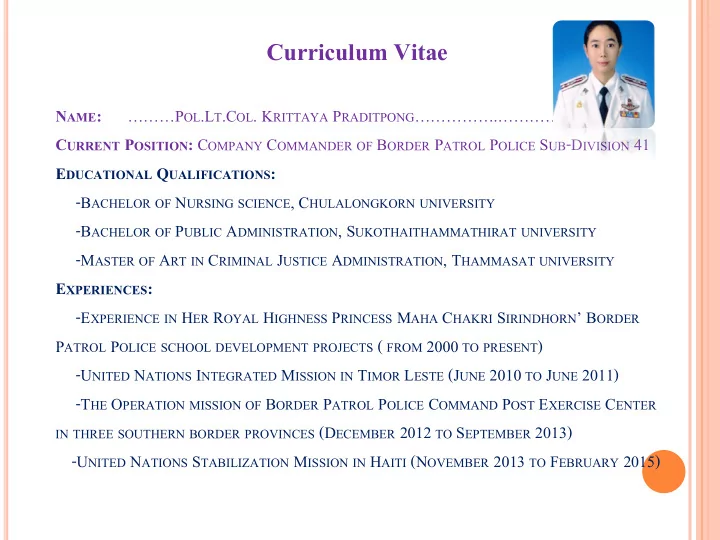
SLIDE 1 NAME: ………POL.LT.COL. KRITTAYA PRADITPONG…………….………………….. CURRENT POSITION: COMPANY COMMANDER OF BORDER PATROL POLICE SUB-DIVISION 41 EDUCATIONAL QUALIFICATIONS:
- BACHELOR OF NURSING SCIENCE, CHULALONGKORN UNIVERSITY
- BACHELOR OF PUBLIC ADMINISTRATION, SUKOTHAITHAMMATHIRAT UNIVERSITY
- MASTER OF ART IN CRIMINAL JUSTICE ADMINISTRATION, THAMMASAT UNIVERSITY
EXPERIENCES:
- EXPERIENCE IN HER ROYAL HIGHNESS PRINCESS MAHA CHAKRI SIRINDHORN’ BORDER
PATROL POLICE SCHOOL DEVELOPMENT PROJECTS ( FROM 2000 TO PRESENT)
- UNITED NATIONS INTEGRATED MISSION IN TIMOR LESTE (JUNE 2010 TO JUNE 2011)
- THE OPERATION MISSION OF BORDER PATROL POLICE COMMAND POST EXERCISE CENTER
IN THREE SOUTHERN BORDER PROVINCES (DECEMBER 2012 TO SEPTEMBER 2013)
- UNITED NATIONS STABILIZATION MISSION IN HAITI (NOVEMBER 2013 TO FEBRUARY 2015)
Curriculum Vitae
SLIDE 2
Nutritional and Health Development on Children and Youth
in Border Patrol Police Schools Initiated by Her Royal Highness Princess Maha Chakri Sirindhorn
SLIDE 3
Background & History
Border Patrol Police Schools (or BPP Schools)
SLIDE 4
Border Patrol Police Schools are schools that provide basic education to
children and youth in rural areas, far away from telecommunication systems.
SLIDE 5
The schools are under the supervision of the Royal Thai Police.
SLIDE 6
Thailand has 4,863-km borders with neighboring countries.
Context of the Communities
SLIDE 7
Context of the Communities
SLIDE 8 School’s Philosophy and Missions
The core philosophy of Border Patrol Police Schools is
‘Creating Wisdom, Developing Quality of Life, Establishing Stability’.
SLIDE 9 Area School
BPP Teacher Civilian Teacher Service Area Pre- Primary Primary Secondary Total Community Population Central
43 1,699 4,412 584 6,695 287 136 128 74,291
North Eastern
45 1,123 3,197
291 34 129 58,793
Northern
67 2,036 5,234 332 7,602 339 169 206 60,962
Southern
41 1,646 3,845
312 78 152 97,820
Total
196 6,504 16,688 916 24,108 1,229 417 615 291,866
Enrollment
During the academic year 2014, Border Patrol Police Schools enrolled 6,504 kindergarten students, 16,688 primary-level students (1st grade to 6th grade), and 916 secondary-level students (7th grade to 12th grade). The details are as follows:
SLIDE 10 Border Patrol Police Schools are under the supervision of Superintendent Border
Patrol Police Area and Border Patrol Police Headquarters. Each Border Patrol Police School has its own educational committee, which consists of a principal and representatives from the
- villages. The committee will support the school in terms of basic education and other school
development activities. In total, there are 1,229 border patrol police teachers and 417 civilian teachers. (Approximately there are 7 border patrol police teachers and 2 civilian teachers at each school.)
Administration
SLIDE 11 Providing Education
Out of the 196 schools, 192 schools provide only primary education, 2 schools provide
- nly secondary education, and the other 2 schools provide both primary and secondary education
per the Ministry of Education’s Basic Education Core Curriculum B.E. 2551 (2008). The curriculum includes eight learning subject areas as follows: (i) Thai Language, (ii) Mathematics, (iii) Science, (iv) Social Studies, (v) Religion and Culture, (vi) Health and Physical Education, (vii) Arts, and (viii) Occupation and Technology and Foreign Languages
Praratchathannayao Secondary School Primary School
SLIDE 12
Providing Education
SLIDE 13
In order to help the children to achieve their learning goals and better quality of life, Border Patrol Police Schools have undertaken development activities in accordance with HRH Princess Maha Chakri Sirindhorn’s Initiative since 1986. These development activities have been carried out as parts of school curriculum (by integrating in eight learning areas), as additional courses, or as learner development activities.
Her Royal Highness Princess Maha Chakri Sirindhorn’s Initiative
SLIDE 14
School Lunch Services (1)
SLIDE 15
School Lunch Services(2)
SLIDE 16
School Lunch Services(3)
SLIDE 17
School Milk Services
Every school day, each child will receive 7 baht (22 cents) from the School Milk Program. The school serves 200 cc of milk (prepared from powder milk) in the morning or afternoon.
SLIDE 18
Nutrition Monitoring Program
Weights and heights of children are measured twice a year by a trained health teacher. Then, the nutritional status of each child is interpreted using the Thai Child Growth Standards. Special cares are provided for children who are malnourished. For example, during lunchtime, one additional egg and an additional glass of milk will be served to the malnourished children.
SLIDE 19
Promoting Physical Activity
SLIDE 20
Personal Hygiene Practices
SLIDE 21
Health Services
SLIDE 22
Agriculture or School Farm
SLIDE 23
Nutritional Status
The schools are now facing the double burdens of malnutrition: (i) under-nutrition and (ii) over-nutrition. During 2010-2014, the malnutrition problem has slightly increased but the underweight problem has decreased for pre-primary students. Stunting and wasting have slightly decreased but the obesity problem has increased for primary students. Overall nutritional status of pre-primary students and primary students are shown as follows.
SLIDE 24
Prevalence rate of underweight (weight for age) of pre-primary students
SLIDE 25
Prevalence rate of stunting (height for age) of primary students
SLIDE 26
Prevalence rate of wasting (weight for height) of primary students
SLIDE 27
Prevalence rate of obesity (weight for height) of primary students
SLIDE 28
Physical fitness test
Most of children’s physical fitness results are in acceptable ranges
Percentage of pre-primary students passed the physical fitness test
SLIDE 29
Percentage of primary students passed the physical fitness test
SLIDE 30
The deficiency can be measured using the total goiter rate in schoolchildren. This is currently not a problem.
Iodine Deficiency Disorders
SLIDE 31 Year % of Children Having Healthy Eating Habits % of Children Having Hygienic Habits Grade 3 Grade 6 Grade 3 Grade 6 2010 90.31 94.77 80.48 83.17 2011 91.79 95.65 81.60 84.41 2012 93.83 96.28 84.89 86.33 2013 93.77 97.11 87.22 89.17 2014 95.58 97.95 87.92 89.57
Healthy Eating Habits and Personal Hygiene Practices Lunchtime provides an opportunity for children to practice healthy eating habits and
good personal hygiene. At the end of the school year, 3rd graders and 6th graders were evaluated in terms of their healthy eating habits and hygienic habits. The results are shown as follows.
Percentages of primary students having proper health behaviors
SLIDE 32 The production from the school’s farm supplies materials for school’s lunch
- services. There are four groups of agricultural production, namely, meat, legumes,
vegetables and fruits. Most of Border Patrol Police Schools can produce most of the food materials (except legumes) enough for all students for every school day in a year (200 days). The target for meat production in is 40g/student/day. From 2010 to 2014, meat production in schools has increased. Most of the production was eggs, native chickens, catfish, tilapias and frogs. All productions are shown as follows.
School Agriculture Products
SLIDE 33
Agricultural Production: Meat
SLIDE 34
Agricultural Production: Legumes
SLIDE 35
Agricultural Production: Vegetables
SLIDE 36
Agricultural Production: Fruit
SLIDE 37 Year % of Children Having Agriculture Knowledge at Good Level % of Children Having Agriculture Skills at Good Level Grade 3 Grade 6 Grade 3 Grade 6 2010 74.61 88.50 66.12 83.70 2011 75.81 87.69 70.03 84.55 2012 78.61 88.42 72.73 85.72 2013 83.85 92.89 76.79 88.89 2014 84.89 93.28 74.52 88.29
Knowledge and Skills in Agriculture of Students
School agriculture provides an opportunity for children to learn and practice their agricultural knowledge and skills. At the end of the school year, 3rd graders and 6th graders were evaluated. The results are shown as follows.
Percentages of primary students having agriculture knowledge and skill at good level
SLIDE 38