Review Review of topics for midterm Next class Homeworks 1 - - PowerPoint PPT Presentation

review
SMART_READER_LITE
LIVE PREVIEW

Review Review of topics for midterm Next class Homeworks 1 - - PowerPoint PPT Presentation

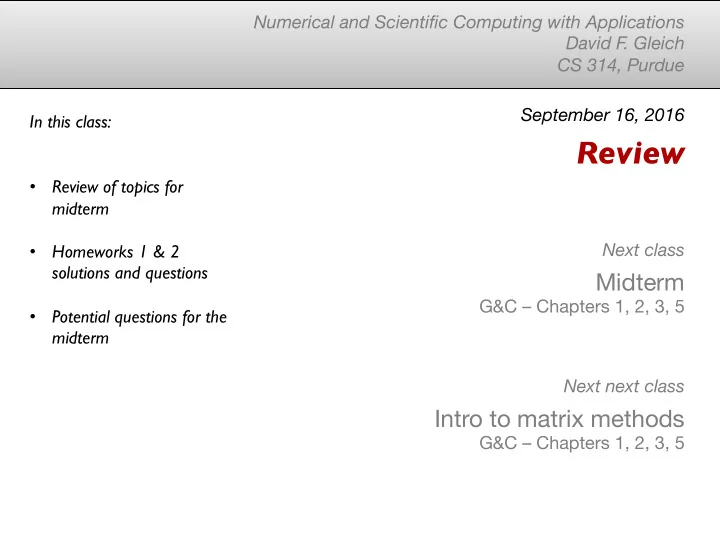
Numerical and Scientific Computing with Applications David F . Gleich CS 314, Purdue September 16, 2016 In this class: Review Review of topics for midterm Next class Homeworks 1 & 2 solutions and questions Midterm G&C


slide-1
SLIDE 1

Midterm

G&C – Chapters 1, 2, 3, 5 Numerical and Scientific Computing with Applications David F . Gleich CS 314, Purdue September 16, 2016

Review

Next class

Intro to matrix methods

G&C – Chapters 1, 2, 3, 5 Next next class In this class:

  • Review of topics for

midterm

  • Homeworks 1 & 2

solutions and questions

  • Potential questions for the

midterm

slide-2
SLIDE 2

… the midterm …

slide-3
SLIDE 3

Background I assume

Linear algebra Calculus Differential equations Discrete math Programming Probability I’ll try to remind you what you need to know

slide-4
SLIDE 4

Topics we’ve covered

Week 1 Details of the class History of numerical computing The importance of numerical computing Mathematical modeling The XKCD raptor problem Google’s PageRank Week 2 Variables and expressions in Julia Matrix and vector

  • perations in Julia

Control flow in Julia Week 3 The need for floating point IEEE Floating point representations General floating point systems How to add/sub/mult with floating point IEEE Rounding modes Floating point guarantees Floating point properties IEEE Exceptions Problematic floating point computations Week 4 Monte Carlo methods The Monte Hall prob Integrating a circle. Google’s random surfer Monte Carlo integration + variance computations Central limit theorem & accuracy

slide-5
SLIDE 5

Homework questions

Homework 1 Drunkard’s walk (or random walk on a line) A simple economy Acceleration and raptors Writing matrices for search engines Simple Matlab operations Mandelbrot Homework 2 Floating point representations Converting random number generators Nearest number Relative roundoff error Floating point exceptions Fibonacci roots & floating point Fun with floats! Monte Carlo integration The Birthday paradox Random walks and birthdays

slide-6
SLIDE 6

Homeworks 1 & 2

slide-7
SLIDE 7

Potential questions for the midterm

A trinary digit is a value that is either 0, 1, 2. Consider a floating point system with trinary digits (“trits”). Suppose that we use 3 trits for the mantissa to represent (t1.t2t3)3. (This is not a hidden bit representation.) And the set

  • f exponents is -1, 0, 1 (just one trit). Suppose also that we

use one trit for the sign. List all (non-negative) floating point numbers in repeating decimal notation with exponent 0 Is the floating point representation of 0 unique? How many ways are there to represent 1/3 (decimal) in this system?

slide-8
SLIDE 8

Monte Carlo methods

PageRank by

1 2 3 4 5 6

What is the probability of Taking a random walk from node 3 to node 5 (assuming we start at node 3).

slide-9
SLIDE 9

Monte Carlo Methods

Write pseudocode to estimate the following probability. What is the probability that two circles with radius 1 will intersect if their centers are drawn with x and y coordinates that have a random normal distribution with mean 0 and variance 1?

slide-10
SLIDE 10

Solution

function circle_intersect() c1 = randn(2) c2 = randn(2) if norm(c1-c2) <= 1 # if the distance between return 1 # centers <= 1, they intersect else return 0 end end Wins = 0 for t=1:ntrials wins += circle_intersect() End Wins/ntrials

slide-11
SLIDE 11

What does the following code do?

N = 50 x = linspace(0,1,N) y = zeros(N) For i=1:N y[i] = sin(x[i]^2) End Plot(x,y,title=@sprintf(“.18f”, sum(y)))

slide-12
SLIDE 12

Mathematical Models

Suppose that we want to simulate a race between two sprinters started by a flag signal. Sprinter 1 runs at 10 m/s and accelerates to this speed in 0.1 s. Sprinter 2 runs at 10.1 m/s and accelerates to this speed in 0.15 s. Describe an assumption we would need to make to simulate a race.

slide-13
SLIDE 13

Monte Carlo Integration

Explain which figure illustrates Riemann-style integration and which illustrates Monte Carlo integration.

slide-14
SLIDE 14

Relative importance to exam

Week 1 Details of the class History of numerical computing The importance of numerical computing Mathematical modeling The XKCD raptor problem Google’s PageRank Week 2 (Important to read!) Variables and expressions in Julia Matrix and vector

  • perations in Julia

Control flow in Julia Week 3 The need for floating point IEEE Floating point representations General floating point systems How to add/sub/mult with floating point IEEE Rounding modes Floating point guarantees Floating point properties IEEE Exceptions Problematic floating point computations Week 4 Monte Carlo methods The Monte Hall prob Integrating a circle. Google’s random surfer Monte Carlo integration + variance computations Central limit theorem & accuracy